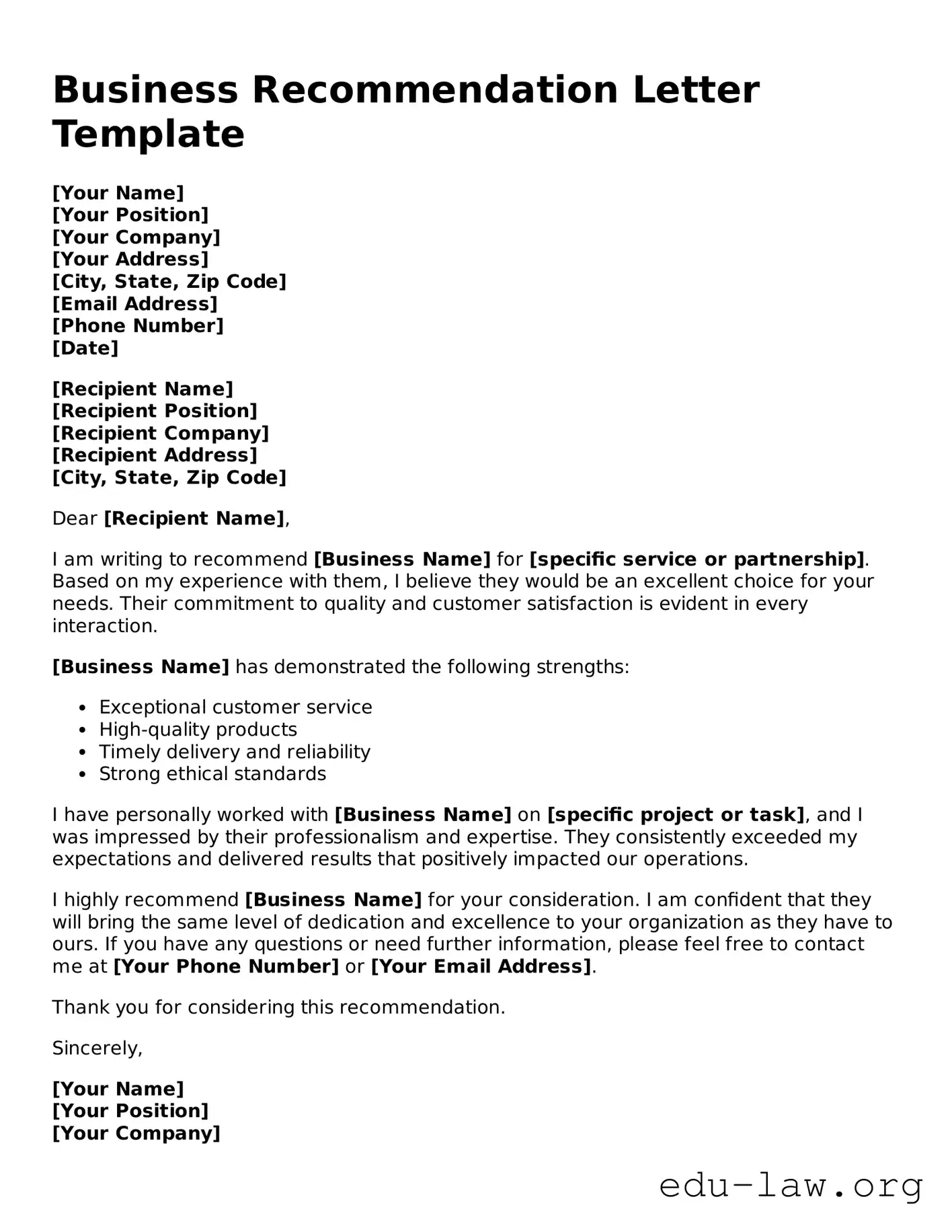
When seeking to establish credibility and trust in a professional setting, a Business Recommendation Letter can play a pivotal role. This form serves as a vital tool for individuals and organizations alike, providing a structured way to convey endorsements and support. Typically, it includes essential elements such as the recommender's contact information, the recipient's details, and a comprehensive description of the relationship between the two parties. Furthermore, it outlines the specific qualities and achievements of the individual or business being recommended, highlighting their strengths and contributions. A well-crafted letter not only reflects the recommender's genuine belief in the recipient's capabilities but also serves to enhance the recipient's reputation in the eyes of potential clients, employers, or partners. Understanding the nuances of this form can significantly impact professional relationships and opportunities.
Business Recommendation Letter Template
[Your Name]
[Your Position]
[Your Company]
[Your Address]
[City, State, Zip Code]
[Email Address]
[Phone Number]
[Date]
[Recipient Name]
[Recipient Position]
[Recipient Company]
[Recipient Address]
[City, State, Zip Code]
Dear [Recipient Name],
I am writing to recommend [Business Name] for [specific service or partnership]. Based on my experience with them, I believe they would be an excellent choice for your needs. Their commitment to quality and customer satisfaction is evident in every interaction.
[Business Name] has demonstrated the following strengths:
I have personally worked with [Business Name] on [specific project or task], and I was impressed by their professionalism and expertise. They consistently exceeded my expectations and delivered results that positively impacted our operations.
I highly recommend [Business Name] for your consideration. I am confident that they will bring the same level of dedication and excellence to your organization as they have to ours. If you have any questions or need further information, please feel free to contact me at [Your Phone Number] or [Your Email Address].
Thank you for considering this recommendation.
Sincerely,
[Your Name]
[Your Position]
[Your Company]
| Fact Name | Description |
|---|---|
| Purpose | A Business Recommendation Letter form is used to provide a formal endorsement of a business or individual, highlighting their skills and qualifications. |
| Format | The form typically includes sections for the recommender's details, the recipient's information, and the body of the recommendation. |
| Confidentiality | It is important to consider confidentiality when sharing the letter, as it may contain sensitive information. |
| State-Specific Forms | Some states may have specific requirements or formats for recommendation letters; always check local regulations. |
| Governing Laws | In states like California, the California Civil Code governs the use of recommendation letters, ensuring they meet legal standards. |
| Signature Requirement | A signature from the recommender is often required to validate the authenticity of the recommendation. |
After gathering the necessary information, you are ready to fill out the Business Recommendation Letter form. Follow the steps below to ensure that you complete the form accurately and efficiently.
What is a Business Recommendation Letter?
A Business Recommendation Letter is a formal document that endorses an individual or organization. It highlights the strengths, skills, and accomplishments of the person or entity being recommended. This type of letter is often used in professional settings, such as job applications, partnerships, or business dealings, to provide a credible endorsement from a reputable source.
Who can write a Business Recommendation Letter?
Typically, a Business Recommendation Letter is written by someone who has a professional relationship with the individual or organization being recommended. This could include supervisors, colleagues, business partners, or clients. The writer should have sufficient knowledge of the subject’s capabilities and achievements to provide an informed and credible recommendation.
What should be included in a Business Recommendation Letter?
A well-crafted Business Recommendation Letter should include specific details about the individual or organization. Key components often consist of an introduction that states the relationship between the writer and the subject, a description of the subject's skills and accomplishments, examples of their work or contributions, and a concluding statement that encourages the recipient to consider the recommendation seriously.
How long should a Business Recommendation Letter be?
Generally, a Business Recommendation Letter should be concise yet comprehensive. It is advisable to keep the letter to one page, using clear and direct language. This length allows the writer to convey essential information without overwhelming the reader. Brevity helps maintain the reader's attention while ensuring that all critical points are addressed.
Is there a specific format for a Business Recommendation Letter?
While there is no universally mandated format, a Business Recommendation Letter typically follows a standard business letter format. This includes the writer's contact information, the date, the recipient's contact information, a formal salutation, the body of the letter, and a professional closing. Maintaining a clear and organized structure enhances readability and professionalism.
How can I ensure my Business Recommendation Letter is effective?
To ensure effectiveness, the letter should be personalized and tailored to the specific situation. Including concrete examples and quantifiable achievements can strengthen the recommendation. Additionally, using a positive and confident tone throughout the letter can significantly impact how the recommendation is perceived. Lastly, proofreading for grammar and clarity is essential to present a polished final product.
Can a Business Recommendation Letter be used for multiple purposes?
Yes, a Business Recommendation Letter can often be repurposed for different applications, such as job applications, business proposals, or networking opportunities. However, it is advisable to customize the letter for each specific situation to align with the goals and expectations of the recipient. Tailoring the content can enhance its relevance and effectiveness in various contexts.
Not Providing Complete Information: Many individuals forget to fill out all sections of the form. Omitting important details can lead to confusion and delay in processing.
Using Vague Language: It's common for people to use generic phrases instead of specific examples. Clear, detailed descriptions of skills and experiences are essential for a strong recommendation.
Failing to Tailor the Letter: A one-size-fits-all approach often results in a lack of impact. Each recommendation should be customized to reflect the unique qualities of the individual being recommended.
Neglecting to Proofread: Spelling and grammatical errors can undermine the professionalism of the letter. A careful review helps ensure clarity and credibility.
Not Including Relevant Achievements: Highlighting specific accomplishments can strengthen the recommendation. Leaving out significant achievements can make the letter less persuasive.
Using Inappropriate Tone: The tone of the letter should match the context. A formal tone is generally expected, and casual language can detract from the letter’s effectiveness.
Ignoring Formatting Guidelines: Some people overlook the importance of proper formatting. Adhering to guidelines ensures the letter looks professional and is easy to read.
Not Including Contact Information: Failing to provide contact details can hinder follow-up opportunities. Including a phone number or email address allows the recipient to reach out for further information.
A Business Recommendation Letter is a vital document that can help support a company's credibility and reputation. However, it is often accompanied by other important forms and documents that enhance its effectiveness. Below is a list of related documents that are commonly used alongside the Business Recommendation Letter.
In summary, while the Business Recommendation Letter stands on its own, these accompanying documents can significantly enhance its impact. Together, they create a more complete picture of the subject being recommended, helping to establish trust and credibility in professional relationships.
A Business Reference Letter is quite similar to a Personal Reference Letter. While a Business Reference Letter focuses on a person's professional qualities, a Personal Reference Letter highlights an individual's character and personal attributes. Both documents serve to vouch for someone’s credibility and reliability, whether in a professional or personal context. They can be used in job applications, rental agreements, or any situation where a character endorsement is beneficial.
The Employment Verification Letter is another document that shares similarities with a Business Recommendation Letter. This type of letter confirms an individual's employment status, job title, and sometimes salary. Like a recommendation letter, it provides insight into a person's work history and reliability. Both documents can enhance a candidate's application by affirming their professional background and contributions to previous employers.
A Letter of Intent is also akin to a Business Recommendation Letter. This document outlines a person's intent to engage in a business transaction or partnership. While a recommendation letter endorses an individual’s qualifications, a Letter of Intent sets the stage for future collaboration. Both documents convey a sense of professionalism and seriousness, making them essential in business dealings.
When filling out a Business Recommendation Letter form, it’s essential to keep a few key points in mind. Here’s a list of things to do and avoid:
Many people have misconceptions about the Business Recommendation Letter form. Understanding the truth behind these misconceptions can help individuals navigate the process more effectively. Below are some common misunderstandings:
By addressing these misconceptions, individuals can better prepare and utilize Business Recommendation Letters to their advantage.
Filling out and utilizing a Business Recommendation Letter form can significantly enhance professional relationships and opportunities. Here are some key takeaways to consider:
By keeping these points in mind, you can effectively fill out and leverage a Business Recommendation Letter form to support your professional endeavors.