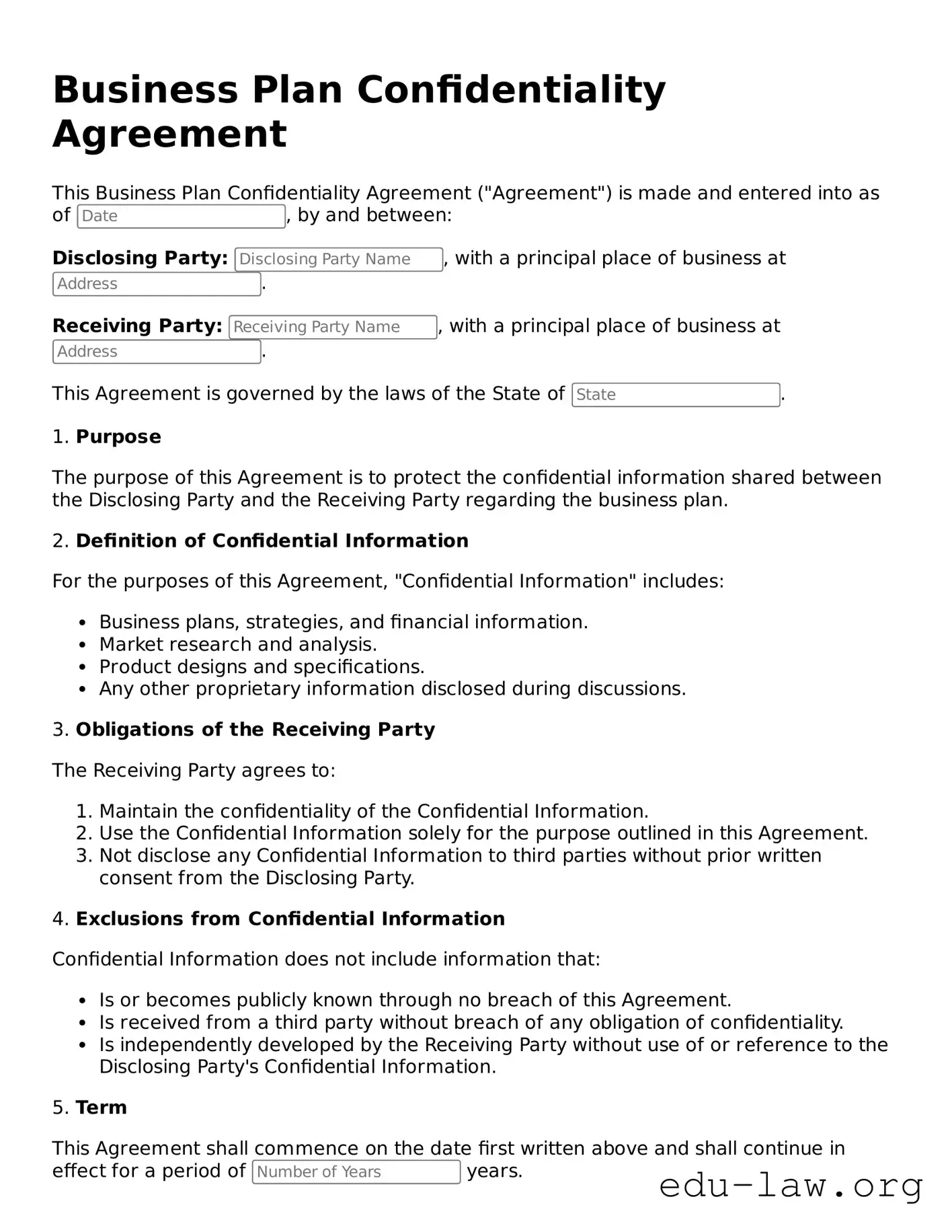
In the world of entrepreneurship, safeguarding innovative ideas and strategic plans is paramount. A Business Plan Confidentiality Agreement serves as a crucial tool for entrepreneurs and businesses alike, ensuring that sensitive information shared during discussions or negotiations remains protected. This agreement outlines the obligations of parties involved, specifying what constitutes confidential information and the duration of the confidentiality obligation. It typically includes clauses that define the scope of the agreement, the permissible use of the disclosed information, and the consequences of any breach. By establishing clear boundaries, the form not only fosters trust between parties but also encourages open communication about business strategies, financial projections, and operational plans. In essence, this agreement is designed to create a secure environment where creativity and collaboration can thrive without the fear of unauthorized disclosure.
Business Plan Confidentiality Agreement
This Business Plan Confidentiality Agreement ("Agreement") is made and entered into as of , by and between:
Disclosing Party: , with a principal place of business at .
Receiving Party: , with a principal place of business at .
This Agreement is governed by the laws of the State of .
1. Purpose
The purpose of this Agreement is to protect the confidential information shared between the Disclosing Party and the Receiving Party regarding the business plan.
2. Definition of Confidential Information
For the purposes of this Agreement, "Confidential Information" includes:
3. Obligations of the Receiving Party
The Receiving Party agrees to:
4. Exclusions from Confidential Information
Confidential Information does not include information that:
5. Term
This Agreement shall commence on the date first written above and shall continue in effect for a period of years.
6. Governing Law
This Agreement shall be governed by and construed in accordance with the laws of the State of .
7. Signatures
By signing below, both parties agree to the terms of this Agreement.
Disclosing Party Signature: ________________________
Date:
Receiving Party Signature: ________________________
Date:
| Fact Name | Description |
|---|---|
| Purpose | The Business Plan Confidentiality Agreement is designed to protect sensitive business information shared between parties. It ensures that proprietary information remains confidential and is not disclosed to unauthorized individuals. |
| Parties Involved | This agreement typically involves at least two parties: the disclosing party, who shares the confidential information, and the receiving party, who agrees to keep the information secret. |
| Duration of Confidentiality | The agreement usually specifies a time frame during which the information must remain confidential. This period can vary depending on the nature of the information and the needs of the parties involved. |
| Governing Law | The governing law for this agreement can vary by state. For example, in California, the agreement would typically be governed by California law, while in New York, New York law would apply. |
| Consequences of Breach | If either party breaches the agreement, they may face legal consequences, including potential damages and injunctions to prevent further disclosure of the confidential information. |
Once you have the Business Plan Confidentiality Agreement form in front of you, it’s time to fill it out carefully. Completing this form accurately is essential for ensuring that all parties involved understand their obligations regarding confidentiality. Follow the steps below to guide you through the process.
After completing these steps, keep a copy for your records. It's a good practice to ensure that both parties have signed copies to avoid any misunderstandings in the future.
What is a Business Plan Confidentiality Agreement?
A Business Plan Confidentiality Agreement is a legal document that protects sensitive information shared between parties. When you share your business plan with potential partners, investors, or employees, this agreement ensures that they keep the information confidential. It helps safeguard your ideas, strategies, and financial projections from being disclosed or misused.
Why do I need this agreement?
This agreement is essential because it creates a formal understanding between you and the other party. Without it, there’s a risk that your confidential information could be shared publicly or with competitors. By having a signed agreement, you establish clear boundaries and legal recourse if the terms are violated.
Who should sign the agreement?
What happens if the agreement is broken?
If someone violates the terms of the agreement, you may have legal options. You can seek damages or an injunction to prevent further disclosures. The specific consequences depend on the agreement’s terms and the laws in your jurisdiction. It’s always best to consult with a legal professional if you find yourself in this situation.
How long does the confidentiality last?
The duration of confidentiality can vary based on the terms set in the agreement. Typically, it lasts for a specified period, often ranging from two to five years. However, some information may remain confidential indefinitely, especially if it is considered a trade secret. Be sure to clearly define the duration in your agreement to avoid any confusion.
Neglecting to Provide Complete Information: One common mistake is failing to fill in all required fields. Omitting details such as names, addresses, or contact information can lead to confusion and may render the agreement ineffective.
Using Vague Language: When describing the confidential information, people often use ambiguous terms. Clear and specific descriptions are essential to ensure that all parties understand what is considered confidential.
Not Identifying All Parties: It is crucial to list all individuals and entities involved in the agreement. Leaving out a party can create loopholes and lead to disputes over confidentiality.
Ignoring the Duration of Confidentiality: Many people overlook the section regarding the duration for which the information must remain confidential. Specifying a timeframe helps set clear expectations for all parties.
Failing to Include Signatures: A common oversight is neglecting to sign the agreement. Without signatures, the document may lack legal enforceability, rendering it ineffective in protecting confidential information.
Overlooking Legal Review: Some individuals choose not to have the agreement reviewed by a legal expert. Skipping this step can lead to unintentional legal pitfalls or misunderstandings about the terms.
Assuming Verbal Agreements are Sufficient: Relying solely on verbal agreements can be a significant error. A written document serves as a clear record and provides legal protection that verbal agreements cannot offer.
A Business Plan Confidentiality Agreement is essential for protecting sensitive information when sharing a business plan with potential partners or investors. However, it is often used alongside other important documents that further define the terms of engagement and protect the interests of all parties involved. Here are ten common forms and documents that complement the Business Plan Confidentiality Agreement:
These documents work together to create a comprehensive framework for business interactions, ensuring clarity and protection for all parties involved. Properly utilizing these forms can help mitigate risks and foster trust in business relationships.
A Non-Disclosure Agreement (NDA) is one of the most closely related documents to a Business Plan Confidentiality Agreement. Both documents serve the primary purpose of protecting sensitive information from being disclosed to unauthorized parties. An NDA typically outlines what information is confidential, the obligations of the receiving party, and the duration of the confidentiality obligation. By signing an NDA, individuals or entities agree not to share specific information, similar to how a Business Plan Confidentiality Agreement ensures that business plans remain protected from competitors or other outsiders.
A Mutual Confidentiality Agreement also shares similarities with the Business Plan Confidentiality Agreement. In this case, both parties involved in a business relationship agree to protect each other's confidential information. This type of agreement is particularly useful when two businesses are collaborating or sharing sensitive data. Just like a Business Plan Confidentiality Agreement, a Mutual Confidentiality Agreement clearly defines what constitutes confidential information and sets the terms for how it should be handled, ensuring that both parties feel secure in their exchanges.
A Proprietary Information Agreement (PIA) is another document that aligns closely with a Business Plan Confidentiality Agreement. The PIA focuses on safeguarding proprietary information, which can include trade secrets, formulas, or unique business strategies. Much like a Business Plan Confidentiality Agreement, a PIA specifies what information is considered proprietary and establishes the responsibilities of the parties involved in protecting that information. This ensures that critical business insights remain confidential and are not misused or disclosed.
When filling out the Business Plan Confidentiality Agreement form, it's important to follow certain guidelines to ensure everything is completed correctly. Here are some things you should and shouldn't do:
Understanding the Business Plan Confidentiality Agreement (BPCA) is crucial for protecting sensitive information. However, several misconceptions can lead to misunderstandings about its purpose and function. Here are seven common misconceptions:
This is false. Any business, regardless of size, can benefit from a BPCA. Startups and small businesses often have sensitive information that needs protection.
While a BPCA establishes a legal framework for confidentiality, it cannot guarantee that all information will remain secret. The effectiveness depends on how well parties adhere to the terms.
This misconception overlooks the fact that a BPCA is useful for any situation where sensitive information is shared, including with potential partners, employees, or contractors.
Most BPCA agreements have a specified duration. After this period, the obligations may cease, unless otherwise stated in the agreement.
While legal advice can be beneficial, many BPCAs are straightforward and can be understood by business owners without extensive legal knowledge.
This is misleading. Oral disclosures can also be protected under a BPCA if they are clearly identified as confidential at the time of disclosure.
Parties can amend the BPCA if both agree to the changes. Flexibility is possible, as long as all involved parties consent to the modifications.
Addressing these misconceptions can help businesses better understand the value of a Business Plan Confidentiality Agreement and ensure that sensitive information is adequately protected.
When filling out and using the Business Plan Confidentiality Agreement form, it is important to keep several key points in mind. This ensures that your sensitive information remains protected and that all parties involved understand their responsibilities.
By following these key takeaways, you can effectively utilize the Business Plan Confidentiality Agreement form to safeguard your business interests.