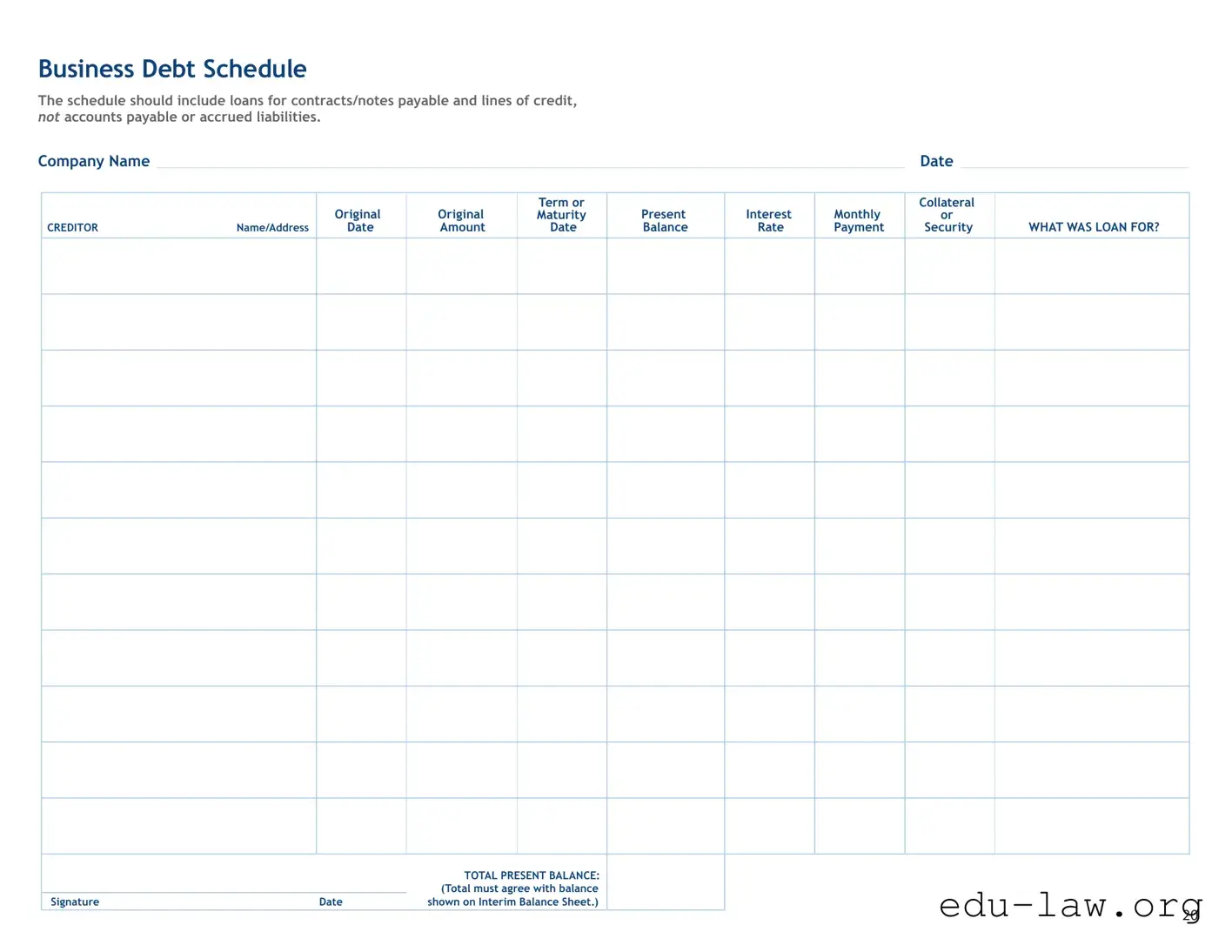
The Business Debt Schedule form serves as a crucial tool for businesses to outline their financial obligations comprehensively. It is designed to capture essential details about various debts, including loans for contracts, notes payable, and lines of credit. However, it specifically excludes accounts payable and accrued liabilities, focusing instead on more formalized borrowing arrangements. Each entry on the form requires the company name and date, along with the creditor's name and address. This information provides a clear picture of who the business owes money to. Additionally, the form requires the original date and amount of the loan, the term or maturity date, the present balance, interest rate, and monthly payment. It also prompts businesses to specify the collateral or security associated with each loan, as well as the purpose of the loan. At the end of the schedule, a total present balance must be calculated, ensuring that it aligns with the balance shown on the interim balance sheet. This meticulous approach not only aids in financial planning but also enhances transparency for stakeholders.

Business Debt Schedule
The schedule should include loans for contracts/notes payable and lines of credit, not accounts payable or accrued liabilities.
Company Name |
|
Date |
CREDITOR |
Name/Address |
Original
Date
Original Amount
Term or Maturity Date
Present Balance
Interest
Rate
Monthly Payment
Collateral
or
Security
WHAT WAS LOAN FOR?
|
|
TOTAL PRESENT BALANCE: |
|
|
(Total must agree with balance |
Signature |
Date |
shown on Interim Balance Sheet.) |
20
| Fact Name | Description |
|---|---|
| Purpose | The Business Debt Schedule form is used to document all business loans, including contracts, notes payable, and lines of credit. |
| Exclusions | Accounts payable and accrued liabilities are not included in this schedule. |
| Required Information | The form requires details such as creditor name, original amount, maturity date, present balance, interest rate, and monthly payment. |
| Collateral | Information about collateral or security for the loans must be provided on the form. |
| Total Balance | The total present balance must match the balance shown on the interim balance sheet. |
| Signature Requirement | A signature and date are required to validate the information provided on the form. |
| State-Specific Forms | Some states may have specific requirements or variations of the Business Debt Schedule, governed by state laws such as the Uniform Commercial Code (UCC). |
| Usage Context | This form is often utilized during financial audits, loan applications, or business valuations to assess the company's debt obligations. |
Completing the Business Debt Schedule form is an important step in documenting your company's financial obligations. This process ensures that all relevant debts are accurately recorded, which is essential for financial reporting and analysis. Following the steps outlined below will help you fill out the form correctly.
What is the purpose of the Business Debt Schedule form?
The Business Debt Schedule form is designed to provide a clear overview of a company's outstanding debts. It helps businesses track loans, contracts, notes payable, and lines of credit. This schedule does not include accounts payable or accrued liabilities, focusing solely on formal debts. By organizing this information, businesses can better manage their financial obligations and prepare for financial reporting or potential financing opportunities.
What information is required to complete the Business Debt Schedule?
To fill out the Business Debt Schedule, you will need to gather specific details about each debt. This includes the creditor's name and address, the original date of the loan, the original amount borrowed, the term or maturity date, the present balance, the interest rate, the monthly payment, collateral or security associated with the loan, and the purpose of the loan. It is crucial that the total present balance matches the balance shown on the interim balance sheet.
Who should complete the Business Debt Schedule?
The Business Debt Schedule should be completed by individuals responsible for financial management within the company. This could include accountants, financial analysts, or business owners. It is important for those completing the form to have access to accurate financial records to ensure that all information is correctly reported.
How often should the Business Debt Schedule be updated?
It is advisable to update the Business Debt Schedule regularly, particularly after any significant financial transactions, such as taking out new loans or making payments on existing debts. Keeping the schedule current helps businesses maintain an accurate understanding of their financial position and aids in strategic planning.
What happens if the total present balance does not match the interim balance sheet?
If the total present balance on the Business Debt Schedule does not match the balance shown on the interim balance sheet, it is essential to investigate the discrepancy. This could indicate errors in recording payments, missed debts, or inaccuracies in financial reporting. Resolving these issues promptly is crucial for maintaining accurate financial records and ensuring compliance with accounting standards.
Is the Business Debt Schedule necessary for all businesses?
While not every business may be legally required to complete a Business Debt Schedule, it is highly beneficial for effective financial management. This form provides valuable insights into a company's liabilities and can assist in making informed decisions about future financing, budgeting, and overall financial health. For businesses seeking loans or investments, having a detailed debt schedule can enhance credibility with potential lenders and investors.
Failing to include all relevant debts. Make sure to list every loan, contract, and line of credit. Omitting any can lead to inaccuracies.
Confusing accounts payable with loans. Remember, the form is for loans and credit lines, not for accounts payable or accrued liabilities.
Incorrectly filling out creditor information. Double-check the name and address of each creditor to ensure accuracy.
Not providing the original date of the loan. This detail is essential for tracking the loan's timeline.
Leaving out the original amount of the loan. This figure is necessary for a complete understanding of your financial obligations.
Failing to indicate the term or maturity date. This information helps clarify when the loan is due.
Not updating the present balance. Ensure that this reflects the current amount owed, as it can change over time.
Omitting the interest rate. This is a critical factor in understanding the cost of the debt.
Not including the monthly payment amount. This helps in assessing cash flow and budgeting.
Ignoring collateral or security details. If there is collateral, it should be clearly stated to avoid confusion.
Make sure to review the total present balance. It must match the balance shown on the interim balance sheet. Attention to detail will help prevent mistakes and ensure accurate reporting.
The Business Debt Schedule form is an important document for businesses to outline their current debts. However, several other forms and documents often accompany it to provide a comprehensive view of a company's financial obligations. Below is a list of these documents, each serving a specific purpose in the financial reporting process.
Using these documents in conjunction with the Business Debt Schedule form allows businesses to present a well-rounded view of their financial situation. This comprehensive approach is essential for making informed decisions and maintaining transparency with stakeholders.
The Business Debt Schedule form serves a vital role in financial documentation, particularly for businesses seeking to outline their liabilities. A similar document is the Loan Amortization Schedule. This schedule details the repayment plan for a specific loan, breaking down each payment into principal and interest components. Like the Business Debt Schedule, it provides a clear view of outstanding balances and payment timelines, helping businesses manage their cash flow effectively.
Another closely related document is the Balance Sheet. This financial statement offers a snapshot of a company's financial position at a given point in time. While the Balance Sheet lists assets, liabilities, and equity, the Business Debt Schedule focuses specifically on liabilities. Both documents are essential for assessing a company’s financial health, but they serve different purposes in financial analysis.
The Cash Flow Statement is also akin to the Business Debt Schedule. It tracks the inflow and outflow of cash within a business over a specific period. While the Business Debt Schedule highlights outstanding debts, the Cash Flow Statement shows how those debts impact liquidity. Together, they provide a comprehensive view of a company's financial operations, revealing how debt obligations influence cash availability.
The Accounts Payable Aging Report shares similarities with the Business Debt Schedule as well. This report categorizes outstanding invoices based on how long they have been unpaid. While the Business Debt Schedule focuses on loans and credit lines, the Accounts Payable Aging Report emphasizes short-term obligations. Both documents are crucial for managing liabilities and ensuring timely payments to creditors.
The Personal Guarantee Form is another document that aligns with the Business Debt Schedule. This form is often required when a business owner personally guarantees a loan, adding a layer of personal liability to the business debt. Like the Business Debt Schedule, it provides clarity on financial obligations, ensuring that all parties understand the extent of liability involved.
Lastly, the Debt Covenant Compliance Certificate is similar in that it monitors a company's adherence to specific financial ratios and conditions set by lenders. This document ensures that the business remains in good standing with its creditors. While the Business Debt Schedule lists the debts themselves, the Debt Covenant Compliance Certificate assesses the company’s ability to manage those debts according to agreed-upon terms.
When filling out the Business Debt Schedule form, it is crucial to approach the task with care and attention to detail. Below are five important guidelines to follow, as well as some common pitfalls to avoid.
Here are some common misconceptions about the Business Debt Schedule form:
Filling out the Business Debt Schedule form accurately is essential for maintaining a clear overview of your company's financial obligations. Here are some key takeaways to consider: