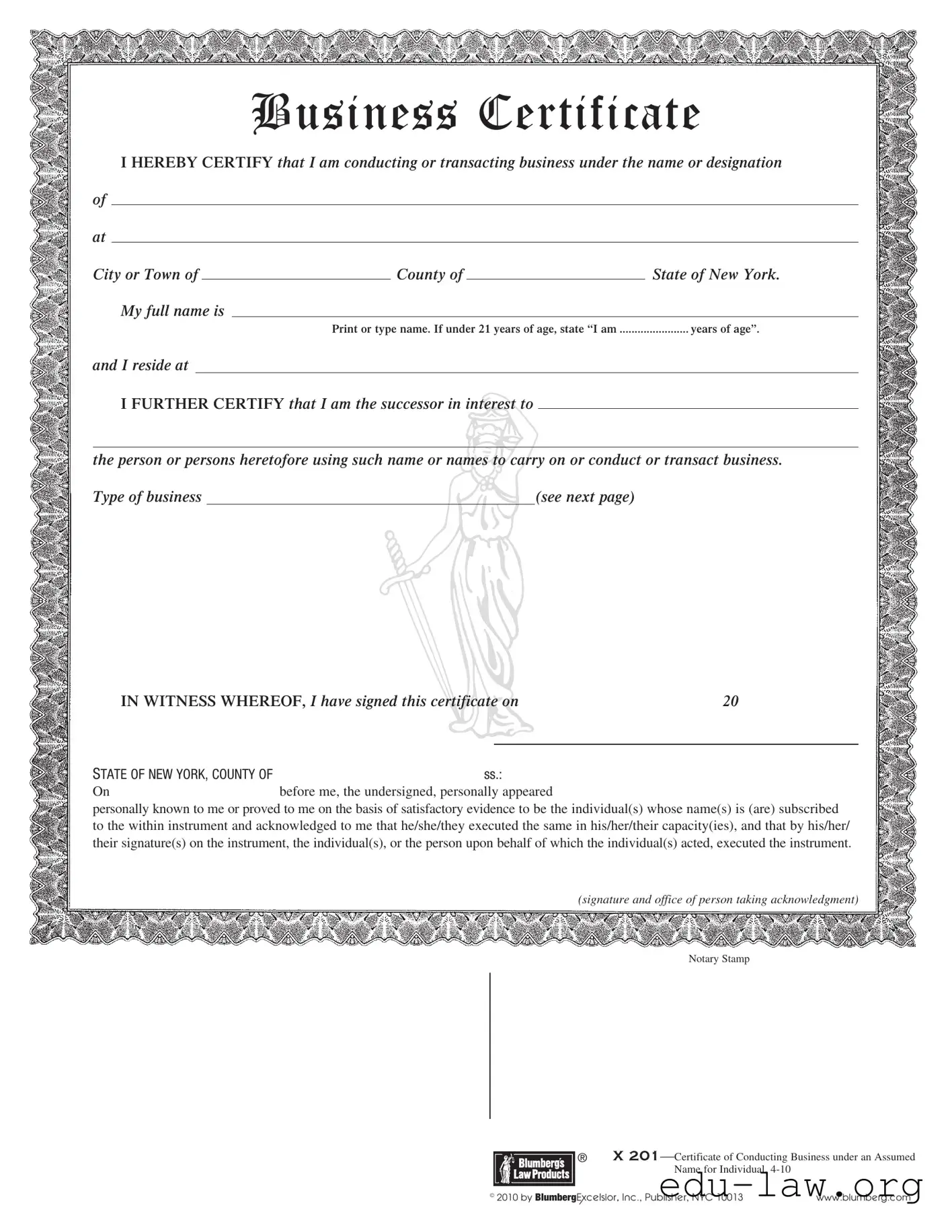
When embarking on a new business venture in New York, one essential step is completing the Business Certificate form. This document serves as a formal declaration that you are operating under a specific business name within a designated city or county. It captures critical information, including your full name, age, and residential address, ensuring transparency and accountability. If you are stepping into the shoes of a previous business owner, the form allows you to certify your status as the successor in interest. Additionally, it requires you to specify the type of business you are conducting, ranging from retail and real estate to professional services and entertainment. To lend authenticity to the document, it must be signed in the presence of a notary public, who will verify your identity and acknowledge your signature. Importantly, a certified copy of this certificate must be prominently displayed at your business location, aligning with local regulations. Understanding the nuances of this form not only facilitates compliance but also lays a solid foundation for your entrepreneurial journey.

BUSINESS CERTIFICATE
I HEREBY CERTIFY that I am conducting or transacting business under the name or designation
of at
City or Town ofCounty ofState of New York. My full name is
Print or type name. If under 21 years of age, state “I am |
years of age”. |
and I reside at
I FURTHER CERTIFY that I am the successor in interest to
the person or persons heretofore using such name or names to carry on or conduct or transact business.
Type of business |
|
(see next page) |
IN WITNESS WHEREOF, I have signed this certificate on |
20 |
||
STATE OF NEW YORK, COUNTY OF |
|
|
|
SS.: |
|
||
On |
before me, the undersigned, personally appeared |
|
|
personally known to me or proved to me on the basis of satisfactory evidence to be the individual(s) whose name(s) is (are) subscribed to the within instrument and acknowledged to me that he/she/they executed the same in his/her/their capacity(ies), and that by his/her/ their signature(s) on the instrument, the individual(s), or the person upon behalf of which the individual(s) acted, executed the instrument.
(signature and office of person taking acknowledgment)
Notary Stamp
|
|
® |
X |
|
|
|
|
Name for Individual, |
|
|
|
|
|
|
© 2010 by BlumbergExcelsior, Inc., Publisher, NYC 10013 |
www.blumberg.com |
|||

State of New York |
ss.: |
|
County of |
||
|
||
On |
before me, the undersigned, |
|
personally appeared |
|
personally known to me or proved to me on the basis of satisfac- tory evidence to be the individual(s) whose name(s) is (are) sub- scribed to the within instrument and acknowledged to me that he/ she/they executed the same in his/her/their capacity(ies), and that by his/her/their signature(s) on the instrument, the individual(s), or the person upon behalf of which the individual(s) acted, executed the instrument.
State of |
ss.: |
|
County of |
||
|
||
On |
before me, the undersigned, |
|
personally appeared |
|
personally known to me or proved to me on the basis of satis- factory evidence to be the individual(s) whose name(s) is (are) subscribed to the within instrument and acknowledged to me that he/she/they executed the same in his/her/their capacity(ies), and that by his/her/their signature(s) on the instrument, the individual(s), or the person upon behalf of which the individual(s) acted, executed the instrument.
(signature and office of individual taking acknowledgment) |
(signature and office of individual taking acknowledgment) |
INDEX No.
CERTIFICATE
OF
CONDUCTING BUSINESS UNDER
THE NAME OF
GBL §130.4. A certified copy of the original certificate, or if an amended certificate has been filed, then of the most recent amended certificate filed shall be conspicuously displayed on the premises at each place in which the business for which the same was filed is conducted.
Some counties request the type of business.
Consultant Services |
|
Educational Services |
|
Real Estate Services |
|
Retail Trade |
|
Home Improvement Services |
Wholesale Trade |
Other (state type) |
|
| Fact Name | Details |
|---|---|
| Purpose | The Business Certificate serves to officially register a business name in New York, ensuring compliance with local regulations. |
| Governing Law | This certificate is governed by New York General Business Law §130.4. |
| Age Requirement | The individual must declare their age. If under 21, they must state, “I am years of age.” |
| Successor Certification | The signer certifies they are the successor in interest to any previous users of the business name. |
| Type of Business | The form requires the applicant to specify the type of business being conducted, such as retail, finance, or professional services. |
| Notary Requirement | The certificate must be acknowledged by a notary public, who verifies the identity of the signer. |
| Display Requirement | A certified copy of the certificate must be displayed at each business location where the name is used. |
| Signature | The individual must sign the certificate, affirming the truth of the information provided. |
| Filing Location | The certificate must be filed in the county where the business is located, ensuring local jurisdiction compliance. |
Completing the Business Certificate form is a straightforward process that requires careful attention to detail. After filling out the form, it will need to be submitted to the appropriate local authority. Ensure that all information is accurate and that the form is signed in the presence of a notary public.
What is a Business Certificate form?
The Business Certificate form is a legal document used to certify that an individual or entity is conducting business under a specific name in New York State. It includes essential information such as the business name, the individual's full name, age, and address, as well as the type of business being conducted.
Who needs to file a Business Certificate?
Any individual or entity conducting business under a name that is different from their legal name must file a Business Certificate. This requirement applies to sole proprietors, partnerships, and other business entities operating under an assumed name in New York State.
How do I complete the Business Certificate form?
To complete the form, fill in your business name, the city and county where the business is located, and your full name. If you are under 21 years of age, indicate your age. You must also provide your residential address and specify the type of business you are conducting. Finally, sign and date the form to certify the information provided is accurate.
Where do I submit the Business Certificate form?
The completed Business Certificate form should be submitted to the County Clerk's office in the county where your business is located. It is important to check with the specific county for any additional requirements or procedures that may apply.
Is there a fee associated with filing the Business Certificate?
Yes, there is typically a fee for filing a Business Certificate, which varies by county. It is advisable to contact the County Clerk’s office for the exact fee and accepted payment methods.
Do I need to renew my Business Certificate?
In general, a Business Certificate does not need to be renewed unless there is a change in the business name, ownership, or type of business. If any of these changes occur, a new certificate must be filed to reflect the updated information.
What happens if I do not file a Business Certificate?
If you fail to file a Business Certificate when required, you may face legal consequences, including fines or penalties. Additionally, not filing can affect your ability to enforce contracts or take legal action in the event of disputes related to your business.
Failing to provide the full name of the individual completing the form. Ensure that the name is printed or typed clearly.
Not indicating if the individual is under 21 years of age. If applicable, include the age in the designated space.
Leaving out the residential address. This information is necessary for identification and verification purposes.
Neglecting to specify the type of business being conducted. This detail is crucial for regulatory compliance.
Omitting the date when the certificate is signed. This date is essential for record-keeping and legal purposes.
Not having the document witnessed by a notary public. The acknowledgment section must be completed properly.
Providing incomplete information about the county or city/town where the business is conducted. Ensure all geographical details are accurate.
Failing to include the notary stamp. This is a required element for the certificate to be valid.
Submitting the form without checking for errors or omissions. Review the entire document carefully before submission.
When starting a business, various forms and documents are often required to ensure compliance with local laws and regulations. Alongside the Business Certificate form, several other important documents may be necessary. Here’s a brief overview of six such forms that can help you navigate the process more smoothly.
Each of these documents plays a crucial role in establishing and operating a business legally and effectively. Ensuring that you have the correct paperwork can save you from potential legal issues down the line. Always consider consulting with a legal professional to guide you through the process.
The Business Certificate form shares similarities with a DBA (Doing Business As) registration. Both documents allow individuals or businesses to operate under a name different from their legal name. The DBA registration is essential for maintaining transparency with customers and local authorities. It helps to establish a business identity while ensuring that the name is not already in use by another entity. Like the Business Certificate, a DBA requires the owner to provide personal information and details about the business type.
Another document that resembles the Business Certificate is the Partnership Agreement. This agreement outlines the terms and conditions under which two or more individuals operate a business together. It includes information about each partner's contributions, responsibilities, and profit-sharing arrangements. Similar to the Business Certificate, it requires signatures from all parties involved, ensuring that everyone agrees to the terms laid out in the document.
The Articles of Incorporation is also comparable to the Business Certificate. This document is filed with the state to legally establish a corporation. It contains vital information such as the corporation's name, purpose, and the names of the initial directors. Like the Business Certificate, it serves to formalize a business entity and provides a public record of its existence, helping to protect the owners' personal assets.
A Business License is another document that functions similarly to the Business Certificate. This license is required by local governments to allow businesses to operate legally within their jurisdiction. It ensures that the business complies with local regulations and zoning laws. Both documents help to legitimize a business and make it accountable to the community in which it operates.
The Operating Agreement is yet another document that shares traits with the Business Certificate. This agreement is essential for LLCs (Limited Liability Companies) and outlines the management structure and operating procedures of the business. It specifies the rights and responsibilities of the members. Like the Business Certificate, it is a foundational document that helps clarify how the business will run and how decisions will be made.
The Certificate of Formation is also akin to the Business Certificate. This document is filed with the state to create a limited liability company (LLC). It includes basic information about the LLC, such as its name and registered agent. Similar to the Business Certificate, it is a crucial step in establishing a business entity and ensuring compliance with state laws.
Lastly, the Business Registration form is comparable to the Business Certificate. This form is often required by local or state governments to register a new business. It collects information about the business owner, the business name, and its location. Like the Business Certificate, it serves as a formal declaration of the business's existence and is used to track businesses operating within a specific area.
When filling out the Business Certificate form, there are several important things to keep in mind. Here’s a list of what you should and shouldn’t do:
By following these guidelines, you can help ensure that your Business Certificate is filled out correctly and efficiently.
Misconceptions about the Business Certificate form can lead to confusion and potential legal issues. Here are five common misunderstandings:
When filling out and using the Business Certificate form, keep these key takeaways in mind: