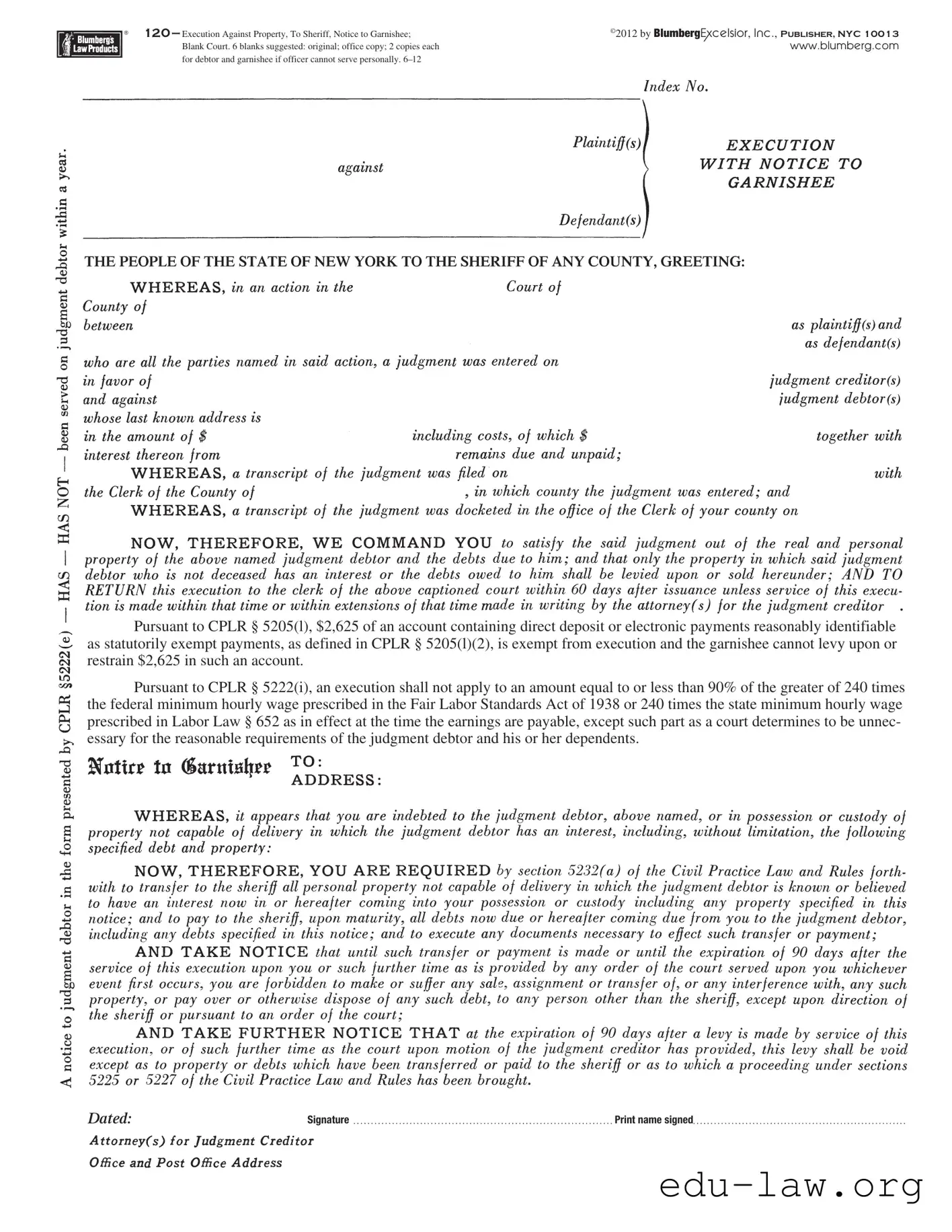
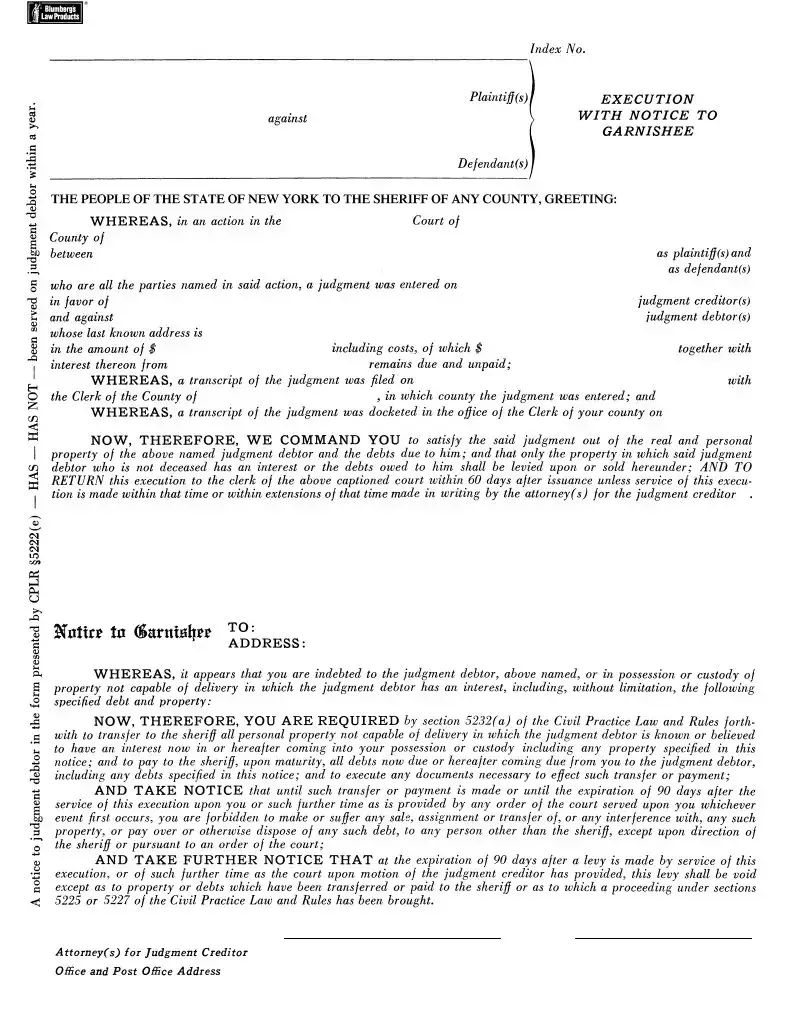
The Blumberg 120 form serves as a critical document in the execution of a judgment against a debtor's property. This form is designed to facilitate the process of garnishment, allowing creditors to collect debts owed by a judgment debtor through the seizure of their property. It includes several key components, such as the identification of the debtor and garnishee, as well as the specific property subject to execution. The form also outlines important exemptions under New York law, including protections for certain amounts in bank accounts, which are deemed exempt from execution. Specifically, the law protects $2,625 of direct deposits or electronic payments that are identifiable as statutorily exempt. Furthermore, the Blumberg 120 form provides guidance on how to handle situations where a debtor has not been served with a summons, ensuring that any execution against property is appropriately restricted. This document is essential for attorneys and law offices as it streamlines the process of enforcing judgments while adhering to legal standards and protecting the rights of debtors.
120 — Execution Against Property, To Sheriff, Notice to Garnishee; |
©2012 by BlumbergExcelsior, Inc., PUBLISHER, NYC 10013 |
Blank Court. 6 blanks suggested: original; office copy; 2 copies each |
www.blumberg.com |
for debtor and garnishee if officer cannot serve personally. |
|
Pursuant to CPLR § 5205(l), $2,625 of an account containing direct deposit or electronic payments reasonably identifiable as statutorily exempt payments, as defined in CPLR § 5205(l)(2), is exempt from execution and the garnishee cannot levy upon or restrain $2,625 in such an account.
Pursuant to CPLR § 5222(i), an execution shall not apply to an amount equal to or less than 90% of the greater of 240 times the federal minimum hourly wage prescribed in the Fair Labor Standards Act of 1938 or 240 times the state minimum hourly wage prescribed in Labor Law § 652 as in effect at the time the earnings are payable, except such part as a court determines to be unnec- essary for the reasonable requirements of the judgment debtor and his or her dependents.
DATED: |
Signature |
Print name signed |

ENDORSEMENT
Please take notice that the following named defendants were not served with a summons herein, viz.:
and that, as to them, the execution must be restricted as below prescribed.
An execution against property shall not be levied upon the sole property of such a defendant, but it may be collected out of real and personal property owned by him jointly with the other defendants who were summoned or with any of them, and out of the real and personal property of the latter or any of them.
Attorney(s) for
Name and Address of Garnishee
Address of Judgment Debtor
Location of Property
INDEX NO.COURTCOUNTY OF
EXECUTION
|
|
|
AGAINST PROPERTY |
|
|
|
|
With Notice to Garnishee |
|
|
|
|
|
|
|
|
|
|
|
|
|
|
LAW OFFICES OF |
|
|
|
|
Plaintiff(s) |
|
|
|
against |
|
|
|
|
|
Defendant(s) |
|
|
|
|
|
|
|
|
|
|
|
Sheriff of any County |
Attorney(s) for |
|||
Levy and collect as within directed |
Office and Post Office Address |
|||
with interest from |
|
|
||
besides your fees, etc. |
Dated and time received |
|||
Sheriff
| Fact Name | Fact Description |
|---|---|
| Form Purpose | The Blumberg 120 form is used for executing against property and notifying a garnishee. |
| Publisher Information | This form is published by BlumbergExcelsior, Inc., located in New York City. |
| Copies Required | Six copies are suggested: one original, one office copy, and two copies each for the debtor and garnishee. |
| Exempt Amount | According to CPLR § 5205(l), $2,625 from accounts with direct deposits is exempt from execution. |
| Income Protection | CPLR § 5222(i) protects 90% of earnings equal to 240 times the federal or state minimum wage from execution. |
| Defendant Notification | The form includes a section for notifying about defendants who were not served with a summons. |
| Joint Property Collection | Execution can be collected from jointly owned property of defendants who were summoned. |
| Legal Representation | The form requires the name and address of the attorney representing the garnishee. |
| Execution Location | The form must specify the location of the property against which the execution is directed. |
Filling out the Blumberg 120 form is a straightforward process that requires careful attention to detail. This form is used in legal proceedings involving the execution against property. Once completed, the form will need to be filed with the appropriate court and served to the relevant parties. Here are the steps to fill out the form:
After completing these steps, ensure you have the necessary copies of the form for filing and serving to the involved parties. It is crucial to follow any additional local rules regarding the submission and service of the form to ensure compliance with court procedures.
What is the Blumberg 120 form used for?
The Blumberg 120 form is used for executing a judgment against a debtor's property. It serves as a notice to the sheriff and garnishee, indicating that the creditor intends to collect a debt by seizing the debtor's property. This form outlines the necessary details for the execution process and provides legal notice to all parties involved.
How many copies of the Blumberg 120 form are required?
It is suggested to prepare six copies of the Blumberg 120 form. This includes the original for the court, an office copy for your records, and two copies each for the debtor and the garnishee. If the sheriff cannot serve the documents personally, these copies ensure that all parties receive the necessary notifications.
What exemptions are included in the Blumberg 120 form?
The form includes specific exemptions from execution. For instance, according to CPLR § 5205(l), $2,625 in an account containing identifiable direct deposits or electronic payments is exempt from being seized. This means that the garnishee cannot levy or restrain this amount in the debtor's account.
What does the form say about earnings exemptions?
The Blumberg 120 form outlines that execution shall not apply to amounts equal to or less than 90% of the greater of 240 times the federal or state minimum wage. This protection is in place to ensure that the debtor has enough income to meet their reasonable needs and those of their dependents.
What should be included in the endorsement section of the form?
The endorsement section of the Blumberg 120 form must indicate any defendants who were not served with a summons. It specifies that the execution cannot be levied on the sole property of those defendants. However, it can be collected from jointly owned property with other defendants who were properly summoned.
Who needs to sign the Blumberg 120 form?
The form requires the signature of the attorney representing the creditor. This signature validates the execution request. Additionally, the attorney must print their name and provide their office address for official records.
What information is required to complete the Blumberg 120 form?
To complete the Blumberg 120 form, you need to provide details such as the names and addresses of the plaintiff and defendant, the address of the garnishee, the location of the property, and the index number of the case. This information ensures that the execution is properly directed and legally binding.
Failing to provide the correct number of copies of the form. The Blumberg 120 form requires multiple copies for various parties involved. It's essential to ensure that the original, office copy, and two copies each for the debtor and garnishee are included.
Not clearly identifying the debtor. Accurate identification of the debtor is crucial. Omitting essential details such as the full name or address can lead to complications in the execution process.
Overlooking the exemption amounts. The form outlines specific amounts that are exempt from execution. Failing to account for these exemptions can result in legal challenges and unnecessary complications.
Incorrectly filling out the location of property. Providing an inaccurate or vague location can hinder the sheriff’s ability to execute the order effectively.
Neglecting to include the signature and printed name of the person completing the form. This step is often overlooked but is necessary for the validity of the document.
Forgetting to specify the index number associated with the case. This number is vital for tracking and referencing the execution in court records.
Failing to notify the garnishee properly. It's important to ensure that the garnishee is adequately informed about the execution to avoid potential delays.
Using outdated or incorrect legal references. The form may reference specific laws and statutes. Keeping these references current is essential for compliance.
Not adhering to filing deadlines. Timeliness is crucial in legal processes. Delays in submitting the form can result in missed opportunities for execution.
Ignoring the endorsement section. Properly completing the endorsement section is necessary, especially if some defendants were not served with a summons.
The Blumberg 120 form is an important document used in legal proceedings related to the execution against property. However, several other forms and documents often accompany it to ensure the process is thorough and compliant with legal requirements. Below is a list of these documents, each described to provide clarity on their purpose and function.
Each of these documents plays a vital role in the execution process, helping to ensure that all parties are informed and that the legal proceedings are conducted fairly and according to the law. Understanding these forms can significantly aid in navigating the complexities of legal actions related to property execution.
The Blumberg 120 form is similar to the Writ of Execution. A Writ of Execution is a court order that allows a sheriff or other authorized official to take possession of a debtor's property to satisfy a judgment. Like the Blumberg 120, the Writ of Execution outlines the specific property that can be seized and provides instructions for the sheriff on how to proceed. Both documents serve the purpose of enforcing a court's decision regarding unpaid debts.
Another document that shares similarities with the Blumberg 120 is the Notice of Garnishment. This notice informs a third party, often an employer or bank, that they are required to withhold a portion of a debtor's wages or funds to satisfy a judgment. The Blumberg 120 also involves a garnishee, indicating that both documents aim to collect debts through third parties, ensuring that the debtor's assets are used to pay what they owe.
The Judgment Lien is another related document. A Judgment Lien allows a creditor to place a legal claim on a debtor's property, which can prevent the sale of that property until the debt is paid. Like the Blumberg 120, a Judgment Lien serves as a mechanism for creditors to secure their interests in a debtor's assets, making it more difficult for the debtor to dispose of those assets without addressing the debt first.
The Execution against Property form is also comparable to the Claim of Exemption form. This document is filed by a debtor who wishes to claim certain property as exempt from execution. Both forms deal with the enforcement of judgments, but while the Blumberg 120 is used to initiate the collection process, the Claim of Exemption allows debtors to protect specific assets from being seized.
The Affidavit of Service is another document that complements the Blumberg 120 form. This affidavit serves as proof that the garnishee or debtor has been properly notified of the execution. Both documents are essential in the legal process, ensuring that all parties are informed and that the execution can proceed without legal complications.
The Subpoena Duces Tecum is similar as well. This document requires a witness to produce documents or evidence in a legal proceeding. While the Blumberg 120 focuses on collecting debts, both documents involve compelling parties to participate in the legal process, ensuring that necessary information is available for the court's consideration.
The Request for Hearing is another document that aligns with the Blumberg 120 form. This request allows a debtor to contest the execution or garnishment in court. Both documents are part of the legal process surrounding debt collection, giving debtors an opportunity to respond and protect their rights against potential overreach by creditors.
The Motion to Vacate Judgment can also be considered similar. This motion is filed by a debtor seeking to overturn a judgment against them. While the Blumberg 120 is used to enforce a judgment, both documents are part of the same legal framework, allowing debtors to challenge or comply with court decisions regarding their financial obligations.
Lastly, the Financial Disclosure Statement is akin to the Blumberg 120 form. This statement requires debtors to disclose their financial situation, including income and assets. Both documents are used in the context of debt collection, providing creditors with insight into a debtor's ability to pay and influencing the execution process accordingly.
When filling out the Blumberg 120 form, it's essential to be thorough and accurate. Here are six important dos and don'ts to keep in mind:
The Blumberg 120 form is often misunderstood, leading to confusion among those who need to use it. Here are six common misconceptions about this important legal document:
Understanding these misconceptions can help individuals navigate the complexities of the legal process more effectively. Always consider seeking professional advice for specific situations.
When filling out and using the Blumberg 120 form, it is essential to understand several key points to ensure proper execution and compliance with legal requirements. Below are important takeaways regarding the form:
Using the Blumberg 120 form correctly can streamline the process of collecting a judgment. Attention to detail is crucial to ensure compliance with applicable laws and regulations.