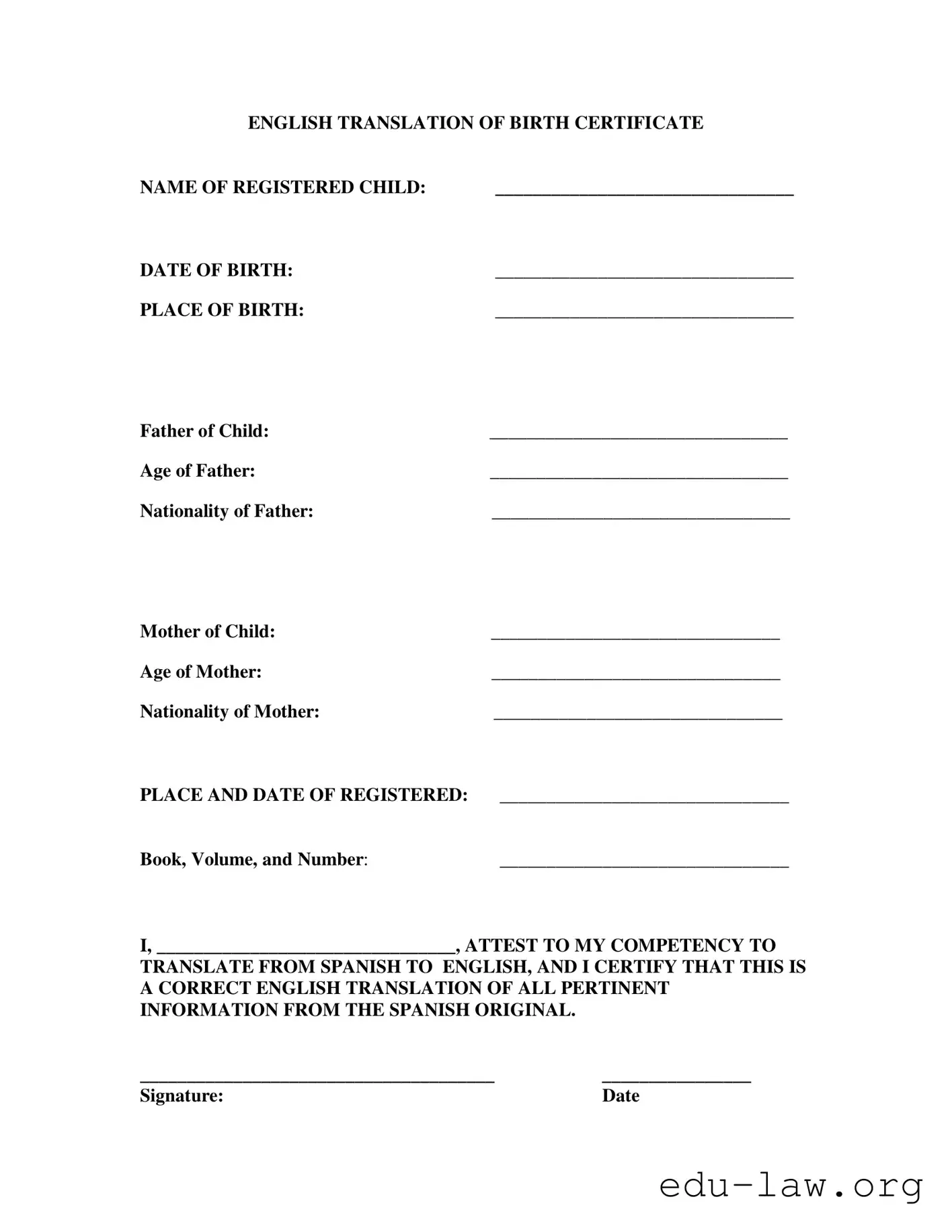
The Birth Certificate Translation to English form serves a crucial role for individuals needing to provide accurate documentation of their birth details in an English-speaking context. This form captures essential information, including the name, date, and place of birth of the registered child. It also requires details about the parents, such as their names, ages, and nationalities, ensuring that all relevant familial connections are documented. Additionally, the form specifies where and when the original birth certificate was registered, alongside the book, volume, and number for reference. A qualified translator must attest to their competency in translating from Spanish to English, providing a certification that the translation accurately reflects the original document. This process is not merely bureaucratic; it is a vital step for many individuals seeking access to services, rights, and opportunities that require official proof of identity and lineage.
ENGLISH TRANSLATION OF BIRTH CERTIFICATE
NAME OF REGISTERED CHILD: |
________________________________ |
DATE OF BIRTH: |
________________________________ |
PLACE OF BIRTH: |
________________________________ |
Father of Child: |
________________________________ |
Age of Father: |
________________________________ |
Nationality of Father: |
________________________________ |
Mother of Child: |
_______________________________ |
Age of Mother: |
_______________________________ |
Nationality of Mother: |
_______________________________ |
PLACE AND DATE OF REGISTERED: |
_______________________________ |
Book, Volume, and Number: |
_______________________________ |
I, ________________________________, ATTEST TO MY COMPETENCY TO
TRANSLATE FROM SPANISH TO ENGLISH, AND I CERTIFY THAT THIS IS A CORRECT ENGLISH TRANSLATION OF ALL PERTINENT INFORMATION FROM THE SPANISH ORIGINAL.
______________________________________ |
________________ |
Signature: |
Date |
| Fact Name | Description |
|---|---|
| Document Purpose | The Birth Certificate Translation to English form is used to provide an accurate English translation of a Spanish birth certificate. |
| Registered Child's Information | The form requires the name, date of birth, and place of birth of the registered child. |
| Parental Details | Information about the child's parents, including their names, ages, and nationalities, must be included. |
| Certification Statement | The translator must attest to their competency in translating from Spanish to English. |
| Signature Requirement | A signature and date from the translator are necessary to validate the translation. |
| State-Specific Forms | Some states may have specific requirements or additional forms related to birth certificate translations. |
| Governing Law | In California, for instance, the translation must comply with the California Family Code Section 7100. |
| Document Accuracy | The translator must ensure that the translation accurately reflects the original document's content. |
| Use of Translation | This translated document is often required for legal purposes, such as immigration or obtaining identification. |
Filling out the Birth Certificate Translation To English form is a straightforward process. Once completed, this form will serve as an official translation of a birth certificate from Spanish to English. Follow these steps carefully to ensure that all necessary information is accurately provided.
After completing the form, review all entries to ensure accuracy. This step is crucial, as any errors may lead to delays or complications in processing the translation. Once confirmed, the form is ready for submission along with the original birth certificate for official use.
What is the purpose of the Birth Certificate Translation To English form?
This form is used to provide an accurate English translation of a birth certificate originally written in another language, such as Spanish. It is essential for legal processes, immigration applications, and other official matters where an English version of the birth certificate is required.
Who needs to fill out this form?
Individuals who possess a birth certificate in a language other than English and need it translated for legal or official purposes should complete this form. This includes parents applying for citizenship for their children or individuals seeking to establish identity in the U.S.
What information is required on the form?
The form requires details such as the name of the registered child, date and place of birth, and information about the parents, including their names, ages, and nationalities. Additionally, it requires the place and date of registration, as well as the book, volume, and number of the original document.
Who can translate the birth certificate?
The translator must attest to their competency in translating from Spanish to English. This means they should have a strong understanding of both languages and be able to accurately convey the information from the original document in English.
Is a notarized translation required?
While a notarized translation is not always required, some institutions may request it. It is advisable to check with the specific agency or organization to determine their requirements regarding notarization.
How do I ensure the translation is accurate?
To ensure accuracy, choose a qualified translator who has experience with legal documents. They should be familiar with the terminology used in birth certificates and capable of providing a precise translation. The translator must sign the form, certifying that the translation is correct.
Can I use this form for translations from languages other than Spanish?
This specific form is designed for translations from Spanish to English. If you have a birth certificate in a different language, you may need to use a different form or seek a translator who can provide a certification for that language pair.
What should I do if there are discrepancies in the original birth certificate?
If there are discrepancies in the original birth certificate, it is crucial to address these issues before translation. Contact the issuing authority to correct any errors, as an accurate translation reflects the original document's content.
How long does the translation process take?
The translation process duration can vary based on the translator's workload and the complexity of the document. Generally, it can take anywhere from a few days to a couple of weeks. It is best to plan ahead and allow sufficient time for this process.
Where can I submit the completed form?
The completed form should be submitted to the agency or organization that requires the translation. This could include immigration offices, schools, or other governmental bodies. Always check their submission guidelines for specific instructions.
Neglecting to Provide Complete Information: Many individuals fail to fill out all the required fields on the form. Each section, from the child's name to the parents' nationalities, is essential for a complete translation. Omitting any detail can lead to delays or complications.
Incorrectly Translating Names: Names should be translated accurately and consistently. Using nicknames or informal versions can create confusion. It's crucial to use the official names as they appear in the original birth certificate.
Missing Signature or Date: The form requires a signature and date to validate the translation. Failing to include these can render the document invalid. Always double-check that these critical elements are present before submission.
Inaccurate Date Formatting: Dates must be formatted correctly according to standard conventions. Using an unfamiliar format can lead to misunderstandings. Ensure that dates are presented in a clear and universally recognized manner.
Overlooking Notarization Requirements: Some jurisdictions may require the translation to be notarized. Not checking local requirements can lead to issues down the line. It’s important to verify whether notarization is necessary for your specific situation.
When obtaining a Birth Certificate Translation to English, several other documents may be required to support your application or to provide additional context. Each of these documents plays a crucial role in ensuring that your identity and legal status are clearly understood. Here is a list of common forms and documents that are often used alongside the Birth Certificate Translation to English form:
Gathering these documents can help streamline the process and ensure that all necessary information is available for review. It’s important to prepare thoroughly to avoid delays and complications. Each document serves a specific purpose and contributes to a complete understanding of your situation.
The Marriage Certificate is similar to the Birth Certificate Translation in that it serves as a vital record documenting a significant life event. Both documents require specific details, such as names, dates, and locations. A marriage certificate often includes the names of both spouses, their ages, and nationalities, mirroring the structure of a birth certificate. Furthermore, translations of marriage certificates may also be necessary for legal purposes, especially in immigration or family law contexts.
The Death Certificate is another document that shares similarities with the Birth Certificate Translation. Both are official records that provide essential information about individuals. A death certificate includes the deceased's name, date of birth, date of death, and cause of death. Just as a birth certificate may need translation for legal or administrative purposes, a death certificate often requires translation when dealing with estates or international matters.
The Adoption Certificate is comparable to the Birth Certificate Translation because it serves to formalize a significant change in an individual's status. This document includes details about the adopted child and their adoptive parents, similar to how a birth certificate lists the child's birth parents. Translations of adoption certificates may be required in cases involving international adoptions or legal proceedings concerning parental rights.
The Immigration Certificate also aligns closely with the Birth Certificate Translation. This document is crucial for individuals seeking to establish residency or citizenship in a new country. It typically contains personal details such as the individual's name, date of birth, and country of origin. Like birth certificates, immigration certificates often require translation to ensure compliance with legal requirements in the destination country.
The Passport is another vital document that shares characteristics with the Birth Certificate Translation. Passports contain personal information, including the holder's name, date of birth, and nationality. When applying for a passport, individuals may need to provide a translated birth certificate to verify their identity and citizenship. This necessity underscores the importance of accurate translations in legal and administrative processes.
The Social Security Card is also similar, as it serves as an official identification document that includes personal information. While it does not contain as much detail as a birth certificate, it is essential for accessing government services and benefits. When applying for a Social Security number, individuals often need to provide a birth certificate, and in cases where the original is in another language, a translation may be required.
Finally, the School Enrollment Form is akin to the Birth Certificate Translation, particularly when enrolling a child in school. This form typically requires the child’s name, date of birth, and parent or guardian information. Schools often request a birth certificate for verification purposes, and if the original is not in English, a translation will be necessary to facilitate the enrollment process.
When filling out the Birth Certificate Translation to English form, it's essential to follow certain guidelines to ensure accuracy and compliance. Here’s a helpful list of what to do and what to avoid:
When it comes to the Birth Certificate Translation to English form, several misconceptions can lead to confusion. Here are nine common misunderstandings:
Understanding these misconceptions can help individuals navigate the process of obtaining a Birth Certificate Translation to English more effectively.
When filling out the Birth Certificate Translation To English form, keep these key points in mind: