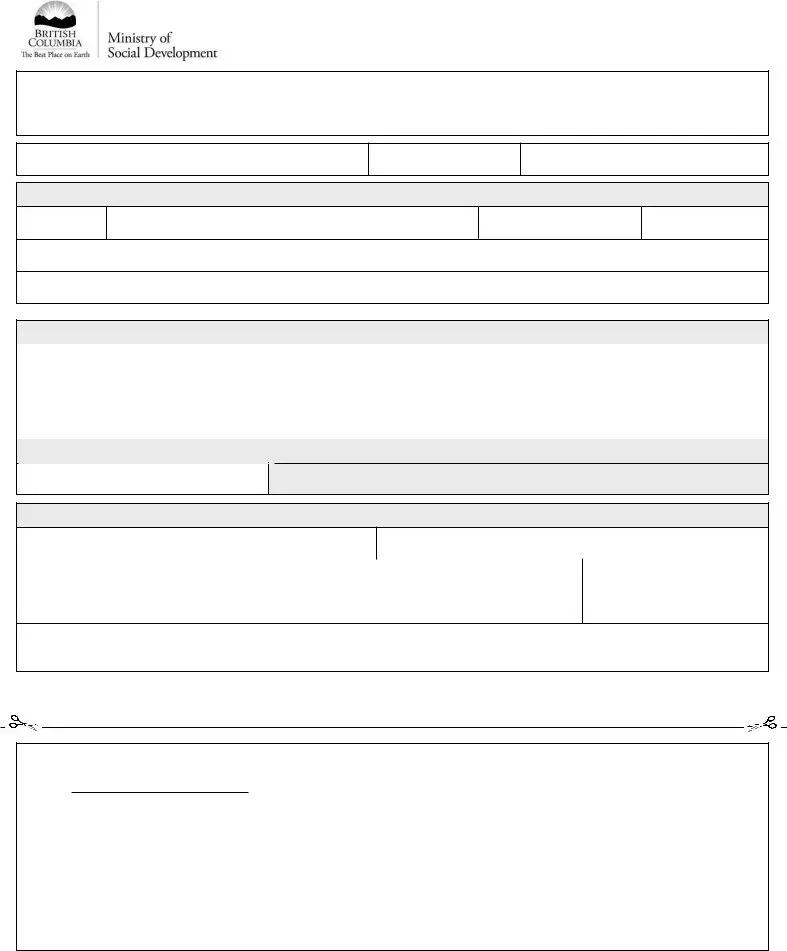
The BC Shelter Information form, officially designated as Form HSD3037, plays a crucial role in the financial assistance process for individuals seeking support for housing costs. This form is essential for applicants and recipients of income assistance, disability assistance, or hardship assistance who are looking to secure funds for rent and security deposits. It requires the completion of specific personal information, including the full name of the applicant or the primary individual associated with the file, as well as the client file number, if available. Additionally, it provides an option to include a Social Insurance Number for further identification. A significant feature of the form is the included blank rent receipt, which serves as proof of rent payment. It is important to note that this document does not constitute a tenancy agreement under the Residential Tenancy Act; rather, it is intended solely for administrative purposes by the Ministry of Social Development. Once completed, the form must be submitted to the local employment and assistance office for processing. The collection of personal information on this form adheres to the guidelines set forth by the Employment and Assistance Act and the Employment and Assistance for Persons with Disabilities Act, ensuring compliance with privacy regulations.

Form HSD3037 — Shelter Information
This form is used to provide the Ministry of Social Development with required rental information for your file. Applicants and recipients of income assistance, disability assistance or hardship assistance may use this form when requesting money to pay rent and/or security deposits.
Please complete the form by following the instructions and ensure you include your full name or the name of the primary person on your file. If you know your client file number (it begins with GA) include it in the space provided. You may also wish to provide your Social Insurance Number.
The form provides a blank rent receipt for your convenience, it can be used to provide proof you paid your rent.
This is not a tenancy agreement under the Residential Tenancy Act and is only used for administrative purposes by Housing and Social Development.
Return the completed form to your local employment and assistance office.
Ministry of Social
Development
SHELTER INFORMATION
The personal information requested on this form is collected under the authority of and will be used for the purpose of administering the Employment and Assistance Act and the Employment and Assistance for Persons with Disabilities Act. The collection, use and disclosure of personal information is subject to the provisions of the Freedom of Information and Protection of Privacy Act. Any questions about this information should be directed to your local Employment and Assistance Office.
CLIENT NAME
DATE(YYYY MMM DD)
(FOR OFFICE USE ONLY)
GA
RENTING OR INTENDING TO RENT AT THE FOLLOWING ADDRESS
SUITE NO.
STREET ADDRESS
CITY/TOWN
POSTAL CODE
MAILING ADDRESS (IF DIFFERENT)
START DATE (YYYY MMM DD) for rental of the room or rental unit
PLEASE COMPLETE EITHER A OR B:
(A) CLIENT’S PORTION OF RENTAL AMOUNT |
TOTAL RENT (IF SHARED) |
MARKET RENT (IF SUBSIDIZED) |
||||||||||
$ |
|
PER MONTH |
$ |
PER MONTH |
$ |
|
PER MONTH |
|||||
SECURITY DEPOSIT REQUIRED? |
CLIENT’S PORTION OF SECURITY DEPOSIT |
ARE UTILITIES INCLUDED IN THE RENTAL RATE? |
||||||||||
|
|
YES |
|
NO |
$ |
|
|
|
|
YES |
|
NO |
|
|
|
|
|
|
|
|
|
|
|
|
|
NUMBER OF ADULTS AT GIVEN ADDRESS |
|
|
NUMBER OF CHILDREN |
AT GIVEN |
ADDRESS |
|||||||
|
|
|
|
|
|
|
|
|
|
|
|
|
OR
(B) ROOM AND BOARD (MEALS INCLUDED)
$PER MONTH
Note: Cost of room and board should include costs associated with food, maintaining the room,
LANDLORD INFORMATION
NAME OF REGISTERED OWNER OF THE LAND (PLEASE PRINT)
NAME OF LANDLORD INCLUDING PROPERTY MANAGER, AGENT (IF DIFFERENT)
ADDRESS OF LANDLORD AND POSTAL CODE |
POSTAL CODE |
TELEPHONE NUMBER OF LANDLORD |
|
|
|
LANDLORD’S SIGNATURE |
|
DATE SIGNED (YYYY MMM DD) |
X
We require a rent receipt in addition to this form immediately upon payment of the first month's rent (if your rent is not paid directly to the landlord by MSD) . All information may be verified. A rent receipt is attached to this form for your convenience.
This form is for Ministry of Social Development information only and does NOT constitute a tenancy agreement under the Residential Tenancy Act.
Rent Receipt
Date:
|
|
(YYYY MMM DD) |
|
|
|
|
|
|
|
|
|
|||
Received from: |
|
|
|
|
For the month of: |
|
||||||||
|
Rent $ |
|
|
|
Room and Board $ |
|
|
|
Security Deposit $ |
|
|
|||
|
|
|
|
|||||||||||
|
|
|
|
|
|
|
|
|
|
|
|
|
|
|
|
|
|
|
|
|
|
|
|
|
|
|
|
|
|
|
|
|
|
|
|
|
|
|
|
|
|
|
|
|
|
|
|
|
|
|
|
Landlord’s Signature |
|
|
|
|
|
|
|
SD3037(10/06/16) |
ORIGINAL - FILE COPY - CLIENT |
| Fact Name | Details |
|---|---|
| Form Title | Form HSD3037 — Shelter Information |
| Purpose | This form collects rental information for the Ministry of Social Development. |
| Eligibility | Used by applicants and recipients of income assistance, disability assistance, or hardship assistance. |
| Client File Number | Include your client file number, which starts with GA, if known. |
| Social Insurance Number | Providing your Social Insurance Number is optional but recommended. |
| Rent Receipt | A blank rent receipt is included for proof of rent payment. |
| Not a Tenancy Agreement | This form does not serve as a tenancy agreement under the Residential Tenancy Act. |
| Submission | Return the completed form to your local employment and assistance office. |
| Governing Laws | Administered under the Employment and Assistance Act and the Employment and Assistance for Persons with Disabilities Act. |
| Privacy Protection | Personal information is protected under the Freedom of Information and Protection of Privacy Act. |
Completing the BC Shelter Information form is a straightforward process. This form is essential for individuals seeking assistance with rental payments or security deposits. Once filled out correctly, it should be submitted to your local employment and assistance office for processing.
What is the purpose of the BC Shelter Information form?
The BC Shelter Information form, also known as Form HSD3037, is designed to provide essential rental information to the Ministry of Social Development. This form is particularly useful for individuals applying for or receiving income assistance, disability assistance, or hardship assistance. By filling out this form, applicants can request financial support for rent and security deposits. It is important to follow the instructions carefully and include your full name and client file number, if available, to ensure your request is processed smoothly.
How should I complete the form?
To complete the BC Shelter Information form, start by providing your full name or the primary person’s name on your file. If you have a client file number that begins with "GA," include it in the designated space. You may also want to provide your Social Insurance Number for added identification. The form includes a blank rent receipt, which you can use to prove that you have paid your rent. Remember, this form is for administrative purposes only and does not serve as a tenancy agreement under the Residential Tenancy Act.
Where do I send the completed form?
Once you have filled out the BC Shelter Information form, it should be returned to your local employment and assistance office. This is where your application will be processed. Be sure to keep a copy for your records and ensure that all required information is included to avoid any delays in processing your request.
What happens to my personal information submitted on this form?
The personal information you provide on the BC Shelter Information form is collected under the authority of the Employment and Assistance Act and the Employment and Assistance for Persons with Disabilities Act. This information will be used solely for the purpose of administering these programs. Additionally, the collection, use, and disclosure of your personal information are protected under the Freedom of Information and Protection of Privacy Act. If you have any questions about your information, you should reach out to your local Employment and Assistance Office for clarification.
Incomplete Personal Information: Failing to provide your full name or the name of the primary person on the file can lead to delays in processing your application.
Missing Client File Number: Not including your client file number, which starts with GA, can result in your form being misplaced or not linked to your existing records.
Incorrect Dates: Entering the wrong start date for your rental agreement can create confusion and may affect your eligibility for assistance.
Omitting Rental Amounts: Forgetting to fill in the total rent or the client’s portion of the rent can cause issues in determining the amount of assistance needed.
Not Indicating Utilities: Failing to specify whether utilities are included in the rental rate may lead to miscalculations in your assistance amount.
Neglecting Landlord Information: Leaving out details about the landlord, such as their name or contact information, can hinder communication and verification processes.
Missing Signature: Not signing the form or having the landlord’s signature on the rent receipt can result in your application being deemed incomplete.
Ignoring the Rent Receipt Requirement: Forgetting to include a rent receipt upon payment of the first month's rent can delay your assistance.
Returning to the Wrong Office: Submitting the completed form to an incorrect office can lead to significant delays in processing your request.
The BC Shelter Information form is a critical document for individuals seeking assistance with rental payments. However, it is often accompanied by other forms and documents that support the application process. Below is a list of additional forms commonly used alongside the BC Shelter Information form, each serving a specific purpose.
Understanding these documents can significantly enhance the application experience. By preparing the necessary forms, individuals can streamline their requests for assistance and ensure they meet all requirements set forth by the Ministry of Social Development.
The BC Shelter Information form is similar to the HUD-50058 form used in the U.S. for public housing authorities. Both forms collect information about rental assistance needs and household composition. They serve to determine eligibility for housing assistance programs. Like the BC form, the HUD-50058 requires personal details and financial information to assess the applicant's situation and ensure compliance with federal regulations. Both forms emphasize the importance of accuracy and completeness to facilitate timely processing of assistance requests.
Another comparable document is the LIHEAP application form, which helps individuals apply for energy assistance. Similar to the BC Shelter Information form, it gathers personal and financial information to determine eligibility for aid. Both forms aim to provide necessary support to low-income households. They require applicants to specify their living situations, including the number of occupants and their respective contributions to the household income. Ensuring the accuracy of the information provided is crucial in both instances to secure assistance effectively.
The Section 8 Housing Choice Voucher application shares similarities with the BC Shelter Information form in its purpose to assist low-income families with housing costs. Both documents collect detailed information about household income, family size, and rental costs. They are designed to ensure that applicants meet specific eligibility criteria. Additionally, both forms require verification of the information submitted, which is essential for maintaining program integrity and accountability in the distribution of funds.
The Emergency Rental Assistance Program (ERAP) application is another document that parallels the BC Shelter Information form. Both forms are used to request financial aid for housing-related expenses. They require applicants to provide personal information, rental details, and reasons for seeking assistance. The goal of both forms is to prevent eviction and ensure housing stability. Timely submission of accurate information is critical in both cases to avoid delays in receiving assistance.
The TANF (Temporary Assistance for Needy Families) application also resembles the BC Shelter Information form. Both documents aim to support low-income families by collecting information about income, household composition, and expenses. They serve to evaluate eligibility for financial assistance programs. Each form emphasizes the need for complete and truthful disclosures, as inaccuracies can lead to delays or denials of assistance. Both forms ultimately aim to provide a safety net for families in need.
The SNAP (Supplemental Nutrition Assistance Program) application shares a similar purpose with the BC Shelter Information form in that it helps low-income individuals access essential resources. While SNAP focuses on food assistance, it also requires information about household income and expenses. Both forms are designed to determine eligibility for assistance programs that support individuals and families facing financial hardships. Accurate completion of both forms is vital for ensuring that applicants receive the help they need.
The SSI (Supplemental Security Income) application is another document that aligns with the BC Shelter Information form. Both forms collect personal and financial information to determine eligibility for assistance. SSI provides financial support to individuals with disabilities, while the BC form focuses on housing assistance. Each application requires careful attention to detail, as the information provided directly impacts the level of support received. Both processes aim to assist vulnerable populations in maintaining their livelihoods.
The Medicaid application also shares similarities with the BC Shelter Information form in that it collects information to determine eligibility for financial assistance. Medicaid provides healthcare coverage to low-income individuals, while the BC form addresses housing needs. Both applications require detailed personal and financial information, emphasizing the importance of accuracy. The goal of both forms is to ensure that individuals receive the necessary support to maintain their health and well-being.
Finally, the WIC (Women, Infants, and Children) application is another comparable document. While WIC focuses on nutrition assistance, it also collects information about household income and family size. Similar to the BC Shelter Information form, it aims to provide support to low-income families. Both applications require accurate and complete information to assess eligibility for assistance. The overarching goal of both forms is to promote the health and stability of families in need.
When filling out the BC Shelter Information form, it’s important to follow certain guidelines to ensure your application is processed smoothly. Here are four things you should and shouldn’t do:
By following these simple guidelines, you can make the process easier for yourself and the Ministry of Social Development.
Here are 10 misconceptions about the BC Shelter Information form, along with clarifications for each:
This form is not a tenancy agreement under the Residential Tenancy Act. It is used solely for administrative purposes by the Ministry of Social Development.
Both applicants and recipients of income assistance, disability assistance, or hardship assistance may use this form when requesting money for rent or security deposits.
The form requests personal information, such as your full name and client file number, to process your request accurately.
A rent receipt is required in addition to this form, especially if the rent is not paid directly to the landlord by the Ministry of Social Development.
This form can be used by anyone renting or intending to rent, including those living in shared accommodations or seeking room and board.
While it is not mandatory, providing your Social Insurance Number can help streamline the processing of your request.
The personal information collected is protected under the Freedom of Information and Protection of Privacy Act, ensuring confidentiality.
The completed form must be returned to your local employment and assistance office for processing.
It is important to complete the form as instructed, as any alterations may lead to delays or rejection of your request.
For those receiving income assistance or other forms of support, completing this form is often necessary to secure funds for rent and security deposits.
Here are some key takeaways about filling out and using the BC Shelter Information form: