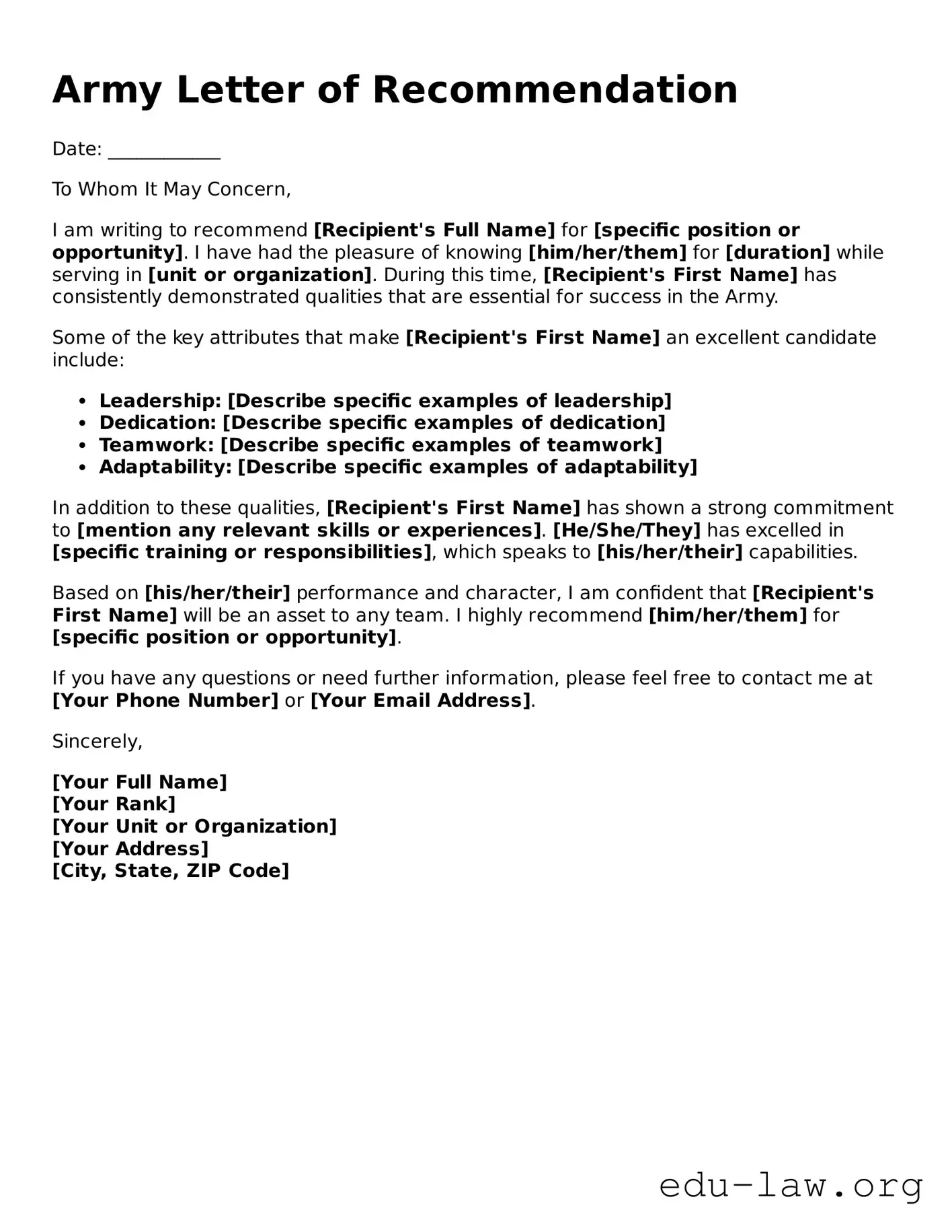
The Army Letter of Recommendation form serves as a vital tool for individuals seeking to advance their military careers or apply for various programs within the Army. This form is designed to gather insights and endorsements from supervisors, peers, or mentors who can attest to an applicant's qualifications, character, and potential. It typically includes sections for personal information, the recommender's relationship to the applicant, and specific comments regarding the applicant’s skills and accomplishments. The form not only emphasizes the importance of personal attributes such as leadership, integrity, and teamwork but also allows for detailed anecdotes that highlight the applicant's contributions and achievements. By providing a structured format, the Army Letter of Recommendation form ensures that recommendations are comprehensive and focused, ultimately aiding decision-makers in evaluating candidates for promotions, assignments, or special programs.
Army Letter of Recommendation
Date: ____________
To Whom It May Concern,
I am writing to recommend [Recipient's Full Name] for [specific position or opportunity]. I have had the pleasure of knowing [him/her/them] for [duration] while serving in [unit or organization]. During this time, [Recipient's First Name] has consistently demonstrated qualities that are essential for success in the Army.
Some of the key attributes that make [Recipient's First Name] an excellent candidate include:
In addition to these qualities, [Recipient's First Name] has shown a strong commitment to [mention any relevant skills or experiences]. [He/She/They] has excelled in [specific training or responsibilities], which speaks to [his/her/their] capabilities.
Based on [his/her/their] performance and character, I am confident that [Recipient's First Name] will be an asset to any team. I highly recommend [him/her/them] for [specific position or opportunity].
If you have any questions or need further information, please feel free to contact me at [Your Phone Number] or [Your Email Address].
Sincerely,
[Your Full Name]
[Your Rank]
[Your Unit or Organization]
[Your Address]
[City, State, ZIP Code]
| Fact Name | Description |
|---|---|
| Purpose | The Army Letter of Recommendation form is used to provide a formal endorsement for a soldier, typically for promotions, awards, or special assignments. |
| Format | The form usually includes sections for the recommender's information, the soldier's details, and the actual recommendation text. |
| Submission Process | After completion, the form must be submitted to the appropriate military authority or unit, often through a chain of command. |
| State-Specific Forms | Some states may have their own specific forms for recommendations, governed by state military regulations. |
| Confidentiality | Recommendations are typically considered confidential and may not be shared with the individual being recommended without proper authorization. |
Completing the Army Letter of Recommendation form is a straightforward process that requires attention to detail. Following these steps will ensure that the form is filled out correctly and submitted in a timely manner.
What is the Army Letter of Recommendation form?
The Army Letter of Recommendation form is a document used to provide a formal endorsement for an individual seeking to join the Army or advance within its ranks. It serves as a testament to the candidate's character, skills, and suitability for military service. This letter is typically written by someone who knows the individual well, such as a supervisor, teacher, or community leader.
Who should write a letter of recommendation?
Letters of recommendation should ideally be written by individuals who can speak to the candidate's qualifications and character. This could include military supervisors, teachers, coaches, or community leaders. The recommender should have firsthand knowledge of the candidate's abilities and experiences to provide a credible endorsement.
What information should be included in the letter?
A strong letter of recommendation should include specific details about the candidate's skills, accomplishments, and character traits. It should mention the recommender's relationship with the candidate and provide examples that illustrate the candidate's strengths. Additionally, the letter should conclude with a clear endorsement of the candidate's potential for success in the Army.
Is there a specific format for the letter?
While there is no strict format required, the letter should be professional and clearly organized. It should include the date, the recommender's contact information, and a formal greeting. The body of the letter should be structured logically, and it should end with a closing statement and the recommender's signature.
How long should the letter be?
Typically, a letter of recommendation should be one page long. This length allows the recommender to provide sufficient detail without overwhelming the reader. The focus should be on quality rather than quantity, emphasizing the most relevant points about the candidate.
Can the letter be submitted electronically?
Yes, many Army applications allow for electronic submissions of letters of recommendation. However, it is important to check the specific requirements of the application process. If submitting electronically, ensure that the letter is in a compatible format and that all instructions are followed carefully.
How should the letter be delivered?
Delivery methods can vary based on the application process. Letters may need to be mailed directly to the recruiting office, submitted through an online portal, or handed to the candidate for inclusion in their application package. Always confirm the preferred method to ensure timely and proper delivery.
What if the recommender is not familiar with military service?
While it is beneficial for the recommender to have some knowledge of military service, it is not a strict requirement. What matters most is the recommender's ability to provide an honest and compelling assessment of the candidate's qualities. If the recommender lacks military experience, they should focus on the candidate's strengths that are relevant to the Army's values and mission.
Are there any common mistakes to avoid when writing the letter?
Yes, some common mistakes include being overly vague, failing to provide specific examples, or using generic phrases that do not truly reflect the candidate's abilities. It's also important to avoid exaggeration or insincerity, as authenticity is key in a recommendation letter. Proofreading for grammar and clarity is essential as well.
How can a candidate help their recommender?
A candidate can assist their recommender by providing them with relevant information, such as their resume, a list of accomplishments, and details about the position they are applying for. This background can help the recommender tailor their letter to highlight the most pertinent qualities and experiences, ultimately strengthening the recommendation.
Incomplete Information: One of the most common mistakes is not providing all the required information. Ensure that every section of the form is filled out completely. Missing details can delay the processing of the recommendation.
Generic Language: Using vague or generic phrases can weaken the recommendation. Instead of saying "he is a good soldier," provide specific examples of achievements or qualities that demonstrate the individual's capabilities.
Failure to Follow Instructions: Each form comes with specific guidelines. Ignoring these instructions can lead to rejection. Pay close attention to formatting, length, and submission procedures.
Neglecting to Proofread: Spelling and grammatical errors can undermine the professionalism of the recommendation. Take the time to review the document carefully. A well-written letter reflects positively on both the recommender and the candidate.
When preparing a letter of recommendation for an Army service member, several other forms and documents can enhance the application process. These documents provide additional context and support for the recommendation, ensuring a comprehensive overview of the candidate’s qualifications and character.
Incorporating these documents alongside the Army Letter of Recommendation can significantly strengthen the overall application. Each piece adds depth and context, helping to create a well-rounded representation of the individual’s qualifications and potential for future success.
The Army Letter of Recommendation form shares similarities with the Military Performance Evaluation Report (NCOER). Both documents serve to assess an individual's performance and potential within the military. The NCOER provides a structured evaluation of a non-commissioned officer's abilities, achievements, and leadership qualities. Like the Army Letter of Recommendation, it is used to inform decisions regarding promotions, assignments, and other career advancements. Both documents require input from supervisors and are critical in shaping a service member's career trajectory.
Another document comparable to the Army Letter of Recommendation is the Officer Evaluation Report (OER). This report evaluates an officer's performance and potential for future assignments. Similar to the Army Letter of Recommendation, the OER includes input from superiors and focuses on leadership, skills, and accomplishments. Both documents are integral to the officer's career progression and are used to make informed decisions about promotions and assignments.
The Enlisted Record Brief (ERB) also bears resemblance to the Army Letter of Recommendation. The ERB provides a comprehensive summary of a soldier's career, including education, training, and performance history. While the Army Letter of Recommendation emphasizes specific achievements and personal endorsements, the ERB presents a broader overview. Both documents play a vital role in evaluating a soldier's qualifications for advancement and opportunities within the military.
Similarly, the DA Form 638, which is used for award recommendations, aligns with the Army Letter of Recommendation in its purpose of recognizing individual achievements. The DA Form 638 details the accomplishments of a service member and provides a narrative that supports the recommendation for an award. Like the Army Letter of Recommendation, it requires input from supervisors and peers, highlighting the importance of collaboration in acknowledging service members' contributions.
The Fitness Report (FITREP) is another document that shares similarities with the Army Letter of Recommendation. Used primarily in the Navy and Marine Corps, the FITREP evaluates a service member's performance and potential for future roles. Much like the Army Letter of Recommendation, it is a formal assessment that influences career decisions, including promotions and assignments. Both documents focus on performance metrics and personal attributes that contribute to a service member's success.
The Personal Data Record (PDR) is also comparable to the Army Letter of Recommendation. The PDR contains essential information about a service member's career, including assignments, education, and training. While it does not provide recommendations, it serves as a foundational document that supports the context in which an Army Letter of Recommendation is written. Both documents are essential for understanding a service member's qualifications and experiences.
The Statement of Accomplishments is another document that reflects similarities with the Army Letter of Recommendation. This statement outlines specific achievements and contributions made by a service member, often in a narrative format. Like the Army Letter of Recommendation, it is used to support applications for promotions, awards, or other opportunities within the military. Both documents emphasize the importance of individual contributions to the overall mission.
The Letter of Instruction (LOI) can also be seen as similar to the Army Letter of Recommendation in that it provides guidance and expectations for specific tasks or roles. While the LOI is more focused on outlining duties and responsibilities, it can include endorsements or recommendations for service members taking on new roles. Both documents serve to guide and inform decisions regarding a service member's career path.
Lastly, the Career Development Plan (CDP) shares characteristics with the Army Letter of Recommendation. The CDP outlines a service member's goals, training, and professional development. While it is more of a strategic document, it can include elements that align with the recommendations found in an Army Letter of Recommendation. Both documents aim to foster growth and advancement within the military, emphasizing the importance of planning and support for individual careers.
When filling out the Army Letter of Recommendation form, it's important to approach the task thoughtfully. Here are some guidelines to help you navigate the process effectively.
Following these tips can help create a strong recommendation that highlights the individual's qualifications and character.
Understanding the Army Letter of Recommendation form is essential for anyone involved in the military application process. However, several misconceptions exist regarding this important document. Below are ten common misconceptions, along with explanations to clarify them.
Many believe that a letter of recommendation is optional, but it is often required for certain positions or promotions within the Army. Always check specific requirements.
While friends and family may wish to help, only individuals with relevant military experience or knowledge of the applicant's skills should write the letter.
A strong letter of recommendation should be specific and tailored to the applicant's qualifications and achievements, rather than a one-size-fits-all document.
While there are guidelines, each letter should reflect the unique qualities of the applicant and the writer's perspective, so variations are acceptable.
Typing the letter is perfectly acceptable and often preferred for clarity and professionalism.
A signature adds credibility to the letter. Therefore, it is important for the writer to sign the document before submission.
Timeliness is crucial. Submitting the letter after the deadline may result in disqualification from consideration.
Depending on the application requirements, multiple letters may be needed to provide a well-rounded view of the applicant's abilities.
While positivity is important, the content should also provide specific examples of the applicant's skills and accomplishments to be truly effective.
Current service members may also need letters for promotions or special assignments, making them relevant at various career stages.
By dispelling these misconceptions, individuals can better understand the importance and requirements of the Army Letter of Recommendation form, ensuring a more effective application process.
When filling out and using the Army Letter of Recommendation form, there are several important points to keep in mind. Here are some key takeaways:
By keeping these takeaways in mind, you can create a compelling and effective Army Letter of Recommendation that truly highlights the strengths of the individual it represents.