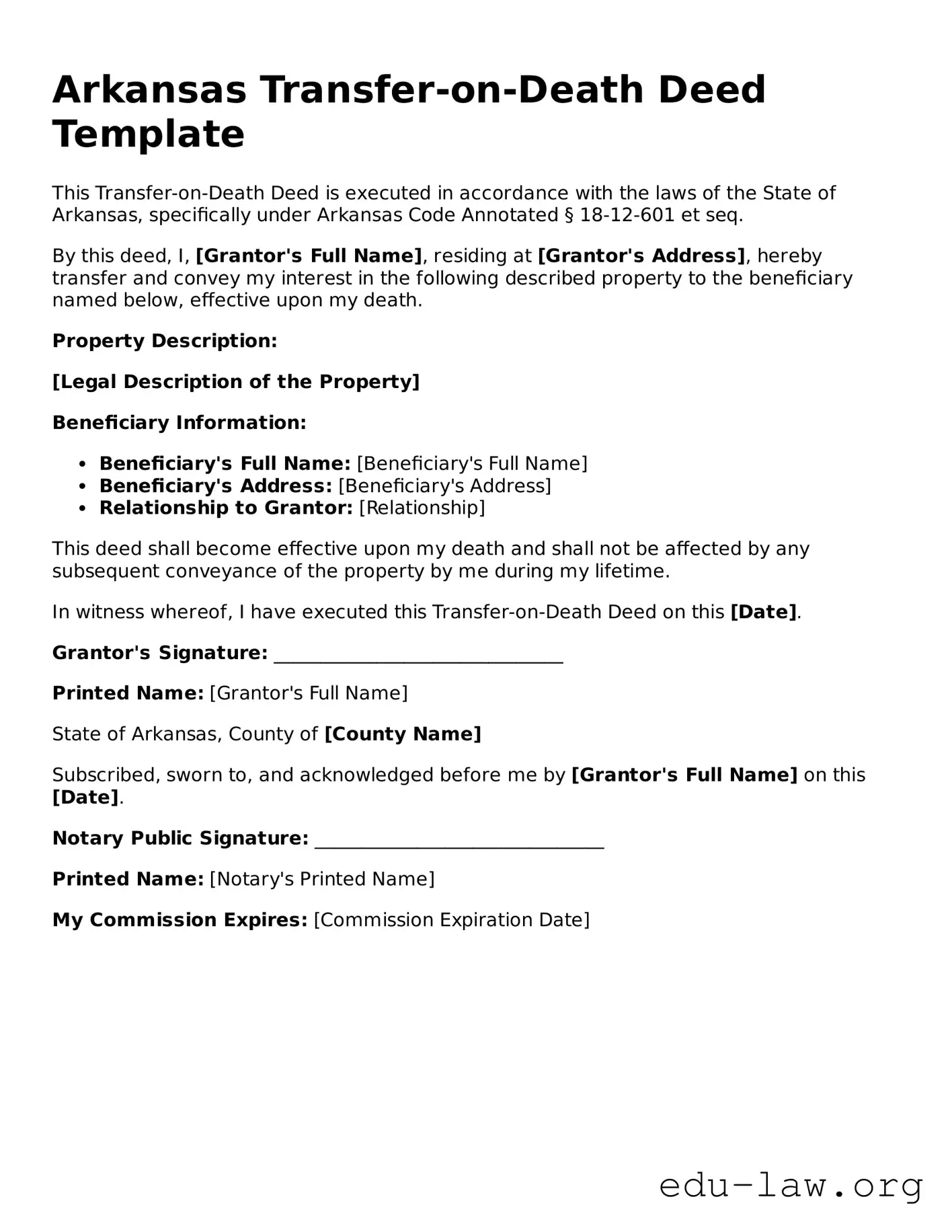
The Arkansas Transfer-on-Death Deed form serves as a valuable estate planning tool, allowing property owners to transfer real estate to designated beneficiaries upon their passing, without the need for probate. This straightforward process enables individuals to maintain control over their property during their lifetime while ensuring a smooth transition of ownership after death. By utilizing this form, property owners can specify who will inherit their property, simplifying the transfer process and potentially reducing the emotional and financial burden on their loved ones. The deed must be executed in accordance with state laws, including proper notarization and recording, to be valid. Understanding the nuances of this form is essential for anyone looking to secure their legacy and provide for their beneficiaries in a clear and efficient manner.
Arkansas Transfer-on-Death Deed Template
This Transfer-on-Death Deed is executed in accordance with the laws of the State of Arkansas, specifically under Arkansas Code Annotated § 18-12-601 et seq.
By this deed, I, [Grantor's Full Name], residing at [Grantor's Address], hereby transfer and convey my interest in the following described property to the beneficiary named below, effective upon my death.
Property Description:
[Legal Description of the Property]
Beneficiary Information:
This deed shall become effective upon my death and shall not be affected by any subsequent conveyance of the property by me during my lifetime.
In witness whereof, I have executed this Transfer-on-Death Deed on this [Date].
Grantor's Signature: _______________________________
Printed Name: [Grantor's Full Name]
State of Arkansas, County of [County Name]
Subscribed, sworn to, and acknowledged before me by [Grantor's Full Name] on this [Date].
Notary Public Signature: _______________________________
Printed Name: [Notary's Printed Name]
My Commission Expires: [Commission Expiration Date]
| Fact Name | Details |
|---|---|
| Definition | An Arkansas Transfer-on-Death Deed allows property owners to transfer real estate to beneficiaries upon their death without going through probate. |
| Governing Law | The Transfer-on-Death Deed in Arkansas is governed by Arkansas Code Annotated § 18-12-601 to § 18-12-610. |
| Execution Requirements | The deed must be signed by the property owner and notarized. Witnesses are not required. |
| Revocation | Property owners can revoke the deed at any time before their death by executing a new deed or a written revocation. |
| Effect on Creditors | Transfer-on-Death Deeds do not shield the property from creditors' claims against the estate of the deceased. |
After obtaining the Arkansas Transfer-on-Death Deed form, it is important to fill it out accurately to ensure that the transfer of property occurs as intended. Following the completion of the form, it will need to be signed and filed appropriately to take effect.
What is a Transfer-on-Death Deed in Arkansas?
A Transfer-on-Death Deed (TODD) allows property owners in Arkansas to transfer real estate to beneficiaries upon their death without going through probate. This deed is a simple way to ensure that your property passes directly to your chosen heirs, making the process smoother and quicker for them.
How do I create a Transfer-on-Death Deed?
To create a TODD, you must fill out the appropriate form, which includes details such as your name, the property description, and the names of the beneficiaries. After completing the form, it must be signed and notarized. Finally, the deed should be recorded with the county clerk’s office where the property is located to be legally effective.
Can I change or revoke a Transfer-on-Death Deed after it is created?
Yes, you can change or revoke a TODD at any time before your death. To do this, you must create a new deed that explicitly revokes the previous one or file a formal revocation with the county clerk. It’s important to ensure that the new deed is properly executed and recorded to avoid any confusion.
What types of property can be transferred using a Transfer-on-Death Deed?
In Arkansas, a TODD can be used to transfer real estate, such as residential homes, land, or commercial properties. However, it cannot be used for personal property, bank accounts, or other types of assets. Always verify that the property in question qualifies for a TODD before proceeding.
Are there any tax implications associated with a Transfer-on-Death Deed?
Generally, transferring property via a TODD does not trigger immediate tax consequences. The property will receive a step-up in basis for the beneficiaries, which can reduce capital gains taxes if they decide to sell the property later. However, it’s advisable to consult a tax professional for specific guidance tailored to your situation.
What happens if a beneficiary dies before the property owner?
If a beneficiary named in the TODD dies before the property owner, the transfer of the property will typically not occur to that beneficiary. Instead, the property will pass to the remaining beneficiaries named in the deed. If no alternate beneficiaries are designated, the property may be distributed according to the owner's will or state intestacy laws.
Incomplete Information: Many individuals fail to provide all necessary details. This can include missing names, addresses, or property descriptions. Ensure every section is filled out completely to avoid delays.
Incorrect Signatures: It's crucial to have the correct signatures on the form. Some people forget to sign or have the wrong person sign. Make sure that all required parties sign the document in the appropriate places.
Not Notarizing the Document: A common mistake is neglecting to have the deed notarized. This step is essential for the deed to be legally valid. Always ensure that a notary public witnesses and stamps the document.
Failing to Record the Deed: After completing the form, some individuals forget to record it with the county clerk. Without recording, the deed may not be enforceable. Always file the deed promptly to secure the transfer of property.
The Arkansas Transfer-on-Death Deed allows property owners to transfer real estate to beneficiaries upon their death without the need for probate. This deed is often accompanied by several other legal documents that facilitate the transfer of property and clarify ownership rights. Below is a list of commonly used forms and documents that may be relevant in conjunction with the Transfer-on-Death Deed.
Understanding these documents can help individuals navigate the complexities of property transfer and estate planning. Each form plays a distinct role in ensuring that assets are handled according to the owner's wishes and in compliance with state laws.
The Arkansas Transfer-on-Death Deed (TODD) allows property owners to transfer real estate to beneficiaries upon their death without going through probate. Similar to the TODD, a Living Trust also facilitates the transfer of assets outside of probate. In a Living Trust, the property owner places their assets into a trust during their lifetime. Upon death, the assets are distributed according to the terms of the trust, offering privacy and potentially reducing estate taxes.
A Will is another document that shares similarities with the TODD. Like the TODD, a Will dictates how a person's assets will be distributed after their death. However, unlike the TODD, a Will must go through probate, which can be a lengthy and public process. The TODD allows for a more streamlined transfer of real estate directly to the beneficiaries.
When filling out the Arkansas Transfer-on-Death Deed form, it's essential to approach the task with care. Here’s a list of ten things to keep in mind, ensuring that your deed is completed accurately and effectively.
By following these guidelines, you can navigate the process of completing the Transfer-on-Death Deed form with confidence. Taking the time to ensure accuracy and compliance will help protect your wishes and streamline the transfer of property in the future.
Understanding the Arkansas Transfer-on-Death Deed form is essential for effective estate planning. However, several misconceptions can lead to confusion. Below is a list of common misconceptions regarding this form.
Clarifying these misconceptions can help individuals make informed decisions regarding their estate planning in Arkansas.
Filling out and using the Arkansas Transfer-on-Death Deed form requires careful attention to detail. Here are some key takeaways to consider: