In the state of Arkansas, navigating the complexities of estate management can often feel overwhelming, especially when dealing with the passing of a loved one. Fortunately, the Arkansas Small Estate Affidavit form offers a streamlined process for settling smaller estates without the need for formal probate proceedings. This form is particularly beneficial for heirs or beneficiaries who find themselves in a situation where the total value of the estate falls below a certain threshold, making it an accessible option for many families. By utilizing this affidavit, individuals can efficiently claim their rightful inheritance, whether it involves personal property, bank accounts, or other assets. The form requires specific information, such as the names of the deceased and the heirs, a detailed inventory of the estate's assets, and a declaration of the estate's value. Additionally, it serves as a legal document that affirms the rightful claimants' entitlement to the estate, thus simplifying the transfer process. Understanding how to properly fill out and file this affidavit can save time, reduce stress, and help ensure that the wishes of the deceased are honored while providing a clear path for beneficiaries to follow.
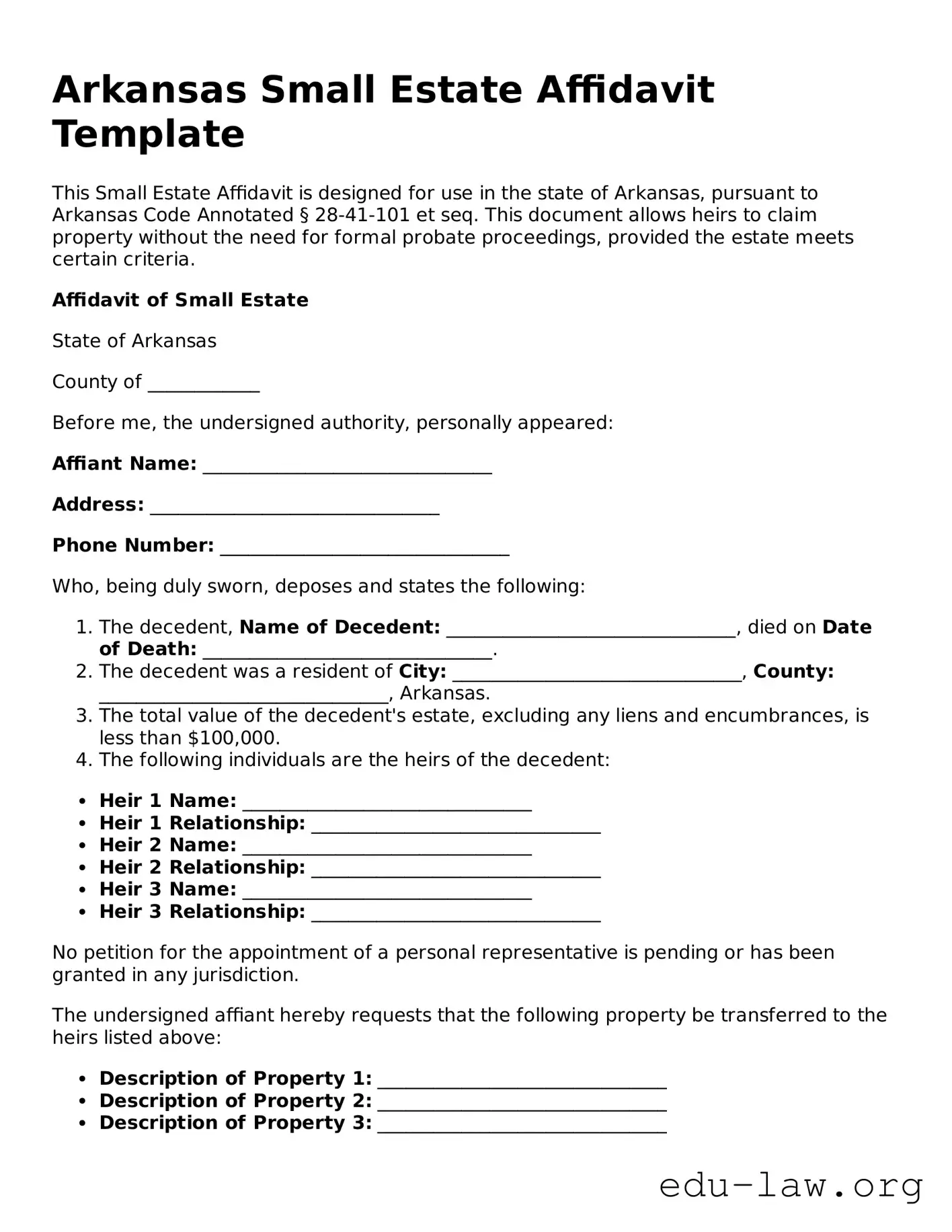
Arkansas Small Estate Affidavit Template
This Small Estate Affidavit is designed for use in the state of Arkansas, pursuant to Arkansas Code Annotated § 28-41-101 et seq. This document allows heirs to claim property without the need for formal probate proceedings, provided the estate meets certain criteria.
Affidavit of Small Estate
State of Arkansas
County of ____________
Before me, the undersigned authority, personally appeared:
Affiant Name: _______________________________
Address: _______________________________
Phone Number: _______________________________
Who, being duly sworn, deposes and states the following:
No petition for the appointment of a personal representative is pending or has been granted in any jurisdiction.
The undersigned affiant hereby requests that the following property be transferred to the heirs listed above:
Affiant understands that this affidavit is made under penalty of perjury and that any false statements made herein may result in criminal charges.
Executed on this Date: _______________________________.
_______________________________
Signature of Affiant
_______________________________
Printed Name of Affiant
Sworn to and subscribed before me this ____ day of ____________, 20__.
_______________________________
Notary Public
My commission expires: _______________________________
| Fact Name | Description |
|---|---|
| Purpose | The Arkansas Small Estate Affidavit allows individuals to claim assets of a deceased person without going through formal probate, provided the estate meets certain criteria. |
| Eligibility | This form can be used if the total value of the deceased's estate is less than $100,000, excluding real estate. |
| Governing Law | The use of the Small Estate Affidavit in Arkansas is governed by Arkansas Code Annotated § 28-41-101 et seq. |
| Filing Requirements | The affidavit must be signed by all heirs or beneficiaries of the estate, affirming their relationship to the deceased. |
| Asset Transfer | Once the affidavit is filed, it enables the transfer of the deceased's assets directly to the heirs or beneficiaries without the need for probate court intervention. |
| Timeframe | The affidavit can typically be processed quickly, allowing heirs to access the deceased's assets in a timely manner. |
Once you have gathered the necessary information and documents, you can proceed to fill out the Arkansas Small Estate Affidavit form. This process involves providing specific details about the deceased and their estate. Make sure to review the completed form for accuracy before submission.
After completing the form, you will need to file it with the appropriate court in the county where the deceased lived. Be prepared to provide any additional documentation that may be required by the court.
What is the Arkansas Small Estate Affidavit form?
The Arkansas Small Estate Affidavit is a legal document that allows heirs to claim property and assets of a deceased person without going through the lengthy probate process. This form is typically used when the total value of the estate is below a certain threshold, which, as of 2023, is $100,000 for personal property and $50,000 for real property. By using this affidavit, heirs can expedite the transfer of assets directly to them.
Who is eligible to use the Small Estate Affidavit in Arkansas?
Eligibility to use the Small Estate Affidavit is generally limited to heirs of the deceased. The individual must be a beneficiary named in the will or a legal heir under Arkansas intestacy laws if there is no will. Additionally, the estate must meet the value limits set by Arkansas law. It is important to ensure that no formal probate proceedings have been initiated before filing this affidavit.
How do I complete the Arkansas Small Estate Affidavit form?
To complete the form, start by gathering necessary information about the deceased, including their full name, date of death, and details about the estate's assets. The form requires you to provide a list of the assets, their estimated values, and any debts owed by the deceased. After filling out the form, it must be signed in front of a notary public. This step is crucial, as notarization lends legal validity to the affidavit.
What happens after I file the Small Estate Affidavit?
Once the Small Estate Affidavit is filed with the appropriate court or county clerk's office, it becomes a public record. The heirs can then use this affidavit to collect assets from financial institutions, transfer titles, or claim property. However, it is advisable to keep copies of the affidavit and any supporting documents for your records. If any disputes arise regarding the estate, the affidavit can serve as evidence of your claim to the assets.
Are there any fees associated with filing the Small Estate Affidavit?
Yes, there may be fees associated with filing the Arkansas Small Estate Affidavit. These fees can vary by county and may include costs for notarization and filing with the court or county clerk. It is recommended to check with the local court or clerk’s office for the exact fee structure. Additionally, some counties may offer fee waivers for low-income individuals, so it's worth inquiring about available options.
Incomplete Information: Many individuals fail to provide all necessary details. This includes missing names, addresses, or relationships of heirs. Each piece of information is crucial for the affidavit's validity.
Incorrect Value Assessment: Some people underestimate or overestimate the total value of the estate. Accurately calculating the estate's worth is essential to ensure it falls within Arkansas's small estate limits.
Not Including All Assets: It’s common to overlook certain assets. Bank accounts, vehicles, and personal property must all be listed to provide a complete picture of the estate.
Failure to Sign: Neglecting to sign the affidavit is a frequent oversight. Without a signature, the document cannot be processed, delaying the estate settlement.
Missing Notarization: Some individuals forget to have the affidavit notarized. This step is vital, as it adds a layer of authenticity to the document.
Incorrect Use of the Form: Using the wrong version of the Small Estate Affidavit can lead to complications. Always ensure you have the most current form available.
Ignoring State Requirements: Each state has specific rules regarding small estates. Some people overlook Arkansas's requirements, which can result in the affidavit being rejected.
Not Seeking Guidance: Many individuals attempt to complete the affidavit without assistance. Consulting with a knowledgeable professional can help avoid common pitfalls and ensure accuracy.
The Arkansas Small Estate Affidavit is a useful tool for settling small estates without going through formal probate. However, several other forms and documents may accompany it to ensure a smooth process. Below is a list of these documents, each serving a specific purpose in the estate settlement process.
Each of these documents plays a critical role in the small estate process in Arkansas. Together, they help ensure that the estate is settled fairly and in accordance with the law.
The Arkansas Small Estate Affidavit is similar to the Affidavit of Heirship, which is often used in estate planning and probate matters. This document allows individuals to declare the heirs of a deceased person without going through formal probate proceedings. Both documents serve to simplify the transfer of assets to rightful heirs, reducing the time and cost associated with estate settlement. The Affidavit of Heirship typically requires information about the deceased's family and can be used for real property transfers, much like the Small Estate Affidavit facilitates the distribution of smaller estates.
Another comparable document is the Petition for Summary Administration. This legal filing is designed for estates that meet specific criteria, allowing for a quicker probate process. Like the Small Estate Affidavit, it aims to expedite the distribution of assets to beneficiaries. The Petition for Summary Administration requires court approval, while the Small Estate Affidavit does not. However, both documents ultimately aim to streamline the transfer of assets and minimize the burden on heirs.
The Small Estate Affidavit also shares similarities with the Will. A will outlines a person's wishes regarding the distribution of their estate after death. While a will is a more formal document that requires probate, the Small Estate Affidavit serves as an alternative for smaller estates, allowing heirs to claim assets without going through a lengthy court process. Both documents require the identification of beneficiaries and can specify how assets should be distributed, but the Small Estate Affidavit is specifically tailored for situations where the estate is below a certain value threshold.
Lastly, the Small Estate Affidavit is akin to the Transfer on Death Deed (TODD). A TODD allows individuals to transfer real property upon death without going through probate. This document, like the Small Estate Affidavit, simplifies the process of transferring assets directly to beneficiaries. Both documents are designed to avoid the complexities of probate, enabling smoother transitions of property ownership. However, a TODD specifically pertains to real estate, while the Small Estate Affidavit can encompass a wider range of assets.
When filling out the Arkansas Small Estate Affidavit form, it is important to follow certain guidelines to ensure accuracy and compliance. Below is a list of things you should and shouldn't do.
When dealing with estate matters in Arkansas, the Small Estate Affidavit can often be misunderstood. Here are six common misconceptions about this form:
This is not true. The Small Estate Affidavit is designed for estates with a total value below a certain threshold, regardless of the deceased's overall wealth. This allows for a simpler process for those with modest estates.
In reality, not all assets qualify. For example, jointly owned property or assets with designated beneficiaries, like life insurance policies, do not fall under this affidavit.
This is a misconception. While the affidavit simplifies the process, it still requires proper documentation to prove the estate's value and the heirs' identities.
Only certain individuals, typically the heirs or personal representatives, are eligible to file this affidavit. Understanding who qualifies is crucial to avoid complications.
This is misleading. The affidavit primarily facilitates the transfer of assets to heirs, but it does not address the settlement of debts. Debts must still be managed separately.
This is incorrect. While the affidavit simplifies the process, it can still be contested in certain situations, especially if there are disputes among heirs or claims from creditors.
Understanding these misconceptions can help individuals navigate the estate process more effectively and avoid potential pitfalls.
Filling out the Arkansas Small Estate Affidavit form can simplify the process of settling an estate. Here are some key takeaways to keep in mind:
By following these guidelines, individuals can navigate the small estate process more efficiently.