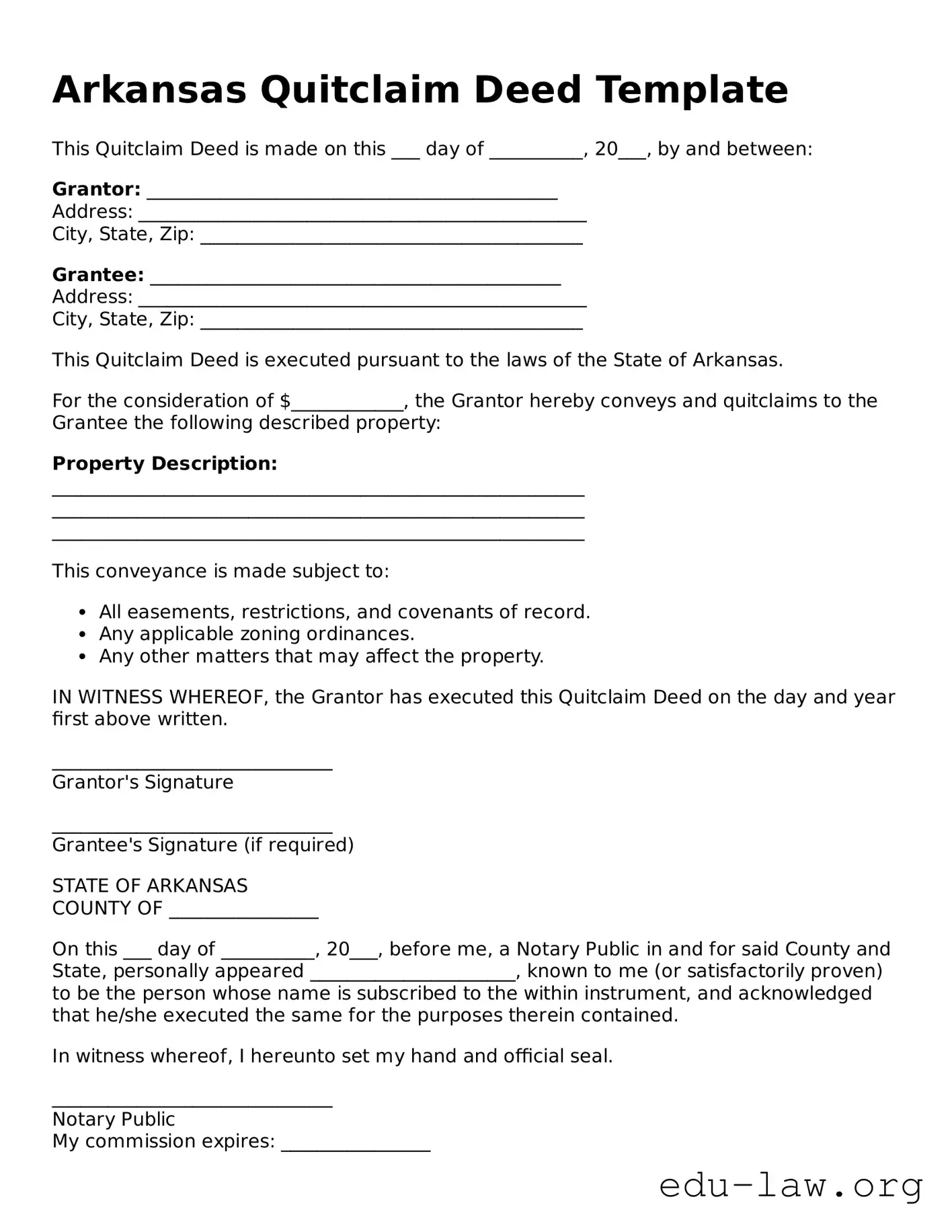
In the realm of property transactions, the Arkansas Quitclaim Deed serves as a vital tool for individuals looking to transfer ownership rights swiftly and efficiently. This legal document allows the current property owner, known as the grantor, to convey their interest in a property to another party, referred to as the grantee. Unlike other types of deeds, the quitclaim deed does not guarantee that the grantor holds clear title to the property; instead, it transfers whatever interest the grantor may have, if any. This aspect makes it particularly useful in specific situations, such as family transfers or when resolving title issues. The form must be completed with accurate information, including the names of both parties, a description of the property, and the date of the transfer. Once executed, the quitclaim deed should be recorded with the appropriate county office to ensure public notice of the change in ownership. Understanding the nuances of the Arkansas Quitclaim Deed is essential for anyone involved in property transfers, as it can simplify the process while also highlighting the importance of clear communication and trust between parties.
Arkansas Quitclaim Deed Template
This Quitclaim Deed is made on this ___ day of __________, 20___, by and between:
Grantor: ____________________________________________
Address: ________________________________________________
City, State, Zip: _________________________________________
Grantee: ____________________________________________
Address: ________________________________________________
City, State, Zip: _________________________________________
This Quitclaim Deed is executed pursuant to the laws of the State of Arkansas.
For the consideration of $____________, the Grantor hereby conveys and quitclaims to the Grantee the following described property:
Property Description:
_________________________________________________________
_________________________________________________________
_________________________________________________________
This conveyance is made subject to:
IN WITNESS WHEREOF, the Grantor has executed this Quitclaim Deed on the day and year first above written.
______________________________
Grantor's Signature
______________________________
Grantee's Signature (if required)
STATE OF ARKANSAS
COUNTY OF ________________
On this ___ day of __________, 20___, before me, a Notary Public in and for said County and State, personally appeared ______________________, known to me (or satisfactorily proven) to be the person whose name is subscribed to the within instrument, and acknowledged that he/she executed the same for the purposes therein contained.
In witness whereof, I hereunto set my hand and official seal.
______________________________
Notary Public
My commission expires: ________________
| Fact Name | Description |
|---|---|
| Definition | A quitclaim deed is a legal document used to transfer ownership of real estate from one party to another without any warranties regarding the title. |
| Governing Law | The Arkansas Quitclaim Deed is governed by the Arkansas Code Annotated, specifically Title 18, Chapter 12. |
| Parties Involved | The form requires at least two parties: the grantor (the person transferring the property) and the grantee (the person receiving the property). |
| Consideration | While a nominal consideration is typically stated, it is not required for the validity of the deed. |
| Recording | To ensure public notice of the transfer, the quitclaim deed should be recorded in the county where the property is located. |
| Usage | Quitclaim deeds are often used in situations such as transferring property between family members or clearing up title issues. |
After obtaining the Arkansas Quitclaim Deed form, you will need to complete it accurately to ensure a smooth transfer of property rights. Follow these steps carefully to fill out the form correctly.
What is a Quitclaim Deed in Arkansas?
A Quitclaim Deed is a legal document used to transfer ownership of real estate from one party to another without guaranteeing that the title is clear. In Arkansas, it is often used among family members or in situations where the seller cannot guarantee the property’s title. This type of deed conveys whatever interest the grantor has in the property, if any, but does not provide any warranties or guarantees regarding the property’s title.
When should I use a Quitclaim Deed?
You might consider using a Quitclaim Deed in several situations. Common scenarios include transferring property between family members, resolving disputes over property ownership, or when gifting property. It is also useful in divorce settlements where one spouse relinquishes their interest in a property to the other.
How do I complete a Quitclaim Deed in Arkansas?
To complete a Quitclaim Deed in Arkansas, you will need to provide specific information, including the names of the grantor (the person transferring the property) and the grantee (the person receiving the property), a description of the property, and the date of the transfer. Once filled out, the document must be signed by the grantor in the presence of a notary public. Finally, it should be filed with the county clerk’s office where the property is located.
Do I need a lawyer to create a Quitclaim Deed?
While it is not legally required to have a lawyer draft a Quitclaim Deed, consulting with one can be beneficial. A legal professional can ensure that the deed is correctly formatted and that all necessary details are included. They can also help clarify any potential issues regarding the property’s title.
Is a Quitclaim Deed the same as a Warranty Deed?
No, a Quitclaim Deed is not the same as a Warranty Deed. A Warranty Deed provides a guarantee that the grantor holds clear title to the property and has the right to transfer it. In contrast, a Quitclaim Deed does not offer any guarantees about the title, making it a riskier option for the grantee.
What are the tax implications of using a Quitclaim Deed?
Generally, transferring property via a Quitclaim Deed may have tax implications. In Arkansas, a transfer of property may be subject to transfer taxes, although many transfers between family members are exempt. It is advisable to consult with a tax professional to understand any potential tax liabilities that may arise from the transfer.
Can a Quitclaim Deed be revoked?
Once a Quitclaim Deed is executed and recorded, it cannot be revoked unilaterally. However, the grantor may create a new deed to transfer the property back or to another party. If there are disputes regarding the deed, legal action may be necessary to resolve them.
How does a Quitclaim Deed affect my mortgage?
If the property is mortgaged, transferring ownership via a Quitclaim Deed does not automatically relieve the grantor of their mortgage obligations. The lender may still hold the original borrower responsible for the mortgage payments. It is essential to consult with the lender before executing a Quitclaim Deed to understand any implications for the mortgage.
What happens if the grantor has no ownership interest?
If the grantor has no ownership interest in the property, the Quitclaim Deed will transfer no rights to the grantee. This situation can create complications, especially if the grantee believes they are receiving ownership. It is crucial to verify the grantor's ownership status before proceeding with the deed.
Where do I file a Quitclaim Deed in Arkansas?
A Quitclaim Deed must be filed with the county clerk’s office in the county where the property is located. It is important to check with the specific county office for any local requirements or fees associated with recording the deed.
Failing to include all necessary parties. All grantors and grantees must be clearly identified.
Not providing a complete legal description of the property. This description must accurately detail the property being transferred.
Omitting the date of the transfer. The date is crucial for establishing the timeline of the transaction.
Not signing the form. The deed must be signed by the grantor to be valid.
Using incorrect or outdated forms. It is important to use the most current version of the Quitclaim Deed form.
Failing to notarize the document. A notarized signature is often required for the deed to be legally recognized.
Neglecting to check for any liens or encumbrances on the property. This information is essential for both parties.
Not filing the deed with the appropriate county office. After completion, the deed must be recorded to be enforceable.
A Quitclaim Deed is an important document used in real estate transactions, particularly for transferring property ownership without making any guarantees about the title. When using a Quitclaim Deed in Arkansas, several other forms and documents may be necessary to ensure a smooth transfer of property. Below is a list of commonly used documents that accompany a Quitclaim Deed.
Understanding these documents is essential for anyone involved in a property transaction. Each one plays a role in ensuring that the transfer of ownership is clear, legally binding, and free of complications. Always consult with a professional when navigating these forms to ensure compliance with local laws and regulations.
A Warranty Deed is similar to a Quitclaim Deed in that both are used to transfer property ownership. However, the key difference lies in the level of protection they offer. A Warranty Deed guarantees that the seller has clear title to the property and will defend against any claims. In contrast, a Quitclaim Deed offers no such guarantees, making it a riskier option for the buyer.
A Bargain and Sale Deed also shares similarities with a Quitclaim Deed, as both convey property without warranties. However, a Bargain and Sale Deed implies that the seller has some ownership rights and has not encumbered the property. While it may provide more assurance than a Quitclaim Deed, it still lacks the full protections found in a Warranty Deed.
A Grant Deed is another document that resembles a Quitclaim Deed. Like the Quitclaim Deed, it transfers ownership of property. However, a Grant Deed provides some assurances, such as the promise that the seller has not sold the property to anyone else and that the property is free from undisclosed encumbrances. This gives buyers a bit more confidence compared to a Quitclaim Deed.
An Executor’s Deed is used to transfer property from a deceased person's estate. While it functions similarly to a Quitclaim Deed in that it conveys ownership without warranties, it is specifically tied to the probate process. This document ensures that the transfer is carried out according to the deceased's wishes, but it does not guarantee the title's status.
A Trustee’s Deed is issued when property is transferred from a trust. Similar to a Quitclaim Deed, it does not guarantee the title. However, it is executed by a trustee who has the legal authority to manage the trust’s assets. This can add a layer of credibility to the transaction, even though the document itself does not provide warranties.
A Deed of Gift is a type of deed used when property is given as a gift. While it serves the same purpose of transferring ownership like a Quitclaim Deed, it typically involves no exchange of money. This document can create emotional ties and is often used among family members, but it also does not guarantee the title to the recipient.
A Special Purpose Deed is utilized for specific situations, such as transferring property due to a divorce or foreclosure. While it functions similarly to a Quitclaim Deed in that it conveys ownership without warranties, it is tailored for particular legal circumstances. This specificity can make it more suitable in certain contexts than a standard Quitclaim Deed.
Finally, a Mineral Deed is used to transfer rights to minerals beneath the surface of a property. While it shares the fundamental purpose of transferring ownership with a Quitclaim Deed, it focuses specifically on mineral rights rather than the surface property itself. This distinction is crucial for those involved in real estate transactions related to natural resources.
When filling out the Arkansas Quitclaim Deed form, it’s important to be thorough and accurate. Here’s a handy list of things you should and shouldn’t do to ensure the process goes smoothly.
By following these guidelines, you can help ensure that your Quitclaim Deed is filled out correctly and processed without unnecessary delays.
When it comes to the Arkansas Quitclaim Deed form, several misconceptions can lead to confusion. Understanding these can help individuals make informed decisions regarding property transfers.
This is partially true. A quitclaim deed transfers whatever interest the grantor has in the property, but it does not guarantee that the grantor has a valid title. The recipient may receive nothing if the grantor has no ownership.
This is false. A warranty deed provides a guarantee that the title is clear, while a quitclaim deed offers no such assurance. The risk is higher with a quitclaim deed.
This is incorrect. While often used among family members, quitclaim deeds can be used for any property transfer. They are common in various situations, including divorce settlements and business transactions.
This is misleading. A quitclaim deed does not remove existing liens or encumbrances. The new owner may still be responsible for any debts tied to the property.
This is not accurate. To make the transfer official and protect the new owner’s rights, the quitclaim deed must be recorded with the appropriate county office.
This is false. Quitclaim deeds can be used for any type of property, including commercial real estate and vacant land. The form is versatile and applicable in various contexts.
When dealing with the Arkansas Quitclaim Deed form, it’s essential to understand its significance and proper usage. Here are some key takeaways: