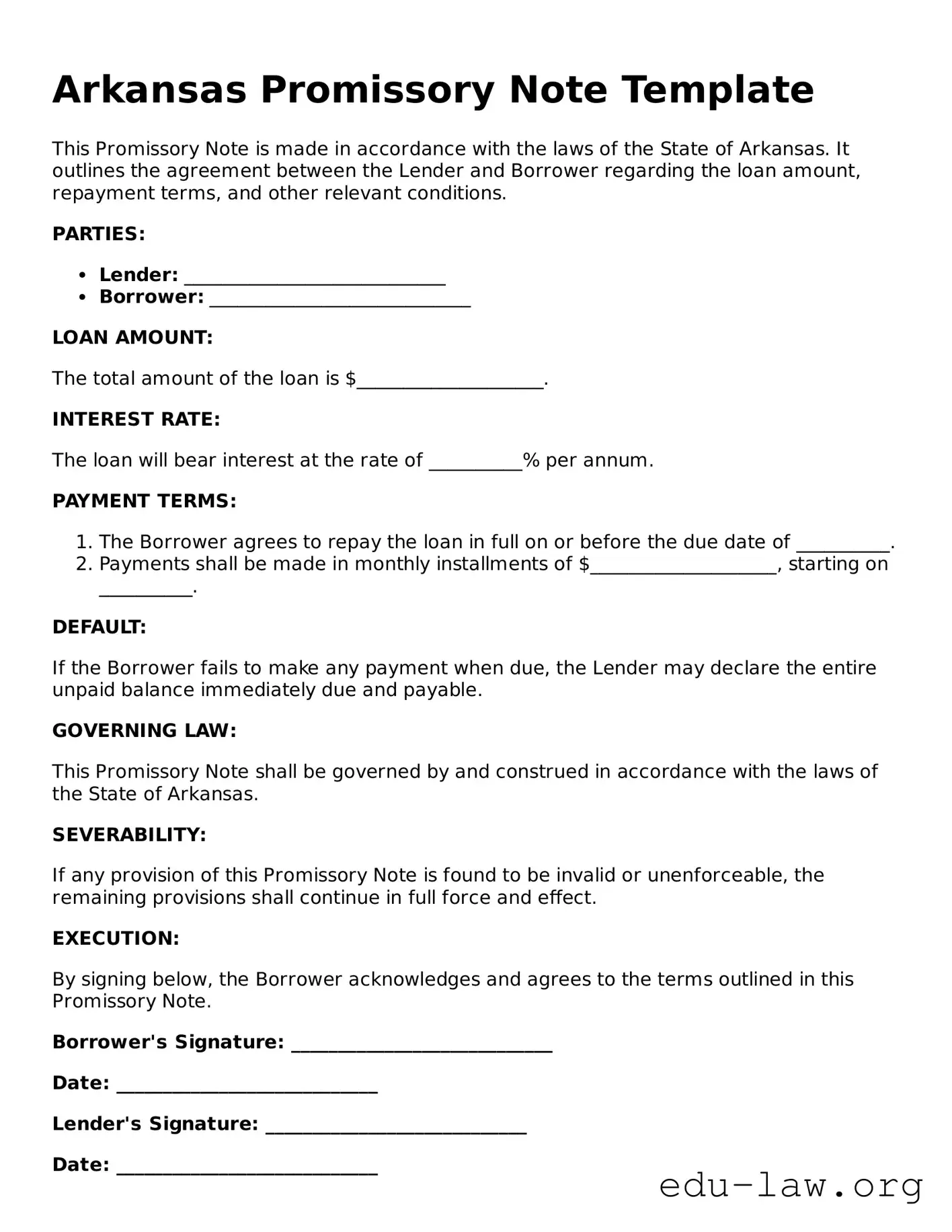
The Arkansas Promissory Note form is a vital document in the realm of personal and business finance, serving as a written promise to repay borrowed money under specified terms. This form outlines key elements such as the principal amount, interest rate, repayment schedule, and the consequences of default. It is essential for both lenders and borrowers to understand the implications of the note, as it legally binds the borrower to repay the loan as agreed. Furthermore, the document can include provisions for late fees, prepayment penalties, and other terms that may protect the lender's interests. By clearly defining the obligations of each party, the Promissory Note fosters transparency and trust in financial transactions. Whether you are lending money to a friend or entering into a business agreement, using this form can help ensure that everyone is on the same page regarding the terms of the loan.
Arkansas Promissory Note Template
This Promissory Note is made in accordance with the laws of the State of Arkansas. It outlines the agreement between the Lender and Borrower regarding the loan amount, repayment terms, and other relevant conditions.
PARTIES:
LOAN AMOUNT:
The total amount of the loan is $____________________.
INTEREST RATE:
The loan will bear interest at the rate of __________% per annum.
PAYMENT TERMS:
DEFAULT:
If the Borrower fails to make any payment when due, the Lender may declare the entire unpaid balance immediately due and payable.
GOVERNING LAW:
This Promissory Note shall be governed by and construed in accordance with the laws of the State of Arkansas.
SEVERABILITY:
If any provision of this Promissory Note is found to be invalid or unenforceable, the remaining provisions shall continue in full force and effect.
EXECUTION:
By signing below, the Borrower acknowledges and agrees to the terms outlined in this Promissory Note.
Borrower's Signature: ____________________________
Date: ____________________________
Lender's Signature: ____________________________
Date: ____________________________
| Fact Name | Description |
|---|---|
| Definition | A promissory note is a written promise to pay a specified amount of money to a designated person at a certain time. |
| Governing Law | In Arkansas, promissory notes are governed by the Uniform Commercial Code (UCC) as adopted by the state. |
| Key Elements | The note must include the principal amount, interest rate, payment schedule, and the signatures of the parties involved. |
| Enforceability | To be enforceable, the note must be in writing and signed by the borrower; oral agreements are generally not recognized. |
After obtaining the Arkansas Promissory Note form, you are ready to fill it out. This document will require specific details about the loan agreement between the lender and the borrower. Ensure that all information is accurate and complete to avoid any issues later.
Once completed, review the form to ensure all details are correct. Both parties should retain a copy for their records. This will help in managing the loan effectively.
What is an Arkansas Promissory Note?
An Arkansas Promissory Note is a legal document that outlines a borrower's promise to repay a specific amount of money to a lender under agreed-upon terms. This document serves as a written record of the loan agreement and includes essential details such as the loan amount, interest rate, repayment schedule, and any penalties for late payments.
Who should use a Promissory Note in Arkansas?
Anyone lending or borrowing money in Arkansas can benefit from using a Promissory Note. This includes individuals, businesses, and organizations. Whether it’s a personal loan between friends or a formal business transaction, having a Promissory Note helps protect both parties by clearly outlining the terms of the agreement.
What information is required in an Arkansas Promissory Note?
Key information typically includes the names and addresses of both the borrower and lender, the principal amount of the loan, the interest rate, the repayment schedule, and the due date. Additionally, any terms regarding default, prepayment, and collateral should be clearly stated to avoid misunderstandings.
Is a Promissory Note legally binding in Arkansas?
Yes, a properly executed Promissory Note is legally binding in Arkansas. It provides enforceable terms for both parties involved. However, it’s crucial that the document is signed by both the borrower and lender to validate the agreement. If disputes arise, the note can serve as evidence in court.
Can a Promissory Note be modified after it has been signed?
Yes, a Promissory Note can be modified if both parties agree to the changes. It is essential to document any modifications in writing and have both parties sign the revised agreement. This helps prevent future disputes and ensures clarity regarding the new terms.
What happens if the borrower defaults on the Promissory Note?
If a borrower defaults, meaning they fail to make the required payments, the lender has several options. They may pursue legal action to recover the owed amount, which could include filing a lawsuit. The specific consequences of default should be clearly outlined in the Promissory Note to ensure both parties understand their rights and obligations.
Neglecting to include all necessary details: Many individuals forget to provide essential information such as the full names of both the borrower and the lender, the loan amount, and the interest rate. Omitting any of these details can lead to confusion or disputes later on.
Not specifying the repayment schedule: A common oversight is failing to outline how and when the borrower will repay the loan. Clearly stating the payment frequency—whether it’s weekly, monthly, or annually—helps both parties understand their obligations.
Ignoring the importance of signatures: Some people forget to sign the document or fail to have a witness or notary present when signing. This can render the note unenforceable in a legal context, leading to complications if a dispute arises.
Using vague language: Ambiguity can create problems down the line. Phrases like "as agreed" or "reasonable terms" leave too much open to interpretation. It’s crucial to be specific about all terms and conditions to avoid misunderstandings.
Failing to keep copies: After completing the Promissory Note, some individuals neglect to make copies for both the borrower and lender. Keeping a record of the signed document is vital for future reference and ensures that both parties have access to the same information.
When entering into a financial agreement, particularly one involving a promissory note in Arkansas, several additional forms and documents may be necessary to ensure clarity and legality. Each of these documents serves a specific purpose, helping both parties understand their rights and obligations. Below is a list of common documents that may accompany an Arkansas Promissory Note.
Understanding these additional documents can help both borrowers and lenders navigate their financial agreements more effectively. Each form plays a crucial role in protecting the interests of both parties, ultimately fostering a more transparent and secure lending environment.
The Arkansas Promissory Note form shares similarities with a standard loan agreement. Both documents outline the terms of a loan, including the amount borrowed, interest rate, repayment schedule, and consequences for default. A loan agreement may be more detailed, often including clauses related to collateral, warranties, and borrower obligations, but the fundamental purpose remains the same: to formalize the borrowing arrangement between parties.
A mortgage note is another document that bears resemblance to the Arkansas Promissory Note. While a promissory note typically involves unsecured loans, a mortgage note is secured by real property. Both documents contain essential information about the borrower, lender, and loan terms. However, a mortgage note specifically includes provisions related to the property being financed, such as descriptions of the property and the rights of the lender in case of default.
A personal loan agreement also exhibits similarities with the Arkansas Promissory Note. Both documents serve to establish the terms of a loan between individuals or entities. They outline the principal amount, interest rate, and repayment schedule. However, personal loan agreements may include additional details regarding the purpose of the loan and any personal guarantees, which are less common in a standard promissory note.
A business loan agreement is akin to the Arkansas Promissory Note in that it formalizes the terms of a loan for business purposes. This document outlines the loan amount, interest rate, and repayment terms, similar to a promissory note. However, business loan agreements often include additional provisions related to business operations, financial covenants, and the use of funds, which are not typically found in personal promissory notes.
An IOU, or informal acknowledgment of debt, shares some characteristics with the Arkansas Promissory Note. Both documents signify a borrower’s obligation to repay a debt. However, an IOU is generally less formal and may not include specific repayment terms or interest rates. It serves more as a simple acknowledgment of debt rather than a legally binding contract.
A car loan agreement is similar to the Arkansas Promissory Note in that it outlines the terms under which a borrower agrees to repay a loan used to purchase a vehicle. Both documents detail the loan amount, interest rate, and repayment schedule. However, a car loan agreement typically includes specific information about the vehicle being financed and may also involve the lender retaining a security interest in the car until the loan is fully repaid.
A student loan agreement also mirrors the Arkansas Promissory Note in its function as a formal loan document. Both agreements specify the amount borrowed, interest rates, and repayment terms. However, student loan agreements often include provisions unique to education financing, such as deferment options, grace periods, and eligibility for forgiveness programs, which are not typically found in traditional promissory notes.
A lease agreement can be compared to the Arkansas Promissory Note in that both documents involve financial obligations. A lease agreement outlines the terms under which a tenant agrees to pay rent for a property. While a promissory note details repayment of a loan, a lease agreement focuses on rental payments and may include provisions for security deposits and maintenance responsibilities.
A credit card agreement also bears similarities to the Arkansas Promissory Note. Both documents outline the terms of borrowing, including interest rates and repayment obligations. However, a credit card agreement typically allows for revolving credit, meaning the borrower can borrow and repay repeatedly up to a certain limit, whereas a promissory note usually involves a fixed loan amount with a set repayment schedule.
Finally, a debt settlement agreement can be likened to the Arkansas Promissory Note in that both documents address financial obligations. A debt settlement agreement formalizes the terms under which a debtor agrees to pay a reduced amount to settle a debt. While a promissory note establishes the original loan terms, a debt settlement agreement modifies those terms to reflect a new arrangement, often due to the borrower’s financial difficulties.
When filling out the Arkansas Promissory Note form, it’s essential to approach the task with care. Here are some important dos and don'ts to keep in mind:
Understanding the Arkansas Promissory Note form is crucial for anyone involved in lending or borrowing money. However, several misconceptions often arise. Below are six common misunderstandings, along with explanations to clarify them.
While notarization can add an extra layer of authenticity, it is not a legal requirement for a promissory note to be enforceable in Arkansas. As long as the note is signed by the borrower and contains the essential terms, it remains valid.
This is not true. Promissory notes can be used for loans of any size. Whether it’s a small personal loan between friends or a larger business transaction, a promissory note serves as a formal agreement outlining the terms of repayment.
In fact, a valid promissory note must include certain key terms. These typically include the amount borrowed, interest rate, repayment schedule, and the names of both the borrower and lender. Without these details, the note may lack enforceability.
While verbal agreements can be legally binding, they are often difficult to enforce due to the lack of tangible evidence. A written promissory note provides clear documentation of the terms agreed upon, making it easier to resolve disputes if they arise.
Although both documents are legally binding, they serve different purposes. A promissory note specifically focuses on the promise to repay a loan, whereas a contract may cover a broader range of obligations and agreements between parties.
This is incorrect. Parties can amend a promissory note if both the borrower and lender agree to the changes. It is advisable to document any amendments in writing to avoid confusion in the future.
Filling out and using the Arkansas Promissory Note form requires careful attention to detail. Here are key takeaways to ensure proper use:
Completing the Arkansas Promissory Note form accurately is crucial for protecting both parties' interests. Take the time to review each section carefully.