When embarking on the journey of forming a limited liability company (LLC) in Arkansas, one of the most crucial documents you will encounter is the Operating Agreement. This essential form serves as the backbone of your business, outlining the structure, management, and operational procedures of your LLC. It details the roles and responsibilities of members, ensuring everyone understands their contributions and obligations. Additionally, the Operating Agreement addresses how profits and losses will be distributed, providing clarity and preventing potential disputes down the line. Moreover, it outlines the decision-making processes and procedures for adding or removing members, giving your LLC a solid framework for governance. By carefully crafting this document, you not only comply with state requirements but also foster a cooperative environment among members, setting the stage for your business’s success.
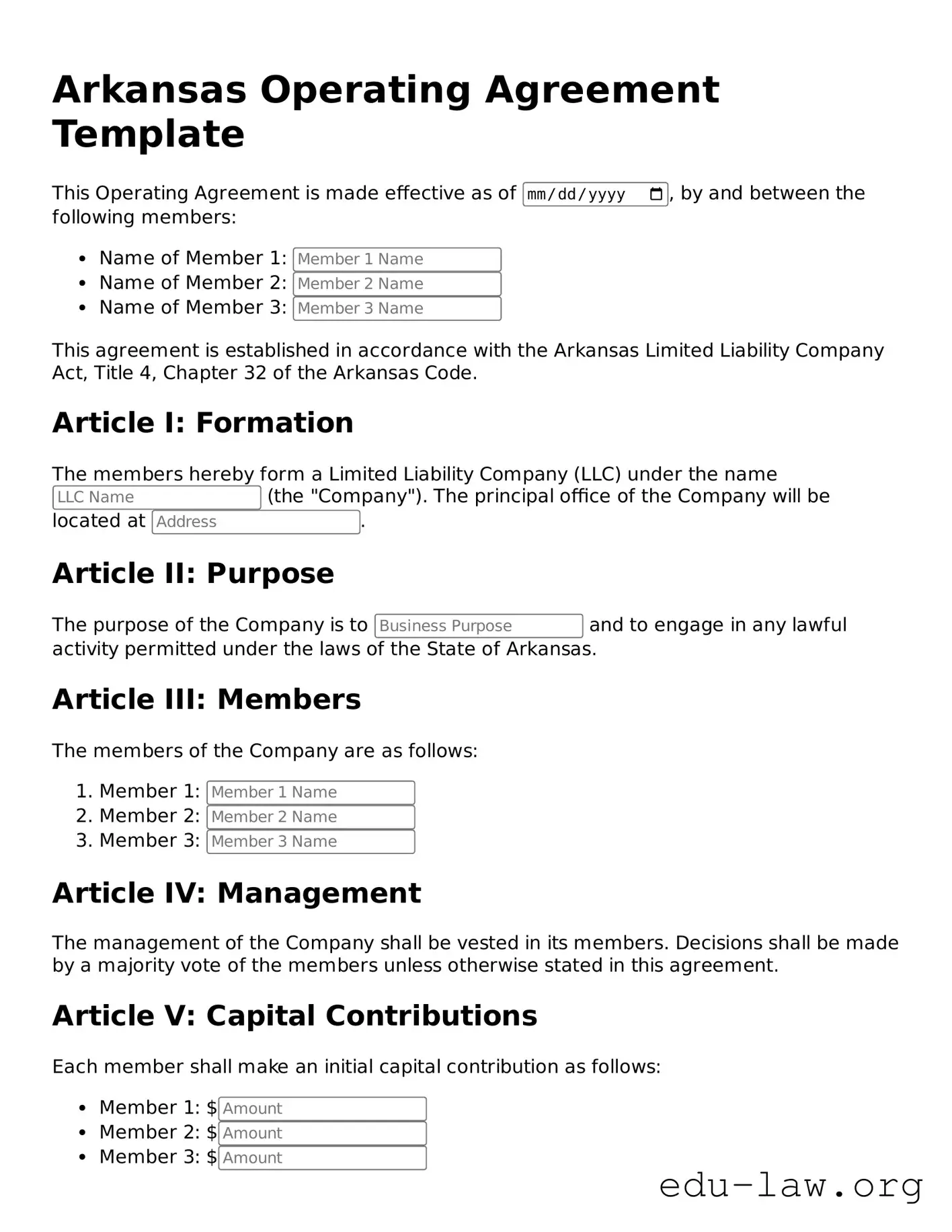
Arkansas Operating Agreement Template
This Operating Agreement is made effective as of , by and between the following members:
This agreement is established in accordance with the Arkansas Limited Liability Company Act, Title 4, Chapter 32 of the Arkansas Code.
Article I: Formation
The members hereby form a Limited Liability Company (LLC) under the name (the "Company"). The principal office of the Company will be located at .
Article II: Purpose
The purpose of the Company is to and to engage in any lawful activity permitted under the laws of the State of Arkansas.
Article III: Members
The members of the Company are as follows:
Article IV: Management
The management of the Company shall be vested in its members. Decisions shall be made by a majority vote of the members unless otherwise stated in this agreement.
Article V: Capital Contributions
Each member shall make an initial capital contribution as follows:
Article VI: Distributions
Distributions of profits and losses shall be allocated to the members in proportion to their respective ownership percentages as follows:
Article VII: Amendments
This Operating Agreement may be amended only by a written agreement signed by all members.
Article VIII: Governing Law
This agreement shall be governed by and construed in accordance with the laws of the State of Arkansas.
IN WITNESS WHEREOF, the members have executed this Operating Agreement as of the date first above written.
Member 1 Signature: ________________________ Date: ____________
Member 2 Signature: ________________________ Date: ____________
Member 3 Signature: ________________________ Date: ____________
| Fact Name | Details |
|---|---|
| Purpose | The Arkansas Operating Agreement form outlines the management structure and operational procedures of a limited liability company (LLC). |
| Governing Law | This form is governed by the Arkansas Limited Liability Company Act, specifically under Title 4, Chapter 32 of the Arkansas Code. |
| Mandatory Requirement | While not required to be filed with the state, having an operating agreement is essential for LLCs to establish internal rules. |
| Key Components | Typical components include member roles, profit distribution, and procedures for adding or removing members. |
| Flexibility | The agreement allows members to customize terms according to their specific needs and preferences. |
Filling out the Arkansas Operating Agreement form is an important step in establishing your business structure. After completing the form, you will be able to finalize your business operations and clarify the roles and responsibilities of all members involved.
What is an Arkansas Operating Agreement?
An Arkansas Operating Agreement is a legal document that outlines the management structure and operating procedures of a Limited Liability Company (LLC) in Arkansas. This agreement serves as an internal guideline for the members of the LLC, detailing their rights, responsibilities, and obligations. It is not required by law in Arkansas, but it is highly recommended for clarity and protection of all parties involved.
Why is an Operating Agreement important?
The Operating Agreement is crucial because it helps prevent misunderstandings among members. By clearly outlining how the LLC will be managed, how profits and losses will be distributed, and the procedures for adding or removing members, this document provides a roadmap for the company’s operations. Additionally, it can protect the limited liability status of the members by demonstrating that the LLC is a separate entity.
Who should create the Operating Agreement?
All members of the LLC should participate in the creation of the Operating Agreement. It is beneficial for members to collaborate and discuss the terms that will govern their business relationship. In some cases, it may be advisable to consult with a legal professional to ensure that the agreement complies with state laws and adequately addresses the needs of the members.
Can the Operating Agreement be amended?
Yes, the Operating Agreement can be amended. Members may find that changes are necessary as the business evolves. The amendment process should be clearly outlined in the original Operating Agreement to ensure that all members understand how changes can be made. Typically, a majority or unanimous consent of the members is required for amendments.
Is the Operating Agreement filed with the state?
No, the Operating Agreement is not filed with the state of Arkansas. This document is kept internally within the LLC and is not a public record. However, it is advisable to maintain a copy of the agreement in a safe place, as it may be needed for reference or in the event of a legal dispute.
What should be included in an Operating Agreement?
An Operating Agreement should include several key components. These typically consist of the LLC's name, purpose, duration, member contributions, profit and loss distribution, management structure, voting rights, and procedures for member changes. Additionally, it may address dispute resolution methods and the process for dissolving the LLC if necessary.
What happens if there is no Operating Agreement?
If an LLC does not have an Operating Agreement, the default rules set forth by Arkansas state law will apply. This can lead to unintended consequences, such as disputes over management and profit distribution. Without a clear agreement, members may face difficulties in resolving conflicts, which could jeopardize the business's operations and relationships among members.
Failing to include all members' names and addresses. Every member of the LLC should be listed to ensure clarity and legal recognition.
Not specifying the management structure. It's important to indicate whether the LLC will be managed by members or appointed managers.
Omitting the purpose of the LLC. Clearly stating the business purpose helps in defining the scope of operations and can impact legal compliance.
Neglecting to outline profit distribution. Members should agree on how profits and losses will be shared to avoid future disputes.
Inadequate provisions for member changes. Addressing how new members can join or how existing members can leave is crucial for ongoing operations.
Not including a dispute resolution process. Establishing a method for resolving disagreements can save time and money in the long run.
Forgetting to sign and date the agreement. Without signatures, the document may not be legally binding, which can lead to complications.
The Arkansas Operating Agreement form is an essential document for limited liability companies (LLCs) in Arkansas. It outlines the management structure, member responsibilities, and operational procedures of the business. In addition to this agreement, several other forms and documents are commonly used in conjunction with it to ensure proper legal compliance and smooth business operations. Below is a list of these related documents.
Using these forms and documents in conjunction with the Arkansas Operating Agreement can help ensure that your LLC operates smoothly and remains compliant with state regulations. Each document plays a vital role in establishing a solid foundation for your business and protecting the interests of its members.
The Arkansas Operating Agreement is similar to the LLC Operating Agreement, which is a foundational document for limited liability companies. This agreement outlines the management structure, member responsibilities, and operational procedures of the LLC. Both documents serve to clarify the roles of members and managers, ensuring that all parties understand their rights and obligations. Like the Arkansas Operating Agreement, the LLC Operating Agreement can help prevent disputes by providing clear guidelines for decision-making and profit distribution.
Another document akin to the Arkansas Operating Agreement is the Partnership Agreement. This agreement is used by general partnerships to define the relationship between partners, including their contributions, profit-sharing, and decision-making processes. Both documents emphasize the importance of clear communication and mutual understanding among parties involved. By outlining each partner's role and responsibilities, the Partnership Agreement, much like the Operating Agreement, helps to minimize conflicts and misunderstandings.
The Corporate Bylaws document is also similar to the Arkansas Operating Agreement. Bylaws govern the internal management of a corporation, detailing how the corporation will operate, including the roles of directors and officers. Both documents serve as internal guidelines that help maintain order and structure within the organization. Just as the Operating Agreement specifies the management framework for an LLC, Corporate Bylaws provide a roadmap for corporate governance, ensuring that all members are on the same page regarding operational procedures.
Another comparable document is the Shareholders Agreement. This agreement is typically used in corporations to outline the rights and responsibilities of shareholders. It addresses issues such as voting rights, transfer of shares, and dispute resolution. Like the Arkansas Operating Agreement, the Shareholders Agreement aims to protect the interests of all parties involved and provides a framework for resolving conflicts that may arise among shareholders.
The Joint Venture Agreement is also similar to the Arkansas Operating Agreement. This document outlines the terms of a partnership between two or more parties who agree to work together on a specific project. Both agreements detail the contributions of each party, the distribution of profits, and the management of the venture. By providing a clear structure, the Joint Venture Agreement, like the Operating Agreement, helps to ensure that all parties understand their roles and responsibilities, thereby reducing the likelihood of disputes.
Lastly, the Memorandum of Understanding (MOU) shares similarities with the Arkansas Operating Agreement. An MOU is often used to outline the terms of a partnership or collaboration between organizations. While it may not be legally binding, it serves as a formal agreement that clarifies the intentions and expectations of the parties involved. Both documents emphasize the importance of clear communication and mutual agreement, providing a foundation for a successful working relationship.
When filling out the Arkansas Operating Agreement form, it is essential to follow certain guidelines to ensure accuracy and compliance. Below is a list of things you should and shouldn't do.
Following these guidelines will help ensure that your Arkansas Operating Agreement is completed properly and serves its intended purpose.
When it comes to the Arkansas Operating Agreement form, several misconceptions often arise. Understanding these can help business owners make informed decisions. Here are five common misconceptions:
While it's highly recommended for Limited Liability Companies (LLCs) in Arkansas to have an Operating Agreement, it is not legally required. However, having one can clarify the management structure and protect members' interests.
Many people believe that the Operating Agreement must be filed with the state and thus becomes public. In reality, this document is kept private and is not submitted to the Arkansas Secretary of State.
This is a common myth. Even small LLCs benefit from an Operating Agreement, as it helps outline roles, responsibilities, and procedures, regardless of the size of the business.
Some think that Operating Agreements are set in stone. In fact, they can be amended as needed, provided all members agree to the changes. This flexibility allows businesses to adapt to new circumstances.
While financial aspects are important, the Operating Agreement also addresses governance, decision-making processes, and member responsibilities. It serves as a comprehensive guide for the LLC's operations.
By dispelling these misconceptions, business owners can better appreciate the value of an Operating Agreement in Arkansas. It serves as a vital tool for ensuring smooth operations and protecting the interests of all members involved.
When filling out and using the Arkansas Operating Agreement form, it's essential to understand its significance and how to properly complete it. Here are some key takeaways: