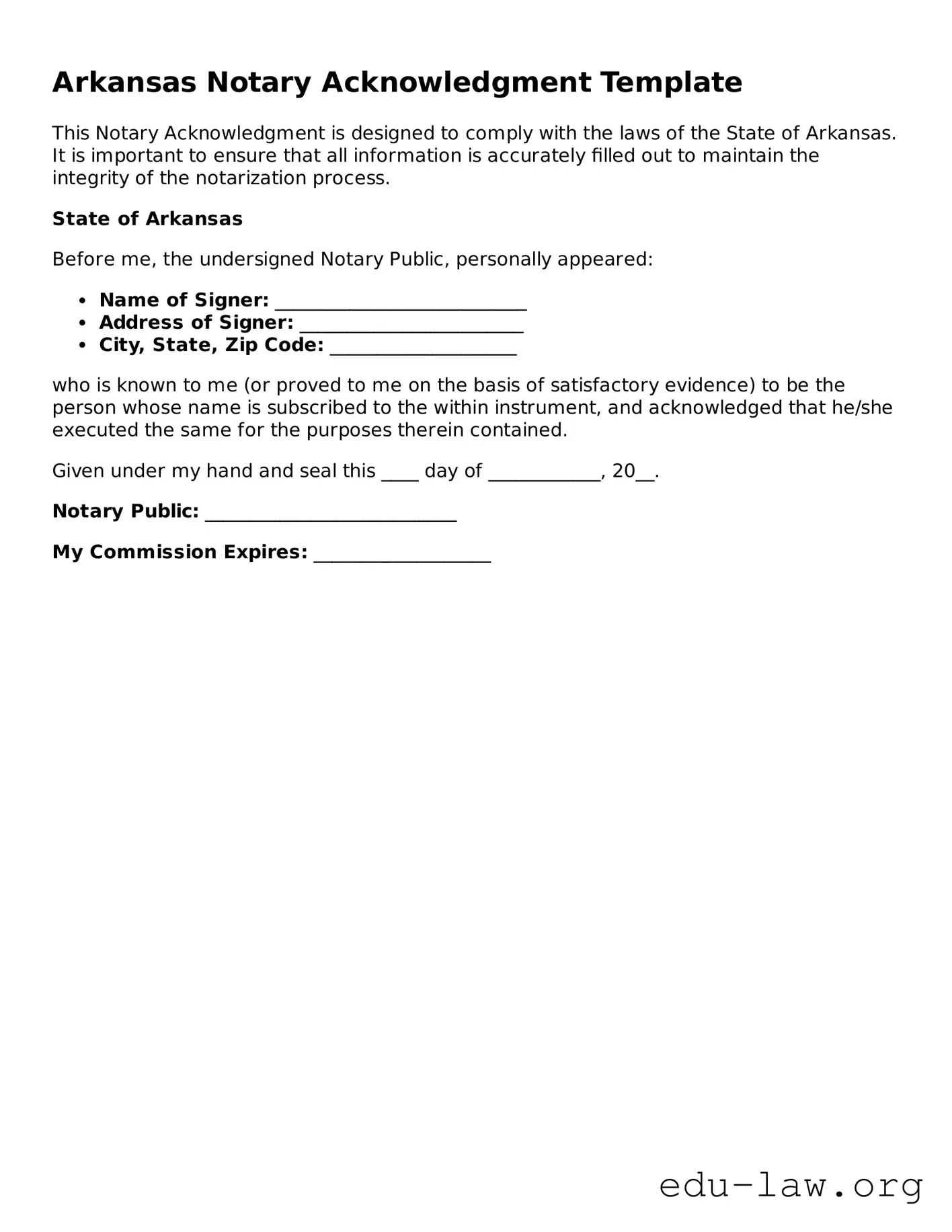
The Arkansas Notary Acknowledgment form plays a crucial role in the notarization process, ensuring that documents are legally recognized and properly executed. This form serves as a declaration by a notary public, affirming that the individual signing the document has done so voluntarily and is of sound mind. It includes essential details such as the name of the signer, the date of the acknowledgment, and the notary's signature and seal. By providing a clear record of the signing event, this form helps prevent fraud and misrepresentation. Understanding the components and requirements of the Arkansas Notary Acknowledgment form is vital for anyone involved in legal transactions, as it enhances the credibility of documents and protects the rights of all parties involved. Whether you are a signer, a notary, or a legal professional, familiarity with this form can streamline the notarization process and ensure compliance with state laws.
Arkansas Notary Acknowledgment Template
This Notary Acknowledgment is designed to comply with the laws of the State of Arkansas. It is important to ensure that all information is accurately filled out to maintain the integrity of the notarization process.
State of Arkansas
Before me, the undersigned Notary Public, personally appeared:
who is known to me (or proved to me on the basis of satisfactory evidence) to be the person whose name is subscribed to the within instrument, and acknowledged that he/she executed the same for the purposes therein contained.
Given under my hand and seal this ____ day of ____________, 20__.
Notary Public: ___________________________
My Commission Expires: ___________________
| Fact Name | Description |
|---|---|
| Purpose | The Arkansas Notary Acknowledgement form is used to verify the identity of the signer and confirm that they signed the document voluntarily. |
| Governing Law | This form is governed by the Arkansas Code Annotated, specifically Title 21, Chapter 14, which outlines the duties and powers of notaries public. |
| Signature Requirement | The signer must appear in person before the notary public and provide valid identification to complete the acknowledgement process. |
| Document Types | This form can be used for various documents, including deeds, contracts, and affidavits, where notarization is required. |
Once you have the Arkansas Notary Acknowledgement form in hand, you’re ready to fill it out. Follow these steps carefully to ensure that all required information is provided accurately.
What is an Arkansas Notary Acknowledgement form?
The Arkansas Notary Acknowledgement form is a legal document used to confirm that a signature on a document is authentic. It provides a way for a notary public to certify that they have witnessed the signing of the document by the individual whose signature appears on it. This form is commonly used in various transactions, including property deeds, contracts, and affidavits.
Who can act as a notary public in Arkansas?
In Arkansas, a notary public must be at least 18 years old, a resident of the state, and possess a high school diploma or its equivalent. They must also complete an application process, which includes a background check and obtaining a notary bond. Once appointed, notaries are authorized to perform notarial acts, including acknowledgements.
When is a Notary Acknowledgement form required?
A Notary Acknowledgement form is typically required when a document needs to be legally verified. This includes situations where the document will be recorded in public records or where legal rights may be affected. For example, if you are signing a deed to transfer property, a notary acknowledgment may be necessary to ensure the transaction is valid and enforceable.
How do I complete an Arkansas Notary Acknowledgement form?
To complete the form, the signer must appear before the notary public and provide valid identification. The notary will then ask the signer to acknowledge that they are signing the document voluntarily. After the acknowledgment, the notary will complete the form by filling in the necessary details, including the date, the signer's name, and their own signature and seal.
Is there a fee for notarization in Arkansas?
Yes, notaries in Arkansas are allowed to charge a fee for their services. The maximum fee for a standard notarization is set by state law. However, notaries can choose to waive this fee if they wish. It is advisable to discuss fees with the notary beforehand to avoid any misunderstandings.
Can a Notary Acknowledgement form be used for any document?
While a Notary Acknowledgement form can be used for many types of documents, it is important to ensure that the document is eligible for notarization. Certain legal documents, such as wills or some court documents, may have specific requirements. Always verify that the document you wish to notarize is appropriate for an acknowledgment to avoid any complications.
Failing to include the signer's name correctly. It is essential that the name matches the identification provided.
Not providing the date of the acknowledgment. This date is crucial for record-keeping and legal purposes.
Omitting the notary's signature. Without the notary's signature, the acknowledgment is invalid.
Forgetting to include the notary's seal. The seal serves as a verification of the notary's authority.
Using an incorrect format for the acknowledgment. Adhering to the specified format is necessary for acceptance.
Neglecting to confirm the capacity in which the signer is acting. This information is important for understanding the context of the signature.
The Arkansas Notary Acknowledgment form is an essential document used to verify the identity of individuals signing a document. It serves as proof that the signer appeared before a notary public and acknowledged their signature. However, this form is often accompanied by other important documents that facilitate various legal processes. Below is a list of forms and documents frequently used alongside the Arkansas Notary Acknowledgment form.
These documents, when used in conjunction with the Arkansas Notary Acknowledgment form, help ensure that legal transactions are carried out smoothly and with proper verification. Understanding the purpose of each form can simplify the process and promote clarity in legal matters.
The Arkansas Notary Acknowledgment form is similar to the Affidavit. An affidavit is a written statement confirmed by oath or affirmation, typically used as evidence in court. Both documents require the signature of the individual making the statement, as well as the notarization by a public official. The purpose of both is to verify the identity of the signer and ensure that the document is executed voluntarily and with an understanding of its contents.
Another document akin to the Notary Acknowledgment is the Power of Attorney. This legal document allows one person to act on behalf of another in legal or financial matters. Like the Notary Acknowledgment, a Power of Attorney must be signed by the principal and witnessed or notarized to confirm the identity and capacity of the individual granting authority. Both documents serve to protect the interests of the parties involved and provide a clear record of consent.
The Deed is also comparable to the Arkansas Notary Acknowledgment. A deed is a legal document that conveys ownership of real property. It requires the signature of the grantor, and notarization is often necessary to validate the transfer. The Notary Acknowledgment serves to affirm that the grantor willingly signed the deed, ensuring that the transaction is legitimate and binding.
Similarly, the Mortgage Document shares similarities with the Notary Acknowledgment. A mortgage is a legal agreement where a borrower pledges property as security for a loan. The borrower must sign the mortgage, and it is typically notarized to confirm the identity of the signer and the voluntary nature of the agreement. Both documents aim to establish clear, enforceable terms between the parties involved.
The Bill of Sale is another document that resembles the Notary Acknowledgment. A Bill of Sale transfers ownership of personal property from one party to another. It requires signatures from both the seller and the buyer, and notarization is often included to verify the identities of the parties and the authenticity of the transaction. This process helps prevent disputes over ownership and ensures clarity in the exchange.
The Certificate of Acknowledgment is closely related to the Notary Acknowledgment. This document is specifically used to certify that a person has appeared before a notary public and acknowledged their signature on another document. Both forms require the notary to verify the identity of the signer and confirm that they understand the document they are signing, providing an added layer of protection against fraud.
Another document that shares characteristics with the Notary Acknowledgment is the Trust Agreement. A Trust Agreement outlines the terms under which a trust is created and managed. It often requires notarization to ensure that the grantor's intentions are clear and that the document is executed with full understanding. Both documents emphasize the importance of consent and clarity in legal arrangements.
The Lease Agreement is also similar to the Notary Acknowledgment. A Lease Agreement outlines the terms under which one party rents property from another. While notarization is not always required, it can enhance the document's legitimacy. Both documents aim to protect the rights of the parties involved and ensure that all terms are clearly understood and agreed upon.
Finally, the Consent Form bears resemblance to the Notary Acknowledgment. A Consent Form is often used to obtain permission for various actions, such as medical procedures or participation in research studies. Like the Notary Acknowledgment, it requires the signature of the consenting party and may be notarized to confirm the individual's identity and willingness to agree to the terms outlined. Both documents serve to protect individuals by ensuring informed consent is obtained.
When filling out the Arkansas Notary Acknowledgement form, there are important steps to follow. Here’s a list of things you should and shouldn’t do:
Misconceptions about the Arkansas Notary Acknowledgment form can lead to confusion for those needing notary services. Here are seven common misunderstandings:
Notaries can certify copies of documents. Many people believe that notaries can certify copies of documents, but this is not always true. In Arkansas, a notary's primary function is to witness signatures, not to verify the authenticity of copies.
All notaries can perform the same functions. Notaries have different levels of authority based on their training and state laws. In Arkansas, some notaries may have additional training that allows them to perform specific tasks, while others may not.
The notary must know the signer personally. It is a common belief that a notary must personally know the individual signing the document. However, what matters is that the notary can verify the signer's identity through acceptable forms of identification.
Notaries can give legal advice. Some individuals think that notaries can provide legal advice or guidance on how to fill out documents. This is not the case; notaries are not authorized to offer legal counsel.
Signatures must be made in front of the notary. It is often assumed that signers must sign documents in the presence of the notary. While this is true for many situations, some documents allow for remote notarization, where the signing can occur online.
Notaries can refuse to notarize for any reason. While notaries have the right to refuse service, there are specific legal reasons for doing so. For example, if the signer appears to be under duress or cannot provide valid identification, a notary may refuse to proceed.
Notary acknowledgments are the same as notarized signatures. People often confuse notary acknowledgments with notarized signatures. A notary acknowledgment is a specific type of notarization that verifies the signer’s identity and their intent to sign the document.
Understanding these misconceptions can help individuals navigate the notary process more effectively in Arkansas.
When filling out and using the Arkansas Notary Acknowledgement form, consider the following key takeaways: