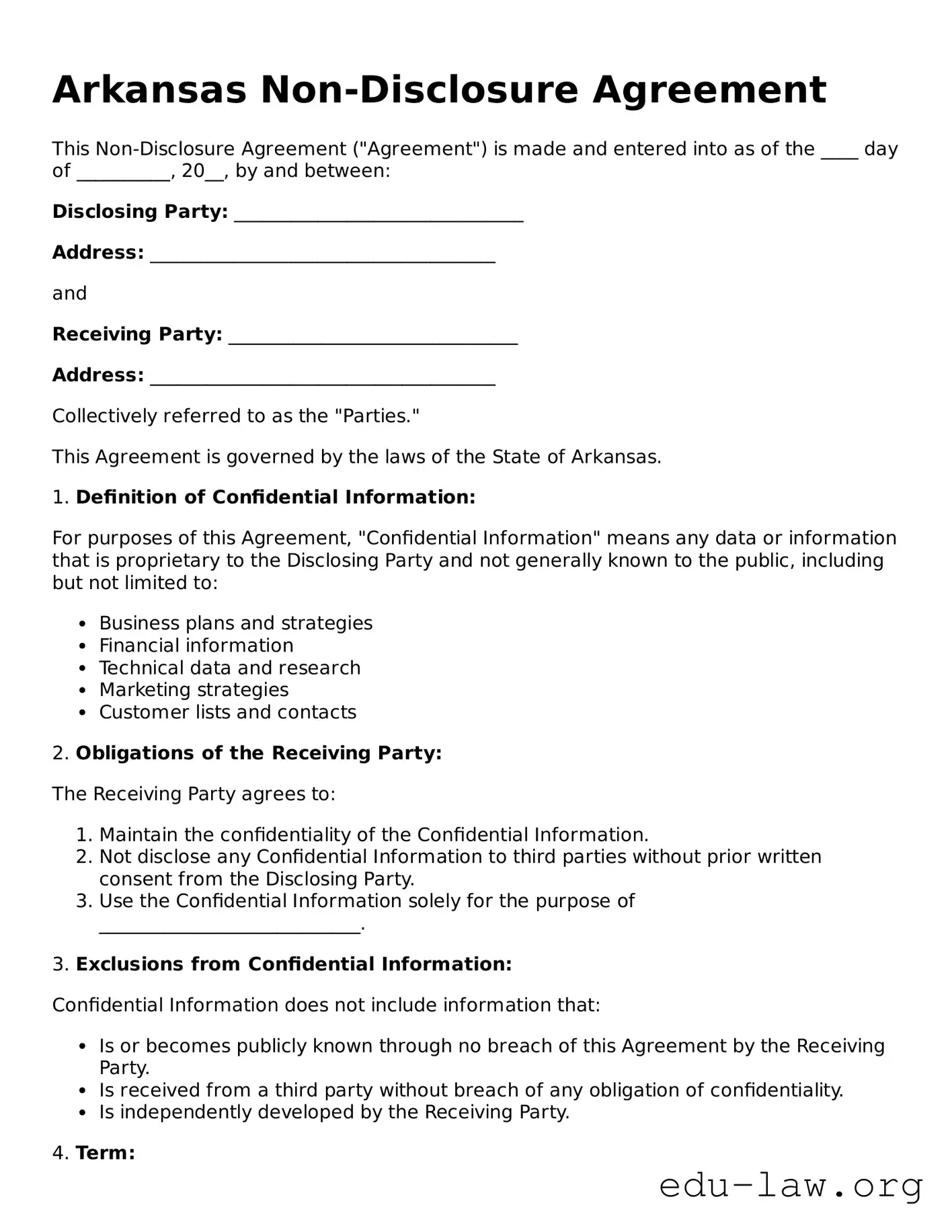
The Arkansas Non-disclosure Agreement (NDA) form serves as a vital tool for individuals and businesses seeking to protect sensitive information from unauthorized disclosure. This legally binding document outlines the terms under which confidential information can be shared, ensuring that all parties involved understand their obligations. Typically, the NDA includes essential components such as the definition of confidential information, the duration of the agreement, and the responsibilities of each party regarding the handling of sensitive data. Furthermore, it may specify the consequences for any breach of the agreement, thereby reinforcing the importance of confidentiality. By utilizing this form, parties can foster trust and collaboration while safeguarding proprietary information, trade secrets, and other critical data from potential misuse. Whether for business negotiations, employee relations, or partnerships, the Arkansas NDA is an indispensable resource for anyone looking to maintain confidentiality in their dealings.
Arkansas Non-Disclosure Agreement
This Non-Disclosure Agreement ("Agreement") is made and entered into as of the ____ day of __________, 20__, by and between:
Disclosing Party: _______________________________
Address: _____________________________________
and
Receiving Party: _______________________________
Address: _____________________________________
Collectively referred to as the "Parties."
This Agreement is governed by the laws of the State of Arkansas.
1. Definition of Confidential Information:
For purposes of this Agreement, "Confidential Information" means any data or information that is proprietary to the Disclosing Party and not generally known to the public, including but not limited to:
2. Obligations of the Receiving Party:
The Receiving Party agrees to:
3. Exclusions from Confidential Information:
Confidential Information does not include information that:
4. Term:
This Agreement shall commence on the date first written above and shall continue for a period of ____ years unless terminated earlier by either Party with ____ days written notice to the other Party.
5. Return of Materials:
Upon termination of this Agreement, the Receiving Party shall return or destroy all materials containing Confidential Information.
6. No License:
Nothing in this Agreement grants the Receiving Party any rights in or to the Confidential Information, except as expressly set forth herein.
7. Governing Law:
This Agreement shall be governed by and construed in accordance with the laws of the State of Arkansas.
IN WITNESS WHEREOF, the Parties have executed this Non-Disclosure Agreement as of the date first above written.
Disclosing Party Signature: ___________________________
Date: _______________
Receiving Party Signature: ___________________________
Date: _______________
| Fact Name | Details |
|---|---|
| Purpose | The Arkansas Non-disclosure Agreement (NDA) is designed to protect confidential information shared between parties. |
| Governing Law | This agreement is governed by the laws of the State of Arkansas. |
| Parties Involved | Typically, the NDA involves at least two parties: the disclosing party and the receiving party. |
| Duration | The duration of confidentiality can vary, but it is often specified in the agreement to ensure clarity. |
| Enforcement | If a breach occurs, the injured party may seek legal remedies, including injunctions or monetary damages. |
After obtaining the Arkansas Non-disclosure Agreement form, you will need to complete it accurately to ensure that all parties understand their obligations regarding confidentiality. This process involves filling out specific sections of the form with relevant information. Follow these steps to complete the form correctly.
What is a Non-disclosure Agreement (NDA) in Arkansas?
A Non-disclosure Agreement (NDA) is a legal contract that protects confidential information shared between parties. In Arkansas, it ensures that sensitive information, such as business secrets or proprietary data, is not disclosed to unauthorized individuals or entities.
Who typically uses an NDA?
NDAs are commonly used by businesses, employers, and contractors. They are essential when sharing confidential information during negotiations, partnerships, or employment relationships. Anyone who needs to protect sensitive information can benefit from an NDA.
What information can be protected under an NDA?
Confidential information can include trade secrets, business plans, customer lists, financial data, and any proprietary information that gives a business a competitive edge. The NDA should clearly define what constitutes confidential information.
How long does an NDA last in Arkansas?
The duration of an NDA can vary. Typically, the agreement will specify the length of time that the information must remain confidential. This period can range from a few years to indefinitely, depending on the nature of the information and the agreement between the parties.
Are NDAs enforceable in Arkansas?
Yes, NDAs are generally enforceable in Arkansas, provided they meet certain legal requirements. The agreement must be clear, reasonable, and not overly broad. Courts will enforce NDAs as long as they protect legitimate business interests.
What happens if someone breaches an NDA?
If a party breaches an NDA, the other party may seek legal remedies. This can include monetary damages, injunctive relief to prevent further disclosures, or both. The specific consequences should be outlined in the NDA itself.
Can an NDA be modified after it is signed?
Yes, an NDA can be modified, but both parties must agree to the changes. It is advisable to document any modifications in writing and have both parties sign the updated agreement to ensure clarity and enforceability.
Do I need a lawyer to create an NDA?
While it is possible to create an NDA without legal assistance, consulting with a lawyer is recommended. A legal professional can ensure that the NDA meets all legal requirements and adequately protects your interests.
Can an NDA be used for personal relationships?
Yes, NDAs can be used in personal relationships, particularly when sensitive information is shared, such as in business partnerships or when discussing private matters. However, the enforceability may vary based on the context and the nature of the relationship.
Is there a standard NDA template for Arkansas?
While there are standard NDA templates available, it is important to customize any template to fit the specific needs of the parties involved. Tailoring the agreement ensures that it addresses all relevant concerns and complies with Arkansas law.
Failing to clearly define confidential information. It's crucial to specify what information is considered confidential. Vague descriptions can lead to misunderstandings.
Not including the duration of confidentiality. The agreement should state how long the information must remain confidential. Omitting this detail can create uncertainty.
Neglecting to identify all parties involved. Ensure that all individuals or entities that will be bound by the agreement are clearly listed. Missing a party can weaken the agreement.
Using overly complex language. The agreement should be easy to understand. Complicated terms can confuse the parties and lead to misinterpretations.
Not including exceptions to confidentiality. It's important to outline situations where disclosure is permissible. Without these exceptions, the agreement may be too restrictive.
Forgetting to sign and date the agreement. An unsigned agreement is not legally binding. Both parties must provide their signatures and the date to validate the document.
Overlooking local laws and regulations. Each state may have specific requirements for non-disclosure agreements. Failing to comply with Arkansas laws can invalidate the agreement.
A Non-disclosure Agreement (NDA) is an essential document for protecting confidential information. In Arkansas, it is often accompanied by other forms and documents that help clarify the terms and conditions of confidentiality. Below is a list of commonly used documents that complement the NDA.
Using these documents alongside the Arkansas Non-disclosure Agreement can provide a comprehensive approach to protecting sensitive information. Each document plays a unique role in ensuring clarity and security in business relationships.
The Arkansas Non-Disclosure Agreement (NDA) shares similarities with the Confidentiality Agreement. Both documents are designed to protect sensitive information shared between parties. They outline the obligations of the receiving party to keep the disclosed information confidential and specify the duration of the confidentiality obligation. The primary difference lies in the context of use; while NDAs often pertain to business relationships, Confidentiality Agreements can be broader and apply to various situations, including personal matters.
Another document akin to the Arkansas NDA is the Non-Circumvention Agreement. This type of agreement is used to prevent one party from bypassing another to engage directly with a third party. Like the NDA, it aims to protect the interests of the disclosing party. Both documents emphasize trust and the importance of maintaining professional relationships, though the Non-Circumvention Agreement focuses more on preventing direct dealings that could undermine the original agreement.
The Mutual Non-Disclosure Agreement is also similar to the Arkansas NDA, but with a notable distinction. In a Mutual NDA, both parties agree to protect each other's confidential information. This reciprocal nature fosters a balanced relationship and encourages open communication. In contrast, a standard NDA typically involves one party disclosing information while the other party agrees to keep it confidential.
The Proprietary Information Agreement is another document that aligns closely with the Arkansas NDA. This agreement specifically addresses the protection of proprietary information, which is often a subset of confidential information. It defines what constitutes proprietary information and establishes the obligations of the parties involved. The focus on proprietary information makes it particularly relevant in industries where intellectual property is a key concern.
The Employment Non-Disclosure Agreement is particularly relevant in the context of employee-employer relationships. This document ensures that employees do not disclose sensitive company information during or after their employment. Similar to the Arkansas NDA, it outlines the specific information deemed confidential and the consequences of unauthorized disclosure, emphasizing the importance of trust in the workplace.
A License Agreement may also bear similarities to the Arkansas NDA, especially when it includes confidentiality clauses. License Agreements grant permission to use certain intellectual property while often requiring the receiving party to keep the terms and any shared information confidential. Both documents emphasize the protection of proprietary information, though License Agreements typically involve the use of that information rather than just its disclosure.
The Service Agreement can also be compared to the Arkansas NDA when it includes confidentiality provisions. In service agreements, businesses often share sensitive information with service providers. These clauses serve to protect that information, similar to the way an NDA would. While the primary focus of a Service Agreement is the terms of service, the confidentiality aspect ensures that sensitive information remains protected throughout the relationship.
The Joint Venture Agreement is another document that may incorporate elements similar to the Arkansas NDA. When two or more parties collaborate on a project, they often share confidential information. This agreement typically includes confidentiality provisions to protect each party's interests. The shared goal of collaboration necessitates trust, making the confidentiality aspect crucial to the success of the venture.
Lastly, the Partnership Agreement may also contain confidentiality clauses akin to those found in the Arkansas NDA. In partnerships, parties often share sensitive business information, and a confidentiality clause helps safeguard that information. Both documents underscore the importance of trust and cooperation among partners, ensuring that sensitive information is not disclosed to outside parties.
When filling out the Arkansas Non-disclosure Agreement form, it’s important to follow certain guidelines to ensure that the document is completed correctly. Here’s a list of things you should and shouldn’t do:
There are several misconceptions about the Arkansas Non-disclosure Agreement (NDA) form that can lead to confusion. Understanding these can help ensure that individuals and businesses use NDAs effectively.
Understanding the Arkansas Non-disclosure Agreement (NDA) form is essential for protecting sensitive information. Here are key takeaways to consider: