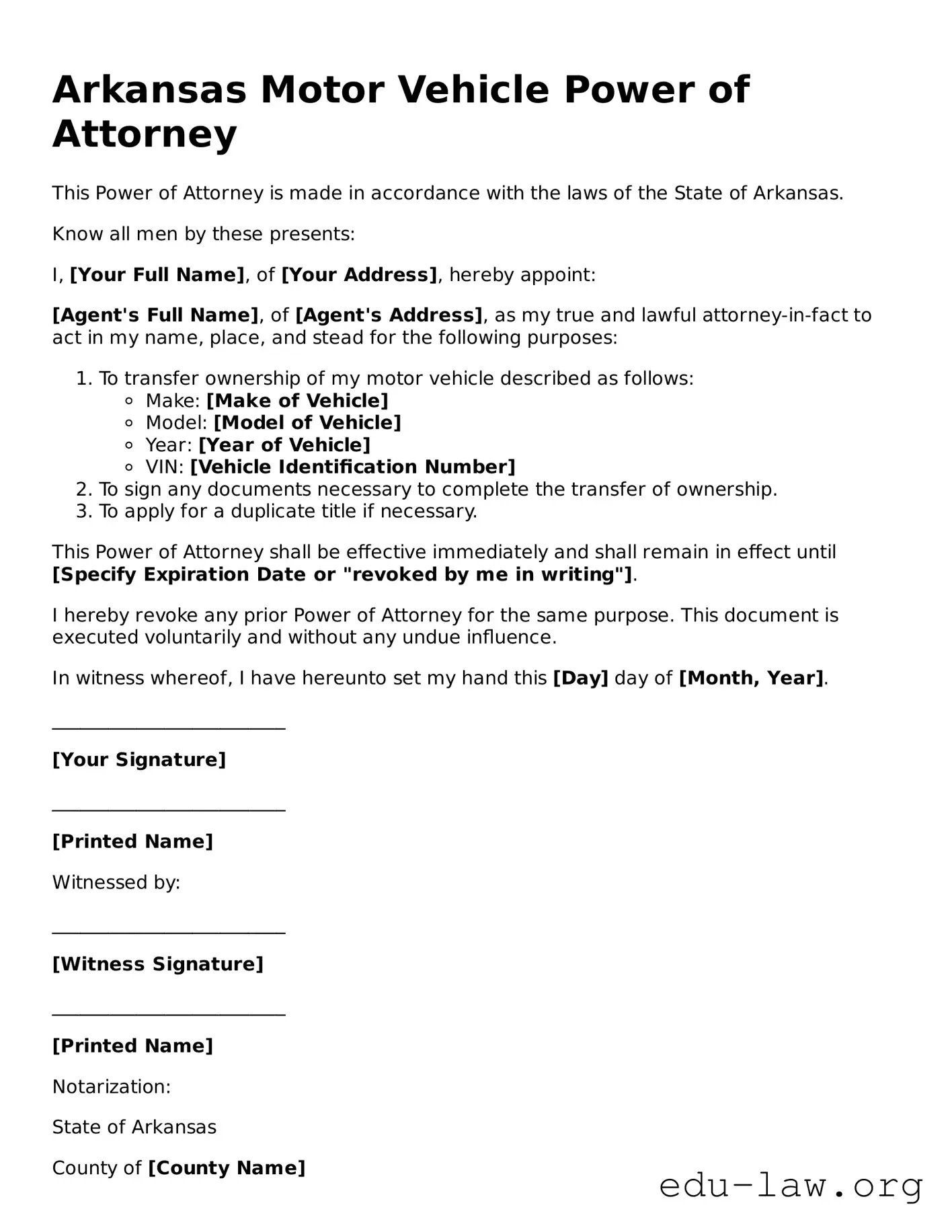
The Arkansas Motor Vehicle Power of Attorney form is a crucial document for anyone looking to manage vehicle-related transactions on behalf of another individual. This form empowers a designated agent to perform various tasks, such as transferring ownership, registering a vehicle, or obtaining title documents. By granting this authority, the vehicle owner can ensure that their interests are represented, even if they are unable to handle these matters personally. It's important to note that the form requires specific information, including the names and addresses of both the principal and the agent, as well as details about the vehicle in question. Additionally, the document must be signed and dated to be valid, and it may need to be notarized, depending on the circumstances. Understanding the ins and outs of this form can simplify the process of managing vehicle transactions, making it an essential tool for both individuals and businesses in Arkansas.
Arkansas Motor Vehicle Power of Attorney
This Power of Attorney is made in accordance with the laws of the State of Arkansas.
Know all men by these presents:
I, [Your Full Name], of [Your Address], hereby appoint:
[Agent's Full Name], of [Agent's Address], as my true and lawful attorney-in-fact to act in my name, place, and stead for the following purposes:
This Power of Attorney shall be effective immediately and shall remain in effect until [Specify Expiration Date or "revoked by me in writing"].
I hereby revoke any prior Power of Attorney for the same purpose. This document is executed voluntarily and without any undue influence.
In witness whereof, I have hereunto set my hand this [Day] day of [Month, Year].
_________________________
[Your Signature]
_________________________
[Printed Name]
Witnessed by:
_________________________
[Witness Signature]
_________________________
[Printed Name]
Notarization:
State of Arkansas
County of [County Name]
Subscribed and sworn before me this [Day] day of [Month, Year].
_________________________
[Notary Public Signature]
My Commission Expires: [Expiration Date]
| Fact Name | Description |
|---|---|
| Purpose | The Arkansas Motor Vehicle Power of Attorney form allows an individual to designate another person to act on their behalf regarding motor vehicle transactions. |
| Governing Law | This form is governed by the Arkansas Code Annotated § 27-14-101 et seq., which outlines the regulations for motor vehicle transactions in the state. |
| Signatures Required | Both the principal (the person granting power) and the agent (the person receiving power) must sign the form to validate it. |
| Notarization | Notarization is recommended but not mandatory for the form to be effective in most situations. |
| Revocation | The principal can revoke the power of attorney at any time, provided they do so in writing and notify the agent. |
| Use Cases | This form is commonly used for tasks such as transferring vehicle titles, registering vehicles, and handling insurance matters. |
| Validity | The power of attorney remains valid until the principal revokes it or passes away, whichever occurs first. |
Filling out the Arkansas Motor Vehicle Power of Attorney form is a straightforward process. Once completed, this form will allow you to designate someone to act on your behalf regarding motor vehicle matters. Follow the steps below to ensure accurate completion.
After filling out the form, submit it to the appropriate authority, such as the DMV, along with any required documentation. Ensure that your Agent has a copy to facilitate any transactions related to the motor vehicle.
What is a Motor Vehicle Power of Attorney in Arkansas?
A Motor Vehicle Power of Attorney (POA) in Arkansas is a legal document that allows one person, known as the "principal," to appoint another person, called the "agent," to handle specific tasks related to motor vehicles on their behalf. This can include signing documents, transferring titles, or registering vehicles. The POA is particularly useful when the principal is unable to manage these tasks due to being out of state, illness, or other reasons.
How do I complete the Arkansas Motor Vehicle Power of Attorney form?
To complete the form, you’ll need to provide some basic information about both the principal and the agent. This includes names, addresses, and contact details. You will also need to specify the powers you are granting to the agent. After filling out the form, both parties must sign it. It’s a good idea to have the signatures notarized to ensure the document is legally binding and to avoid any potential disputes later on.
Do I need to have the Motor Vehicle Power of Attorney notarized?
While notarization is not strictly required for the Motor Vehicle Power of Attorney to be valid in Arkansas, it is highly recommended. Having the document notarized adds an extra layer of authenticity and can help prevent challenges to its validity. It also ensures that all parties involved understand the powers being granted and that the document is executed properly.
Can I revoke a Motor Vehicle Power of Attorney in Arkansas?
Yes, you can revoke a Motor Vehicle Power of Attorney at any time, as long as you are mentally competent. To do this, you should create a written notice of revocation and provide it to the agent and any relevant parties, such as the Department of Motor Vehicles. It’s important to keep a record of the revocation to avoid any confusion in the future.
What happens if the principal becomes incapacitated?
If the principal becomes incapacitated, the Motor Vehicle Power of Attorney generally remains valid unless it was specifically stated that it would terminate upon incapacity. However, if the principal has not granted durable powers in the document, the agent may lose their authority to act on behalf of the principal. It’s crucial to consider including durable provisions in the POA if you want it to remain effective during periods of incapacity.
Failing to provide accurate personal information. It’s essential to include correct names, addresses, and contact details for both the principal and the agent.
Not specifying the powers granted. Clearly outline what authority the agent has over the vehicle to avoid confusion later.
Overlooking the need for signatures. Both the principal and the agent must sign the form for it to be valid.
Neglecting to date the form. A date is crucial as it indicates when the powers were granted.
Using outdated forms. Always ensure that you are using the most current version of the Power of Attorney form.
Failing to notarize the document when required. Some situations may necessitate notarization to enhance its legal standing.
Not providing sufficient details about the vehicle. Include the vehicle identification number (VIN) and other relevant information to avoid ambiguity.
Leaving sections blank. Every applicable section should be filled out completely to prevent any misunderstandings.
Ignoring state-specific requirements. Familiarize yourself with Arkansas laws regarding Power of Attorney for motor vehicles to ensure compliance.
Not keeping a copy of the completed form. Retaining a copy for personal records is essential in case of future disputes or questions.
When dealing with vehicle transactions in Arkansas, several forms may accompany the Motor Vehicle Power of Attorney. Each of these documents serves a specific purpose and can help streamline the process. Below is a list of commonly used forms that you might encounter.
Having these forms ready can simplify your vehicle transactions and ensure compliance with state regulations. Each document plays a vital role in the process, making it essential to understand their purposes and requirements.
The Arkansas Motor Vehicle Power of Attorney form shares similarities with the General Power of Attorney. Both documents allow one person to designate another to act on their behalf. In the case of the General Power of Attorney, the authority can extend to various matters, including financial and legal decisions. However, the Motor Vehicle Power of Attorney is more specialized, focusing specifically on vehicle-related transactions such as registration, title transfers, and other motor vehicle matters. This specificity makes it a useful tool for vehicle owners who need someone else to handle their car-related affairs.
Another document that resembles the Arkansas Motor Vehicle Power of Attorney is the Limited Power of Attorney. This form is also used to grant authority to another person, but it is typically restricted to specific tasks or a defined period. For example, if someone needs assistance with selling a vehicle but does not want to give away broader powers, a Limited Power of Attorney would be appropriate. Like the Motor Vehicle Power of Attorney, it ensures that the designated person can perform necessary actions without overstepping boundaries.
The Vehicle Title Application is another relevant document. While not a power of attorney in itself, it is often used in conjunction with the Motor Vehicle Power of Attorney. When someone is unable to attend the DMV to apply for a vehicle title, the Power of Attorney allows a designated person to submit the application on their behalf. This collaboration simplifies the process of obtaining a vehicle title, ensuring that all necessary paperwork is completed efficiently.
Similar to the Motor Vehicle Power of Attorney is the Healthcare Power of Attorney. While the latter pertains to medical decisions, both documents serve the purpose of allowing someone to act in another person's best interest. In situations where a vehicle owner may be incapacitated, the Motor Vehicle Power of Attorney ensures that someone can manage their vehicle-related affairs. This parallel highlights the importance of having trusted individuals who can step in when needed.
The Bill of Sale is another document that often comes into play during vehicle transactions. While it is not a power of attorney, it can be executed alongside the Motor Vehicle Power of Attorney. A Bill of Sale acts as proof of the sale of a vehicle, detailing the buyer, seller, and terms of the transaction. When combined with the Power of Attorney, it allows the designated person to complete the sale process smoothly, ensuring all legal requirements are met.
The Affidavit of Heirship can also be compared to the Motor Vehicle Power of Attorney. This document is used to establish the rightful ownership of property, including vehicles, after the death of the owner. When someone passes away, the heirs may need to transfer the title of the vehicle. The Motor Vehicle Power of Attorney, in this context, allows a designated person to handle the transfer process, making it easier for heirs to manage their loved one's estate.
The DMV Release of Liability form is another document that complements the Motor Vehicle Power of Attorney. This form notifies the Department of Motor Vehicles that a vehicle has been sold or transferred. When someone uses the Power of Attorney to sell a vehicle, completing the Release of Liability ensures that the original owner is no longer responsible for any incidents involving that vehicle. This protects the seller from future liabilities and clarifies ownership for the new buyer.
Lastly, the Vehicle Registration Renewal form shares a connection with the Motor Vehicle Power of Attorney. When someone is unable to renew their vehicle registration in person, they can use the Power of Attorney to authorize another individual to complete the process on their behalf. This ensures that the vehicle remains legally registered without requiring the owner to be physically present, thus streamlining the renewal process.
When filling out the Arkansas Motor Vehicle Power of Attorney form, it's important to ensure accuracy and completeness. Here are some guidelines to help you navigate the process smoothly.
Following these steps will help ensure that your form is completed correctly and processed without delay. Take your time, and don't hesitate to ask for assistance if needed.
Understanding the Arkansas Motor Vehicle Power of Attorney form can be tricky, especially with the many misconceptions floating around. Here are five common misunderstandings that people often have:
By clearing up these misconceptions, individuals can better navigate the process of using the Arkansas Motor Vehicle Power of Attorney form. Understanding its true purpose and limitations is key to making informed decisions.
When dealing with the Arkansas Motor Vehicle Power of Attorney form, it's important to understand its purpose and how to use it effectively. Here are some key takeaways:
Understanding these points will help ensure that you fill out and use the form correctly, making the process smoother for everyone involved.