Creating a Last Will and Testament is an essential step in ensuring that your wishes are honored after your passing. In Arkansas, this legal document serves several important functions. It allows you to specify how your assets will be distributed among your beneficiaries, ensuring that your loved ones receive what you intend for them. The form typically includes sections for naming an executor, who will oversee the distribution of your estate, and for appointing guardians for any minor children you may have. Additionally, you can include provisions for debts and taxes, providing clarity on how these obligations should be handled. Understanding the Arkansas Last Will and Testament form is crucial, as it can help prevent disputes among family members and ensure that your final wishes are respected. Taking the time to fill out this form correctly can bring peace of mind to you and your family.
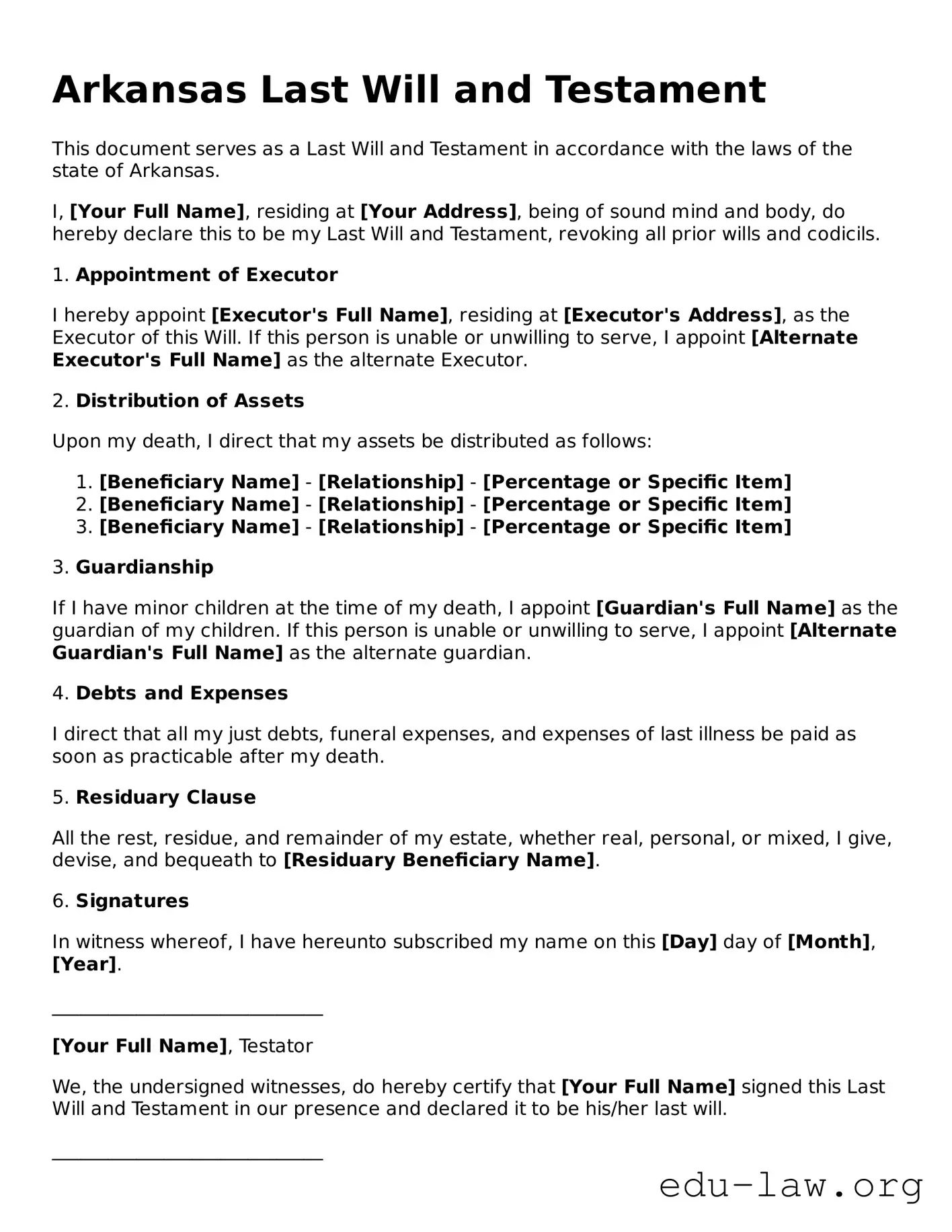
Arkansas Last Will and Testament
This document serves as a Last Will and Testament in accordance with the laws of the state of Arkansas.
I, [Your Full Name], residing at [Your Address], being of sound mind and body, do hereby declare this to be my Last Will and Testament, revoking all prior wills and codicils.
1. Appointment of Executor
I hereby appoint [Executor's Full Name], residing at [Executor's Address], as the Executor of this Will. If this person is unable or unwilling to serve, I appoint [Alternate Executor's Full Name] as the alternate Executor.
2. Distribution of Assets
Upon my death, I direct that my assets be distributed as follows:
3. Guardianship
If I have minor children at the time of my death, I appoint [Guardian's Full Name] as the guardian of my children. If this person is unable or unwilling to serve, I appoint [Alternate Guardian's Full Name] as the alternate guardian.
4. Debts and Expenses
I direct that all my just debts, funeral expenses, and expenses of last illness be paid as soon as practicable after my death.
5. Residuary Clause
All the rest, residue, and remainder of my estate, whether real, personal, or mixed, I give, devise, and bequeath to [Residuary Beneficiary Name].
6. Signatures
In witness whereof, I have hereunto subscribed my name on this [Day] day of [Month], [Year].
_____________________________
[Your Full Name], Testator
We, the undersigned witnesses, do hereby certify that [Your Full Name] signed this Last Will and Testament in our presence and declared it to be his/her last will.
_____________________________
[Witness 1 Full Name], Witness
_____________________________
[Witness 2 Full Name], Witness
| Fact Name | Description |
|---|---|
| Governing Law | The Arkansas Last Will and Testament form is governed by the Arkansas Probate Code, specifically Ark. Code Ann. § 28-40-101 et seq. |
| Age Requirement | Individuals must be at least 18 years old to create a valid will in Arkansas. |
| Testamentary Capacity | The person creating the will must be of sound mind and capable of understanding the implications of their decisions. |
| Written Document | The will must be in writing. Oral wills are not recognized in Arkansas. |
| Signature Requirement | The testator must sign the will at the end of the document. If unable to sign, they may direct someone else to sign on their behalf in their presence. |
| Witnesses | At least two witnesses must sign the will, affirming that they witnessed the testator's signature. |
| Self-Proving Wills | Arkansas allows for self-proving wills, which can simplify the probate process. This requires the testator and witnesses to sign an affidavit in front of a notary. |
| Revocation | A will can be revoked by creating a new will or by physically destroying the existing will with the intent to revoke it. |
| Holographic Wills | Holographic wills, which are handwritten and signed by the testator, are recognized in Arkansas but must meet specific criteria. |
| Filing Requirement | While it is not required to file a will during the testator's lifetime, it must be filed with the probate court after their death. |
After gathering the necessary information, you are ready to complete the Arkansas Last Will and Testament form. This document will serve as a clear expression of your wishes regarding the distribution of your assets and the care of any dependents after your passing.
Once you have completed the form, ensure that it is stored in a safe place and that your executor and beneficiaries know where to find it. This will help avoid confusion and ensure that your wishes are honored. It is advisable to review the document periodically and make updates as needed.
What is a Last Will and Testament in Arkansas?
A Last Will and Testament is a legal document that outlines how a person's assets and affairs should be handled after their death. In Arkansas, this document allows individuals to specify who will inherit their property, appoint guardians for minor children, and designate an executor to manage the estate. It ensures that your wishes are honored and provides clarity for your loved ones during a difficult time.
Who can create a Last Will and Testament in Arkansas?
In Arkansas, any person who is at least 18 years old and of sound mind can create a Last Will and Testament. This means you must be capable of understanding the implications of your decisions. If you are under 18, you may still create a will if you are legally emancipated or if you are a member of the armed forces.
Does a Last Will and Testament need to be notarized in Arkansas?
While it is not required for a Last Will and Testament to be notarized in Arkansas, doing so can provide an additional layer of validity. A notarized will is often easier to prove in court, should any disputes arise. However, the will must be signed by at least two witnesses who are not beneficiaries to be considered valid.
What happens if someone dies without a will in Arkansas?
If a person dies without a will, they are said to have died "intestate." In this case, Arkansas law determines how their assets will be distributed. Generally, the estate will go to the deceased's closest relatives, such as a spouse, children, or parents. This process can be lengthy and may not reflect the deceased's wishes, which is why having a will is important.
Can I change my Last Will and Testament once it’s created?
Yes, you can change your Last Will and Testament at any time as long as you are of sound mind. This is often done through a document called a codicil, which allows you to make specific changes without rewriting the entire will. Alternatively, you can create a new will that revokes the previous one. It's essential to ensure that any changes are made following Arkansas law to maintain the will's validity.
What should I include in my Last Will and Testament?
Your Last Will and Testament should include several key elements. Start with your personal information, such as your name and address. Clearly identify your beneficiaries and specify what each will receive. If you have minor children, designate a guardian for them. Additionally, appoint an executor who will manage your estate and ensure that your wishes are carried out. Including a clause that revokes any previous wills is also advisable.
How is a Last Will and Testament executed in Arkansas?
To execute a Last Will and Testament in Arkansas, you must sign the document in the presence of at least two witnesses. These witnesses must also sign the will, confirming that they witnessed your signature. It’s important that the witnesses are not beneficiaries of the will, as this could lead to complications during probate. Once executed, the will should be stored safely, but it does not need to be filed with the court until after your death.
What is the probate process for a Last Will and Testament in Arkansas?
The probate process is the legal procedure through which a deceased person's will is validated and their estate is settled. In Arkansas, the executor named in the will will file the will with the probate court. The court will then oversee the administration of the estate, ensuring that debts are paid and assets are distributed according to the will. This process can take several months to complete, depending on the complexity of the estate and any potential disputes among beneficiaries.
Not including all necessary information. It’s crucial to provide complete details about yourself, your beneficiaries, and your assets.
Failing to properly sign the document. In Arkansas, your will must be signed by you and witnessed by two individuals who are not beneficiaries.
Using outdated or incorrect forms. Always ensure you have the most current version of the Last Will and Testament form.
Not specifying alternate beneficiaries. In case a primary beneficiary cannot inherit, having alternatives ensures your wishes are honored.
Neglecting to date the will. A date helps establish the document's validity and can clarify your intentions over time.
Overlooking the need for a self-proving affidavit. Including this can simplify the probate process.
Using vague language. Clear and precise wording prevents misunderstandings regarding your wishes.
Not updating the will after major life changes. Changes such as marriage, divorce, or the birth of children should prompt a review and possible revision of your will.
Ignoring state-specific requirements. Each state has its own laws regarding wills. Familiarity with Arkansas laws is essential for a valid will.
When preparing a Last Will and Testament in Arkansas, several additional forms and documents may be beneficial to ensure comprehensive estate planning. Each of these documents serves a specific purpose and can help clarify intentions, manage assets, or designate responsibilities.
Incorporating these documents into estate planning can provide clarity and peace of mind. Each form plays a vital role in ensuring that an individual's wishes are respected and that their loved ones are supported during difficult times.
The Arkansas Last Will and Testament form shares similarities with a Living Will. A Living Will is a legal document that outlines a person's preferences regarding medical treatment in the event they become incapacitated. While a Last Will primarily deals with the distribution of assets after death, a Living Will focuses on healthcare decisions during a person's life. Both documents reflect an individual's wishes and can provide clarity to family members and healthcare providers, ensuring that personal values and preferences are respected in critical situations.
Another document akin to the Arkansas Last Will and Testament is the Durable Power of Attorney. This document grants someone the authority to make financial or legal decisions on behalf of another individual if they become unable to do so themselves. Similar to a Last Will, the Durable Power of Attorney serves to ensure that a person's wishes are honored, but it operates during their lifetime rather than after death. Both documents require careful consideration of whom to appoint and how decisions will be made.
The Arkansas Last Will and Testament also resembles a Revocable Living Trust. This trust allows individuals to manage their assets during their lifetime and specifies how those assets will be distributed after death. Like a Last Will, a Revocable Living Trust can help avoid probate, but it also offers the advantage of maintaining privacy regarding asset distribution. Both documents can work in tandem to provide comprehensive estate planning, ensuring that an individual's intentions are carried out effectively.
A Health Care Proxy is another document that shares similarities with a Last Will. This document designates someone to make healthcare decisions on behalf of an individual if they are unable to communicate their wishes. While a Last Will addresses asset distribution, a Health Care Proxy focuses on medical decisions. Both documents emphasize the importance of having trusted individuals in place to carry out one’s wishes, whether in financial matters or health-related scenarios.
The Arkansas Last Will and Testament is also comparable to a Codicil. A Codicil is an amendment or addition to an existing will that allows individuals to make changes without creating an entirely new document. This is similar to how a Last Will can be updated to reflect changes in personal circumstances or preferences. Both documents serve to clarify an individual's intentions and ensure that their estate plan remains relevant over time.
Additionally, the Arkansas Last Will and Testament can be likened to a Letter of Intent. While not a legally binding document, a Letter of Intent provides guidance to executors and beneficiaries regarding an individual's wishes and desires. It can accompany a Last Will to clarify specific intentions or provide additional context. Both documents aim to communicate an individual's preferences clearly, aiding in the administration of their estate.
The Affidavit of Heirship also shares some characteristics with the Last Will. This document is used to establish the heirs of a deceased person when no will exists. While a Last Will explicitly outlines who receives assets, an Affidavit of Heirship provides a legal declaration of who the heirs are. Both documents play crucial roles in determining how an estate is settled, ensuring that rightful heirs are recognized and assets are distributed accordingly.
Another similar document is the Testamentary Trust. This trust is created through a Last Will and Testament and takes effect upon the individual's death. It allows for the management of assets on behalf of beneficiaries, particularly minors or those who may not be capable of managing their inheritance. Like a Last Will, a Testamentary Trust provides a framework for asset distribution, but it also incorporates ongoing management of those assets, ensuring that they are used appropriately over time.
Finally, the Arkansas Last Will and Testament is akin to a Prenuptial Agreement. While primarily associated with marriage, a Prenuptial Agreement outlines how assets will be handled in the event of a divorce or separation. Both documents involve careful consideration of asset distribution and can help prevent disputes among family members. They serve to clarify intentions and protect individual interests, ensuring that personal wishes are respected under various circumstances.
When filling out the Arkansas Last Will and Testament form, it is important to follow certain guidelines to ensure that your wishes are clearly expressed and legally valid. Here are some things you should and shouldn't do:
By following these guidelines, you can create a clear and effective Last Will and Testament that reflects your wishes and protects your loved ones.
Understanding the Arkansas Last Will and Testament form is crucial for anyone looking to ensure their wishes are respected after their passing. Unfortunately, several misconceptions can lead to confusion and potential legal issues. Below is a list of common misunderstandings surrounding this important document.
Addressing these misconceptions is vital. Taking the time to understand the nuances of the Arkansas Last Will and Testament form can help individuals make informed decisions about their estate planning. Ensuring that your wishes are clearly documented and legally recognized is essential for peace of mind.
When creating a Last Will and Testament in Arkansas, there are several important points to keep in mind. Understanding these can help ensure that your wishes are clearly communicated and legally recognized.
By following these guidelines, individuals can create a Last Will and Testament that accurately reflects their wishes and meets Arkansas legal requirements.