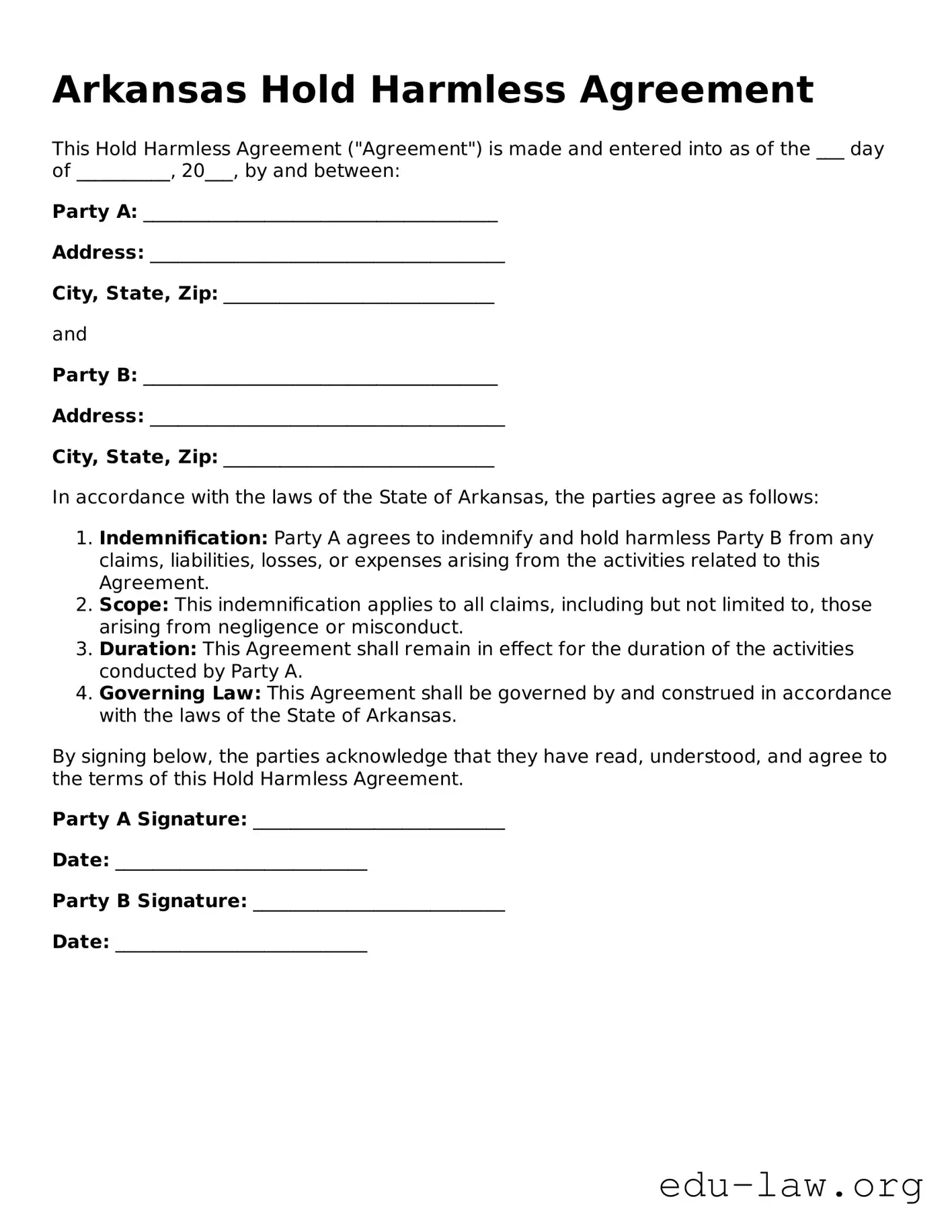
The Arkansas Hold Harmless Agreement form serves as a crucial legal tool designed to protect individuals and organizations from liability in various situations. This agreement outlines the responsibilities of parties involved in activities where risks may be present, such as events, construction projects, or recreational activities. By signing this document, one party agrees to assume all risks associated with the activity and absolves the other party of any legal claims that may arise from accidents or injuries. Key components of the form include clear definitions of the parties involved, a detailed description of the activities covered, and specific clauses that address the extent of liability. Furthermore, it often requires signatures and dates to ensure that all parties acknowledge their understanding and acceptance of the terms. Utilizing this form can provide peace of mind, fostering a safer environment for all participants while clarifying the expectations and responsibilities of each party. Understanding the nuances of the Arkansas Hold Harmless Agreement is essential for anyone looking to engage in activities that carry inherent risks.
Arkansas Hold Harmless Agreement
This Hold Harmless Agreement ("Agreement") is made and entered into as of the ___ day of __________, 20___, by and between:
Party A: ______________________________________
Address: ______________________________________
City, State, Zip: _____________________________
and
Party B: ______________________________________
Address: ______________________________________
City, State, Zip: _____________________________
In accordance with the laws of the State of Arkansas, the parties agree as follows:
By signing below, the parties acknowledge that they have read, understood, and agree to the terms of this Hold Harmless Agreement.
Party A Signature: ___________________________
Date: ___________________________
Party B Signature: ___________________________
Date: ___________________________
| Fact Name | Details |
|---|---|
| Definition | The Arkansas Hold Harmless Agreement is a legal document that protects one party from liability for any damages or injuries that may occur during an event or activity. |
| Purpose | This agreement is commonly used to ensure that one party does not hold another party responsible for accidents or incidents. |
| Common Use | It is often used in events like sports activities, community gatherings, or when renting facilities. |
| Governing Law | The agreement is governed by the laws of the State of Arkansas. |
| Parties Involved | Typically, the agreement involves at least two parties: the indemnitor (the party being held harmless) and the indemnitee (the party providing the protection). |
| Legal Enforceability | For the agreement to be enforceable, it must be clear, specific, and voluntarily signed by both parties. |
| Limitations | Some limitations may apply, especially regarding gross negligence or willful misconduct, which may not be covered. |
| Duration | The duration of the hold harmless provision should be clearly stated in the agreement. |
| Modification | Any changes to the agreement must be made in writing and signed by both parties to be valid. |
| Importance | Having a Hold Harmless Agreement can significantly reduce legal risks and liabilities for event organizers and property owners. |
Once you have the Arkansas Hold Harmless Agreement form in front of you, it’s important to fill it out carefully. This will ensure that all necessary information is provided accurately. Follow these steps to complete the form correctly.
After completing the form, ensure that all information is correct. You may need to keep a copy for your records or submit it as required. It’s always a good idea to double-check everything before moving forward.
What is an Arkansas Hold Harmless Agreement?
An Arkansas Hold Harmless Agreement is a legal document that protects one party from liability for any damages or injuries that may occur during a specific event or activity. It is commonly used in various situations, such as rental agreements, events, or construction projects, to ensure that one party does not hold the other responsible for certain risks.
Who typically uses a Hold Harmless Agreement in Arkansas?
This agreement is often used by property owners, event organizers, contractors, and businesses. Anyone who wants to limit their liability in relation to another party’s actions or the risks associated with a particular activity may find this agreement beneficial.
Is a Hold Harmless Agreement legally binding in Arkansas?
Yes, when properly drafted and signed, a Hold Harmless Agreement is legally binding in Arkansas. However, it is essential that both parties fully understand the terms and conditions outlined in the agreement. Clear communication helps ensure that everyone is on the same page.
What should be included in a Hold Harmless Agreement?
A Hold Harmless Agreement should include the names of the parties involved, a description of the activity or event, the specific risks being assumed, and the duration of the agreement. It is also important to include any relevant state laws that may apply. Clarity in these details can prevent misunderstandings later on.
Can a Hold Harmless Agreement be challenged in court?
Yes, while Hold Harmless Agreements are generally enforceable, they can be challenged in court. If a court finds that the agreement is overly broad, ambiguous, or if it violates public policy, it may not be upheld. Courts may also consider whether both parties had equal bargaining power when the agreement was signed.
Do I need a lawyer to create a Hold Harmless Agreement?
While it is not legally required to have a lawyer draft a Hold Harmless Agreement, consulting with one can be beneficial. A lawyer can ensure that the document meets all legal requirements and adequately protects your interests. This step can provide peace of mind.
How can I ensure that my Hold Harmless Agreement is enforceable?
To increase the chances of enforceability, ensure that the agreement is clear and specific. Both parties should read and understand the terms before signing. It is also advisable to have the agreement witnessed or notarized. These steps can help validate the document and its intent.
What happens if someone is injured despite the Hold Harmless Agreement?
If someone is injured despite the existence of a Hold Harmless Agreement, the injured party may still seek compensation. However, the agreement may limit their ability to hold the other party liable. The specifics will depend on the language of the agreement and the circumstances surrounding the injury.
Can a Hold Harmless Agreement be revoked?
Yes, a Hold Harmless Agreement can be revoked if both parties agree to do so. This should be done in writing to avoid any confusion. Revoking the agreement does not affect any liabilities that may have occurred while it was in effect, so it’s important to consider the implications before taking this step.
Not reading the entire agreement carefully. Many people rush through the form without fully understanding the terms and conditions.
Failing to include all necessary personal information. Omitting details like your full name or contact information can lead to issues later.
Not specifying the scope of the agreement. It's important to clearly outline what activities or situations the agreement covers.
Neglecting to date the form. Without a date, it may be unclear when the agreement was made, which can complicate matters.
Overlooking the need for signatures. Both parties must sign the agreement to make it legally binding.
Using vague language. Clear and specific language helps avoid misunderstandings about the agreement's intent.
Not seeking legal advice if unsure. If there are questions about the terms, consulting a legal professional can provide clarity.
Assuming the agreement is standard without checking. Each situation may require different terms, so customization is often necessary.
Forgetting to keep a copy. Always retain a signed copy for your records to reference later if needed.
Ignoring local laws or regulations. It's essential to ensure that the agreement complies with Arkansas laws to avoid potential issues.
The Arkansas Hold Harmless Agreement is a legal document that protects one party from liability for certain risks associated with a specific activity or event. When using this form, individuals or organizations often rely on additional documents to ensure comprehensive coverage and clarity. Below is a list of other forms and documents that are frequently used alongside the Hold Harmless Agreement in Arkansas.
Using these documents in conjunction with the Arkansas Hold Harmless Agreement can provide a more robust framework for managing risks and responsibilities associated with events and activities. Each document serves a specific purpose, contributing to overall safety and legal protection.
The Indemnity Agreement is similar to the Hold Harmless Agreement in that both documents seek to protect one party from legal liability for certain actions or events. In an Indemnity Agreement, one party agrees to compensate another for any losses or damages that may arise from specific activities. While a Hold Harmless Agreement often focuses on preventing claims from third parties, an Indemnity Agreement explicitly outlines the financial responsibilities of one party towards another in the event of a claim or lawsuit.
The Release of Liability form shares similarities with the Hold Harmless Agreement as both documents are designed to limit legal exposure. A Release of Liability form typically requires an individual to relinquish their right to sue for injuries or damages that may occur during a specific activity, such as participating in a sports event. Like the Hold Harmless Agreement, this form emphasizes the acceptance of risk by the participant, thereby protecting the organization or individual facilitating the activity.
The Waiver of Liability is another document that parallels the Hold Harmless Agreement. A Waiver of Liability is often signed by participants in activities that carry inherent risks, such as adventure sports. By signing this waiver, individuals acknowledge the risks involved and agree not to hold the organization liable for any injuries sustained. Both documents serve the purpose of mitigating risk for the party providing the activity, though the Waiver of Liability often requires a more explicit acknowledgment of risk by the participant.
The Liability Insurance Policy is also comparable to the Hold Harmless Agreement, albeit in a different context. While the Hold Harmless Agreement is a contractual arrangement between parties, a Liability Insurance Policy provides financial protection against claims made by third parties. This policy can cover legal fees and damages resulting from lawsuits, thus serving a similar protective function. However, the Hold Harmless Agreement typically shifts responsibility between parties, whereas insurance transfers that risk to an insurance company.
The Consent Form, often used in medical or research settings, resembles the Hold Harmless Agreement in that both require individuals to acknowledge and accept certain risks. A Consent Form informs participants about the nature of the procedure or study and what risks are involved. By signing, participants agree to proceed despite these risks, similar to how a Hold Harmless Agreement protects a provider from claims arising from participation in an activity.
The Service Agreement can also be likened to the Hold Harmless Agreement. In a Service Agreement, one party agrees to provide services to another, often including clauses that limit liability for damages resulting from the services rendered. While the Hold Harmless Agreement focuses on indemnifying against claims from third parties, the Service Agreement establishes the terms under which the service provider operates, including any limitations on liability that may apply.
Finally, the Partnership Agreement can bear similarities to the Hold Harmless Agreement, particularly in the context of liability among partners. A Partnership Agreement outlines the responsibilities and liabilities of each partner in a business arrangement. It may include clauses that limit liability for actions taken by one partner on behalf of the partnership, much like how a Hold Harmless Agreement protects one party from the actions of another in specific situations. Both documents aim to clarify responsibilities and protect individuals from unforeseen legal consequences.
When filling out the Arkansas Hold Harmless Agreement form, it is essential to follow certain guidelines to ensure the document is completed correctly. Below is a list of things to do and avoid during this process.
Things You Should Do:
Things You Shouldn't Do:
Misconceptions about the Arkansas Hold Harmless Agreement can lead to confusion and potential legal pitfalls. Understanding these misconceptions is crucial for ensuring clarity and compliance. Below are six common misconceptions:
It absolves all liability. Many believe that signing a Hold Harmless Agreement completely eliminates any liability. In reality, it typically limits liability but does not eliminate it entirely, especially in cases of gross negligence or willful misconduct.
It is only for businesses. Some think that Hold Harmless Agreements are exclusively for business entities. However, individuals can also use these agreements to protect themselves in various situations, such as during events or personal transactions.
It is a one-size-fits-all document. There is a misconception that one standard form can be used for all situations. In truth, each agreement should be tailored to the specific circumstances and needs of the parties involved.
Signing means you cannot sue. People often assume that signing a Hold Harmless Agreement waives their right to sue. While it may limit certain claims, it does not prevent legal action in all cases, particularly if the terms are deemed unenforceable.
It is not legally binding. Some individuals believe that these agreements hold no legal weight. However, when properly executed and clear, they can be enforceable in a court of law.
It protects against all risks. There is a belief that a Hold Harmless Agreement covers every possible risk. In reality, it usually addresses specific risks outlined in the document, and any risks not mentioned may not be covered.
Addressing these misconceptions can help individuals and organizations navigate the complexities of liability and risk management more effectively.
When considering the Arkansas Hold Harmless Agreement form, it is important to understand its implications and proper usage. Here are key takeaways to keep in mind: