In the state of Arkansas, the General Power of Attorney form serves as a vital legal document that empowers an individual, often referred to as the "agent" or "attorney-in-fact," to act on behalf of another person, known as the "principal." This form is particularly significant as it allows the agent to make a wide array of decisions regarding financial matters, property management, and other essential affairs when the principal is unable to do so themselves, whether due to illness, absence, or incapacity. The authority granted can be broad or limited, depending on the principal's wishes, and it is crucial for the document to be executed in compliance with state laws to ensure its validity. Additionally, the General Power of Attorney can be durable, meaning it remains effective even if the principal becomes incapacitated, or it can be non-durable, terminating upon the principal's incapacitation. Understanding the implications of this form is essential for anyone considering granting power to another, as it not only outlines the scope of authority but also addresses the responsibilities and limitations placed on the agent. As such, the General Power of Attorney is a powerful tool that can facilitate decision-making and ensure that an individual's preferences are respected during times of need.
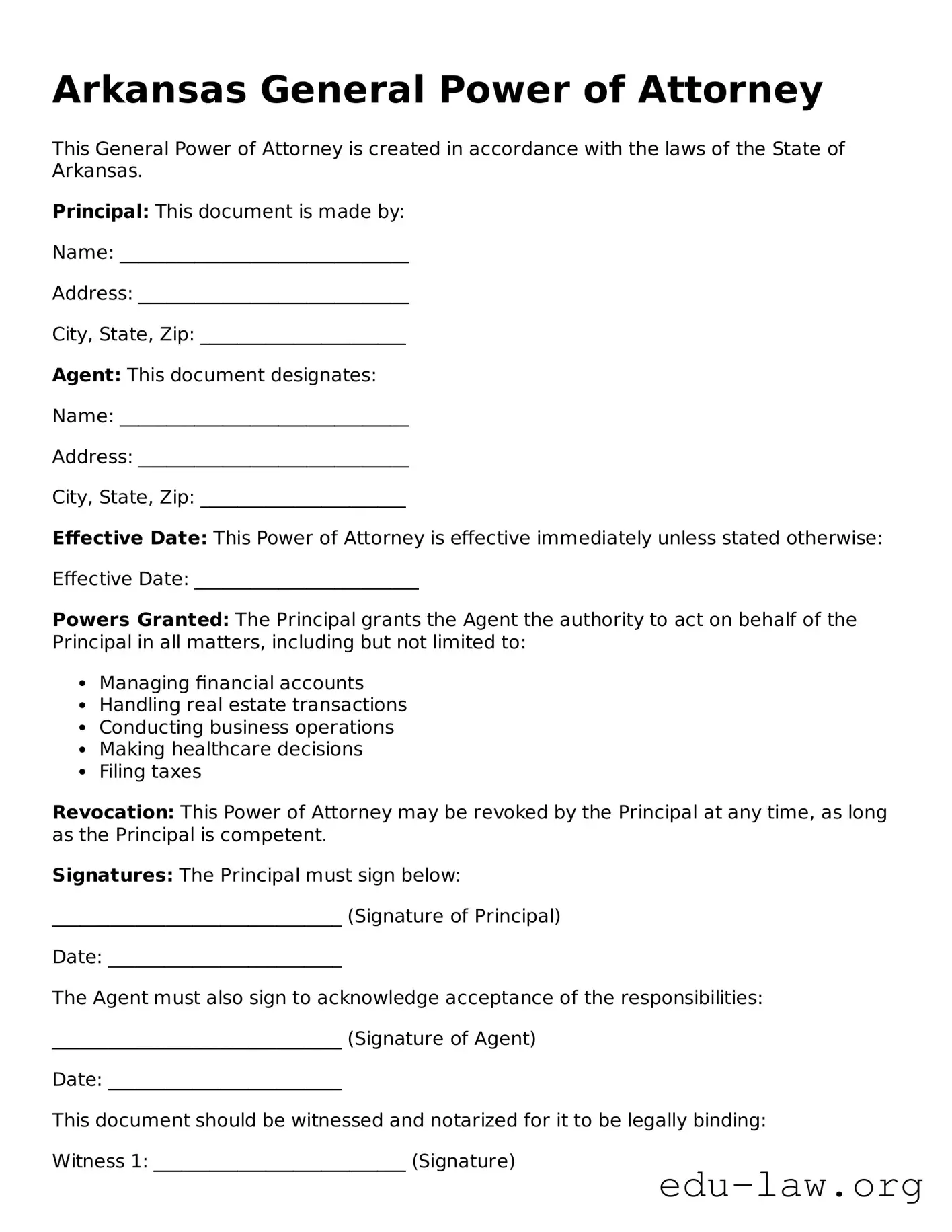
Arkansas General Power of Attorney
This General Power of Attorney is created in accordance with the laws of the State of Arkansas.
Principal: This document is made by:
Name: _______________________________
Address: _____________________________
City, State, Zip: ______________________
Agent: This document designates:
Name: _______________________________
Address: _____________________________
City, State, Zip: ______________________
Effective Date: This Power of Attorney is effective immediately unless stated otherwise:
Effective Date: ________________________
Powers Granted: The Principal grants the Agent the authority to act on behalf of the Principal in all matters, including but not limited to:
Revocation: This Power of Attorney may be revoked by the Principal at any time, as long as the Principal is competent.
Signatures: The Principal must sign below:
_______________________________ (Signature of Principal)
Date: _________________________
The Agent must also sign to acknowledge acceptance of the responsibilities:
_______________________________ (Signature of Agent)
Date: _________________________
This document should be witnessed and notarized for it to be legally binding:
Witness 1: ___________________________ (Signature)
Date: ________________________________
Witness 2: ___________________________ (Signature)
Date: ________________________________
Notary Public:
State of Arkansas
County of ___________________________
Subscribed and sworn to before me this ____ day of ____________, 20__.
_______________________________ (Notary Public Signature)
My Commission Expires: ________________
| Fact Name | Description |
|---|---|
| Definition | The Arkansas General Power of Attorney form allows an individual (the principal) to appoint someone else (the agent) to make decisions on their behalf. |
| Governing Law | This form is governed by the Arkansas Code Annotated, specifically under Title 28, Chapter 68. |
| Durability | The power of attorney can be durable, meaning it remains effective even if the principal becomes incapacitated, unless stated otherwise in the document. |
| Revocation | The principal can revoke the power of attorney at any time, as long as they are mentally competent to do so. |
| Agent's Authority | The agent's authority can be broad or limited, depending on what the principal specifies in the form. |
After you complete the Arkansas General Power of Attorney form, it will be ready for use. Ensure that all necessary parties have signed and that the document is stored in a safe place. You may need to present this document to various institutions or individuals, so keep copies handy.
What is a General Power of Attorney in Arkansas?
A General Power of Attorney (GPOA) is a legal document that allows one person, known as the principal, to appoint another person, called the agent or attorney-in-fact, to make decisions on their behalf. This can include handling financial matters, managing property, and making legal decisions. The GPOA is broad in scope and grants the agent significant authority to act in the principal’s best interest.
Why would someone need a General Power of Attorney?
People often use a General Power of Attorney to ensure that their financial and legal affairs can be managed if they become incapacitated or unavailable. This document can be particularly useful for individuals who travel frequently, have health concerns, or simply want to plan ahead for unforeseen circumstances. By designating an agent, you can have peace of mind knowing that someone you trust will handle your affairs when you cannot.
How do I create a General Power of Attorney in Arkansas?
To create a General Power of Attorney in Arkansas, you need to fill out a specific form that meets state requirements. It’s important to clearly outline the powers you wish to grant to your agent. After completing the form, you must sign it in the presence of a notary public. This step is crucial, as notarization adds an extra layer of legitimacy to the document. Once signed and notarized, provide copies to your agent and any relevant institutions.
Can I revoke a General Power of Attorney?
Yes, you can revoke a General Power of Attorney at any time, as long as you are mentally competent. To do this, you need to create a written revocation document and notify your agent and any institutions that may have a copy of the original GPOA. This helps prevent any confusion about who has the authority to act on your behalf.
What happens if the principal becomes incapacitated?
If the principal becomes incapacitated, the General Power of Attorney remains effective unless it is specifically stated to be durable. A durable GPOA continues to be valid even if the principal loses the ability to make decisions. This means that the agent can continue to act on behalf of the principal, ensuring that their affairs are managed appropriately during this time.
Can I limit the powers granted in a General Power of Attorney?
Yes, you can limit the powers granted in a General Power of Attorney. While a GPOA is typically broad, you have the option to specify which powers your agent can exercise. For example, you might allow your agent to manage your bank accounts but not to sell your property. Clearly outlining these limitations in the document is essential to ensure that your wishes are respected.
Is a General Power of Attorney the same as a Medical Power of Attorney?
No, a General Power of Attorney and a Medical Power of Attorney are not the same. A General Power of Attorney primarily deals with financial and legal matters, while a Medical Power of Attorney specifically allows someone to make healthcare decisions on your behalf if you are unable to do so. It’s important to have both documents in place if you want to ensure that your financial, legal, and medical affairs are managed according to your wishes.
Do I need an attorney to create a General Power of Attorney?
While it is not legally required to have an attorney to create a General Power of Attorney in Arkansas, it is highly recommended. An attorney can help ensure that the document meets all legal requirements and accurately reflects your intentions. This can save you time and potential complications down the line. If you have specific concerns or complex situations, consulting with a legal professional is wise.
How long does a General Power of Attorney last?
A General Power of Attorney remains in effect until it is revoked by the principal, the principal passes away, or the document specifies a termination date. If the principal becomes incapacitated and the GPOA is not durable, it will no longer be valid. It’s important to regularly review your GPOA to ensure it still meets your needs and intentions.
Not Specifying Powers Clearly: Many individuals fail to clearly define the powers they wish to grant. This can lead to confusion or disputes later on. It's essential to be specific about what the agent can and cannot do.
Forgetting to Date the Document: Some people overlook the importance of dating the Power of Attorney form. Without a date, it may be difficult to determine when the authority was granted, which can create legal complications.
Neglecting to Sign and Initial: A common error is not signing the document in the appropriate places. Both the principal and any witnesses must sign. Initialing any changes or corrections is also crucial to ensure clarity and validity.
Not Considering Witness Requirements: In Arkansas, certain situations require witnesses to the signing of the Power of Attorney. Failing to include witnesses when necessary can invalidate the document.
Ignoring Revocation of Previous Powers: If there are prior Powers of Attorney in effect, individuals often forget to revoke them. It's important to clearly state that the new document revokes any previous ones to avoid conflicts.
When creating a General Power of Attorney in Arkansas, it’s often helpful to consider additional forms and documents that can support your needs. Each of these documents serves a specific purpose and can enhance your overall estate planning strategy.
Considering these additional documents can help ensure that your wishes are clearly communicated and legally protected. Each one plays a vital role in comprehensive estate planning, giving you peace of mind for the future.
The Arkansas General Power of Attorney (GPOA) form shares similarities with the Durable Power of Attorney (DPOA). Both documents grant an individual the authority to make decisions on behalf of another person. However, the key distinction lies in durability. The DPOA remains effective even if the principal becomes incapacitated, while the GPOA may not. This makes the DPOA a critical tool for long-term planning, particularly for those concerned about potential future health issues.
Another document akin to the GPOA is the Medical Power of Attorney (MPOA). The MPOA specifically focuses on healthcare decisions, allowing an appointed agent to make medical choices when the principal is unable to do so. While the GPOA can encompass a broad range of financial and legal matters, the MPOA is limited to health-related decisions. This specialization ensures that healthcare preferences are honored during times of incapacity.
The Springing Power of Attorney is also comparable to the GPOA. This type of power of attorney becomes effective only upon the occurrence of a specific event, typically the incapacitation of the principal. Like the GPOA, it allows an agent to act on behalf of the principal. However, the springing nature means that the agent's authority is not active until certain conditions are met, providing an added layer of control for the principal.
Lastly, the Limited Power of Attorney (LPOA) bears resemblance to the GPOA in that it allows someone to act on behalf of another. However, the LPOA is restricted to specific tasks or decisions, such as selling a property or managing a bank account. This contrasts with the GPOA, which provides broader authority. The LPOA is ideal for situations where the principal wants to delegate authority for a defined purpose without granting sweeping powers.
When filling out the Arkansas General Power of Attorney form, it is essential to follow certain guidelines to ensure the document is valid and effective. Below is a list of dos and don'ts to consider.
Many people hold misconceptions about the Arkansas General Power of Attorney form. Understanding the realities can help individuals make informed decisions. Here are eight common misconceptions:
Clarifying these misconceptions can empower individuals to use the General Power of Attorney effectively and responsibly.
When filling out and using the Arkansas General Power of Attorney form, consider the following key takeaways: