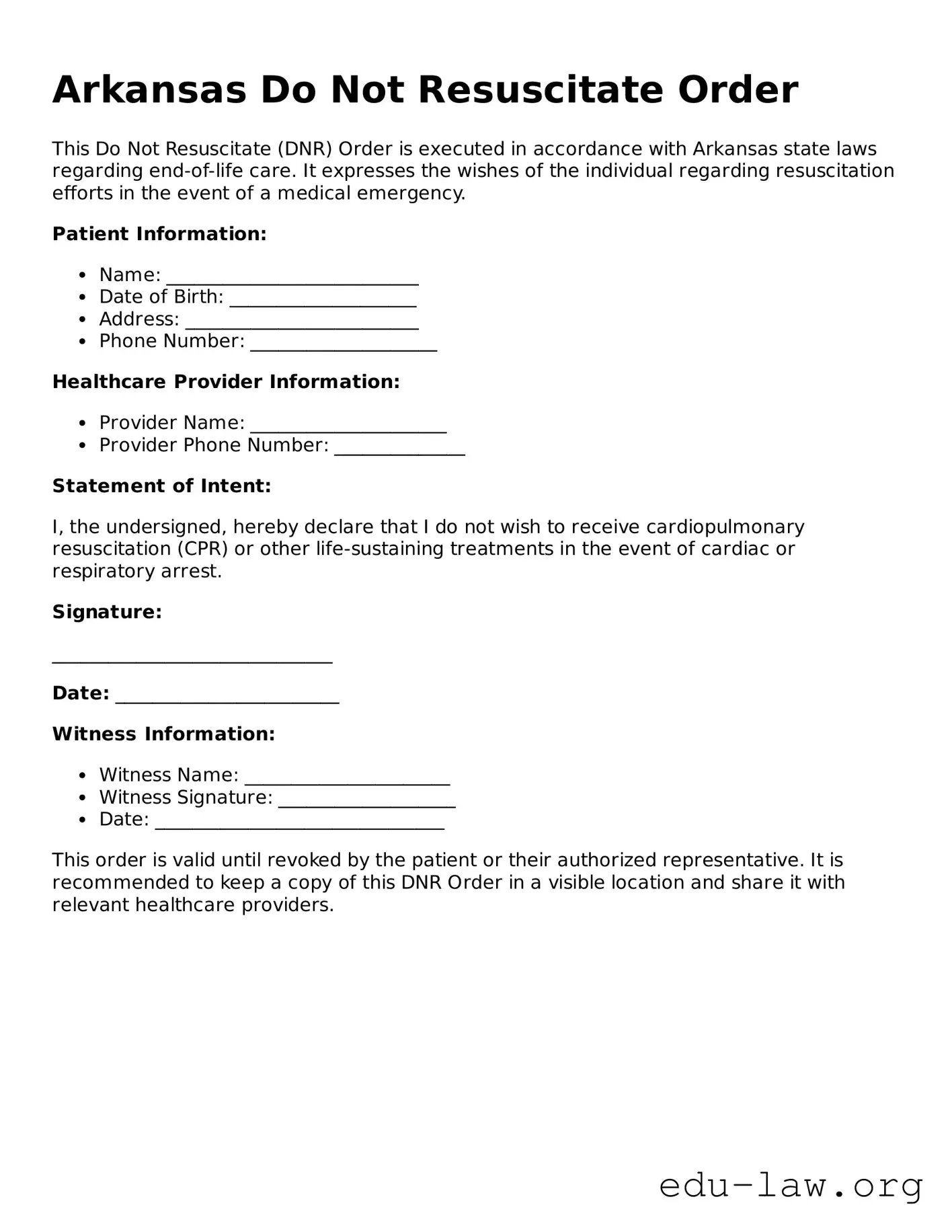
In the realm of healthcare decision-making, the Arkansas Do Not Resuscitate (DNR) Order form plays a crucial role for individuals wishing to express their preferences regarding life-sustaining treatments. This legally binding document allows patients to communicate their desire not to receive cardiopulmonary resuscitation (CPR) in the event of a cardiac arrest or respiratory failure. By completing this form, individuals can ensure that their wishes are respected, providing peace of mind for both themselves and their loved ones. The DNR Order must be signed by a qualified healthcare provider and the patient or their legal representative, making it an important part of end-of-life planning. It is vital for individuals to understand the implications of this order, including how it interacts with other medical directives and the importance of sharing it with family members and healthcare professionals. As healthcare becomes increasingly complex, having a clear understanding of the DNR Order form can empower individuals to make informed choices about their medical care and ensure that their preferences are honored during critical moments.
Arkansas Do Not Resuscitate Order
This Do Not Resuscitate (DNR) Order is executed in accordance with Arkansas state laws regarding end-of-life care. It expresses the wishes of the individual regarding resuscitation efforts in the event of a medical emergency.
Patient Information:
Healthcare Provider Information:
Statement of Intent:
I, the undersigned, hereby declare that I do not wish to receive cardiopulmonary resuscitation (CPR) or other life-sustaining treatments in the event of cardiac or respiratory arrest.
Signature:
______________________________
Date: ________________________
Witness Information:
This order is valid until revoked by the patient or their authorized representative. It is recommended to keep a copy of this DNR Order in a visible location and share it with relevant healthcare providers.
| Fact Name | Details |
|---|---|
| Governing Law | The Arkansas Do Not Resuscitate Order is governed by Arkansas Code Annotated § 20-10-1201 et seq. |
| Purpose | The form allows individuals to refuse resuscitation efforts in the event of cardiac or respiratory arrest. |
| Eligibility | Any adult capable of making medical decisions can complete the DNR order. |
| Signature Requirement | The form must be signed by the patient or their legally authorized representative. |
| Healthcare Provider's Role | A physician must sign the order to validate it and ensure it aligns with the patient's wishes. |
| Visibility | The DNR order should be prominently displayed in the patient's medical record and at their residence. |
| Revocation | Patients can revoke the DNR order at any time, verbally or in writing. |
| Emergency Medical Services | Emergency medical personnel are required to honor the DNR order when it is presented. |
| Form Accessibility | The Arkansas DNR form is available through healthcare providers and online state resources. |
Completing the Arkansas Do Not Resuscitate Order form is an important step in expressing your healthcare wishes. After filling out the form, you will need to ensure it is properly signed and shared with your healthcare providers and loved ones to ensure your preferences are respected.
What is a Do Not Resuscitate (DNR) Order in Arkansas?
A Do Not Resuscitate Order is a legal document that allows a person to refuse resuscitation efforts in the event of a cardiac arrest or respiratory failure. In Arkansas, this order is recognized by medical professionals and ensures that if a patient’s heart stops beating or they stop breathing, emergency medical personnel will not perform CPR or other life-saving measures. It is important for individuals to discuss their wishes with their healthcare providers and family members before completing a DNR order.
Who can request a DNR Order in Arkansas?
In Arkansas, a DNR order can be requested by a patient who is at least 18 years old and has the capacity to make their own medical decisions. If the patient is unable to make decisions, a legally authorized representative, such as a spouse, adult child, or legal guardian, may request the order on their behalf. It’s crucial that the person requesting the DNR understands the implications of the order and has had a thorough discussion with medical professionals about the patient's health status and prognosis.
How is a DNR Order created in Arkansas?
To create a DNR order in Arkansas, the patient or their representative must fill out the official DNR form provided by the Arkansas Department of Health. This form must be signed by the patient and their physician. The physician’s signature confirms that they have discussed the order with the patient and agree that it reflects the patient’s wishes. Once completed, the form should be kept in a place where it can be easily accessed by medical personnel, such as on the refrigerator or in a medical file.
Will a DNR Order affect other medical treatments?
No, a DNR order specifically addresses resuscitation efforts only. It does not affect other medical treatments or interventions that a patient may receive. Patients with a DNR order can still receive necessary medical care, such as medications, pain management, and comfort measures. It is essential to communicate clearly with healthcare providers about the patient’s overall treatment goals to ensure that all aspects of care align with their wishes.
Can a DNR Order be revoked in Arkansas?
Yes, a DNR order can be revoked at any time by the patient or their authorized representative. To revoke the order, the individual should inform their healthcare provider and any medical personnel who may be involved in their care. It is advisable to complete a new DNR form if the individual wishes to change their decision regarding resuscitation. Clear communication is key to ensuring that all parties are aware of the patient’s current wishes.
What should I do if I have questions about a DNR Order?
If you have questions about a DNR order, it is best to consult with a healthcare professional or an attorney who specializes in healthcare law. They can provide guidance tailored to your specific situation and help clarify any concerns you may have. Additionally, many hospitals and hospice organizations offer resources and support for patients and families navigating end-of-life decisions.
Not including the patient's full name. It is essential to provide the complete legal name to avoid any confusion about the individual's identity.
Failing to sign the form. A signature is necessary to validate the document. Without it, the order may not be honored.
Not dating the form. A date indicates when the order was created, which is important for its enforcement and relevance.
Overlooking witness signatures. Arkansas law requires that the form be signed by at least one witness, ensuring that the order is legitimate.
Using incorrect terminology. Misunderstanding the terms related to resuscitation can lead to unintended consequences. Clarity is crucial.
Not discussing the order with healthcare providers. Communication with medical professionals ensures everyone understands the patient's wishes.
Neglecting to provide copies to relevant parties. It's important to share the order with family members and healthcare providers to ensure it is honored.
Forgetting to review and update the order. Changes in health status or personal wishes may require updates to the DNR order.
The Arkansas Do Not Resuscitate (DNR) Order form is an important document for individuals who wish to express their preferences regarding medical treatment in emergency situations. Along with the DNR form, there are several other documents that can be used to ensure that a person's healthcare wishes are respected. Below is a list of these related forms and documents.
Each of these documents plays a vital role in creating a comprehensive plan for healthcare preferences. Having them in place can alleviate stress and ensure that an individual's wishes are honored during critical times.
The Arkansas Do Not Resuscitate (DNR) Order form shares similarities with the Advance Healthcare Directive, a crucial document that outlines an individual’s preferences regarding medical treatment in situations where they cannot communicate their wishes. Both documents empower patients to assert their autonomy over medical decisions, ensuring that healthcare providers respect their choices. While the DNR specifically addresses resuscitation efforts, the Advance Healthcare Directive encompasses a broader range of medical interventions, allowing individuals to specify their desires regarding various treatments, such as life support and pain management. This comprehensive approach facilitates clearer communication between patients and healthcare providers, ultimately leading to more personalized care aligned with the patient’s values.
Another document akin to the Arkansas DNR is the Physician Orders for Life-Sustaining Treatment (POLST). This form serves as a medical order that translates a patient’s treatment preferences into actionable guidelines for healthcare providers. Like the DNR, the POLST form is designed for individuals with serious illnesses or those nearing the end of life. It includes detailed instructions on resuscitation and other life-sustaining measures, ensuring that medical personnel follow the patient’s wishes during emergencies. The POLST is particularly beneficial because it is recognized across various healthcare settings, making it a vital tool for ensuring that a patient’s preferences are honored consistently.
The Living Will is another document that bears resemblance to the Arkansas DNR Order form. This legal instrument allows individuals to express their wishes regarding end-of-life care, particularly in situations where they are unable to communicate. While the DNR focuses specifically on resuscitation efforts, the Living Will addresses a broader spectrum of medical interventions, including the use of artificial nutrition and hydration. Both documents emphasize the importance of patient autonomy and the right to refuse certain medical treatments. By clearly articulating their preferences, individuals can alleviate the burden on family members and healthcare providers, fostering a more compassionate approach to end-of-life care.
Lastly, the Durable Power of Attorney for Healthcare is a vital document that complements the Arkansas DNR Order form. This legal arrangement allows individuals to designate a trusted person to make healthcare decisions on their behalf if they become incapacitated. While the DNR specifies what actions should or should not be taken in emergencies, the Durable Power of Attorney provides a broader scope of authority, enabling the appointed agent to make decisions regarding all aspects of medical care. This relationship can enhance communication between patients, families, and healthcare providers, ensuring that the individual’s wishes are respected and upheld in various medical situations.
When filling out the Arkansas Do Not Resuscitate Order form, it's essential to approach the process with care. Here’s a helpful list of things to do and avoid:
Taking these steps can help ensure that your wishes are respected and clearly communicated to your healthcare team.
Understanding the Arkansas Do Not Resuscitate (DNR) Order form is essential for both patients and healthcare providers. However, several misconceptions can lead to confusion. Here are eight common misunderstandings:
This is false. A DNR order specifically relates to resuscitation efforts during cardiac arrest. Patients will still receive other forms of medical treatment.
While many people with terminal illnesses choose to have a DNR, it is not limited to them. Anyone can request a DNR based on their personal healthcare preferences.
This is not entirely accurate. While a physician's signature is important, the DNR can also be valid if signed by the patient or their legal representative, depending on the situation.
This is a misconception. DNR orders can be created and honored in various settings, including at home or in long-term care facilities.
This is incorrect. Patients can revoke or modify their DNR orders at any time, reflecting changes in their wishes or health status.
Many people view a DNR as a way to prioritize quality of life over aggressive medical interventions. It reflects personal choices about end-of-life care.
Assuming that all providers are aware of your DNR can lead to issues. It’s crucial to communicate your wishes clearly and ensure that the DNR is accessible in medical records.
This is misleading. A DNR specifically addresses resuscitation efforts in the event of cardiac arrest and does not apply to other medical emergencies or interventions.
By dispelling these misconceptions, individuals can make informed decisions regarding their healthcare preferences and ensure their wishes are respected.
Filling out a Do Not Resuscitate (DNR) Order form in Arkansas is an important decision that requires careful consideration. Here are some key takeaways to help guide you through the process:
By understanding these key points, you can make informed decisions about your healthcare preferences. It's essential to communicate your wishes clearly and ensure that they are documented properly.