When it comes to transferring property ownership in Arkansas, the Arkansas Deed form plays a crucial role in ensuring that the transaction is legally recognized and binding. This document serves as the official record of the transfer, detailing essential information such as the names of the grantor (the person selling or giving away the property) and the grantee (the person receiving the property). It also specifies the property's legal description, which is vital for identifying the exact location and boundaries of the land involved. Additionally, the deed may include information about any liens or encumbrances that could affect the property, providing transparency for the new owner. In some cases, the form can also outline specific conditions or restrictions related to the property, which can be important for both parties to understand. By carefully completing and filing the Arkansas Deed form, individuals can ensure a smooth transfer of ownership and protect their rights throughout the process.
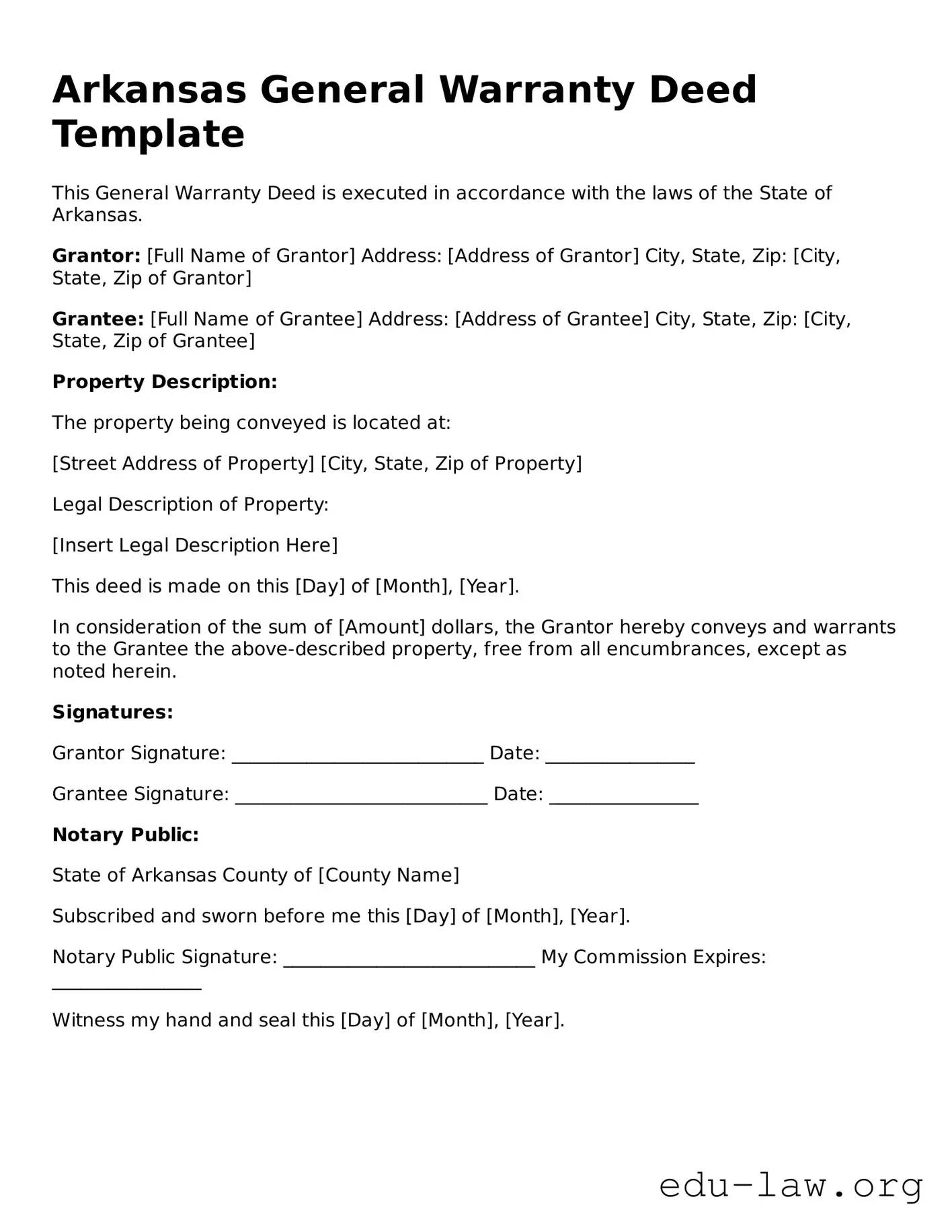
Arkansas General Warranty Deed Template
This General Warranty Deed is executed in accordance with the laws of the State of Arkansas.
Grantor: [Full Name of Grantor] Address: [Address of Grantor] City, State, Zip: [City, State, Zip of Grantor]
Grantee: [Full Name of Grantee] Address: [Address of Grantee] City, State, Zip: [City, State, Zip of Grantee]
Property Description:
The property being conveyed is located at:
[Street Address of Property] [City, State, Zip of Property]
Legal Description of Property:
[Insert Legal Description Here]
This deed is made on this [Day] of [Month], [Year].
In consideration of the sum of [Amount] dollars, the Grantor hereby conveys and warrants to the Grantee the above-described property, free from all encumbrances, except as noted herein.
Signatures:
Grantor Signature: ___________________________ Date: ________________
Grantee Signature: ___________________________ Date: ________________
Notary Public:
State of Arkansas County of [County Name]
Subscribed and sworn before me this [Day] of [Month], [Year].
Notary Public Signature: ___________________________ My Commission Expires: ________________
Witness my hand and seal this [Day] of [Month], [Year].
| Fact Name | Description |
|---|---|
| Governing Law | The Arkansas Deed form is governed by the Arkansas Code Annotated, Title 18, Chapter 12. |
| Types of Deeds | Common types include warranty deeds, quitclaim deeds, and special warranty deeds. |
| Grantor and Grantee | The deed must clearly identify the grantor (seller) and the grantee (buyer). |
| Property Description | A legal description of the property must be included to avoid ambiguity. |
| Consideration | The deed should state the consideration, or payment, involved in the transfer. |
| Signature Requirements | The grantor must sign the deed for it to be valid; notarization is also recommended. |
| Recording | To protect the grantee’s interest, the deed should be recorded with the county clerk. |
| Transfer Taxes | Arkansas imposes a transfer tax on real estate transactions, which must be paid upon recording. |
| Title Insurance | Purchasing title insurance is advisable to protect against potential title issues. |
| Legal Assistance | Consulting a lawyer can help ensure the deed complies with all legal requirements. |
Once you have the Arkansas Deed form ready, you will need to fill it out carefully. After completing the form, you can proceed with filing it with the appropriate county office. This step is essential to ensure that the transfer of property is legally recognized.
What is an Arkansas Deed form?
An Arkansas Deed form is a legal document used to transfer ownership of real estate from one party to another. It outlines the details of the property being transferred, including its legal description, the names of the grantor (seller) and grantee (buyer), and any conditions of the transfer. This document must be properly executed and recorded to be legally binding and enforceable.
What types of Deed forms are available in Arkansas?
In Arkansas, there are several types of Deed forms, including Warranty Deeds, Quitclaim Deeds, and Special Warranty Deeds. A Warranty Deed provides a guarantee that the grantor holds clear title to the property and has the right to sell it. A Quitclaim Deed transfers whatever interest the grantor has in the property without any guarantees. A Special Warranty Deed offers limited warranties, covering only the period during which the grantor owned the property.
How do I fill out an Arkansas Deed form?
Filling out an Arkansas Deed form requires careful attention to detail. Start by entering the names and addresses of both the grantor and grantee. Next, provide a legal description of the property, which can usually be found on the property’s tax records. Make sure to include any relevant information about the transaction, such as the sale price. Once completed, both parties should sign the form in the presence of a notary public to ensure its validity.
Do I need to record the Deed after it is signed?
Yes, recording the Deed is essential. After signing, the Deed should be filed with the county clerk's office in the county where the property is located. This step provides public notice of the transfer and protects the rights of the new owner. Failing to record the Deed may result in complications regarding ownership and future transactions.
Are there any fees associated with filing an Arkansas Deed form?
Yes, there are typically fees associated with filing a Deed in Arkansas. These fees can vary by county and may include recording fees, transfer taxes, and other related costs. It’s advisable to check with the local county clerk’s office for the specific fees applicable to your situation. Budgeting for these expenses will help ensure a smooth transfer process.
Failing to include all necessary parties involved in the transaction. Each owner must be clearly identified.
Not providing a complete legal description of the property. This description should accurately reflect the boundaries and specifics of the land.
Using incorrect names or misspellings. Ensure that names are spelled correctly as they appear on official documents.
Omitting the date of the transaction. The date is crucial for record-keeping and legal purposes.
Not signing the deed in the presence of a notary public. A signature without notarization may render the document invalid.
Failing to include the consideration amount. This refers to the price paid for the property and must be clearly stated.
Neglecting to check local requirements. Different counties may have specific rules regarding deed submissions.
Not providing the necessary identification for all parties. Identification may be required to verify the identities of those involved.
Forgetting to record the deed after it has been completed. Recording is essential to protect ownership rights.
Leaving out any additional clauses or stipulations. If there are conditions or agreements, they should be clearly stated in the deed.
When transferring property in Arkansas, the Deed form is a critical document. However, several other forms and documents often accompany it to ensure a smooth and legally compliant transaction. Below is a list of common documents that you may encounter during this process.
Understanding these documents can significantly aid in navigating the complexities of property transactions in Arkansas. Each plays a vital role in ensuring that both buyers and sellers are protected and that the transfer process is conducted smoothly.
The Arkansas Deed form shares similarities with a Quitclaim Deed, which is often used to transfer property without any guarantees about the title. Like the Arkansas Deed, the Quitclaim Deed conveys the interest of the grantor in the property, but it does so without affirming that the grantor holds clear title. This means that if there are any issues with the title, the grantee has no recourse against the grantor. Both documents serve to facilitate the transfer of property, but the Quitclaim Deed is generally considered less secure for the grantee.
Another document akin to the Arkansas Deed is the Warranty Deed. This type of deed provides a stronger assurance to the grantee, as it guarantees that the grantor holds clear title to the property and has the right to transfer it. The Warranty Deed includes specific covenants that protect the grantee against any future claims to the property. While both the Arkansas Deed and the Warranty Deed serve to transfer ownership, the Warranty Deed offers additional legal protections that make it a more secure option for buyers.
The Special Purpose Deed also bears a resemblance to the Arkansas Deed, particularly in its function of transferring property. This type of deed is often used for specific transactions, such as transferring property into a trust or between family members. Like the Arkansas Deed, the Special Purpose Deed can be tailored to fit particular needs, but it may include unique provisions that address the specific circumstances of the transaction. Both documents facilitate property transfers, but the Special Purpose Deed is more specialized in its application.
Lastly, the Bargain and Sale Deed is another document that aligns with the Arkansas Deed in terms of property transfer. This deed implies that the grantor has the right to sell the property but does not provide any warranties regarding the title. While the Arkansas Deed may or may not include warranties, the Bargain and Sale Deed specifically indicates that the grantor is transferring their interest without guaranteeing that the title is free of defects. Thus, both documents serve to convey ownership, but the level of assurance regarding the title differs significantly.
When filling out the Arkansas Deed form, attention to detail is crucial. Here are ten important dos and don'ts to keep in mind:
Understanding the Arkansas Deed form can be challenging, and several misconceptions often arise. Below is a list of common misunderstandings along with clarifications to help you navigate this important document.
By dispelling these misconceptions, individuals can better understand the significance of the Arkansas Deed form and ensure that their property transactions are handled correctly and effectively.
When filling out and using the Arkansas Deed form, it is essential to keep several key points in mind. Understanding these aspects can help ensure that the process is smooth and legally sound.
By keeping these takeaways in mind, individuals can navigate the process of using the Arkansas Deed form more effectively.