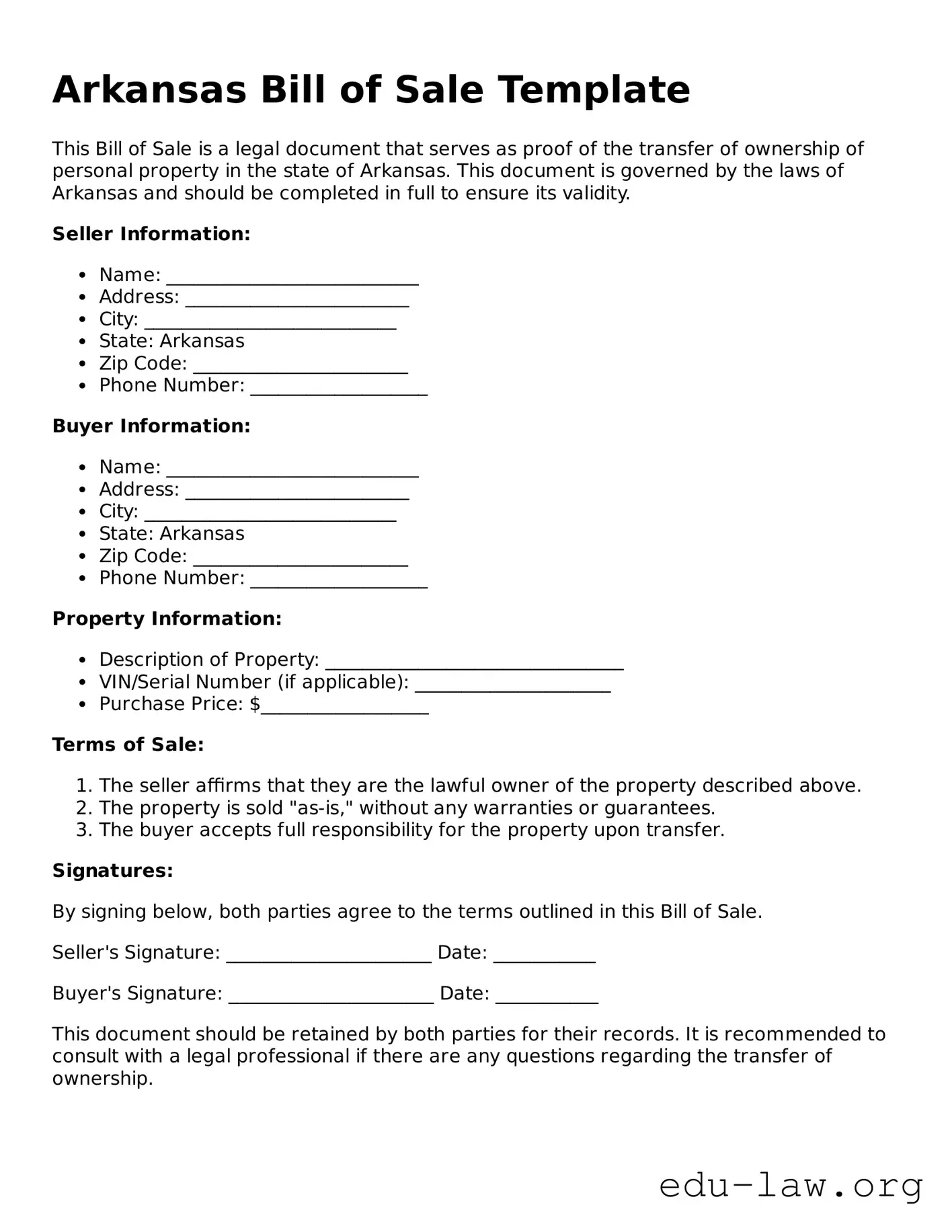
The Arkansas Bill of Sale form serves as a crucial document in various transactions, particularly when it comes to the transfer of personal property. This form provides a clear record of the sale, detailing essential information such as the buyer's and seller's names, addresses, and contact information. It also includes a description of the item being sold, which can range from vehicles to furniture, ensuring that both parties have a mutual understanding of what is being exchanged. Additionally, the form typically outlines the sale price and any terms or conditions associated with the transaction, such as warranties or guarantees. By documenting these key elements, the Bill of Sale not only protects the interests of both the buyer and the seller but also serves as a reference point in case of disputes. Furthermore, having a properly completed Bill of Sale can be beneficial for registration purposes, especially in the case of vehicles, where it may be required by the state. Overall, this form is an essential tool for anyone engaging in the sale of personal property in Arkansas, providing clarity and security in the transaction process.
Arkansas Bill of Sale Template
This Bill of Sale is a legal document that serves as proof of the transfer of ownership of personal property in the state of Arkansas. This document is governed by the laws of Arkansas and should be completed in full to ensure its validity.
Seller Information:
Buyer Information:
Property Information:
Terms of Sale:
Signatures:
By signing below, both parties agree to the terms outlined in this Bill of Sale.
Seller's Signature: ______________________ Date: ___________
Buyer's Signature: ______________________ Date: ___________
This document should be retained by both parties for their records. It is recommended to consult with a legal professional if there are any questions regarding the transfer of ownership.
| Fact Name | Description |
|---|---|
| Purpose | The Arkansas Bill of Sale is used to document the transfer of ownership of personal property between parties. |
| Governing Law | This form is governed by the Arkansas Code Annotated § 4-2-101 et seq. |
| Types of Property | It can be used for various types of personal property, including vehicles, boats, and equipment. |
| Notarization | While notarization is not required, it is recommended for added legal protection. |
| Buyer and Seller Information | The form requires the full names and addresses of both the buyer and the seller. |
| Purchase Price | The purchase price must be clearly stated in the document. |
| Condition of Property | The seller should disclose the condition of the property being sold, including any known defects. |
| Signatures | Both parties must sign the bill of sale to validate the transaction. |
| Record Keeping | It is advisable for both parties to keep a copy of the bill of sale for their records. |
| Legal Use | The bill of sale can be used as evidence in legal disputes regarding the property. |
After obtaining the Arkansas Bill of Sale form, the next step is to accurately fill it out. This document serves as a record of the transaction between the buyer and seller. It is essential to ensure that all information is correct to avoid any future disputes.
Once the form is completed, both parties should retain a copy for their records. This ensures that both the buyer and seller have proof of the transaction.
What is an Arkansas Bill of Sale form?
An Arkansas Bill of Sale form is a legal document that records the transfer of ownership of personal property from one person to another. This form is essential for establishing proof of the transaction, detailing what was sold, and providing information about the buyer and seller. It is commonly used for vehicles, boats, and other valuable items.
Do I need a Bill of Sale for every transaction in Arkansas?
No, not every transaction requires a Bill of Sale. However, it is highly recommended for significant purchases, especially for vehicles or items that may require registration. A Bill of Sale can help protect both the buyer and the seller by documenting the terms of the sale.
What information should be included in the Arkansas Bill of Sale?
The Bill of Sale should include the names and addresses of both the buyer and seller, a description of the item being sold (including make, model, and VIN for vehicles), the purchase price, and the date of the transaction. Additional details, such as any warranties or conditions of the sale, can also be included to clarify the agreement.
Is a Bill of Sale legally binding in Arkansas?
Yes, a Bill of Sale is a legally binding document in Arkansas as long as it is properly completed and signed by both parties. It serves as evidence of the transaction and can be used in court if any disputes arise. Always ensure that both parties retain a copy for their records.
Do I need to have the Bill of Sale notarized?
In Arkansas, notarization is not required for a Bill of Sale to be valid. However, having the document notarized can add an extra layer of authenticity and may be beneficial if there are any future disputes. Some buyers or sellers may prefer notarization for peace of mind.
Can I create my own Bill of Sale, or do I need a specific form?
You can create your own Bill of Sale as long as it includes all necessary information. There are also many templates available online that can be used to ensure all essential details are covered. Just make sure that the document is clear and contains the information required by Arkansas law.
What should I do after completing the Bill of Sale?
After completing the Bill of Sale, both the buyer and seller should sign it. It’s important for each party to keep a copy for their records. If the item being sold requires registration, the buyer may need to present the Bill of Sale to the appropriate state agency, such as the Department of Motor Vehicles for vehicle transactions.
Where can I find a Bill of Sale form for Arkansas?
You can find a Bill of Sale form for Arkansas at various online legal document websites, or you may visit local office supply stores. Additionally, some state government websites provide downloadable templates that you can fill out. Always ensure that the form you use complies with Arkansas laws.
Incomplete Information: Failing to provide all required details, such as the names and addresses of both the buyer and seller, can lead to issues later on.
Incorrect Vehicle Identification Number (VIN): Not double-checking the VIN can result in confusion or disputes regarding ownership.
Missing Signatures: Both parties must sign the document. Omitting a signature can render the Bill of Sale invalid.
Not Dating the Document: Forgetting to include the date of the transaction can complicate matters, especially for tax purposes.
Failure to Provide a Purchase Price: Leaving the purchase price blank or inaccurately stating it can lead to legal complications.
Omitting Condition Details: Not describing the condition of the item being sold can lead to misunderstandings between the buyer and seller.
Using Inaccurate Descriptions: Providing vague or misleading descriptions of the item can result in disputes after the sale.
Not Keeping Copies: Failing to make copies of the signed Bill of Sale for both parties can create problems if proof of sale is needed later.
Ignoring State Requirements: Not adhering to specific Arkansas regulations regarding Bill of Sale forms can lead to legal issues.
Neglecting to Verify Identification: Not confirming the identity of the buyer or seller can lead to fraud or misrepresentation.
A Bill of Sale is an important document used in the transfer of ownership for various types of property, including vehicles, personal items, and real estate. In Arkansas, several other forms and documents may accompany a Bill of Sale to ensure a smooth transaction. Below is a list of commonly used documents that may be relevant in conjunction with a Bill of Sale.
Having these documents prepared and organized can facilitate a smoother transaction process. It is advisable to review each document carefully to ensure all necessary information is included and accurate before finalizing any sale.
The Arkansas Bill of Sale form is similar to a Vehicle Bill of Sale. Both documents serve as proof of transfer of ownership for a vehicle. They typically include details such as the buyer and seller's information, vehicle identification number (VIN), make, model, and purchase price. This document is essential for registering the vehicle in the new owner's name and can help resolve disputes regarding ownership in the future.
Another document akin to the Arkansas Bill of Sale is the Personal Property Bill of Sale. This form is used when selling items other than vehicles, such as furniture or electronics. It outlines the terms of the sale, including the description of the item, the sale price, and the date of the transaction. Like the Arkansas Bill of Sale, it provides legal protection for both parties involved in the transaction.
The Real Estate Bill of Sale is also similar. This document is used when personal property is included in the sale of real estate, such as appliances or fixtures. It specifies the items being sold alongside the property and ensures that both the buyer and seller are clear about what is included in the transaction. This prevents misunderstandings during the closing process.
A Rental Agreement can be compared to the Arkansas Bill of Sale in that both documents outline terms related to property. While a Bill of Sale transfers ownership, a Rental Agreement establishes the terms for using property without transferring ownership. It details the rental period, payment terms, and responsibilities of both the landlord and tenant, creating a clear understanding of the arrangement.
The Lease Agreement shares similarities as well. Like a Rental Agreement, it governs the use of property for a specified time. However, a Lease Agreement is typically longer-term and may include clauses related to maintenance, renewal, and termination. Both documents aim to protect the rights of the parties involved while outlining their obligations.
The Assignment of Contract is another document that bears resemblance to the Arkansas Bill of Sale. This form allows one party to transfer their rights and obligations under a contract to another party. It includes details about the original contract and the parties involved. Both documents formalize the transfer of interests, ensuring that all parties are aware of the changes being made.
A Power of Attorney document can also be compared to the Arkansas Bill of Sale. While the Bill of Sale transfers ownership of a specific item, a Power of Attorney allows one person to act on behalf of another in legal or financial matters. Both documents require clear identification of the parties involved and serve to protect their interests in transactions.
The Affidavit of Title is similar in that it serves as proof of ownership. This document is often used when selling a vehicle without a title. It includes a sworn statement by the seller affirming their ownership and the absence of any liens against the vehicle. Like the Bill of Sale, it provides legal assurance to the buyer regarding the legitimacy of the sale.
The Warranty Deed can also be related to the Bill of Sale. While a Bill of Sale is used for personal property, a Warranty Deed is used in real estate transactions to transfer ownership of property. It guarantees that the seller has clear title to the property and the right to sell it. Both documents are critical in establishing ownership and protecting the buyer’s interests.
Lastly, the Gift Receipt is similar in that it documents the transfer of ownership. This document is used when an item is given as a gift rather than sold. It includes the description of the item and the names of the giver and receiver. While it does not involve a financial transaction, it still serves to clarify the change of ownership, similar to the Bill of Sale.
When filling out the Arkansas Bill of Sale form, it's crucial to get it right. This document serves as a legal record of the transaction and protects both the buyer and the seller. Here are eight essential dos and don’ts to keep in mind:
Filling out the Bill of Sale correctly can save you from potential headaches down the road. Take these guidelines seriously to ensure a smooth transaction.
Misconception 1: A Bill of Sale is only necessary for vehicle transactions.
This is incorrect. While a Bill of Sale is commonly used for vehicles, it can also be applied to various other transactions, such as the sale of boats, furniture, or even livestock. Any transfer of ownership of personal property can benefit from a Bill of Sale.
Misconception 2: A Bill of Sale does not need to be notarized.
In Arkansas, notarization is not required for a Bill of Sale to be valid. However, having the document notarized can provide an additional layer of authenticity and may be beneficial in disputes.
Misconception 3: A Bill of Sale is the same as a title transfer.
This is misleading. A Bill of Sale serves as proof of the transaction and the agreement between buyer and seller, but it does not replace the need for a title transfer, especially for vehicles. Title transfer is a separate process that must be completed with the appropriate state agency.
Misconception 4: A Bill of Sale protects the seller from all liabilities.
This is not entirely true. While a Bill of Sale can limit certain liabilities, it does not absolve the seller from all responsibilities. Sellers may still be held accountable for undisclosed defects or misrepresentations about the item sold.
Misconception 5: A Bill of Sale is only needed for high-value transactions.
This is a common error. Regardless of the transaction's value, a Bill of Sale can provide clarity and legal protection for both parties. It is advisable to document even low-value sales to avoid future misunderstandings.
When engaging in a transaction involving the sale of personal property in Arkansas, the Bill of Sale serves as a vital document. Here are key takeaways to consider when filling out and using this form: