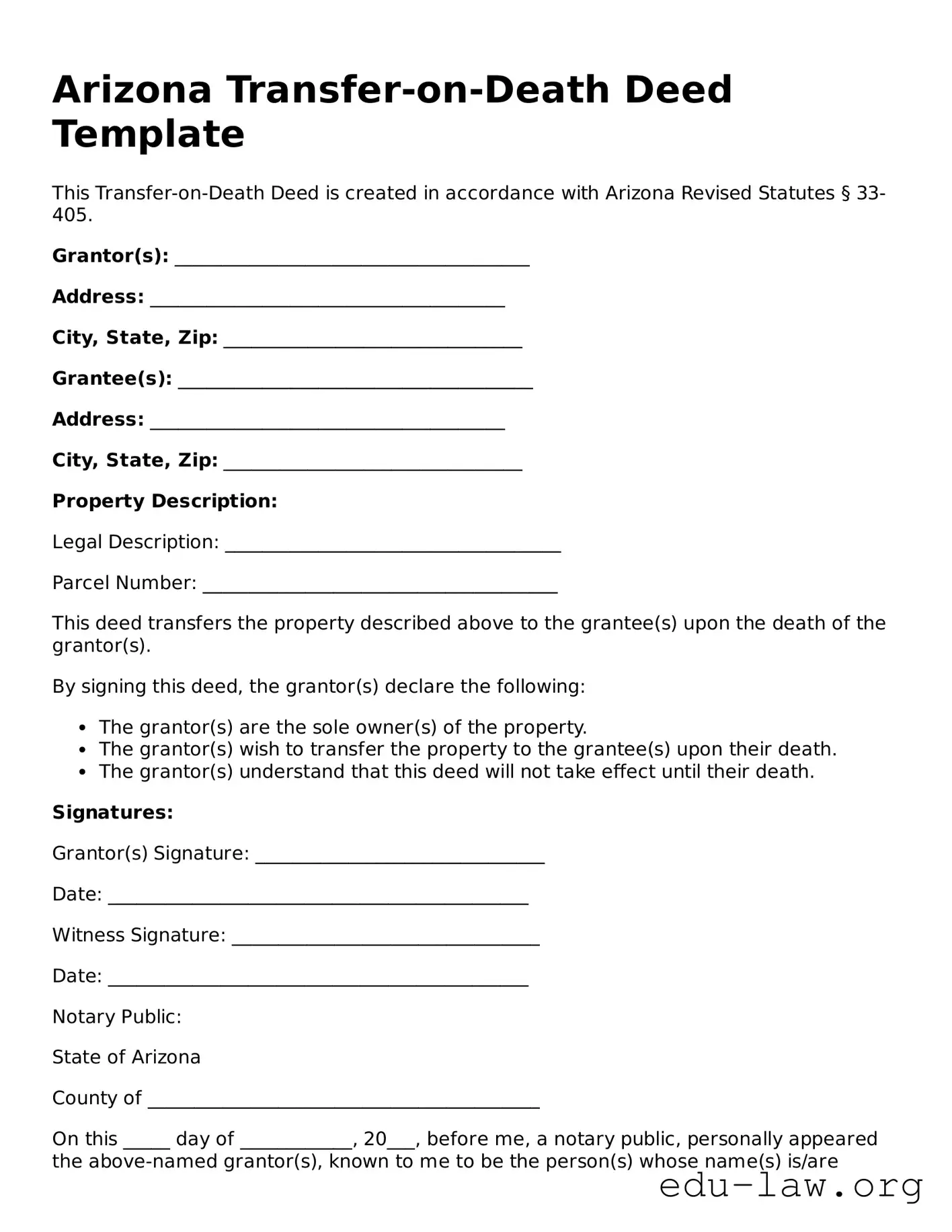
The Arizona Transfer-on-Death Deed (TOD) form serves as a valuable tool for property owners who wish to ensure a smooth transition of their real estate assets upon their passing. This legal document allows individuals to designate one or more beneficiaries to receive their property without the need for probate, simplifying the transfer process significantly. By filling out and recording this deed, property owners maintain full control over their assets during their lifetime. They can sell, mortgage, or otherwise manage their property as they see fit. Importantly, the TOD deed becomes effective only after the owner's death, meaning that it does not interfere with their rights while they are alive. Additionally, the form requires specific information, including the legal description of the property and the names of the beneficiaries, to be valid. Understanding the implications of this form can empower property owners to make informed decisions about their estate planning, ensuring that their wishes are honored and their loved ones are taken care of after their passing.
Arizona Transfer-on-Death Deed Template
This Transfer-on-Death Deed is created in accordance with Arizona Revised Statutes § 33-405.
Grantor(s): ______________________________________
Address: ______________________________________
City, State, Zip: ________________________________
Grantee(s): ______________________________________
Address: ______________________________________
City, State, Zip: ________________________________
Property Description:
Legal Description: ____________________________________
Parcel Number: ______________________________________
This deed transfers the property described above to the grantee(s) upon the death of the grantor(s).
By signing this deed, the grantor(s) declare the following:
Signatures:
Grantor(s) Signature: _______________________________
Date: _____________________________________________
Witness Signature: _________________________________
Date: _____________________________________________
Notary Public:
State of Arizona
County of __________________________________________
On this _____ day of ____________, 20___, before me, a notary public, personally appeared the above-named grantor(s), known to me to be the person(s) whose name(s) is/are subscribed to this instrument, and acknowledged that they executed the same for the purposes therein contained.
Notary Signature: ____________________________________
My Commission Expires: _____________________________
| Fact Name | Description |
|---|---|
| Definition | The Arizona Transfer-on-Death Deed allows property owners to transfer real estate to beneficiaries upon their death without going through probate. |
| Governing Law | The form is governed by Arizona Revised Statutes, specifically ARS § 33-405. |
| Eligibility | Only individuals who own real property in Arizona can execute a Transfer-on-Death Deed. |
| Beneficiaries | Property owners can designate one or more beneficiaries to receive the property upon their death. |
| Revocation | A Transfer-on-Death Deed can be revoked or amended at any time before the owner's death. |
| Filing Requirement | The deed must be recorded with the county recorder's office in the county where the property is located. |
| No Immediate Transfer | Ownership of the property does not transfer to the beneficiary until the death of the owner. |
| Tax Implications | Transfer-on-Death Deeds do not affect property tax assessments until the property is transferred to the beneficiary. |
| Limitations | Real property subject to a mortgage or lien may complicate the transfer process, but it remains possible. |
| Legal Advice | While the form is designed for ease of use, consulting with a legal professional is advisable to ensure compliance and understanding. |
Once you have the Arizona Transfer-on-Death Deed form ready, you will need to fill it out carefully. Make sure to have all necessary information at hand before you begin. This process will help ensure that your intentions are clear and legally recognized.
What is a Transfer-on-Death Deed in Arizona?
A Transfer-on-Death Deed (TOD Deed) allows property owners in Arizona to transfer their real estate to a designated beneficiary upon their death, without the need for probate. This deed is a simple way to ensure that your property goes directly to your chosen beneficiary, making the process smoother and often quicker for them.
Who can use a Transfer-on-Death Deed?
Any individual who owns real estate in Arizona can use a Transfer-on-Death Deed. This includes homeowners and property owners, provided they are of sound mind and at least 18 years old. It’s important to note that both the property owner and the beneficiary must be clearly identified in the deed.
How do I create a Transfer-on-Death Deed?
To create a Transfer-on-Death Deed, you need to fill out the appropriate form, which includes details about the property and the beneficiary. After completing the form, you must sign it in front of a notary public. Finally, the deed must be recorded with the county recorder’s office where the property is located to be effective.
Can I change or revoke a Transfer-on-Death Deed?
Yes, you can change or revoke a Transfer-on-Death Deed at any time while you are alive. To do this, you would need to create a new deed that either names a different beneficiary or explicitly states that the previous deed is revoked. This new deed must also be signed and recorded to take effect.
What happens if the beneficiary dies before me?
If the beneficiary named in your Transfer-on-Death Deed passes away before you, the deed will not automatically transfer the property to them. Instead, you may want to update the deed to name a new beneficiary or consider how you would like the property to be distributed in such cases.
Are there any tax implications with a Transfer-on-Death Deed?
Generally, a Transfer-on-Death Deed does not trigger any immediate tax consequences for the property owner. However, the beneficiary may be responsible for property taxes once the property is transferred. It’s advisable to consult with a tax professional to understand any potential implications.
Can I use a Transfer-on-Death Deed for all types of property?
A Transfer-on-Death Deed can be used for most types of real estate, including single-family homes, condos, and land. However, it cannot be used for personal property like vehicles or bank accounts. Always check local laws to ensure compliance.
Is a Transfer-on-Death Deed the same as a will?
No, a Transfer-on-Death Deed is not the same as a will. While both documents deal with the distribution of property after death, a TOD Deed specifically transfers real estate directly to a beneficiary without going through probate. A will, on the other hand, must go through the probate process to distribute assets.
Do I need an attorney to create a Transfer-on-Death Deed?
While it is not legally required to have an attorney to create a Transfer-on-Death Deed, consulting one can be beneficial. An attorney can help ensure that the deed is filled out correctly and complies with all legal requirements, which may provide peace of mind.
How does a Transfer-on-Death Deed affect my estate plan?
A Transfer-on-Death Deed can be a useful tool in your estate plan. It allows for the direct transfer of property to a beneficiary, which can simplify the distribution process and reduce the burden on your loved ones. However, it’s important to consider how it fits with other elements of your estate plan, such as your will and any trusts.
Not including all required information. Ensure that all necessary details, such as the names of the property owners and the beneficiaries, are filled in completely.
Failing to properly sign the deed. Both the property owner and a notary public must sign the document for it to be valid.
Not recording the deed. After filling out the form, it must be recorded with the county recorder's office. Failing to do this means the deed is not legally effective.
Using incorrect legal descriptions. The property must be accurately described. A vague or incorrect description can lead to complications.
Not considering state laws. Arizona has specific rules regarding Transfer-on-Death Deeds. Ignoring these can result in an invalid deed.
Neglecting to inform beneficiaries. It’s crucial to communicate with beneficiaries about the deed. They should be aware of their future interest in the property.
Overlooking tax implications. Consult a tax professional to understand any potential tax consequences that may arise from transferring property upon death.
When considering a Transfer-on-Death Deed in Arizona, it is essential to understand the other forms and documents that may be necessary to ensure a smooth transfer of property. These documents can help clarify intentions, establish rights, and facilitate the process for beneficiaries.
Understanding these documents can significantly streamline the process of transferring property through a Transfer-on-Death Deed. Proper preparation and attention to detail will ensure that the wishes of the property owner are honored and that beneficiaries receive their intended inheritance without unnecessary complications.
The Arizona Transfer-on-Death Deed (TOD) form shares similarities with a Last Will and Testament. Both documents serve the purpose of transferring property upon the death of the owner. A Last Will and Testament outlines the decedent’s wishes regarding the distribution of their assets, including real estate. However, unlike a will, which goes through probate, a TOD deed allows for the direct transfer of property to the designated beneficiary without the need for court intervention, streamlining the process and reducing associated costs.
Another document comparable to the Arizona Transfer-on-Death Deed is a Revocable Living Trust. Like the TOD deed, a revocable living trust allows individuals to manage their assets during their lifetime and specify how those assets should be distributed after death. The primary distinction lies in the level of control and flexibility. A revocable living trust can hold various types of property and can be altered or revoked at any time during the grantor's life. In contrast, a TOD deed specifically addresses the transfer of real property and becomes irrevocable upon the owner's death.
A Joint Tenancy with Right of Survivorship is also similar to the Arizona Transfer-on-Death Deed. This arrangement allows two or more individuals to hold property together, with the right of survivorship ensuring that, upon the death of one owner, the surviving owner(s) automatically inherit the deceased's share. While both methods facilitate the transfer of property outside of probate, a joint tenancy requires co-ownership during the owner’s lifetime, whereas a TOD deed allows for a single owner to designate a beneficiary without sharing ownership.
Lastly, a Beneficiary Designation for certain financial accounts or insurance policies is akin to the Arizona Transfer-on-Death Deed. This designation allows account holders to name beneficiaries who will receive the assets directly upon their death, bypassing probate. Similar to the TOD deed, beneficiary designations simplify the transfer process and ensure that assets are passed on according to the owner's wishes. However, beneficiary designations typically apply to specific types of accounts rather than real estate, highlighting the unique focus of the TOD deed on property transfers.
When filling out the Arizona Transfer-on-Death Deed form, it's crucial to follow specific guidelines to ensure the document is valid and effective. Here are nine essential dos and don'ts to consider:
Taking these steps seriously can help prevent future complications and ensure a smooth transfer of property upon death.
Understanding the Arizona Transfer-on-Death Deed can be challenging due to several misconceptions. Below is a list of common misunderstandings along with clarifications to help individuals navigate this important estate planning tool.
A Transfer-on-Death Deed allows property to pass directly to beneficiaries upon the owner's death, bypassing probate. In contrast, a will requires probate to distribute assets.
In fact, you can revoke or modify the deed at any time while you are alive. This flexibility allows you to adjust beneficiaries as needed.
This deed is available to any property owner, regardless of marital status. Individuals, couples, and families can all utilize this form.
The transfer occurs only upon the death of the property owner. Until that time, the owner retains full control and ownership of the property.
While the deed helps avoid probate, it does not exempt the property from estate taxes or other liabilities that may arise after death.
While legal assistance can be helpful, it is not mandatory. Many individuals successfully complete the deed on their own using state-provided forms.
The deed remains valid regardless of the owner's debts. However, creditors may still claim against the estate, impacting the beneficiaries.
Multiple beneficiaries can be named, allowing for flexibility in how property is distributed among heirs.
While it may seem daunting, the process is straightforward. Clear instructions are available, making it accessible for most property owners.
When considering the Arizona Transfer-on-Death Deed form, it is essential to understand its implications and requirements. Here are some key takeaways: