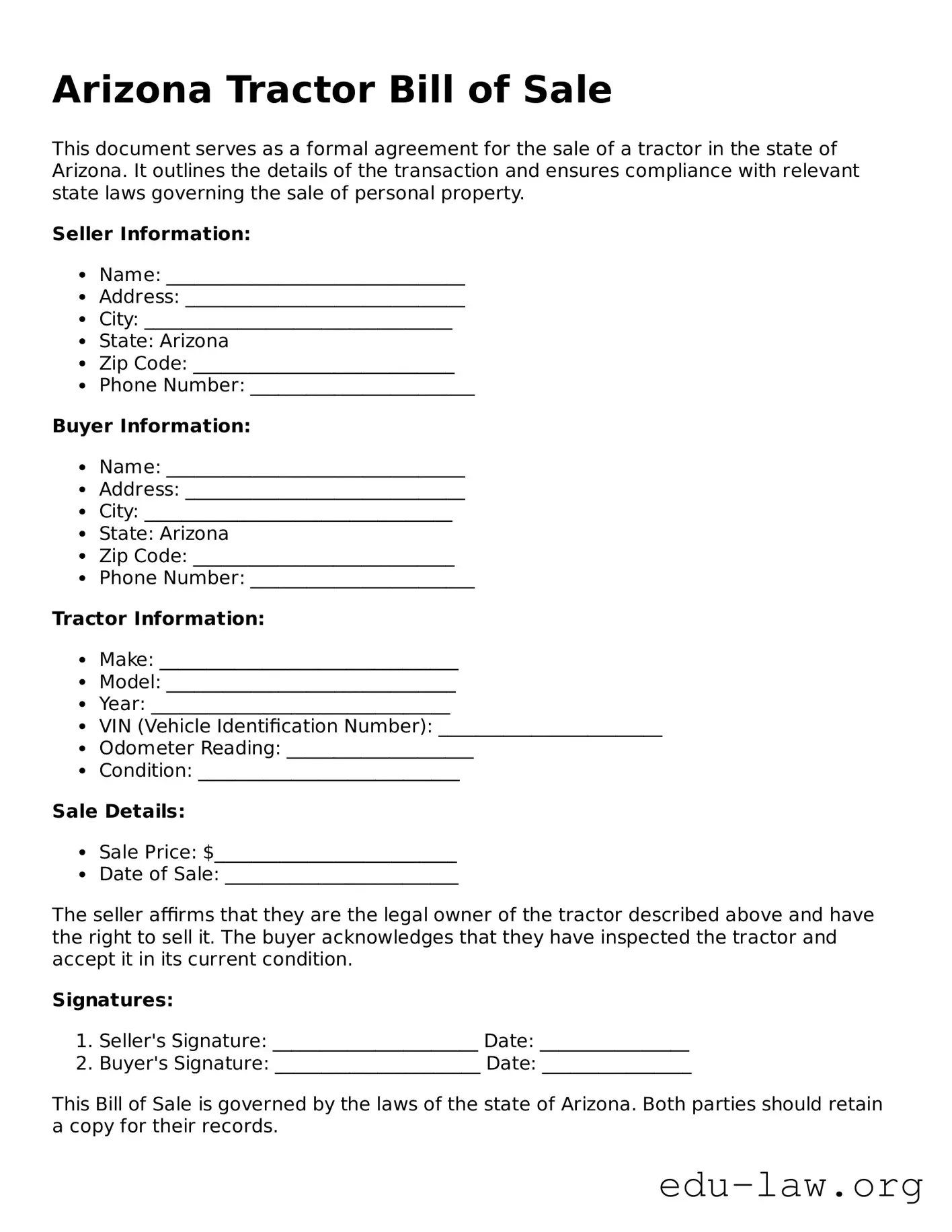
The Arizona Tractor Bill of Sale form serves as an essential document for anyone looking to buy or sell a tractor in the state. This form provides a clear record of the transaction, detailing important information about the buyer, seller, and the tractor itself. Key elements include the names and addresses of both parties, the tractor's make, model, year, and Vehicle Identification Number (VIN), as well as the sale price. Additionally, the form often includes a statement of any warranties or guarantees associated with the tractor. By completing this document, both parties can protect their interests and ensure that the transfer of ownership is legally recognized. Using the Arizona Tractor Bill of Sale form not only simplifies the buying and selling process but also aids in future registration and title transfer, making it a vital tool for anyone involved in agricultural equipment transactions in Arizona.
Arizona Tractor Bill of Sale
This document serves as a formal agreement for the sale of a tractor in the state of Arizona. It outlines the details of the transaction and ensures compliance with relevant state laws governing the sale of personal property.
Seller Information:
Buyer Information:
Tractor Information:
Sale Details:
The seller affirms that they are the legal owner of the tractor described above and have the right to sell it. The buyer acknowledges that they have inspected the tractor and accept it in its current condition.
Signatures:
This Bill of Sale is governed by the laws of the state of Arizona. Both parties should retain a copy for their records.
| Fact Name | Description |
|---|---|
| Purpose | The Arizona Tractor Bill of Sale form is used to document the sale and transfer of ownership of a tractor in the state of Arizona. |
| Governing Law | The sale of tractors in Arizona is governed by the Arizona Revised Statutes, specifically Title 28, which covers motor vehicles. |
| Required Information | The form typically requires details such as the buyer's and seller's names, addresses, and the tractor's make, model, and identification number. |
| Signatures | Both the seller and the buyer must sign the document to validate the sale and transfer of ownership. |
| Notarization | While notarization is not always required, it can provide an extra layer of authenticity and may be necessary for certain transactions. |
| Record Keeping | It is advisable for both parties to keep a copy of the completed Bill of Sale for their records, as it serves as proof of the transaction. |
After obtaining the Arizona Tractor Bill of Sale form, you will need to complete it accurately to ensure a smooth transaction. This document serves as proof of the sale and includes essential details about the tractor and the parties involved. Follow the steps below to fill out the form correctly.
What is the Arizona Tractor Bill of Sale form?
The Arizona Tractor Bill of Sale form is a legal document used to record the sale and transfer of ownership of a tractor in the state of Arizona. This form includes essential details such as the buyer's and seller's names, contact information, a description of the tractor, and the sale price. It serves as proof of the transaction and is crucial for both parties to protect their rights and responsibilities regarding the sale.
Why is a Tractor Bill of Sale important?
A Tractor Bill of Sale is important for several reasons. First, it provides legal evidence of the transaction, which can be useful in case of disputes. Second, it helps establish the transfer of ownership, ensuring that the buyer can register the tractor and obtain insurance. Lastly, it protects the seller by documenting that the tractor has been sold, which can be important for liability purposes.
What information is required on the form?
The Arizona Tractor Bill of Sale form typically requires specific information to be valid. This includes the full names and addresses of both the buyer and seller, the tractor's make, model, year, and Vehicle Identification Number (VIN). Additionally, the sale price and date of the transaction must be included. Some forms may also request the seller's signature and a witness or notary signature to enhance the document's legitimacy.
Is it necessary to notarize the Tractor Bill of Sale?
While notarization is not always required for a Tractor Bill of Sale in Arizona, it is highly recommended. Having the document notarized adds an extra layer of authenticity, which can be beneficial if any legal issues arise in the future. Notarization can also help prevent fraud, ensuring that both parties are protected during the transaction.
Incomplete Information: Many individuals fail to provide all required details. This includes missing the seller's or buyer's full name, address, or contact information. Each section must be filled out completely to ensure the document is valid.
Incorrect Vehicle Identification Number (VIN): A common mistake is entering an incorrect VIN. The VIN must match the one on the tractor's registration documents. Double-checking this number is crucial, as errors can lead to complications during the transfer of ownership.
Failure to Sign: Some people neglect to sign the form. Both the seller and the buyer must sign the document for it to be legally binding. Without signatures, the bill of sale may not be recognized as a valid transaction.
Not Including Sale Price: Omitting the sale price is another frequent error. The form should clearly state the agreed-upon amount for the tractor. This information is essential for tax purposes and for the records of both parties.
When engaging in the sale or purchase of a tractor in Arizona, several documents may accompany the Tractor Bill of Sale form. Each of these documents serves a specific purpose and can help ensure a smooth transaction. Below is a list of common forms that are often used alongside the Tractor Bill of Sale.
Having these documents ready can facilitate a smoother transaction and help avoid potential legal issues in the future. Each form plays a vital role in ensuring that both the buyer and seller are protected throughout the process.
The Vehicle Bill of Sale is a document used for the sale of motor vehicles. Similar to the Tractor Bill of Sale, it serves as proof of the transaction between the buyer and seller. This document typically includes details such as the vehicle's make, model, year, and identification number. Both forms protect the interests of both parties by providing a record of the sale.
The Boat Bill of Sale is another document that shares similarities with the Tractor Bill of Sale. This form is used when buying or selling a boat. It contains information about the boat, including its registration number, hull identification number, and condition. Like the Tractor Bill of Sale, it formalizes the transfer of ownership and provides legal protection for both the buyer and seller.
The Motorcycle Bill of Sale is also comparable. This document is specifically for the sale of motorcycles. It outlines the details of the motorcycle, such as the make, model, year, and VIN. Both the Motorcycle Bill of Sale and the Tractor Bill of Sale ensure that ownership is transferred properly and provide a record for future reference.
The RV Bill of Sale is used for recreational vehicles. It functions similarly to the Tractor Bill of Sale by documenting the sale and transfer of ownership. This document includes important details about the RV, such as its make, model, and year. Both forms help prevent disputes by providing clear evidence of the transaction.
The Snowmobile Bill of Sale is another related document. It is used when buying or selling snowmobiles. Like the Tractor Bill of Sale, it includes essential information about the snowmobile, such as its model and identification number. This document serves to protect both parties in the transaction and confirms the sale.
The ATV Bill of Sale is similar as well. This form is used for all-terrain vehicles. It includes details about the ATV, such as the make, model, and year. Both the ATV Bill of Sale and the Tractor Bill of Sale provide a written record of the sale, which is crucial for legal purposes.
The Equipment Bill of Sale is another document that serves a similar function. This form is used for the sale of various types of equipment, including agricultural machinery. Like the Tractor Bill of Sale, it details the equipment being sold and ensures that both parties have a record of the transaction.
The Firearm Bill of Sale is also relevant. This document is used when buying or selling firearms. It outlines the details of the firearm, such as the make, model, and serial number. Both the Firearm Bill of Sale and the Tractor Bill of Sale protect the rights of the buyer and seller by documenting the sale.
Finally, the Personal Property Bill of Sale is a general form used for various types of personal property sales. It is similar to the Tractor Bill of Sale in that it provides a record of the transaction and details about the item being sold. Both documents help ensure that ownership is transferred properly and legally.
When filling out the Arizona Tractor Bill of Sale form, attention to detail is crucial. Here are five things you should and shouldn't do:
The Arizona Tractor Bill of Sale form is an important document for anyone buying or selling a tractor in the state. However, there are several misconceptions surrounding it. Below are four common misunderstandings, along with clarifications.
This is not true. The Tractor Bill of Sale is required for both new and used tractors. Regardless of the age of the tractor, a bill of sale provides proof of the transaction and is crucial for registration purposes.
While a verbal agreement may seem convenient, it is not legally binding in the same way that a written bill of sale is. The written document protects both the buyer and the seller by clearly outlining the terms of the sale.
In Arizona, notarization of the Tractor Bill of Sale is not a requirement. However, having it notarized can add an extra layer of security and authenticity to the transaction.
This is misleading. It is best practice to complete the Tractor Bill of Sale at the time of the transaction. Doing so ensures that all details are accurately recorded and agreed upon by both parties.
When filling out and using the Arizona Tractor Bill of Sale form, consider the following key takeaways: