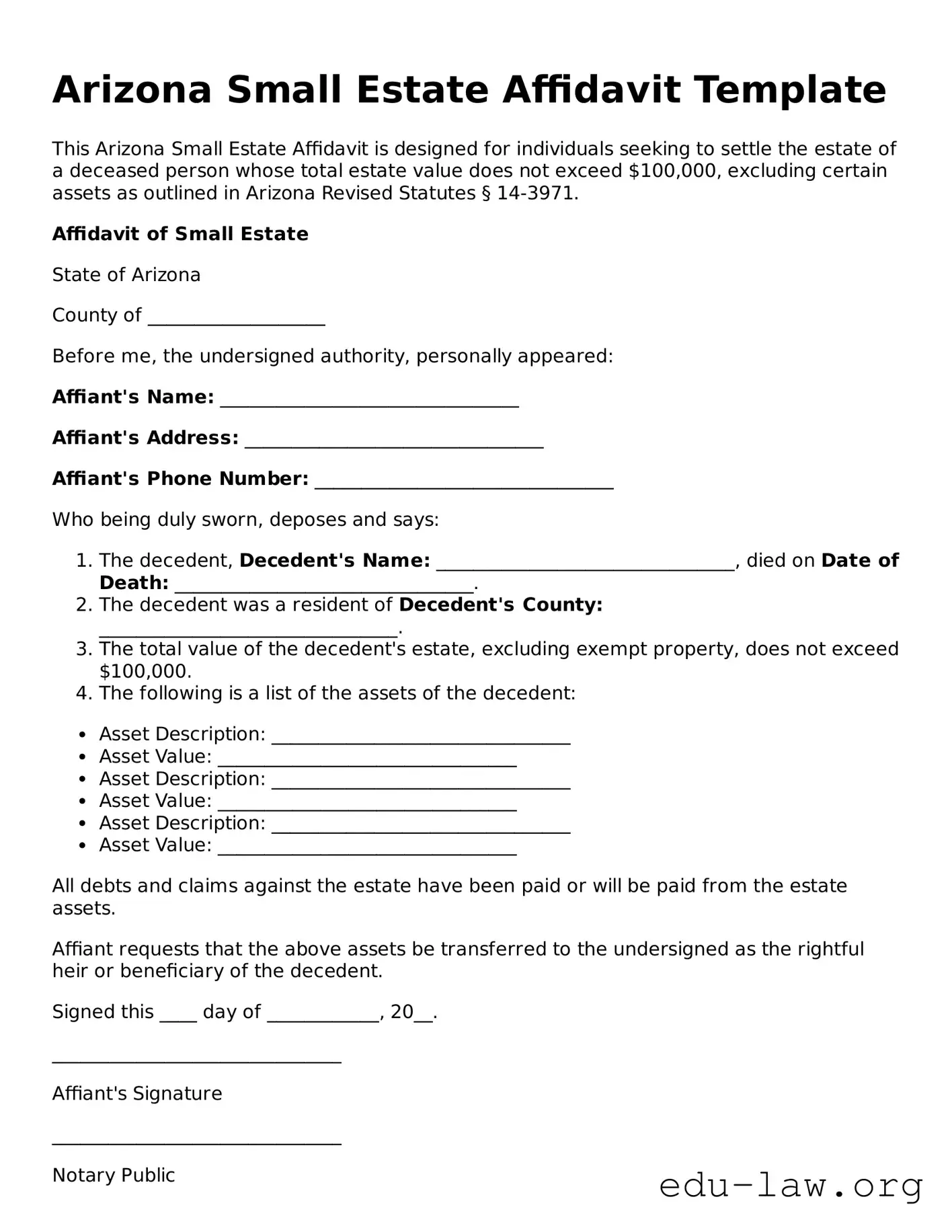
In Arizona, managing the estate of a loved one who has passed away can be a complex process, especially when it comes to settling their financial affairs. However, for smaller estates, the Arizona Small Estate Affidavit offers a streamlined approach to transferring assets without the need for formal probate. This form is designed for estates valued at $75,000 or less, excluding certain types of property like real estate. By using the Small Estate Affidavit, heirs can simplify the distribution of assets, allowing them to claim personal property, bank accounts, and other belongings more efficiently. The affidavit must be signed under oath and typically requires the affiant to provide information about the deceased, the assets involved, and the rightful heirs. This legal tool not only expedites the process but also reduces the emotional and financial burden on families during a challenging time. Understanding how to properly complete and file this form is essential for those looking to navigate the estate settlement process with ease.
Arizona Small Estate Affidavit Template
This Arizona Small Estate Affidavit is designed for individuals seeking to settle the estate of a deceased person whose total estate value does not exceed $100,000, excluding certain assets as outlined in Arizona Revised Statutes § 14-3971.
Affidavit of Small Estate
State of Arizona
County of ___________________
Before me, the undersigned authority, personally appeared:
Affiant's Name: ________________________________
Affiant's Address: ________________________________
Affiant's Phone Number: ________________________________
Who being duly sworn, deposes and says:
All debts and claims against the estate have been paid or will be paid from the estate assets.
Affiant requests that the above assets be transferred to the undersigned as the rightful heir or beneficiary of the decedent.
Signed this ____ day of ____________, 20__.
_______________________________
Affiant's Signature
_______________________________
Notary Public
My commission expires: ________________________________
| Fact Name | Description |
|---|---|
| Purpose | The Arizona Small Estate Affidavit allows individuals to claim assets of a deceased person without going through a formal probate process. |
| Eligibility | This form is applicable when the total value of the deceased's estate is $75,000 or less, excluding real property. |
| Governing Law | The use of the Small Estate Affidavit is governed by Arizona Revised Statutes, specifically A.R.S. § 14-3971. |
| Filing Requirements | The affidavit must be signed under oath and typically requires the signatures of all heirs or beneficiaries of the estate. |
After obtaining the Arizona Small Estate Affidavit form, you will need to carefully fill it out with accurate information. This process involves providing details about the deceased individual, the estate, and the heirs. Once completed, the form will be submitted to the appropriate court or authority to proceed with the estate settlement.
What is the Arizona Small Estate Affidavit form?
The Arizona Small Estate Affidavit form is a legal document that allows individuals to claim the assets of a deceased person without going through the formal probate process. This option is available when the total value of the estate does not exceed a specific threshold, which is currently set at $75,000 for personal property and $100,000 for real property. The affidavit simplifies the transfer of assets, making it easier for heirs or beneficiaries to access what they are entitled to receive.
Who is eligible to use the Small Estate Affidavit?
To use the Small Estate Affidavit, the individual must be an heir or a beneficiary of the deceased person. The estate must meet the value requirements mentioned earlier. Additionally, the deceased must have been a resident of Arizona at the time of death. It is important to note that if there is a will, it should be considered, but the affidavit can still be used if the estate qualifies. Anyone interested in filing should ensure they meet all eligibility criteria before proceeding.
What information is required to complete the form?
Completing the Arizona Small Estate Affidavit requires specific information about the deceased and their assets. This includes the full name and address of the deceased, the date of death, and a list of the assets that are being claimed. It is also necessary to provide details about the affiant, the person signing the affidavit, including their relationship to the deceased. Accurate information is crucial, as any discrepancies could delay the process or lead to legal complications.
How do I file the Small Estate Affidavit?
Filing the Small Estate Affidavit involves several steps. First, the completed form must be signed in front of a notary public. After notarization, the affidavit can be submitted to the appropriate financial institutions, such as banks or insurance companies, to access the deceased's assets. In some cases, it may be necessary to file the affidavit with the county recorder's office, especially if real property is involved. Always keep copies of all documents for your records.
Not checking the eligibility requirements. Before filling out the form, it’s important to ensure that the estate qualifies as a small estate under Arizona law.
Failing to provide accurate information. Double-check names, addresses, and other details. Incorrect information can lead to delays or rejection of the affidavit.
Not including all required assets. Make sure to list all assets that fall under the small estate definition. Omitting any can cause issues.
Neglecting to sign the affidavit. An unsigned form is not valid. Ensure that all necessary signatures are included before submission.
Using outdated forms. Always download the latest version of the Small Estate Affidavit. Using an old form can lead to complications.
Not providing supporting documents. Some assets may require additional documentation. Be prepared to include these when submitting the affidavit.
Ignoring the notary requirement. Most affidavits need to be notarized. Failing to do this can invalidate the document.
Submitting the affidavit to the wrong court. Ensure you know the correct court to file your affidavit. This can vary based on where the deceased lived.
Overlooking deadlines. There may be specific timelines for submitting the affidavit. Missing these can complicate the process.
Not seeking help when needed. If you’re unsure about any part of the process, consider consulting with a legal professional. It’s better to ask for help than to make mistakes.
The Arizona Small Estate Affidavit is a useful tool for settling the estates of individuals who have passed away with limited assets. However, there are several other forms and documents that may be necessary to complete the process smoothly. Here’s a brief overview of some commonly used documents alongside the Small Estate Affidavit.
Having these documents ready can streamline the process and help ensure that the estate is settled in accordance with the law and the wishes of the deceased. Proper preparation can make a difficult time a little easier for everyone involved.
The Arizona Small Estate Affidavit is similar to the California Small Estate Affidavit, which allows individuals to claim property of a deceased person without going through formal probate. In California, this affidavit can be used when the total value of the estate is under a certain threshold, which is set at $166,250 as of 2023. Both documents serve to simplify the transfer of assets, enabling heirs or beneficiaries to access property more quickly and with less expense than traditional probate processes.
Another comparable document is the Texas Small Estate Affidavit. In Texas, this affidavit can be utilized when the estate's total value does not exceed $75,000, excluding certain exempt property. Like its Arizona counterpart, the Texas Small Estate Affidavit allows heirs to bypass formal probate proceedings, streamlining the process of distributing the deceased's assets to rightful beneficiaries. Both documents require the affiant to provide information about the deceased and the estate's assets.
The Florida Summary Administration form is also similar to the Arizona Small Estate Affidavit. This form is used in Florida when an estate's value is under $75,000 or when the decedent has been deceased for more than two years. Summary Administration allows for a simplified process, enabling heirs to receive their inheritance without the need for a full probate process. Both documents aim to reduce the administrative burden on families dealing with the loss of a loved one.
The New York Affidavit for Small Estates serves a similar purpose as the Arizona Small Estate Affidavit. In New York, this document can be used when the estate's value is under $50,000. It allows heirs to collect assets without going through the lengthy probate process. Both forms require the affiant to affirm their relationship to the deceased and provide details about the estate's assets, thus facilitating a quicker resolution for families.
Lastly, the Illinois Small Estate Affidavit shares similarities with the Arizona Small Estate Affidavit. In Illinois, this affidavit can be utilized when the estate's value is less than $100,000. It permits heirs to claim assets without formal probate proceedings. Both documents require the affiant to provide information about the decedent and their heirs, making the transfer of property more efficient during a challenging time.
When filling out the Arizona Small Estate Affidavit form, consider the following guidelines:
The Arizona Small Estate Affidavit is a useful tool for settling the estates of deceased individuals without the need for formal probate. However, several misconceptions can lead to confusion. Here are ten common misconceptions about this form:
Understanding these misconceptions can help individuals navigate the process of settling an estate more confidently. The Arizona Small Estate Affidavit can be a straightforward solution for many, provided the correct information is utilized.
Filling out and using the Arizona Small Estate Affidavit form can be a straightforward process if you understand the key aspects. Here are some important takeaways: