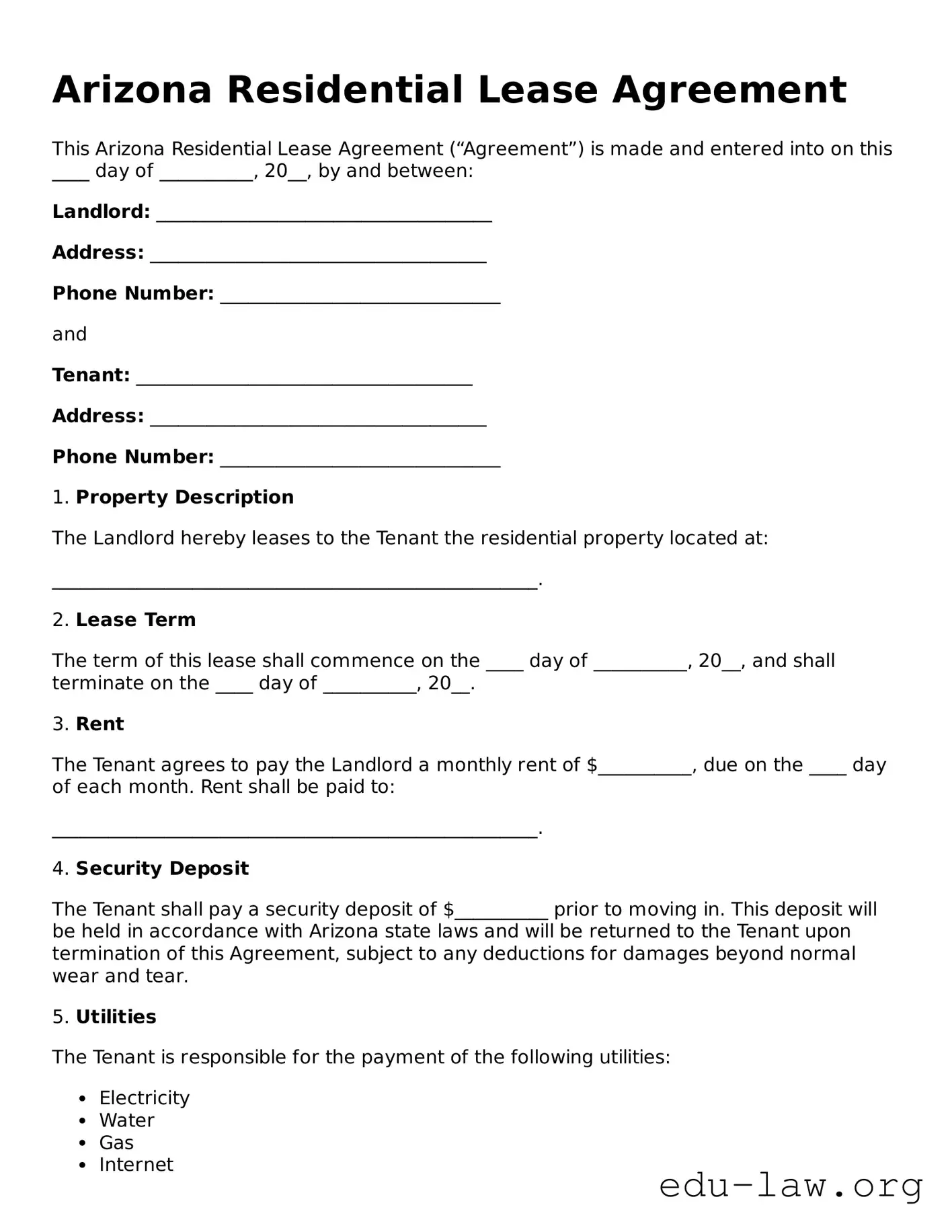
The Arizona Residential Lease Agreement is a crucial document for both landlords and tenants, providing a clear framework for rental arrangements within the state. This agreement outlines essential terms such as the duration of the lease, rental payment details, and security deposit requirements. It also specifies the responsibilities of both parties, including maintenance obligations and rules regarding property use. Furthermore, the form addresses important issues like late fees, termination conditions, and procedures for resolving disputes. By clearly defining these elements, the Arizona Residential Lease Agreement helps prevent misunderstandings and protects the rights of all involved. Understanding this document is vital for anyone entering into a rental agreement in Arizona, as it lays the groundwork for a successful landlord-tenant relationship.
Arizona Residential Lease Agreement
This Arizona Residential Lease Agreement (“Agreement”) is made and entered into on this ____ day of __________, 20__, by and between:
Landlord: ____________________________________
Address: ____________________________________
Phone Number: ______________________________
and
Tenant: ____________________________________
Address: ____________________________________
Phone Number: ______________________________
1. Property Description
The Landlord hereby leases to the Tenant the residential property located at:
____________________________________________________.
2. Lease Term
The term of this lease shall commence on the ____ day of __________, 20__, and shall terminate on the ____ day of __________, 20__.
3. Rent
The Tenant agrees to pay the Landlord a monthly rent of $__________, due on the ____ day of each month. Rent shall be paid to:
____________________________________________________.
4. Security Deposit
The Tenant shall pay a security deposit of $__________ prior to moving in. This deposit will be held in accordance with Arizona state laws and will be returned to the Tenant upon termination of this Agreement, subject to any deductions for damages beyond normal wear and tear.
5. Utilities
The Tenant is responsible for the payment of the following utilities:
6. Maintenance and Repairs
The Tenant shall keep the premises in a clean and sanitary condition. Any needed repairs should be reported to the Landlord promptly. The Landlord shall be responsible for major repairs, unless damage is caused by the Tenant's negligence.
7. Pets
[ ] Pets are allowed with an additional deposit of $__________.
[ ] Pets are not allowed.
8. Termination
Either party may terminate this Agreement at the end of the lease term by providing a written notice at least ____ days prior to the termination date.
9. Governing Law
This Agreement shall be governed by the laws of the State of Arizona.
10. Signatures
By signing below, both parties agree to the terms and conditions outlined in this Agreement:
Landlord Signature: ____________________________ Date: ____________
Tenant Signature: _____________________________ Date: ____________
This Agreement constitutes the entire understanding between the parties and supersedes all prior negotiations, representations, or agreements, whether written or oral.
| Fact Name | Description |
|---|---|
| Governing Law | The Arizona Residential Lease Agreement is governed by Arizona Revised Statutes Title 33, Chapter 10. |
| Parties Involved | The form outlines the responsibilities and rights of both the landlord and tenant. |
| Duration of Lease | The lease agreement specifies the length of the tenancy, typically ranging from one year to month-to-month. |
| Security Deposit | Arizona law limits the security deposit to one and a half months' rent for unfurnished properties. |
Filling out the Arizona Residential Lease Agreement form requires careful attention to detail. Each section must be completed accurately to ensure both parties understand their rights and responsibilities. Follow these steps to complete the form correctly.
What is an Arizona Residential Lease Agreement?
The Arizona Residential Lease Agreement is a legally binding contract between a landlord and a tenant. It outlines the terms and conditions under which a tenant can occupy a residential property. This document typically includes details such as the rental amount, lease duration, security deposit requirements, and responsibilities of both parties.
What should be included in the lease agreement?
A comprehensive lease agreement should include several key components. These typically consist of the names of the parties involved, the property address, the rental amount and due date, lease term (fixed or month-to-month), security deposit information, maintenance responsibilities, and any rules regarding pets or smoking. Additionally, it should outline the procedures for termination and renewal of the lease.
How long is a typical lease term in Arizona?
In Arizona, lease terms can vary. Most residential leases are either for a fixed term of one year or are month-to-month. A fixed-term lease provides stability for both the landlord and tenant, while a month-to-month lease offers more flexibility. It's essential to clarify the lease duration in the agreement.
Can a landlord increase the rent during the lease term?
Generally, a landlord cannot increase the rent during the term of a fixed lease agreement. However, if the lease is month-to-month, the landlord may increase the rent by providing proper notice, typically 30 days in Arizona. The specific terms regarding rent increases should be clearly stated in the lease.
What happens if the tenant wants to break the lease early?
If a tenant wishes to break the lease early, they may face penalties. The lease agreement should specify the consequences of early termination, which may include forfeiting the security deposit or being responsible for rent until a new tenant is found. Arizona law requires landlords to mitigate damages by making reasonable efforts to re-rent the property.
Is a security deposit required?
Yes, a security deposit is commonly required in Arizona. The amount is typically equivalent to one and a half times the monthly rent but cannot exceed two times the monthly rent. The lease agreement should detail the conditions under which the deposit may be withheld at the end of the lease.
What rights do tenants have under Arizona law?
Tenants in Arizona have several rights, including the right to a habitable living environment, the right to privacy, and the right to receive proper notice before eviction. Arizona law also protects tenants from retaliation by landlords for exercising their rights, such as filing complaints about unsafe living conditions.
Can a tenant sublet the property?
Subletting rules should be clearly outlined in the lease agreement. Generally, a tenant must obtain the landlord's permission before subletting the property. If allowed, the lease should specify any conditions or limitations regarding subletting.
What should a tenant do if repairs are needed?
If repairs are needed, the tenant should notify the landlord in writing. Arizona law requires landlords to maintain rental properties in a habitable condition. If the landlord fails to make necessary repairs, tenants may have the right to take further action, including reporting the issue to local authorities or seeking legal remedies.
Are there any specific disclosures required in Arizona?
Yes, Arizona law requires landlords to provide certain disclosures to tenants. These may include information about lead-based paint in properties built before 1978, the presence of bedbugs, and any known issues with the property that could affect health or safety. Such disclosures should be included in the lease agreement or provided as separate documents.
Not including all required information: It’s essential to fill in every section of the lease agreement. Missing information, such as the landlord's name or the rental property's address, can lead to confusion later.
Incorrect dates: Ensure that the start and end dates of the lease are accurate. Mistakes in dates can affect the rental term and create disputes.
Neglecting to specify rent details: Clearly state the amount of rent, payment due dates, and acceptable payment methods. Leaving this information vague can lead to misunderstandings.
Ignoring additional fees: Include any extra fees, such as late payment charges or pet fees. Failing to mention these can result in unexpected costs for tenants.
Not addressing maintenance responsibilities: Clearly outline who is responsible for maintenance and repairs. This helps prevent disputes over property upkeep.
Overlooking tenant and landlord signatures: Both parties must sign the agreement for it to be legally binding. Without signatures, the lease may not hold up in court.
Failing to review local laws: Ensure compliance with Arizona rental laws. Not being aware of local regulations can lead to legal issues down the line.
When entering into a rental agreement in Arizona, it is important to have a comprehensive understanding of the various forms and documents that may accompany the Residential Lease Agreement. Each of these documents serves a specific purpose, ensuring clarity and protection for both landlords and tenants. Below is a list of commonly used forms that can enhance the leasing process.
Understanding these documents can help facilitate a smoother rental experience. By being prepared with the right forms, both landlords and tenants can protect their interests and foster a positive rental relationship.
The Arizona Residential Lease Agreement is similar to the standard Residential Lease Agreement used across many states. Both documents outline the rights and responsibilities of landlords and tenants. They typically include details such as the rental amount, duration of the lease, security deposits, and maintenance responsibilities. The primary goal of both agreements is to protect the interests of both parties while ensuring clear communication regarding rental terms.
Another document that shares similarities is the Commercial Lease Agreement. This agreement is used for renting commercial properties, such as office spaces or retail locations. Like the residential version, it specifies rental terms, duration, and responsibilities. However, it often includes additional clauses related to business operations, zoning laws, and modifications to the property, reflecting the unique needs of commercial tenants.
The Month-to-Month Lease Agreement is also akin to the Arizona Residential Lease Agreement. This type of lease allows tenants to occupy a rental property on a month-to-month basis without a long-term commitment. Similar to the standard lease, it outlines rental terms, but it provides greater flexibility for both landlords and tenants. Either party can terminate the agreement with proper notice, making it a popular choice for those seeking short-term housing.
A Lease Purchase Agreement is another document that bears resemblance to the Arizona Residential Lease Agreement. This agreement combines elements of a lease and a purchase option. Tenants can rent the property with the option to buy it at a later date. It includes terms for both renting and purchasing, allowing tenants to build equity while living in the home. This arrangement can be beneficial for those looking to eventually own a property.
The Lease Option Agreement is similar to the Lease Purchase Agreement but offers a slightly different structure. This document allows tenants to lease a property with the option to buy it at a predetermined price within a specified timeframe. While both agreements provide a pathway to homeownership, the Lease Option Agreement typically does not obligate the tenant to purchase the property, offering more flexibility.
A Rental Application is another document that aligns with the Arizona Residential Lease Agreement. While not a lease itself, the rental application is often completed before the lease is signed. It collects essential information about potential tenants, such as employment history, rental history, and creditworthiness. This document helps landlords assess whether a tenant is a suitable fit for their property.
The Move-In Checklist is closely related to the lease agreement as well. This document is used to record the condition of the rental property before the tenant moves in. Both landlords and tenants typically complete it together. It helps prevent disputes over property damage and ensures that both parties agree on the state of the property at the start of the tenancy.
The Security Deposit Agreement is another important document that complements the Arizona Residential Lease Agreement. This agreement outlines the terms surrounding the security deposit, including the amount, conditions for its return, and any deductions that may be made for damages. It protects both landlords and tenants by clarifying expectations regarding the deposit.
Lastly, the Eviction Notice is a document that, while not a lease agreement, is related to the landlord-tenant relationship. This notice is issued when a tenant fails to comply with lease terms, such as not paying rent. It outlines the reasons for eviction and provides a timeline for the tenant to vacate the property. Understanding this document is crucial for both parties to ensure compliance with legal requirements during the eviction process.
When filling out the Arizona Residential Lease Agreement form, it’s essential to approach the process with care. Here are some important dos and don’ts to keep in mind:
By following these guidelines, you can help ensure that your lease agreement is clear, comprehensive, and legally sound.
When dealing with the Arizona Residential Lease Agreement, many individuals hold misconceptions that can lead to confusion and potential legal issues. Understanding these misconceptions is crucial for both landlords and tenants. Below is a list of ten common misunderstandings regarding this important document.
Many people believe that all lease agreements are interchangeable. In reality, each lease can differ significantly based on specific terms, conditions, and local laws.
Some individuals think that a verbal agreement is as binding as a written lease. However, written agreements provide clear evidence of the terms agreed upon and are typically enforceable in court.
There is a common belief that security deposits cannot be refunded. In Arizona, security deposits can be refunded, provided the property is returned in good condition and all terms of the lease are met.
Some tenants assume that landlords have unrestricted access to the rental property. In Arizona, landlords must give proper notice before entering, except in emergencies.
Many tenants think that rent is fixed for the entire lease period. While it is true that the rent amount is usually set for the lease term, some agreements may allow for increases under specific conditions.
Some people believe that all residential leases ban pets. In fact, pet policies vary by lease, and some landlords may allow pets with certain restrictions.
Many tenants think they can make changes to the property without consulting the landlord. However, most leases require tenants to obtain permission for any alterations.
Some individuals believe that a lease can be valid without signatures. In reality, both parties must sign the lease for it to be legally binding.
While many terms can be negotiated, some landlords may have strict policies that do not allow for changes. It's essential to discuss any desired modifications before signing.
Lastly, there is a misconception that lease agreements apply only to long-term rentals. In fact, lease agreements can also be used for short-term rentals, depending on the terms outlined.
Understanding these misconceptions can help both landlords and tenants navigate their rights and responsibilities more effectively. Clear communication and a thorough understanding of the lease agreement are essential for a successful rental experience.
When filling out and using the Arizona Residential Lease Agreement form, it’s important to keep several key points in mind. This document outlines the rights and responsibilities of both landlords and tenants. Here are some essential takeaways:
By paying attention to these key aspects, both landlords and tenants can create a clear and fair lease agreement that protects their interests.