The Arizona Quitclaim Deed is a valuable tool for property owners looking to transfer their interest in real estate quickly and efficiently. This form serves as a legal document that allows one party, known as the grantor, to convey their ownership rights to another party, referred to as the grantee, without making any guarantees about the title's validity. It is particularly useful in situations such as transferring property between family members, settling estates, or correcting title issues. The simplicity of the quitclaim deed makes it an appealing option, as it does not require the extensive disclosures or warranties found in other types of deeds. However, while it offers a streamlined approach to property transfer, it is essential for both parties to understand the implications of using this form, particularly regarding potential risks related to undisclosed liens or claims. In Arizona, specific requirements must be met for the deed to be valid, including proper execution, notarization, and recording with the county recorder's office. Understanding these elements can help ensure a smooth transaction and protect the interests of everyone involved.
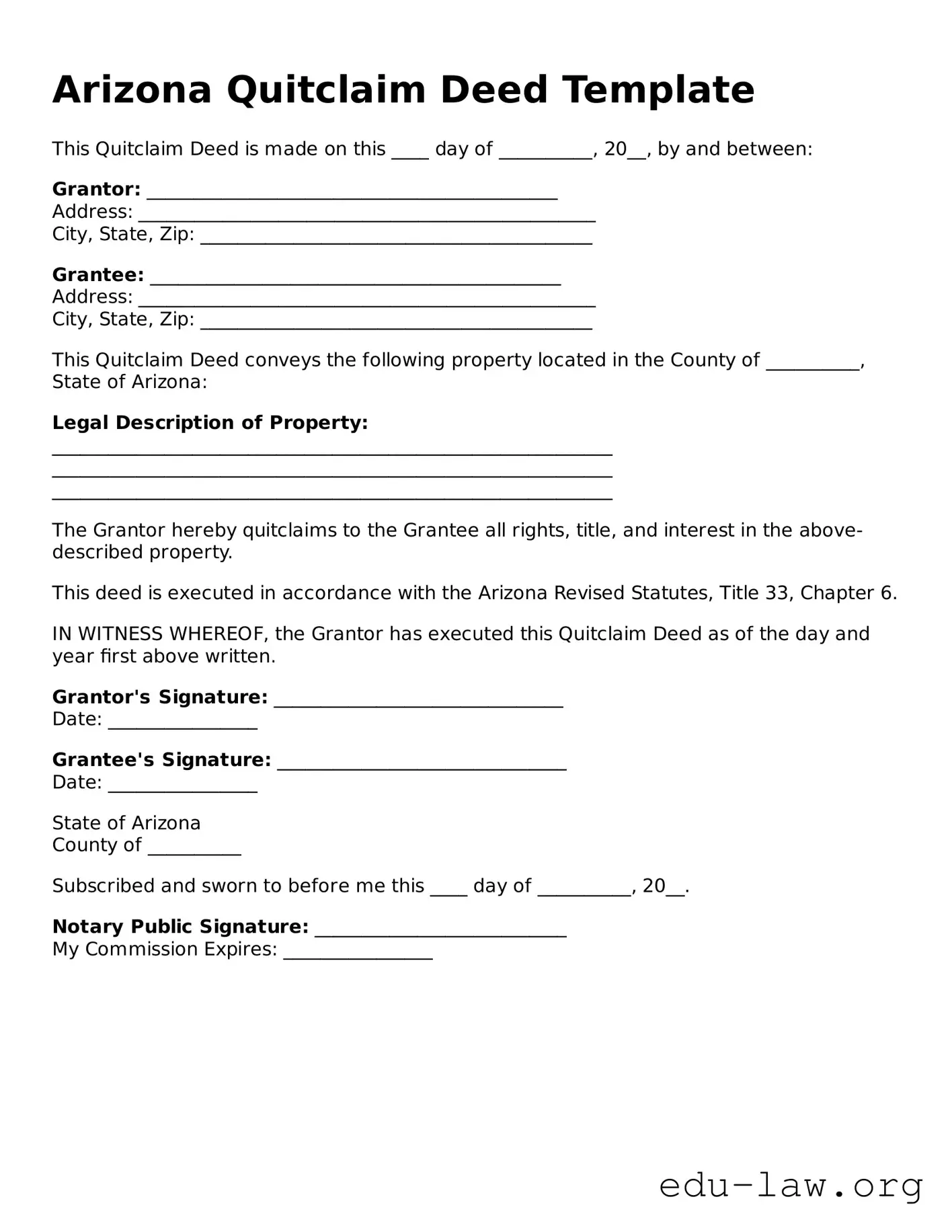
Arizona Quitclaim Deed Template
This Quitclaim Deed is made on this ____ day of __________, 20__, by and between:
Grantor: ____________________________________________
Address: _________________________________________________
City, State, Zip: __________________________________________
Grantee: ____________________________________________
Address: _________________________________________________
City, State, Zip: __________________________________________
This Quitclaim Deed conveys the following property located in the County of __________, State of Arizona:
Legal Description of Property:
____________________________________________________________
____________________________________________________________
____________________________________________________________
The Grantor hereby quitclaims to the Grantee all rights, title, and interest in the above-described property.
This deed is executed in accordance with the Arizona Revised Statutes, Title 33, Chapter 6.
IN WITNESS WHEREOF, the Grantor has executed this Quitclaim Deed as of the day and year first above written.
Grantor's Signature: _______________________________
Date: ________________
Grantee's Signature: _______________________________
Date: ________________
State of Arizona
County of __________
Subscribed and sworn to before me this ____ day of __________, 20__.
Notary Public Signature: ___________________________
My Commission Expires: ________________
| Fact Name | Description |
|---|---|
| Definition | A quitclaim deed is a legal document used to transfer ownership of real estate from one party to another without any guarantees about the property’s title. |
| Governing Law | The Arizona Quitclaim Deed is governed by Arizona Revised Statutes, Title 33, Chapter 6. |
| Usage | This type of deed is often used in situations where the parties know each other, such as family transfers or divorces. |
| Title Assurance | Unlike warranty deeds, quitclaim deeds do not provide any warranty or guarantee of clear title. |
| Form Requirements | The form must include the names of the grantor and grantee, a legal description of the property, and must be signed by the grantor. |
| Recording | To protect the interests of the grantee, the quitclaim deed should be recorded with the county recorder’s office. |
| Consideration | While consideration is not always required, it is common to include a nominal amount, such as $1, to validate the transaction. |
| Tax Implications | Transferring property via a quitclaim deed may have tax implications, including potential gift tax considerations. |
| Limitations | Using a quitclaim deed does not eliminate any existing liens or encumbrances on the property; these remain with the property. |
After you have gathered the necessary information, you are ready to fill out the Arizona Quitclaim Deed form. This document will need to be completed accurately to ensure a smooth transfer of property rights. Follow these steps carefully to complete the form correctly.
What is a Quitclaim Deed in Arizona?
A Quitclaim Deed is a legal document used to transfer ownership of real estate in Arizona. This type of deed allows the current owner, known as the grantor, to transfer their interest in the property to another party, known as the grantee, without making any guarantees about the title. Essentially, the grantor "quits" any claim to the property, and the grantee receives whatever interest the grantor had, if any. This deed is often used among family members or in situations where the parties know each other well.
How do I complete an Arizona Quitclaim Deed?
To complete a Quitclaim Deed in Arizona, you need to fill out the form with specific information. This includes the names of the grantor and grantee, the legal description of the property, and the date of the transfer. The form must be signed by the grantor in the presence of a notary public. After signing, the deed should be filed with the county recorder's office in the county where the property is located. It is essential to ensure that all information is accurate to avoid any issues with the transfer.
Is a Quitclaim Deed the same as a Warranty Deed?
No, a Quitclaim Deed is not the same as a Warranty Deed. A Warranty Deed provides a guarantee that the grantor holds clear title to the property and has the right to sell it. In contrast, a Quitclaim Deed does not offer any such guarantees. The grantor does not assure the grantee that the title is free from claims or encumbrances. Due to this difference, Quitclaim Deeds are typically used in less formal transactions, while Warranty Deeds are preferred for sales involving third parties.
Are there any tax implications when using a Quitclaim Deed in Arizona?
When transferring property using a Quitclaim Deed in Arizona, there may be tax implications to consider. Generally, if no money is exchanged for the property, the transfer may not be subject to state transaction privilege tax. However, it is advisable to consult with a tax professional or attorney to understand any potential tax consequences, especially if the property has appreciated in value or if there are existing liens or mortgages.
Can a Quitclaim Deed be revoked in Arizona?
Once a Quitclaim Deed is executed and recorded, it cannot be unilaterally revoked by the grantor. The transfer of property rights is considered complete. However, if both parties agree, they can execute a new deed to reverse the transaction. This would typically involve the grantee transferring the property back to the grantor. Legal advice may be beneficial in such situations to ensure compliance with applicable laws and regulations.
Failing to include the correct legal description of the property. This description must be precise and can typically be found in the property’s title or deed. Without it, the deed may not be valid.
Not signing the deed in front of a notary public. A quitclaim deed must be notarized to be legally binding. Omitting this step can lead to issues in the future.
Using incorrect names for the parties involved. It is essential to ensure that the names of both the grantor (the person transferring the property) and the grantee (the person receiving the property) are spelled correctly and match their legal identification.
Neglecting to check for existing liens or encumbrances on the property. A quitclaim deed does not clear any existing debts tied to the property, which can create complications for the grantee.
Failing to record the deed with the county recorder's office. After completing the form, it must be submitted for recording. This step is crucial for establishing public notice of the property transfer.
Overlooking state-specific requirements. Arizona may have particular regulations or forms that need to be adhered to when completing a quitclaim deed. Ignoring these can lead to invalidation of the deed.
When dealing with property transfers in Arizona, the Quitclaim Deed is a common document used to convey ownership. However, several other forms and documents often accompany it to ensure a smooth transaction. Below is a list of these important documents, each serving a specific purpose in the process.
Having these documents ready can streamline the property transfer process and help avoid potential issues. Always consult with a professional to ensure all necessary paperwork is completed accurately and efficiently.
The Arizona Warranty Deed is similar to a Quitclaim Deed in that both are used to transfer property ownership. However, the key difference lies in the level of guarantee provided. A Warranty Deed offers a strong assurance that the seller holds clear title to the property and has the right to sell it. In contrast, a Quitclaim Deed transfers whatever interest the seller has in the property, without any warranties. This means that if there are issues with the title, the buyer cannot hold the seller responsible.
The Arizona Grant Deed also resembles a Quitclaim Deed, but with some important distinctions. A Grant Deed ensures that the property has not been sold to anyone else and that there are no undisclosed encumbrances. While a Quitclaim Deed does not provide these assurances, it serves a similar purpose of transferring ownership. Both forms are often used in informal transactions, but the Grant Deed offers more protection for the buyer.
When filling out the Arizona Quitclaim Deed form, it’s important to follow certain guidelines to ensure accuracy and compliance. Here are some key dos and don’ts:
Understanding the Arizona Quitclaim Deed form is essential for anyone involved in property transactions. However, several misconceptions can lead to confusion. Here are nine common misunderstandings:
Awareness of these misconceptions can help individuals navigate property transactions more effectively and avoid potential pitfalls.
Filling out and using the Arizona Quitclaim Deed form requires careful attention to detail. Here are some key takeaways to consider: