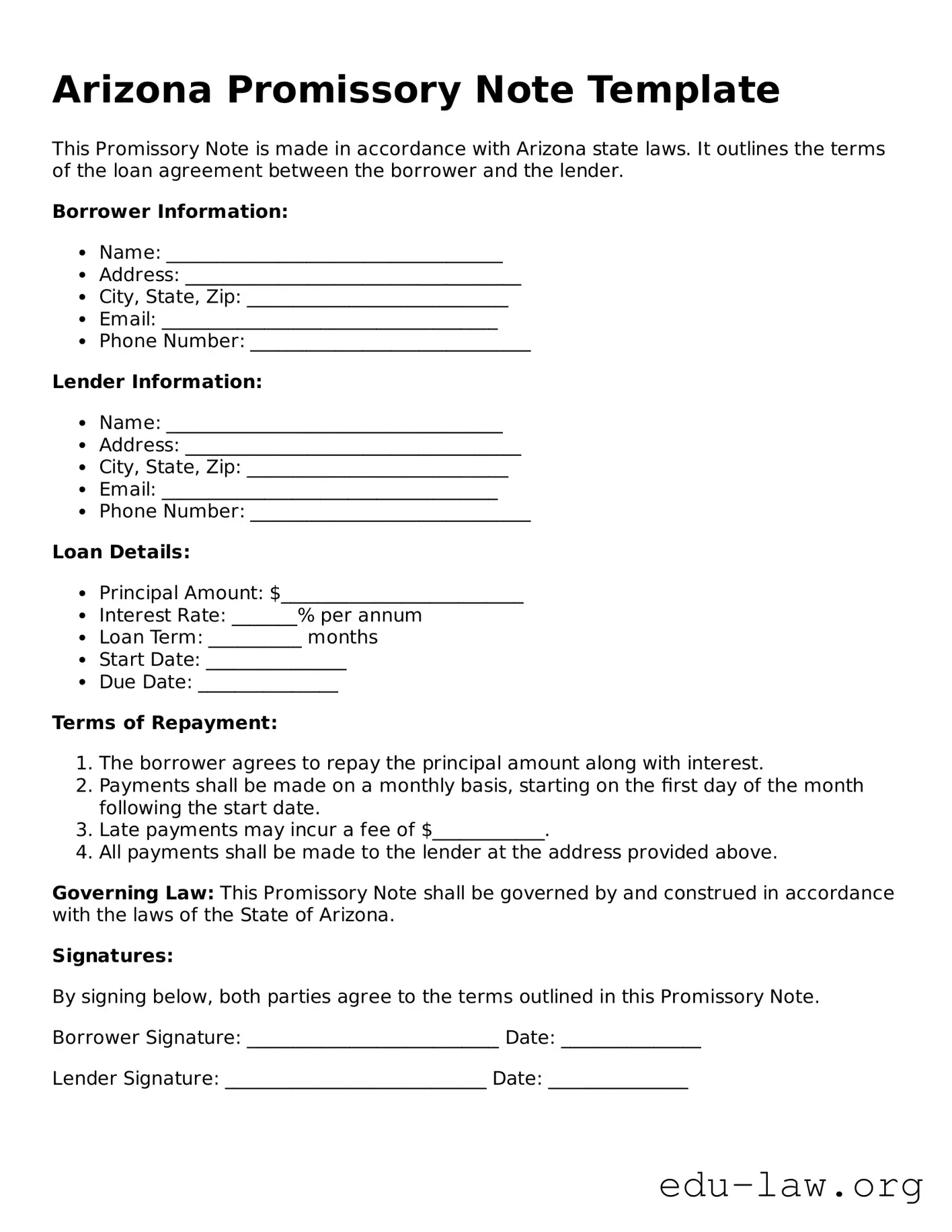
In Arizona, the Promissory Note serves as a vital financial instrument that outlines the terms of a loan agreement between a borrower and a lender. This legally binding document specifies the amount borrowed, the interest rate, and the repayment schedule, ensuring clarity and mutual understanding. Key components include the due date for payments, any penalties for late payments, and the conditions under which the lender may demand immediate repayment. Additionally, the form may outline provisions for default, detailing the rights and responsibilities of both parties. By providing a structured framework for repayment, the Promissory Note not only protects the lender's interests but also offers the borrower a clear roadmap for fulfilling their obligations. Understanding the nuances of this form can empower individuals and businesses alike to engage in financial transactions with confidence.
Arizona Promissory Note Template
This Promissory Note is made in accordance with Arizona state laws. It outlines the terms of the loan agreement between the borrower and the lender.
Borrower Information:
Lender Information:
Loan Details:
Terms of Repayment:
Governing Law: This Promissory Note shall be governed by and construed in accordance with the laws of the State of Arizona.
Signatures:
By signing below, both parties agree to the terms outlined in this Promissory Note.
Borrower Signature: ___________________________ Date: _______________
Lender Signature: ____________________________ Date: _______________
| Fact Name | Details |
|---|---|
| Definition | A promissory note is a written promise to pay a specified amount of money to a designated person or entity at a specified time. |
| Governing Law | The Arizona Uniform Commercial Code (UCC) governs promissory notes in Arizona. |
| Parties Involved | Typically, a promissory note involves two parties: the maker (borrower) and the payee (lender). |
| Interest Rate | The note can specify an interest rate, which must comply with Arizona state usury laws. |
| Payment Terms | Payment terms must be clearly defined, including the due date and payment schedule. |
| Signature Requirement | The maker must sign the promissory note for it to be legally binding. |
| Enforceability | Promissory notes are enforceable in court if they meet the legal requirements set forth in Arizona law. |
| Default Provisions | The note may include provisions outlining what happens in the event of default, such as late fees or acceleration clauses. |
| Transferability | Promissory notes can be transferred to another party, often through endorsement. |
| Record Keeping | Both parties should keep a copy of the signed promissory note for their records. |
After obtaining the Arizona Promissory Note form, you will need to complete it accurately to ensure that all necessary details are included. This form will require specific information about the borrower, the lender, and the terms of the loan. Once filled out, the form should be signed by both parties to make it legally binding.
What is a Promissory Note in Arizona?
A Promissory Note is a written promise to pay a specified amount of money to a designated person or entity at a future date or on demand. In Arizona, it serves as a legal document that outlines the terms of the loan, including the principal amount, interest rate, and repayment schedule.
Who can use a Promissory Note?
Any individual or business can use a Promissory Note in Arizona. It is commonly used in personal loans, business transactions, and real estate financing. Both lenders and borrowers benefit from this document as it formalizes the agreement and provides legal protection.
What are the essential elements of an Arizona Promissory Note?
An effective Promissory Note should include the following elements: the names and addresses of the borrower and lender, the principal amount, interest rate, repayment terms, maturity date, and any provisions for default. Clarity in these terms helps prevent misunderstandings.
Is a Promissory Note legally binding?
Yes, a properly executed Promissory Note is legally binding in Arizona. It becomes enforceable in a court of law, meaning that if the borrower fails to repay, the lender has the right to seek legal remedies to recover the owed amount.
Do I need to have a lawyer to create a Promissory Note?
While it is not mandatory to have a lawyer, consulting one can be beneficial, especially for complex transactions. A legal professional can ensure that the document complies with state laws and accurately reflects the intentions of both parties.
Can a Promissory Note be modified?
Yes, a Promissory Note can be modified if both parties agree to the changes. It is advisable to document any modifications in writing and have both parties sign the amended note to avoid future disputes.
What happens if the borrower defaults on the Promissory Note?
If the borrower defaults, the lender can take legal action to recover the owed amount. This may include filing a lawsuit or seeking a judgment. The terms outlined in the Promissory Note will guide the lender on the appropriate course of action.
Is interest on a Promissory Note regulated in Arizona?
Yes, Arizona has laws regulating the maximum interest rates that can be charged on loans. Lenders must comply with these regulations to ensure that the terms of the Promissory Note are enforceable and legal.
Can a Promissory Note be used for business loans?
Absolutely. Promissory Notes are commonly used for business loans. They provide a clear outline of the loan terms, which can help businesses manage their finances and establish a formal agreement with lenders.
Where can I obtain an Arizona Promissory Note form?
Arizona Promissory Note forms can be obtained from various sources, including online legal document services, office supply stores, or through legal professionals. Ensure that the form you choose complies with Arizona laws and meets your specific needs.
Not including the correct date. The date is crucial as it marks the beginning of the agreement.
Failing to specify the loan amount clearly. Ambiguity can lead to disputes later on.
Omitting the interest rate. Without this, the terms of repayment may be unclear.
Not detailing the payment schedule. This includes when payments are due and how much each payment will be.
Using vague language. Clarity is key; avoid terms that could be interpreted in multiple ways.
Neglecting to include consequences for default. This section outlines what happens if the borrower fails to repay.
Not having both parties sign the document. A signature from both the lender and borrower is essential for validity.
Forgetting to provide contact information for both parties. This is important for communication regarding the loan.
Failing to keep a copy of the signed note. Both parties should retain a copy for their records.
Not seeking legal advice if needed. Consulting with a professional can help avoid costly mistakes.
The Arizona Promissory Note is a critical document for establishing a loan agreement between a borrower and a lender. However, several other forms and documents often accompany it to ensure clarity and legal compliance. Below is a list of these additional documents, each serving a specific purpose in the loan process.
These documents work together to create a comprehensive framework for the loan agreement, protecting both the lender and borrower. Understanding each form's role is essential for a smooth transaction and to avoid potential disputes in the future.
A loan agreement is similar to a promissory note in that it outlines the terms of a loan between a borrower and a lender. Both documents specify the amount borrowed, the interest rate, and the repayment schedule. However, a loan agreement typically includes more comprehensive details about the responsibilities of both parties, collateral, and what happens in case of default. While a promissory note is a straightforward promise to pay, a loan agreement can be more complex and legally binding.
A mortgage is another document that shares similarities with a promissory note. In a mortgage, the borrower promises to repay the loan used to purchase property, and the property itself serves as collateral. Like a promissory note, a mortgage includes details about the loan amount and repayment terms. However, a mortgage also involves a legal claim on the property, meaning that if the borrower fails to repay, the lender can take possession of the property through foreclosure.
A security agreement is also akin to a promissory note. This document is used when a borrower pledges specific assets as collateral for a loan. Similar to a promissory note, it specifies the amount borrowed and the repayment terms. The key difference is that a security agreement details the collateral involved and the lender's rights to that collateral in case of default, while a promissory note focuses solely on the promise to repay the borrowed amount.
An installment agreement is comparable to a promissory note as it outlines a repayment plan for a debt. Both documents specify how much is owed and the schedule for repayment. However, an installment agreement often includes additional terms regarding late payments or changes in the payment schedule. It can be used for various types of debts, making it a bit broader in scope than a typical promissory note.
A personal guarantee is similar to a promissory note in that it involves a commitment to pay a debt. This document is often used in business loans, where an individual agrees to be personally responsible for the debt if the business cannot repay it. While a promissory note is a direct promise to repay, a personal guarantee adds an extra layer of security for the lender by involving the borrower's personal assets.
A loan modification agreement shares similarities with a promissory note in that it alters the terms of an existing loan. When a borrower faces difficulties in repayment, they may enter into a loan modification to change the interest rate, payment amount, or duration of the loan. This agreement, like a promissory note, must be signed by both parties and can help avoid default, but it specifically addresses changes rather than establishing the original terms.
A deed of trust is another document that resembles a promissory note. It is used in real estate transactions and involves three parties: the borrower, the lender, and a trustee. The borrower promises to repay the loan, and the deed of trust secures that promise with the property as collateral. While a promissory note is a straightforward promise to pay, a deed of trust provides a legal framework for the lender to recover the property if the borrower defaults.
Finally, a conditional sales agreement is similar to a promissory note in that it involves a promise to pay for goods or services over time. This type of agreement allows the buyer to take possession of the item while making payments. Like a promissory note, it specifies the amount owed and the payment schedule. However, the conditional sales agreement often includes terms about ownership transfer, stating that the seller retains ownership until the buyer completes all payments.
When filling out the Arizona Promissory Note form, it's essential to follow specific guidelines to ensure accuracy and legality. Below is a list of dos and don'ts to consider:
By adhering to these guidelines, you can help ensure that the Promissory Note is valid and enforceable in Arizona.
Understanding the Arizona Promissory Note form is crucial for anyone involved in lending or borrowing money. However, several misconceptions can lead to confusion. Here are ten common misunderstandings about this important legal document:
By dispelling these misconceptions, individuals can better navigate the complexities of promissory notes in Arizona. Understanding the true nature of these documents can lead to more informed financial decisions.
When filling out and using the Arizona Promissory Note form, consider the following key takeaways:
These points will help ensure that the Promissory Note is completed accurately and serves its intended purpose effectively.