In Arizona, the Power of Attorney (POA) form serves as a vital legal tool that empowers individuals to designate someone they trust to make decisions on their behalf. This document is particularly important for managing financial matters, healthcare choices, or legal affairs when one is unable to act due to illness, absence, or incapacity. The form outlines specific powers granted to the agent, ensuring that the principal's wishes are honored. It can be tailored to be either broad or limited in scope, depending on the individual's needs. Additionally, Arizona law provides guidelines on how the POA can be revoked or altered, offering flexibility as circumstances change. Understanding the nuances of this form is essential for anyone considering how to safeguard their interests and ensure their preferences are respected in times of need.
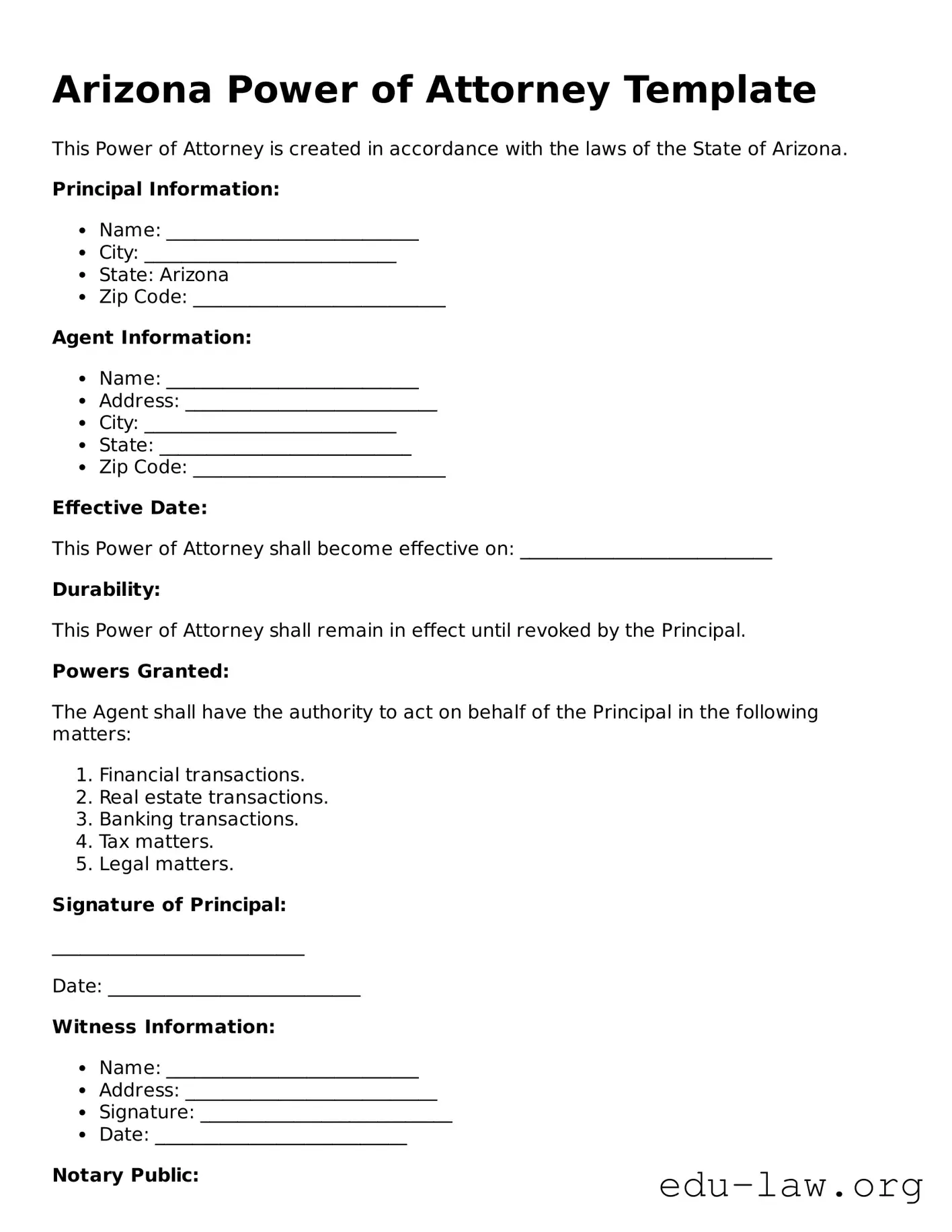
Arizona Power of Attorney Template
This Power of Attorney is created in accordance with the laws of the State of Arizona.
Principal Information:
Agent Information:
Effective Date:
This Power of Attorney shall become effective on: ___________________________
Durability:
This Power of Attorney shall remain in effect until revoked by the Principal.
Powers Granted:
The Agent shall have the authority to act on behalf of the Principal in the following matters:
Signature of Principal:
___________________________
Date: ___________________________
Witness Information:
Notary Public:
State of Arizona
County of ___________________________
Subscribed and sworn before me this ____ day of __________, 20__.
_____________________________
Notary Public Signature
My commission expires: ___________________________
| Fact Name | Description |
|---|---|
| Definition | A Power of Attorney (POA) in Arizona is a legal document that allows one person to act on behalf of another in legal and financial matters. |
| Types of POA | Arizona recognizes several types of POA, including Durable, Springing, and Limited Power of Attorney, each serving different purposes. |
| Governing Laws | The Arizona Power of Attorney is governed by Arizona Revised Statutes, specifically Title 14, Chapter 5. |
| Durability | A Durable Power of Attorney remains effective even if the principal becomes incapacitated, ensuring continuous management of affairs. |
| Signature Requirements | The principal must sign the POA in the presence of a notary public or two witnesses to ensure its validity. |
| Revocation | The principal can revoke the Power of Attorney at any time, as long as they are mentally competent to do so. |
Filling out the Arizona Power of Attorney form is a straightforward process that allows you to designate someone to act on your behalf in various matters. Once you have completed the form, it will need to be signed and notarized to ensure its validity. Here’s how to fill it out step by step:
After completing these steps, your Power of Attorney will be ready for use. Make sure to keep it in a safe place and inform your agent where to find it when needed.
What is a Power of Attorney in Arizona?
A Power of Attorney (POA) is a legal document that allows one person to give another person the authority to make decisions on their behalf. In Arizona, this can include managing financial matters, making healthcare decisions, or handling legal issues. The person granting the authority is known as the principal, while the person receiving the authority is called the agent or attorney-in-fact.
What types of Power of Attorney are available in Arizona?
In Arizona, there are several types of Power of Attorney. A General Power of Attorney grants broad powers to the agent to act on behalf of the principal in various matters. A Limited Power of Attorney restricts the agent’s authority to specific tasks or situations. Additionally, a Durable Power of Attorney remains effective even if the principal becomes incapacitated, while a Springing Power of Attorney only becomes effective under certain conditions, such as the principal's incapacity.
How do I create a Power of Attorney in Arizona?
To create a Power of Attorney in Arizona, you must complete a written document that clearly states your intentions. It should identify both the principal and the agent, outline the powers granted, and include the date of execution. The document must be signed by the principal in the presence of a notary public or two witnesses. It is advisable to keep a copy for your records and provide one to the agent.
Can I revoke a Power of Attorney in Arizona?
Yes, you can revoke a Power of Attorney in Arizona at any time, as long as you are mentally competent. To revoke it, you should create a written notice of revocation and provide it to the agent and any institutions or individuals that may rely on the original Power of Attorney. It is also recommended to destroy any copies of the original document to avoid confusion.
What happens if the principal becomes incapacitated?
If the principal becomes incapacitated and has created a Durable Power of Attorney, the agent can continue to act on their behalf. This is one of the main benefits of a Durable Power of Attorney. However, if a regular Power of Attorney was used, it would become invalid upon the principal's incapacity. It is important to plan ahead to ensure that decisions can be made when necessary.
Not Specifying the Powers Granted: One common mistake is failing to clearly outline the specific powers the agent will have. Without this clarity, the agent may not have the authority to act in the way the principal intended.
Forgetting to Date the Document: It’s crucial to include the date when the Power of Attorney is signed. Omitting the date can lead to confusion about when the authority begins or whether it is still valid.
Neglecting Witness Signatures: In Arizona, certain types of Power of Attorney documents require witnesses. Skipping this step can render the document invalid, which defeats its purpose.
Not Notarizing the Document: Although not always required, notarization can add an extra layer of validity. Failing to have the document notarized when necessary may lead to complications later on.
Using Outdated Forms: Laws can change, and using an outdated version of the Power of Attorney form can lead to issues. Always ensure you are using the most current form available to avoid legal pitfalls.
When establishing a Power of Attorney in Arizona, several other forms and documents may be useful to ensure comprehensive management of your affairs. Below is a list of commonly used documents that complement the Power of Attorney form.
These documents can help ensure that your wishes are respected and that your affairs are managed according to your preferences. It is advisable to consult with a legal professional to determine which documents best suit your needs.
The Arizona Power of Attorney form shares similarities with the Living Will, which is a document that outlines an individual’s wishes regarding medical treatment in the event they become unable to communicate those wishes themselves. Both documents empower individuals to make decisions on behalf of another, but while a Power of Attorney can cover a broad range of decisions, including financial and legal matters, a Living Will specifically addresses healthcare preferences. This focus on medical decisions makes the Living Will a crucial complement to the Power of Attorney, especially for those who want to ensure their health care choices are respected when they cannot advocate for themselves.
Another document akin to the Arizona Power of Attorney is the Healthcare Proxy. This document designates a specific person to make medical decisions on behalf of someone else when they are incapacitated. Like the Power of Attorney, it allows for the delegation of authority, but it is limited to healthcare-related matters. The Healthcare Proxy emphasizes the importance of having a trusted individual to make potentially life-altering decisions, ensuring that the person’s values and preferences are honored in medical situations.
The Living Trust is also similar to the Arizona Power of Attorney in that it allows for the management of an individual’s assets. A Living Trust can help avoid probate and provides a way to manage assets during one’s lifetime and after death. While the Power of Attorney grants authority to manage financial and legal affairs, the Living Trust focuses on asset distribution and management. Both documents serve to streamline decision-making processes and ensure that an individual’s wishes are followed, but they operate in different realms of personal and financial planning.
Another document that bears resemblance to the Arizona Power of Attorney is the Durable Power of Attorney. This version of the Power of Attorney remains effective even if the individual becomes incapacitated. The key difference lies in its durability; while a standard Power of Attorney may become void under certain circumstances, the Durable Power of Attorney is specifically designed to remain in effect, ensuring that the appointed agent can continue to act on behalf of the individual during periods of incapacity.
The Declaration of Guardian is yet another document that aligns closely with the Arizona Power of Attorney. This document allows an individual to designate a guardian for themselves in the event they become unable to make decisions. While the Power of Attorney appoints someone to handle legal and financial matters, the Declaration of Guardian focuses on personal care and decision-making. Both documents are essential for comprehensive planning, as they provide a framework for who will be responsible for the individual’s welfare in different contexts.
Lastly, the Authorization for Release of Medical Information shares similarities with the Arizona Power of Attorney, particularly in its focus on healthcare decisions. This document allows individuals to grant permission for healthcare providers to share their medical information with designated individuals. While the Power of Attorney can authorize someone to make decisions about medical treatment, the Authorization for Release of Medical Information ensures that the appointed agent has access to necessary medical records. This access is crucial for informed decision-making and highlights the interconnectedness of these documents in managing health and legal affairs.
When filling out the Arizona Power of Attorney form, it's important to follow certain guidelines. Here are five things you should do and five things you should avoid.
Things You Should Do:
Things You Shouldn't Do:
When it comes to the Arizona Power of Attorney form, there are several misconceptions that can lead to confusion. Understanding these myths can help individuals make informed decisions about their legal and financial affairs. Here are five common misconceptions:
Many people believe that a Power of Attorney is only useful for managing financial affairs. In reality, it can also grant authority over healthcare decisions, property management, and other personal matters. This flexibility allows individuals to tailor the document to their specific needs.
Some think that a Power of Attorney is permanent and cannot be altered. However, individuals can revoke or modify the document at any time, as long as they are mentally competent. This ensures that the Power of Attorney remains aligned with their current wishes.
While notarization can enhance the credibility of a Power of Attorney, it is not always required in Arizona. The form can be valid if signed by the principal and witnesses, depending on the specific type of Power of Attorney being created.
Many believe that only legal professionals can draft a Power of Attorney. In fact, individuals can create this document on their own using templates or online resources. However, consulting a lawyer can provide peace of mind and ensure that all legal requirements are met.
Some people think that a Power of Attorney is only relevant for seniors. However, anyone over the age of 18 can benefit from having this document in place. Life is unpredictable, and having a Power of Attorney ensures that someone can act on your behalf if needed.
By addressing these misconceptions, individuals can better understand the importance of a Power of Attorney and how it can serve their needs effectively.
Filling out and using the Arizona Power of Attorney form is an important step in planning for your future. Here are some key takeaways to consider:
By understanding these key points, you can make informed decisions about your Power of Attorney and ensure that your wishes are respected.