In Arizona, the Power of Attorney for a Child form serves as a crucial legal tool for parents and guardians who need to delegate authority over their child’s care and decision-making. This form allows an adult, often a relative or trusted friend, to step in temporarily and make important decisions regarding the child’s education, healthcare, and general welfare. The form is particularly useful in situations where parents are unable to be present, such as during travel, medical emergencies, or other unforeseen circumstances. By completing this document, parents can ensure that their child is cared for by someone they trust, while also providing the designated adult with the legal authority to act on their behalf. It’s important to note that the Power of Attorney for a Child is limited in scope and duration, allowing parents to maintain control over their child’s upbringing while providing necessary flexibility. Understanding the requirements and implications of this form is essential for any parent looking to safeguard their child’s well-being in their absence.
Arizona Power of Attorney for a Child
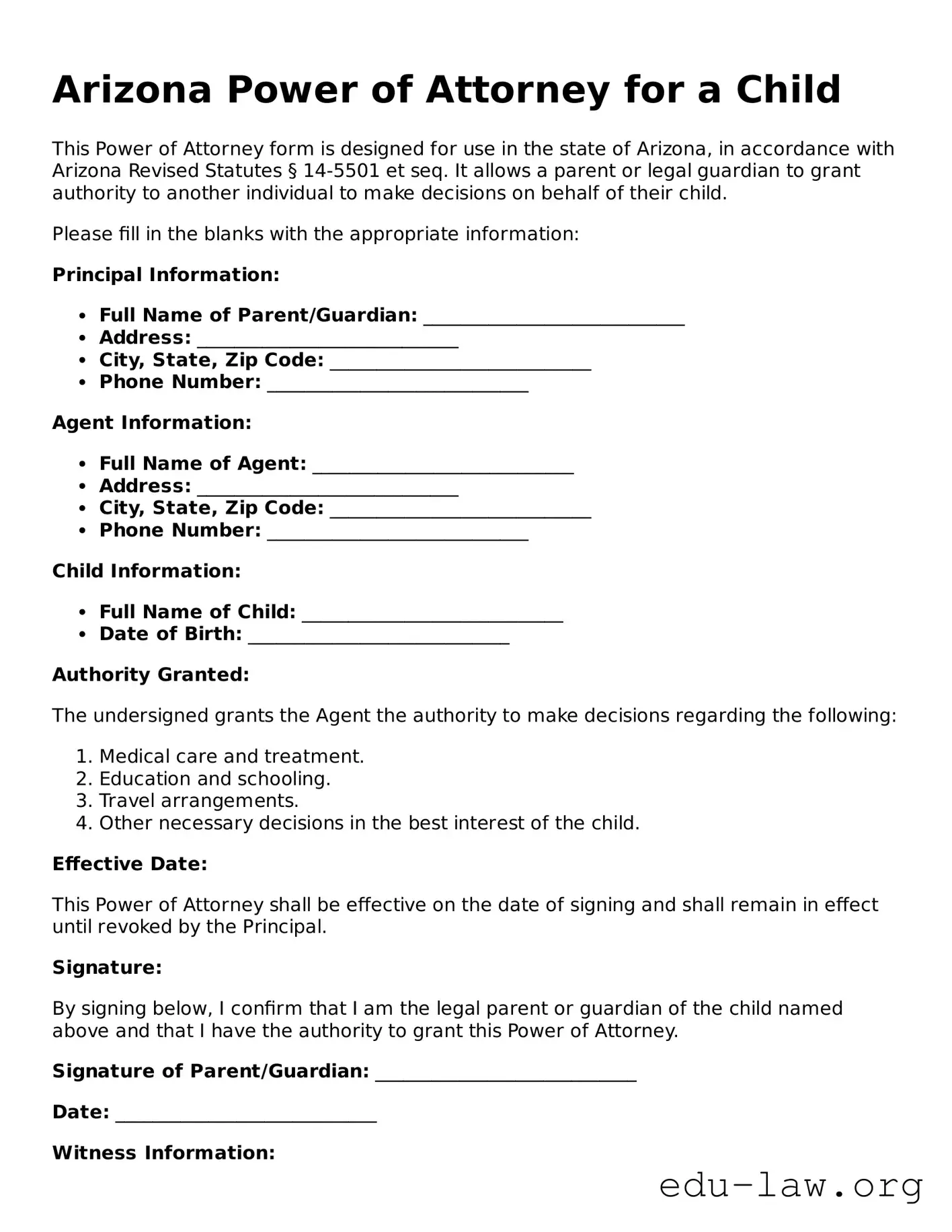
This Power of Attorney form is designed for use in the state of Arizona, in accordance with Arizona Revised Statutes § 14-5501 et seq. It allows a parent or legal guardian to grant authority to another individual to make decisions on behalf of their child.
Please fill in the blanks with the appropriate information:
Principal Information:
Agent Information:
Child Information:
Authority Granted:
The undersigned grants the Agent the authority to make decisions regarding the following:
Effective Date:
This Power of Attorney shall be effective on the date of signing and shall remain in effect until revoked by the Principal.
Signature:
By signing below, I confirm that I am the legal parent or guardian of the child named above and that I have the authority to grant this Power of Attorney.
Signature of Parent/Guardian: ____________________________
Date: ____________________________
Witness Information:
This document should be kept in a safe place and a copy provided to the Agent.
| Fact Name | Details |
|---|---|
| Definition | The Arizona Power of Attorney for a Child form allows a parent or guardian to designate another adult to make decisions for their child. |
| Governing Law | This form is governed by Arizona Revised Statutes, Title 14, Chapter 5. |
| Purpose | It is used to ensure that a trusted adult can care for a child in the absence of the parent or guardian. |
| Duration | The authority granted can be temporary or extend for a longer period, depending on the parent's wishes. |
| Signing Requirements | The form must be signed by the parent or guardian in the presence of a notary public. |
| Revocation | Parents can revoke the power of attorney at any time, provided they do so in writing. |
| Limitations | The form does not grant the designated adult the right to make decisions regarding the child's education or medical care unless specified. |
| Use Cases | This form is often used during travel, emergencies, or when a parent is temporarily unable to care for the child. |
Completing the Arizona Power of Attorney for a Child form is a straightforward process. This form allows a parent or guardian to designate another individual to make decisions on behalf of their child. Follow the steps below to ensure that you fill out the form correctly and completely.
After completing the form, ensure that the agent is aware of their responsibilities and has a copy of the document. This will facilitate smooth communication and decision-making in the best interest of the child.
What is a Power of Attorney for a Child in Arizona?
A Power of Attorney for a Child in Arizona is a legal document that allows a parent or legal guardian to appoint another individual to make decisions on behalf of their child. This can include decisions related to medical care, education, and general welfare. It is particularly useful in situations where the parent may be unavailable due to travel, work commitments, or other reasons. The appointed individual, often referred to as the "agent," must act in the best interest of the child and can only exercise the authority granted by the parent or guardian.
Who can be appointed as an agent in the Power of Attorney for a Child?
In Arizona, any responsible adult can be appointed as an agent in the Power of Attorney for a Child. This may include relatives, family friends, or trusted neighbors. It is crucial to choose someone who is reliable and capable of making decisions that align with the child's best interests. The appointed agent should be informed about their responsibilities and be willing to accept the role.
How long does the Power of Attorney for a Child remain in effect?
The Power of Attorney for a Child can remain in effect for a specified duration as indicated in the document. It can also be set to expire upon a certain event, such as the return of the parent or guardian. However, it is important to note that this document does not grant permanent custody of the child; it is temporary and can be revoked at any time by the parent or guardian.
Is the Power of Attorney for a Child form required to be notarized?
While notarization is not strictly required for the Power of Attorney for a Child in Arizona, it is highly recommended. Having the document notarized adds an extra layer of validity and can help prevent disputes regarding its authenticity. Additionally, some institutions, such as schools or medical facilities, may require a notarized document to recognize the authority of the appointed agent.
Can the Power of Attorney for a Child be revoked?
Yes, a Power of Attorney for a Child can be revoked at any time by the parent or legal guardian. To revoke the document, the parent should create a written notice stating the revocation and provide it to the appointed agent. It is advisable to inform any institutions or individuals who were aware of the original Power of Attorney to ensure that they are aware of the change.
What happens if the parent or guardian is unavailable to make decisions?
If the parent or guardian is unavailable and has executed a Power of Attorney for a Child, the appointed agent will have the authority to make decisions on behalf of the child. This can include medical decisions, educational choices, and other important matters. The agent must act in the child's best interest and adhere to any specific instructions provided by the parent or guardian in the document.
Incomplete Information: One common mistake is failing to provide all required information. This includes not filling out the names and addresses of both the child and the agent. Omitting this information can lead to delays or complications in the future.
Not Specifying Powers: Another frequent error is not clearly specifying the powers granted to the agent. The form should detail what decisions the agent can make on behalf of the child, such as medical decisions or educational matters. Lack of clarity can create confusion.
Improper Signatures: Signatures must be properly executed. Failing to have the document signed by both the parent and the agent can render it invalid. Additionally, if the form requires notarization, neglecting this step is a critical oversight.
Ignoring State Requirements: Each state has specific requirements for Power of Attorney forms. People often overlook Arizona's unique stipulations, such as the need for witnesses or notarization. Ignoring these can invalidate the document.
Not Reviewing the Document: Finally, many individuals do not take the time to review the completed form thoroughly. Errors or omissions can lead to significant issues later. It is essential to double-check all details before submission.
When preparing a Power of Attorney for a Child in Arizona, it's essential to consider other related documents that may enhance the legal framework for child care and custody. These documents can provide additional clarity and security for both the child and the appointed caregiver.
Incorporating these documents alongside the Arizona Power of Attorney for a Child form can create a comprehensive approach to child care and custody. Each form serves a specific purpose, enhancing the overall legal protections for the child and providing peace of mind for parents and guardians.
The Arizona Power of Attorney for a Child form is similar to a General Power of Attorney. Both documents allow an individual to appoint someone else to act on their behalf. In the case of a General Power of Attorney, this authority can extend to various financial and legal matters. However, the Power of Attorney for a Child specifically focuses on making decisions related to the care and welfare of a minor child, such as education, medical care, and travel arrangements.
Another similar document is the Medical Power of Attorney. This form enables an individual to designate someone to make medical decisions on their behalf if they become unable to do so. While the Medical Power of Attorney is typically used for adults, when it comes to children, the Power of Attorney for a Child can encompass medical decisions as well. This ensures that the appointed agent can make timely healthcare choices for the child in emergencies or when parents are unavailable.
The Guardianship document shares similarities with the Power of Attorney for a Child in that both involve the care and protection of a minor. However, Guardianship is a more permanent legal arrangement, often established through court proceedings. In contrast, the Power of Attorney for a Child is generally temporary and can be revoked at any time by the parent or legal guardian, making it a more flexible option for short-term situations.
A Child Custody Agreement also bears resemblance to the Power of Attorney for a Child. Both documents address the rights and responsibilities regarding the care of a child. However, a Child Custody Agreement is typically part of divorce proceedings or separation cases and outlines the living arrangements and visitation rights of parents. The Power of Attorney for a Child, on the other hand, does not involve custody disputes but rather grants authority to another adult for specific decisions regarding the child's welfare.
The Authorization for Release of Medical Records is another document that aligns closely with the Power of Attorney for a Child. This form allows parents or guardians to grant permission for healthcare providers to share a child's medical information with designated individuals. While the Power of Attorney for a Child gives broader authority to make decisions, the Authorization for Release focuses specifically on accessing medical records, ensuring that the appointed agent can effectively manage the child’s healthcare needs.
Lastly, a Travel Consent Form is similar in purpose to the Power of Attorney for a Child, particularly when it comes to travel arrangements. This document is often required when a child is traveling without their parents or legal guardians. It provides permission for the child to travel with another adult, ensuring that the adult has the authority to make decisions if necessary during the trip. The Power of Attorney for a Child can also encompass travel-related decisions, making it a more comprehensive option for parents who need to delegate authority during travel.
When filling out the Arizona Power of Attorney for a Child form, it is important to follow specific guidelines to ensure the document is completed correctly. Below is a list of things you should and shouldn't do.
When it comes to the Arizona Power of Attorney for a Child form, there are several common misconceptions that can lead to confusion. Understanding these misconceptions can help ensure that parents and guardians make informed decisions. Here are five key misconceptions:
Many believe that a Power of Attorney for a Child is only necessary in emergencies. However, this document can be useful for various situations, such as temporary travel or short-term caregiving arrangements.
Some think that signing this form gives the agent unlimited authority over the child. In reality, the form can be tailored to specify the powers granted, ensuring that the agent's authority is limited to what the parent or guardian intends.
Another misconception is that a Power of Attorney for a Child is a permanent arrangement. In fact, this document can be revoked at any time by the parent or guardian, as long as they are of sound mind.
Some people believe that granting a Power of Attorney for a Child takes away their parental rights. This is not true; the parent or guardian retains their rights and responsibilities, while the agent only acts on their behalf in specified matters.
Lastly, there is a belief that the form does not need to be notarized. In Arizona, it is recommended to have the document notarized to ensure its validity and to avoid potential disputes.
By addressing these misconceptions, parents and guardians can better navigate the process of creating a Power of Attorney for a Child, ensuring that they are prepared for various circumstances.
Filling out and using the Arizona Power of Attorney for a Child form is an important step for parents or guardians. This document allows you to designate someone to make decisions on behalf of your child. Here are some key takeaways to consider: