When starting a business in Arizona, particularly a limited liability company (LLC), having a solid foundation is crucial for success. One essential component of that foundation is the Arizona Operating Agreement form. This document serves as an internal guideline, outlining the management structure, roles, and responsibilities of the members involved. It clarifies how profits and losses will be distributed, ensuring that all members are on the same page regarding financial matters. Additionally, the agreement addresses how decisions will be made, including voting rights and procedures, which helps prevent disputes down the line. By establishing protocols for adding new members or handling member departures, the Operating Agreement fosters stability and continuity within the business. Moreover, it can provide legal protection by clearly delineating the boundaries of each member's authority and liability. In essence, this form is not just a piece of paperwork; it's a roadmap for navigating the complexities of running an LLC in Arizona.
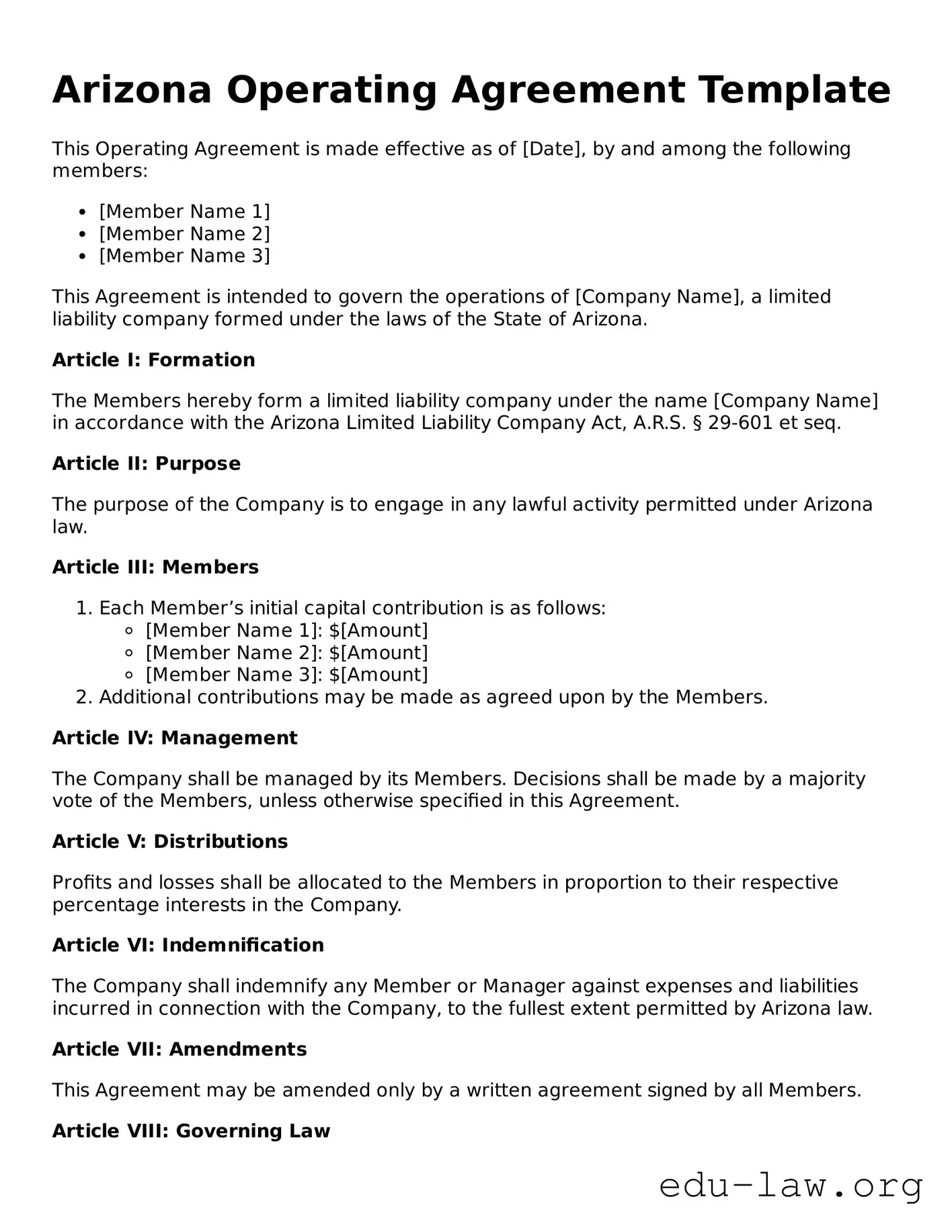
Arizona Operating Agreement Template
This Operating Agreement is made effective as of [Date], by and among the following members:
This Agreement is intended to govern the operations of [Company Name], a limited liability company formed under the laws of the State of Arizona.
Article I: Formation
The Members hereby form a limited liability company under the name [Company Name] in accordance with the Arizona Limited Liability Company Act, A.R.S. § 29-601 et seq.
Article II: Purpose
The purpose of the Company is to engage in any lawful activity permitted under Arizona law.
Article III: Members
Article IV: Management
The Company shall be managed by its Members. Decisions shall be made by a majority vote of the Members, unless otherwise specified in this Agreement.
Article V: Distributions
Profits and losses shall be allocated to the Members in proportion to their respective percentage interests in the Company.
Article VI: Indemnification
The Company shall indemnify any Member or Manager against expenses and liabilities incurred in connection with the Company, to the fullest extent permitted by Arizona law.
Article VII: Amendments
This Agreement may be amended only by a written agreement signed by all Members.
Article VIII: Governing Law
This Agreement shall be governed by and construed in accordance with the laws of the State of Arizona.
IN WITNESS WHEREOF, the Members have executed this Operating Agreement as of the date first above written.
_________________________
[Member Name 1]
_________________________
[Member Name 2]
_________________________
[Member Name 3]
| Fact Name | Description |
|---|---|
| Purpose | The Arizona Operating Agreement outlines the management structure and operating procedures of a limited liability company (LLC). |
| Governing Law | The agreement is governed by the Arizona Limited Liability Company Act, specifically Arizona Revised Statutes Title 29. |
| Members | All members of the LLC should sign the Operating Agreement to ensure that all parties are in agreement regarding the terms. |
| Flexibility | The Operating Agreement can be customized to fit the unique needs of the LLC, allowing for various management structures. |
| Dispute Resolution | It often includes provisions for resolving disputes among members, which can help avoid costly litigation. |
| Amendments | Members can amend the Operating Agreement as needed, which provides the flexibility to adapt to changing circumstances. |
| Tax Treatment | The agreement can specify how the LLC will be taxed, which is crucial for financial planning and compliance. |
| Confidentiality | It can include confidentiality clauses to protect sensitive business information from being disclosed. |
| Not Required by Law | While not legally required, having an Operating Agreement is highly recommended for clarity and protection of members' interests. |
Filling out the Arizona Operating Agreement form is an important step in formalizing your business structure. After completing this form, you will have a clearer understanding of how your business will operate and the responsibilities of each member involved.
What is an Arizona Operating Agreement?
An Arizona Operating Agreement is a legal document that outlines the management structure and operating procedures of a Limited Liability Company (LLC) in Arizona. It serves as an internal guideline for the members of the LLC, detailing their rights, responsibilities, and the distribution of profits and losses.
Is an Operating Agreement required in Arizona?
No, Arizona does not legally require LLCs to have an Operating Agreement. However, it is highly recommended. Having an Operating Agreement can help prevent misunderstandings among members and provide clarity in the management of the business.
Who should draft the Operating Agreement?
What should be included in an Arizona Operating Agreement?
An Operating Agreement typically includes the following key components: the LLC's name and address, the purpose of the LLC, member information, management structure, voting rights, profit and loss distribution, and procedures for adding or removing members. Each section should be tailored to meet the specific needs of the business.
Can the Operating Agreement be amended?
Yes, the Operating Agreement can be amended. The process for making amendments should be clearly outlined within the document itself. Typically, amendments require a majority vote from the members, but the specific requirements can vary based on the agreement.
What happens if there is no Operating Agreement?
If an LLC does not have an Operating Agreement, Arizona law will govern the operations of the business. This may lead to default rules that do not reflect the members' intentions, potentially causing disputes or misunderstandings among members.
How does an Operating Agreement affect liability protection?
An Operating Agreement does not directly affect the liability protection offered by an LLC. However, having a well-drafted Operating Agreement can help reinforce the LLC's status as a separate legal entity, which is crucial for maintaining limited liability protection for its members.
Can one person create an Operating Agreement?
Yes, a single-member LLC can create an Operating Agreement. In this case, the agreement would outline the member's rights and responsibilities. It is still beneficial to have this document, as it helps establish the business as a separate legal entity.
How often should the Operating Agreement be reviewed?
It is a good practice to review the Operating Agreement regularly, especially when significant changes occur within the business, such as the addition of new members or changes in management structure. Regular reviews ensure that the agreement remains relevant and effective.
Where should the Operating Agreement be kept?
The Operating Agreement should be kept in a safe and accessible location, such as a secure file or a digital storage system. All members should have access to the document, as it serves as a reference point for the operations and management of the LLC.
Not Including Member Information: Many people forget to list all members involved in the LLC. Each member's name and address should be clearly stated.
Incorrectly Stating Ownership Percentages: It's essential to accurately reflect each member's ownership percentage. Mistakes here can lead to disputes later.
Omitting Management Structure: Some individuals skip detailing whether the LLC is member-managed or manager-managed. This information is crucial for clarity.
Not Defining Profit and Loss Distribution: Failing to specify how profits and losses will be shared can create confusion and tension among members.
Ignoring Amendment Procedures: Not including a process for making changes to the agreement can make it difficult to adapt to future needs.
Overlooking Dispute Resolution Methods: It's a mistake to not outline how disputes will be resolved. Having a clear plan can prevent costly legal battles.
Failing to Date the Agreement: Forgetting to include the date of the agreement can lead to confusion about when terms were established.
Not Signing the Agreement: This is a common oversight. All members must sign the agreement for it to be valid and enforceable.
When forming a limited liability company (LLC) in Arizona, the Operating Agreement is a crucial document that outlines the management structure and operational guidelines of the business. However, several other forms and documents are often used in conjunction with the Operating Agreement to ensure compliance with state laws and to facilitate smooth business operations. Below is a list of important documents that may accompany the Arizona Operating Agreement.
Understanding these documents can significantly enhance the formation and operation of an LLC in Arizona. Each plays a vital role in ensuring the business runs smoothly and remains compliant with legal requirements. By preparing and maintaining these documents, members can focus on growing their business with confidence.
The Arizona Operating Agreement is similar to the Partnership Agreement. Both documents outline the roles, responsibilities, and obligations of the parties involved. They help define how profits and losses are shared among partners. While the Operating Agreement is specific to limited liability companies (LLCs), the Partnership Agreement caters to general partnerships. This means that the structure and liability aspects differ, but both serve to establish clear expectations among members or partners.
Another document akin to the Arizona Operating Agreement is the Bylaws of a corporation. Bylaws govern the internal management of a corporation, detailing how decisions are made and the roles of officers. Like the Operating Agreement, they provide a framework for governance. Both documents are essential for ensuring that all parties understand their rights and responsibilities, although bylaws apply to corporations rather than LLCs.
The Shareholder Agreement also shares similarities with the Arizona Operating Agreement. This document is designed for corporations and outlines the rights and obligations of shareholders. It addresses issues like stock transfers and voting rights, similar to how an Operating Agreement addresses member roles and profit sharing. Both agreements aim to prevent disputes by clearly defining expectations among stakeholders.
The LLC Membership Agreement is another document comparable to the Arizona Operating Agreement. This agreement specifically pertains to LLCs and outlines the rights and responsibilities of each member. It covers similar topics such as profit distribution, management structure, and decision-making processes. While the terms may vary, both documents serve the same purpose of ensuring clarity and accountability within the organization.
The Joint Venture Agreement is also similar in function to the Arizona Operating Agreement. This document is used when two or more parties come together for a specific project or business activity. Like the Operating Agreement, it establishes the terms of collaboration, including profit sharing and responsibilities. Both agreements are crucial for defining the relationship between parties and mitigating potential conflicts.
The Operating Agreement can also be compared to the Non-Disclosure Agreement (NDA). While NDAs focus on confidentiality, both documents protect the interests of the parties involved. An Operating Agreement safeguards the business structure and member roles, while an NDA ensures that sensitive information remains private. Both are essential for fostering trust and cooperation among parties.
Lastly, the Employment Agreement has similarities with the Arizona Operating Agreement. While the Employment Agreement focuses on the relationship between an employer and an employee, both documents outline roles and responsibilities. They set expectations for performance and behavior. Each agreement is vital for establishing a clear understanding of duties, which helps prevent misunderstandings and disputes.
When filling out the Arizona Operating Agreement form, it is essential to approach the task with care and attention to detail. Here are some important guidelines to follow:
By following these guidelines, you can create a clear and effective Operating Agreement that serves the best interests of your LLC and its members.
Understanding the Arizona Operating Agreement form is crucial for anyone involved in a limited liability company (LLC) in the state. However, several misconceptions can lead to confusion and potential issues. Here’s a list of ten common misconceptions about this important document:
By addressing these misconceptions, LLC members in Arizona can better understand the importance of an operating agreement and ensure that their business operates smoothly and efficiently.
When filling out and using the Arizona Operating Agreement form, it is essential to keep several key points in mind. These takeaways will help ensure that the document serves its intended purpose effectively.