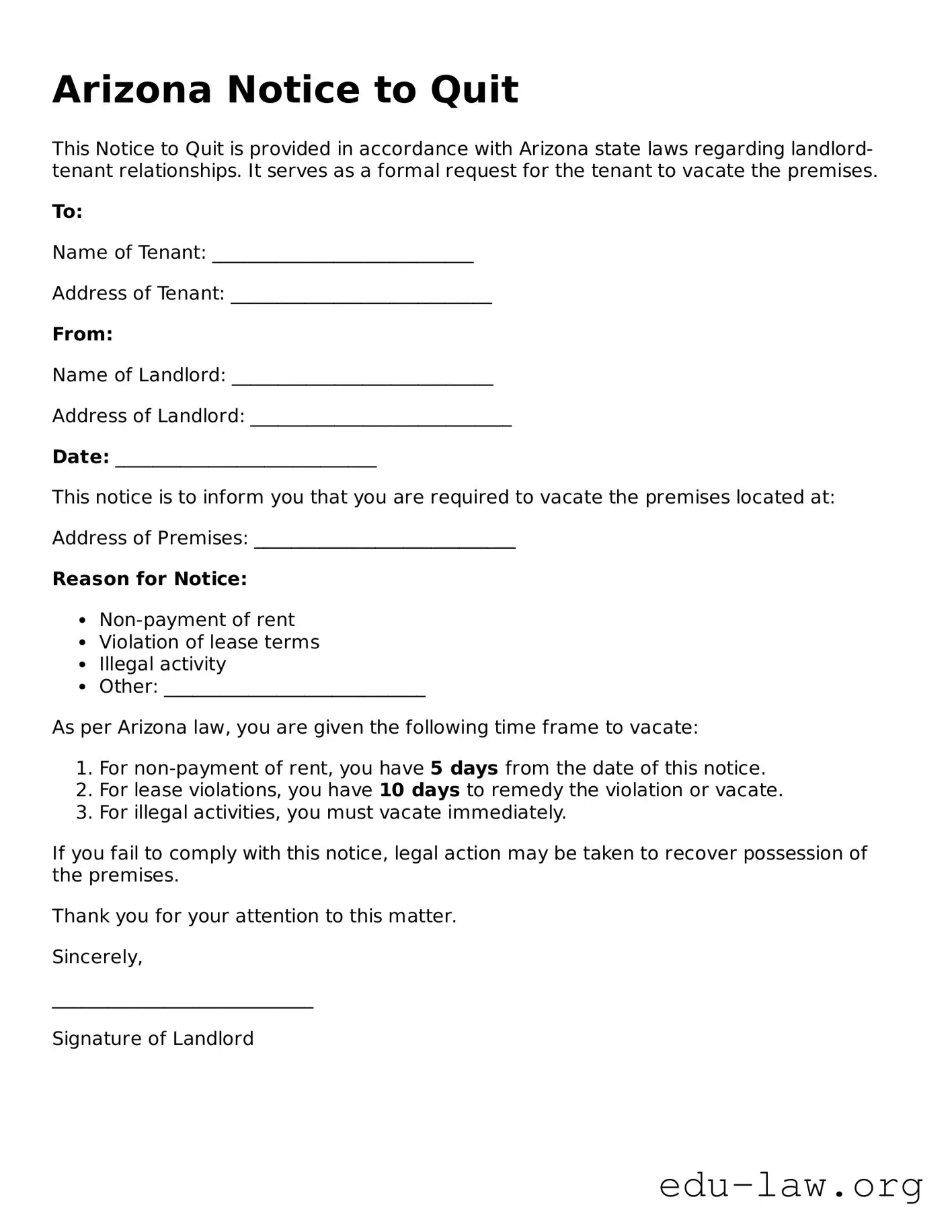
The Arizona Notice to Quit form serves as a crucial document in the landlord-tenant relationship, particularly when a landlord seeks to terminate a rental agreement. This form is typically utilized when a tenant has violated the terms of their lease or failed to pay rent. By issuing this notice, landlords formally communicate their intent to end the tenancy, allowing tenants a specified period to vacate the premises. The document outlines the reasons for termination, which may include non-payment of rent, lease violations, or other grounds recognized under Arizona law. It is important for both parties to understand the legal implications of this notice, as it sets the stage for potential eviction proceedings if the tenant does not comply. Additionally, the form must adhere to specific requirements, such as proper delivery methods and timeframes, to ensure its validity. Understanding the nuances of the Notice to Quit is essential for both landlords and tenants, as it helps protect their rights and responsibilities within the rental agreement.
Arizona Notice to Quit
This Notice to Quit is provided in accordance with Arizona state laws regarding landlord-tenant relationships. It serves as a formal request for the tenant to vacate the premises.
To:
Name of Tenant: ____________________________
Address of Tenant: ____________________________
From:
Name of Landlord: ____________________________
Address of Landlord: ____________________________
Date: ____________________________
This notice is to inform you that you are required to vacate the premises located at:
Address of Premises: ____________________________
Reason for Notice:
As per Arizona law, you are given the following time frame to vacate:
If you fail to comply with this notice, legal action may be taken to recover possession of the premises.
Thank you for your attention to this matter.
Sincerely,
____________________________
Signature of Landlord
| Fact Name | Description |
|---|---|
| Purpose | The Arizona Notice to Quit form is used by landlords to inform tenants that they must vacate the rental property. |
| Governing Law | This form is governed by Arizona Revised Statutes, Title 33, Chapter 10. |
| Notice Period | Typically, a 5-day notice is required for non-payment of rent, while other lease violations may require different notice periods. |
| Delivery Methods | The notice can be delivered in person, by mail, or posted on the rental property. |
| Tenant Rights | Tenants have the right to respond to the notice and may have defenses available to contest eviction. |
| Form Requirements | The notice must include specific information such as the reason for eviction and the deadline to vacate. |
| Legal Consequences | If the tenant does not comply, the landlord may proceed with formal eviction proceedings. |
| Record Keeping | Landlords should keep a copy of the notice and any proof of delivery for their records. |
After obtaining the Arizona Notice to Quit form, it is essential to fill it out accurately to ensure proper legal procedures are followed. This form is a critical step in the process of addressing tenancy issues. Once completed, it will need to be delivered to the tenant, initiating the necessary legal actions.
Once the form is filled out and signed, it must be delivered to the tenant. This can be done in person, through certified mail, or as allowed by local laws. Keeping a record of how and when the notice was delivered is crucial for any future legal proceedings.
What is the Arizona Notice to Quit form?
The Arizona Notice to Quit form is a legal document used by landlords to formally notify tenants that they must vacate the rental property. This notice typically indicates that the tenant has violated a term of the lease agreement or has not paid rent. It serves as a first step in the eviction process, giving the tenant a chance to remedy the situation or leave the premises voluntarily.
When should a landlord use the Notice to Quit?
A landlord should use the Notice to Quit when a tenant has failed to comply with the terms of the lease. This includes non-payment of rent, lease violations, or engaging in illegal activities on the property. The notice gives the tenant a specified period to either correct the issue or vacate the property.
How long does a tenant have to respond to a Notice to Quit?
The time frame for a tenant to respond to a Notice to Quit varies depending on the reason for the notice. For non-payment of rent, tenants typically have five days to pay the overdue amount or vacate the premises. For other lease violations, the notice may require a different response time, often ranging from 10 to 30 days.
Is the Notice to Quit form required by law in Arizona?
While it is not legally required to use a Notice to Quit form, it is highly recommended. Using this form provides a clear, documented way to communicate with the tenant about the issues at hand. It also helps establish a legal basis for eviction proceedings if the situation escalates.
Can a tenant contest a Notice to Quit?
Yes, a tenant can contest a Notice to Quit. If a tenant believes the notice is unjust or incorrect, they may respond in writing or seek legal advice. It's important for tenants to address the notice promptly to avoid further legal complications.
What happens if a tenant does not comply with the Notice to Quit?
If a tenant does not comply with the Notice to Quit, the landlord may proceed with eviction proceedings. This involves filing a complaint with the court and potentially obtaining a judgment to remove the tenant from the property. It is crucial for landlords to follow the legal process to avoid complications.
Can a landlord accept partial rent after issuing a Notice to Quit?
Accepting partial rent after issuing a Notice to Quit can complicate the eviction process. While a landlord may choose to accept partial payment, doing so may imply that the lease agreement is still in effect. It is advisable for landlords to consult with legal counsel before accepting any payments after a notice has been served.
Where can I find a template for the Arizona Notice to Quit form?
Templates for the Arizona Notice to Quit form can be found online through various legal websites, local government resources, or by consulting with a legal professional. Ensure that any template used complies with Arizona state laws and includes all necessary information specific to the situation.
Incorrect Tenant Information: One common mistake is providing inaccurate or incomplete information about the tenant. This includes misspellings of names or wrong addresses. Always double-check the details to ensure they match official documents.
Failure to Specify the Reason for Termination: The form requires a clear reason for the notice. Some individuals forget to include this information or use vague language. Being specific helps avoid confusion and potential disputes.
Not Including a Deadline: The Notice to Quit must specify a deadline by which the tenant must vacate the property. Omitting this date can lead to misunderstandings. Ensure the deadline is reasonable and clearly stated.
Improper Delivery Method: How the notice is delivered matters. Some people assume that sending it via regular mail is sufficient. However, local laws often require personal delivery or certified mail. Verify the acceptable methods to ensure compliance.
The Arizona Notice to Quit form is a crucial document in the eviction process, signaling a tenant to vacate the premises. Several other forms and documents are often used in conjunction with this notice to ensure that all legal requirements are met and to facilitate a smooth transition for both landlords and tenants. Below is a list of common documents that may accompany the Notice to Quit.
These documents play a vital role in the eviction process in Arizona. They help ensure that both landlords and tenants understand their rights and responsibilities, and they facilitate legal compliance throughout the eviction proceedings.
The Arizona Notice to Quit form is similar to the Eviction Notice, which is a formal request from a landlord to a tenant to vacate the rental property. Both documents serve as a legal means to communicate the landlord's intention to terminate the tenancy. However, while the Eviction Notice often outlines specific reasons for the eviction, such as non-payment of rent or lease violations, the Notice to Quit may simply inform the tenant that they must leave without detailing the reasons behind the request.
Another document akin to the Arizona Notice to Quit is the Lease Termination Letter. This letter is used when either party wishes to end a lease agreement at the conclusion of its term. Unlike the Notice to Quit, which can be issued at any time during the tenancy, the Lease Termination Letter typically adheres to the timeline specified in the lease agreement, providing advance notice before the lease officially ends.
The Pay or Quit Notice is also similar, as it is used when a tenant has failed to pay rent. This notice demands that the tenant either pay the overdue rent or vacate the property within a specified timeframe. Like the Notice to Quit, it serves as a preliminary step before legal action can be taken, but it specifically addresses non-payment rather than a general termination of tenancy.
The Cure or Quit Notice shares similarities with the Notice to Quit as well. This document is issued when a tenant violates a term of the lease agreement, such as having unauthorized pets or causing property damage. The Cure or Quit Notice gives the tenant an opportunity to remedy the violation within a set period or face eviction, emphasizing the need for compliance with lease terms.
In addition, the 3-Day Notice to Pay Rent or Quit is a specific type of eviction notice that requires tenants to either pay their overdue rent or vacate the premises within three days. This document is particularly relevant in Arizona, where landlords must follow specific guidelines when notifying tenants of overdue rent. Like the Notice to Quit, it serves as a precursor to potential eviction proceedings.
The 30-Day Notice to Quit is another related document. This notice is often used in month-to-month rental agreements, allowing either party to terminate the lease with a 30-day notice. While the Arizona Notice to Quit can be issued for various reasons, the 30-Day Notice is typically a straightforward way to end a tenancy without requiring justification.
The Termination of Tenancy Notice is also comparable, as it informs tenants that their rental agreement will not be renewed. This notice is often used when a landlord decides to sell the property or when they want to make significant renovations. Like the Notice to Quit, it communicates the landlord's intent to end the tenancy but may not require the tenant to vacate immediately.
The Eviction Summons is another document that follows the Notice to Quit. Once a landlord has issued a Notice to Quit and the tenant has failed to comply, the landlord may file for eviction in court. The Eviction Summons informs the tenant of the legal proceedings and their right to respond. It is a more formal step in the eviction process compared to the Notice to Quit.
Lastly, the Notice of Default is similar in that it serves as a warning to tenants regarding their lease obligations. This document is often used in mortgage situations but can also apply to rental agreements. It alerts tenants that they are in default of their lease terms and may face eviction if the issues are not resolved. Like the Notice to Quit, it emphasizes the importance of adhering to the terms of the agreement.
When filling out the Arizona Notice to Quit form, it’s important to follow specific guidelines to ensure accuracy and compliance with state laws. Here’s a list of things you should and shouldn’t do:
This is not true. A Notice to Quit is a preliminary step that informs a tenant they must vacate the premises. It does not constitute an eviction, which requires a legal process and court involvement.
Landlords must have a valid reason to issue this notice, such as non-payment of rent or lease violations. Arbitrary reasons are not legally permissible.
Ignoring the Notice can lead to legal action. If the tenant does not comply, the landlord may proceed with eviction proceedings, which can result in the tenant losing their home.
While personal service is one method, landlords can also deliver the notice through certified mail or by posting it on the property, depending on state laws.
The required notice period varies based on the reason for the notice. Arizona law specifies different timeframes depending on the situation, such as five days for non-payment of rent.
When dealing with the Arizona Notice to Quit form, it’s essential to understand its purpose and how to use it effectively. Here are some key takeaways:
Using the Arizona Notice to Quit form properly can make a significant difference in the eviction process. Being informed and following the correct procedures is essential for both landlords and tenants.