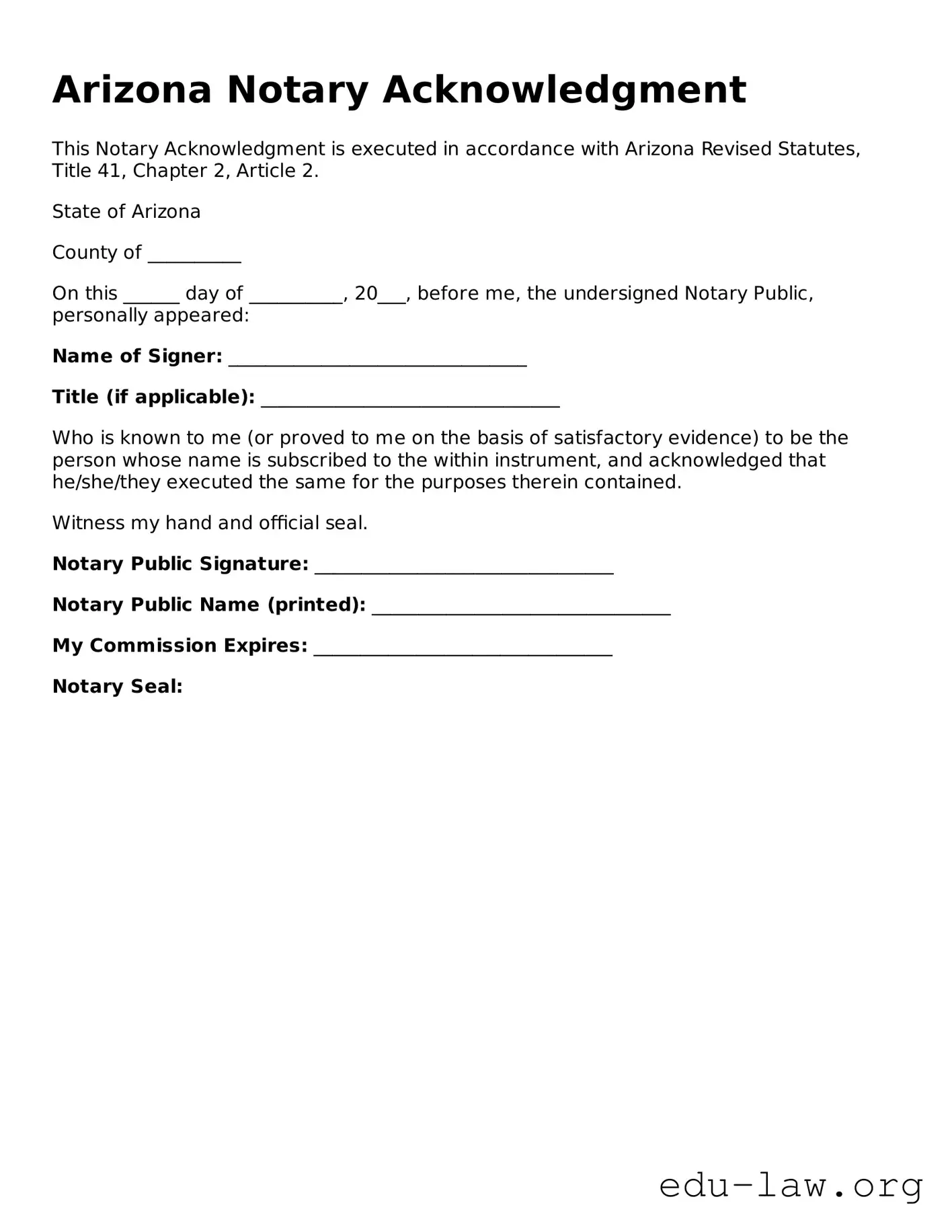
The Arizona Notary Acknowledgement form plays a crucial role in the notarization process, ensuring that documents are legally recognized and authenticated. This form serves as a declaration by the notary public that the individual signing the document has done so willingly and is aware of the contents of the document. Typically, it includes essential details such as the name of the signer, the date of the acknowledgment, and the notary's signature and seal. By using this form, individuals can provide a layer of protection against fraud, as it verifies the identity of the signer and confirms their intent to execute the document. Additionally, the Arizona Notary Acknowledgement form is often required for various legal documents, including deeds, contracts, and affidavits, making it an essential tool for anyone involved in legal transactions within the state. Understanding how to properly complete and utilize this form is vital for ensuring that documents are enforceable and compliant with Arizona law.
Arizona Notary Acknowledgment
This Notary Acknowledgment is executed in accordance with Arizona Revised Statutes, Title 41, Chapter 2, Article 2.
State of Arizona
County of __________
On this ______ day of __________, 20___, before me, the undersigned Notary Public, personally appeared:
Name of Signer: ________________________________
Title (if applicable): ________________________________
Who is known to me (or proved to me on the basis of satisfactory evidence) to be the person whose name is subscribed to the within instrument, and acknowledged that he/she/they executed the same for the purposes therein contained.
Witness my hand and official seal.
Notary Public Signature: ________________________________
Notary Public Name (printed): ________________________________
My Commission Expires: ________________________________
Notary Seal:
| Fact Name | Details |
|---|---|
| Purpose | The Arizona Notary Acknowledgment form is used to verify the identity of individuals signing a document. |
| Governing Law | Arizona Revised Statutes, Title 41, Chapter 2, Article 3 governs notarial acts in Arizona. |
| Signature Requirement | The signer must personally appear before the notary public to sign the document. |
| Identification | Acceptable forms of identification include a driver's license, state ID, or passport. |
| Notary Seal | A notary public must affix their official seal to the acknowledgment form to validate it. |
| Record Keeping | Notaries are required to keep a journal of all notarial acts performed, including acknowledgments. |
| Validity | The acknowledgment remains valid as long as it is executed in accordance with Arizona law. |
| Common Uses | This form is commonly used for real estate transactions, wills, and powers of attorney. |
Once you have the Arizona Notary Acknowledgement form in front of you, it's time to fill it out. Make sure you have all necessary information ready. This will help ensure that the process goes smoothly and that your form is completed correctly.
After completing the form, the notary will need to sign and stamp it. This step is crucial for the document to be valid. Make sure to keep a copy for your records.
What is an Arizona Notary Acknowledgement form?
The Arizona Notary Acknowledgement form is a legal document used to verify that a person has willingly signed a document in the presence of a notary public. This form serves as proof that the signer is who they claim to be and that they understand the contents of the document they are signing.
When do I need to use a Notary Acknowledgement form?
You typically need to use a Notary Acknowledgement form when signing important documents, such as contracts, deeds, or affidavits. If the document requires notarization to be legally valid, an acknowledgment form is essential to ensure the signature is recognized by the law.
Who can act as a notary public in Arizona?
In Arizona, a notary public must be at least 18 years old, a resident of the state, and must complete the required training and application process. They are authorized to perform notarial acts, including witnessing signatures and administering oaths.
How do I complete an Arizona Notary Acknowledgement form?
To complete the form, the signer must appear before the notary. The notary will ask the signer to provide identification to confirm their identity. After verifying the identity, the notary will complete the form, which includes details like the date, the signer’s name, and the notary’s signature and seal.
Is there a fee for notarization in Arizona?
Yes, notaries in Arizona are allowed to charge a fee for their services. The maximum fee for a standard acknowledgment is set by state law. It's important to check with the notary beforehand to understand their specific charges.
What happens if I sign a document without a Notary Acknowledgement?
If you sign a document without a Notary Acknowledgement, the document may not be considered legally binding in certain situations. Many institutions, such as banks or courts, require notarized documents to ensure authenticity and to prevent fraud.
Can a notary refuse to notarize a document?
Yes, a notary can refuse to notarize a document if they believe the signer is not acting willingly, if the signer cannot provide proper identification, or if the document appears to be incomplete or fraudulent. Notaries have a responsibility to ensure that all conditions for notarization are met.
How long is an Arizona Notary Acknowledgement form valid?
The validity of an Arizona Notary Acknowledgement form typically lasts as long as the document itself remains in effect. However, some documents may have specific expiration dates or conditions, so it’s crucial to check the requirements for each individual case.
Incorrect Identification of Signer: One common mistake is failing to accurately identify the signer. The notary must ensure that the name on the document matches the identification presented. If there is a discrepancy, the acknowledgment may be deemed invalid.
Missing Signatures: Another frequent error is neglecting to obtain the necessary signatures. The signer must sign the document in the presence of the notary. If the signature is missing, the acknowledgment cannot be completed properly.
Improper Date Entry: It is essential to enter the correct date of the acknowledgment. Mistakes in the date can lead to confusion regarding when the document was notarized, potentially impacting its legality.
Failure to Complete All Required Fields: The acknowledgment form has specific fields that must be filled out completely. Omitting any required information, such as the notary’s name, commission number, or expiration date, can render the acknowledgment ineffective.
When engaging in legal or financial transactions in Arizona, several documents may accompany the Notary Acknowledgment form. Each serves a specific purpose and helps to ensure that all parties involved are protected and informed. Below is a list of common forms and documents that are often used alongside the Notary Acknowledgment.
Understanding these documents and their purposes can aid in navigating legal transactions more effectively. Each form plays a crucial role in ensuring clarity and protection for all parties involved.
The Arizona Notary Acknowledgment form is similar to the Affidavit of Identity. Both documents serve to confirm the identity of individuals involved in a legal transaction. In an Affidavit of Identity, a person swears to their identity under oath, providing assurance to the parties involved that the signer is indeed who they claim to be. This is crucial in preventing fraud and ensuring that legal documents are executed by the appropriate individuals.
Another document akin to the Notary Acknowledgment is the Power of Attorney. A Power of Attorney grants one person the authority to act on behalf of another in legal matters. Like the Notary Acknowledgment, it requires notarization to verify that the signature is authentic and that the person granting authority is doing so willingly and with full understanding of the implications. This helps to protect against unauthorized actions and ensures that the principal’s wishes are respected.
The Jurat is also similar to the Notary Acknowledgment. A Jurat is a notarial act in which a notary public certifies that a signer has sworn to the truth of the contents of a document. This document requires the signer to take an oath or affirmation before the notary, establishing a legal commitment to the truthfulness of the statement made. Both documents serve to enhance the credibility of the information presented and protect against potential legal disputes.
The Certificate of Acknowledgment is another document that shares similarities with the Notary Acknowledgment. This certificate is often used in real estate transactions to confirm that a signer has willingly signed a document in the presence of a notary. Just like the Notary Acknowledgment, it provides a layer of protection by ensuring that the signer understands the document and its implications, thus minimizing the risk of future legal challenges.
Additionally, the Deed of Trust is comparable to the Notary Acknowledgment in that it often requires notarization to be legally binding. A Deed of Trust secures a loan by transferring the title of the property to a trustee until the borrower repays the loan. The notarization process ensures that the parties involved are properly identified and that they have entered into the agreement knowingly and voluntarily, which is essential for the enforceability of the document.
The Last Will and Testament also bears resemblance to the Notary Acknowledgment. While not all wills require notarization, having a will notarized can help validate its authenticity and ensure that the testator's wishes are honored after their passing. The acknowledgment process reinforces the legitimacy of the document and can prevent disputes among heirs regarding its validity.
The Bill of Sale is another document that may require a Notary Acknowledgment in certain situations. This document serves as proof of the transfer of ownership of goods or property from one party to another. Notarization adds a layer of security by verifying the identities of the parties involved and ensuring that the transaction is conducted fairly and transparently, thus protecting both the buyer and the seller.
Finally, the Consent to Travel form is similar in that it often requires notarization when a minor is traveling without one or both parents. This document provides permission for a child to travel with another adult and ensures that all parties involved are aware of and agree to the travel arrangements. The Notary Acknowledgment process helps to confirm the identities of the consenting parties and protects against potential legal issues that may arise during travel.
When filling out the Arizona Notary Acknowledgement form, it's important to follow certain guidelines to ensure accuracy and compliance. Here’s a list of things you should and shouldn’t do:
By following these guidelines, you can help ensure that the notarization process goes smoothly and that the documents are valid and legally binding.
Understanding the Arizona Notary Acknowledgment form is essential for ensuring that documents are properly notarized. However, several misconceptions can lead to confusion. Below is a list of common misunderstandings regarding this important legal document.
While it is beneficial for a notary to have a prior relationship with the signer, it is not a requirement. The notary's primary responsibility is to verify the identity of the signer through valid identification.
Notaries are not authorized to give legal advice or interpret the law. Their role is strictly to witness signatures and verify identities, not to advise on legal matters.
While notarization adds a layer of authenticity, it does not guarantee that the document will be accepted in court. The content of the document must still comply with legal standards.
Not all documents need to be notarized. Only specific types of documents, such as certain contracts, deeds, and powers of attorney, may require notarization to be legally binding.
Notaries must adhere to specific guidelines and may refuse to notarize if they suspect fraud, if the signer is not present, or if the document is incomplete. However, they cannot refuse without valid reasoning.
The notary does not have to be present when the document is signed, but they must personally witness the signature when performing the acknowledgment. This ensures the signer is indeed the person they claim to be.
In Arizona, notaries are allowed to charge a maximum fee per notarization, as established by state law. They cannot arbitrarily set their own fees beyond this limit.
When it comes to using the Arizona Notary Acknowledgement form, understanding its components and proper usage is essential. Here are some key takeaways to guide you through the process:
By keeping these points in mind, you can ensure that the notarization process is smooth and compliant with Arizona law.