In the dynamic landscape of business, protecting sensitive information is paramount, and the Arizona Non-disclosure Agreement (NDA) form serves as a vital tool in this endeavor. This legal document establishes a formal understanding between parties regarding the confidentiality of shared information. It outlines the types of information considered confidential, the obligations of the parties involved, and the duration of the confidentiality obligations. By signing an NDA, individuals and businesses can safeguard their proprietary data, trade secrets, and other sensitive materials from unauthorized disclosure. Whether you’re a startup looking to secure your innovative ideas or an established company entering into a partnership, understanding the nuances of the Arizona NDA form is essential. It not only fosters trust between parties but also provides a legal framework that can help prevent potential disputes over confidential information. As you navigate the complexities of business relationships, knowing how to effectively utilize this form can be a significant asset in maintaining your competitive edge.
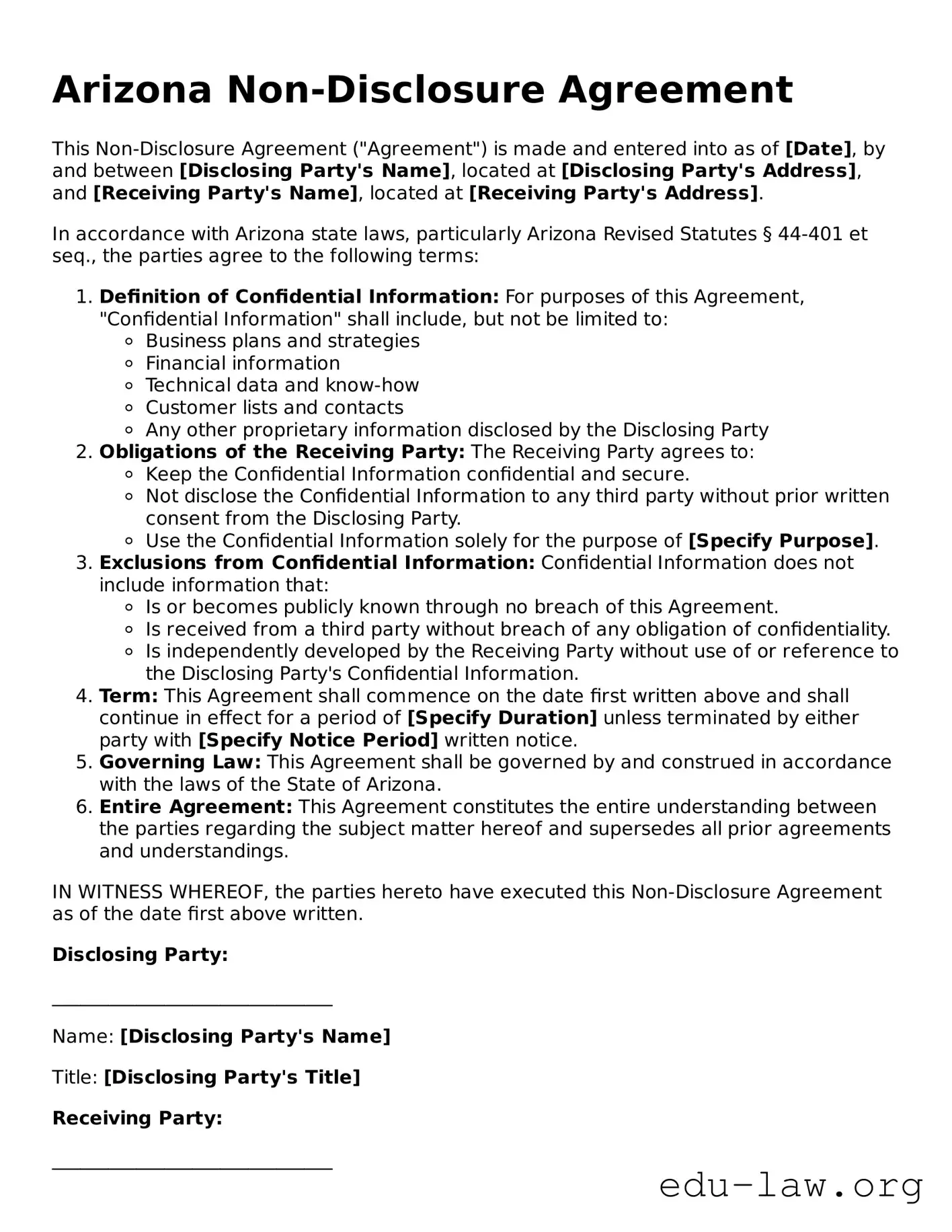
Arizona Non-Disclosure Agreement
This Non-Disclosure Agreement ("Agreement") is made and entered into as of [Date], by and between [Disclosing Party's Name], located at [Disclosing Party's Address], and [Receiving Party's Name], located at [Receiving Party's Address].
In accordance with Arizona state laws, particularly Arizona Revised Statutes § 44-401 et seq., the parties agree to the following terms:
IN WITNESS WHEREOF, the parties hereto have executed this Non-Disclosure Agreement as of the date first above written.
Disclosing Party:
______________________________
Name: [Disclosing Party's Name]
Title: [Disclosing Party's Title]
Receiving Party:
______________________________
Name: [Receiving Party's Name]
Title: [Receiving Party's Title]
| Fact Name | Description |
|---|---|
| Purpose | An Arizona Non-disclosure Agreement (NDA) is designed to protect confidential information shared between parties. |
| Governing Law | The NDA is governed by the laws of the State of Arizona. |
| Parties Involved | The agreement typically involves at least two parties: the disclosing party and the receiving party. |
| Duration of Confidentiality | The NDA usually specifies how long the information must remain confidential, which can vary based on the agreement. |
| Permitted Disclosures | There may be exceptions allowing disclosure under certain circumstances, such as legal requirements. |
| Consequences of Breach | If a party breaches the NDA, they may face legal action and potential damages. |
| Enforceability | For an NDA to be enforceable in Arizona, it must be clear, reasonable, and not overly broad. |
Once you have the Arizona Non-disclosure Agreement form in hand, it's time to complete it. This process involves filling out specific sections with accurate information to ensure the document serves its purpose effectively.
Once you have filled out the form, review it for accuracy. Having both parties sign ensures that the agreement is legally binding. Keep a copy for your records, and provide the other party with theirs. This will help maintain a clear understanding of the confidentiality obligations moving forward.
What is a Non-disclosure Agreement (NDA) in Arizona?
A Non-disclosure Agreement, often referred to as an NDA, is a legal contract that protects confidential information shared between parties. In Arizona, this agreement ensures that sensitive information, such as trade secrets, business strategies, or proprietary data, remains confidential. By signing an NDA, parties agree not to disclose this information to third parties without permission, fostering trust and safeguarding business interests.
Who typically uses an NDA in Arizona?
NDAs are commonly used by businesses, entrepreneurs, and individuals who share sensitive information. For instance, startups may require investors to sign an NDA before discussing their business plans. Employers often ask employees to sign NDAs to protect company secrets. Additionally, consultants and contractors may be asked to sign these agreements when working with businesses to ensure confidentiality regarding their operations and strategies.
What are the key components of an Arizona NDA?
An effective NDA in Arizona typically includes several essential components. First, it clearly defines what constitutes confidential information. Second, it specifies the obligations of the parties involved, particularly regarding how the information should be handled. Third, the agreement outlines the duration of confidentiality, indicating how long the information must remain protected. Lastly, it may include provisions for remedies in case of a breach, helping to ensure that both parties understand the consequences of unauthorized disclosure.
Is an NDA enforceable in Arizona?
Yes, an NDA is generally enforceable in Arizona, provided it meets certain legal requirements. The agreement must be clear and reasonable in scope. Courts in Arizona typically uphold NDAs that protect legitimate business interests and do not impose overly broad restrictions on individuals' ability to work or conduct business. It is important for both parties to understand their rights and obligations under the agreement to ensure its enforceability.
Can an NDA be modified or terminated?
Yes, an NDA can be modified or terminated, but this usually requires the mutual consent of all parties involved. Any changes to the agreement should be documented in writing to ensure clarity and prevent misunderstandings. If circumstances change or if the information is no longer confidential, parties may agree to terminate the NDA, thus releasing each other from their obligations under the contract.
What should I do if I suspect a breach of the NDA?
If you suspect that someone has breached an NDA, it is crucial to address the situation promptly. Start by gathering evidence of the breach, such as emails or communications that indicate unauthorized disclosure. Next, review the NDA to understand the specific obligations and remedies outlined in the agreement. It may be advisable to consult with a legal professional who can guide you on the best course of action, which may include sending a formal notice of breach or pursuing legal remedies.
Are there any limitations to what can be protected under an NDA?
Yes, there are limitations to what can be protected under an NDA. Information that is publicly available or already known to the receiving party cannot be considered confidential. Additionally, facts that are independently developed or disclosed by a third party without breaching another agreement are also not protected. It is essential for parties to clearly identify what constitutes confidential information to avoid confusion and ensure that the NDA is effective in protecting their interests.
Incomplete Information: One common mistake is leaving out essential details. Individuals often forget to fill in their full names, addresses, or the date. This can lead to confusion or disputes later on.
Incorrect Signatures: Another frequent error involves signing the document incorrectly. Some people may not sign in the designated area or may use a name that does not match the one provided in the agreement.
Failing to Define Confidential Information: The agreement should clearly outline what constitutes confidential information. Vague descriptions can lead to misunderstandings about what is protected under the agreement.
Not Specifying the Duration: The length of time that the confidentiality obligations will last is crucial. Omitting this detail can result in uncertainty about how long the parties are bound by the agreement.
Overlooking Governing Law: Parties often forget to include a clause stating which state’s laws will govern the agreement. This can complicate enforcement if a dispute arises.
Ignoring Exceptions: Many people neglect to mention exceptions to the confidentiality obligations. For instance, if certain information is already public, it should be clearly stated to avoid confusion.
Not Including Consequences for Breach: The agreement should specify what happens if one party breaches the terms. Without this, it may be difficult to enforce the agreement effectively.
Failing to Seek Legal Advice: Lastly, individuals often fill out the form without consulting a legal professional. This can lead to errors or omissions that might have been avoided with proper guidance.
When entering into a Non-disclosure Agreement (NDA) in Arizona, several other forms and documents may be useful to ensure comprehensive protection of confidential information. Each document serves a specific purpose and can help clarify the terms of the agreement or facilitate the overall process.
Utilizing these documents in conjunction with an Arizona Non-disclosure Agreement can help clarify the roles and responsibilities of each party, thereby enhancing the protection of sensitive information. It is advisable to consider each document's relevance based on the specific circumstances of the agreement.
The Arizona Non-Disclosure Agreement (NDA) shares similarities with the Confidentiality Agreement. Both documents aim to protect sensitive information from being disclosed to unauthorized parties. A Confidentiality Agreement typically outlines the specific information that must remain confidential, the obligations of the parties involved, and the duration of the confidentiality obligation. Like the NDA, it serves to establish trust between parties engaged in business discussions or collaborations, ensuring that proprietary information is safeguarded against potential leaks or misuse.
Another document comparable to the Arizona NDA is the Non-Compete Agreement. While the primary focus of a Non-Compete Agreement is to restrict one party from competing with another within a specified timeframe and geographical area, it often includes confidentiality clauses that protect trade secrets and sensitive information. Both agreements aim to preserve the competitive edge of a business by preventing former employees or partners from sharing critical information that could benefit competitors.
The Arizona NDA also resembles the Non-Circumvention Agreement. This type of agreement is designed to prevent one party from bypassing the other to engage directly with a third party, often in business transactions. Like the NDA, it includes provisions that protect confidential information shared during negotiations. Both documents emphasize the importance of trust and transparency in business relationships, ensuring that parties do not exploit shared information for their own gain without consent.
Lastly, the Arizona NDA is similar to the Proprietary Information Agreement. This document specifically addresses the handling of proprietary information, which is often a subset of confidential information. The Proprietary Information Agreement outlines what constitutes proprietary information, the obligations of the parties to protect it, and the consequences of unauthorized disclosure. Both the NDA and the Proprietary Information Agreement are essential tools for businesses looking to safeguard their intellectual property and maintain a competitive advantage in their industry.
When filling out the Arizona Non-disclosure Agreement form, it is essential to approach the task with care. Below are five recommendations for what to do and what to avoid during this process.
Non-disclosure agreements (NDAs) are important legal tools used to protect sensitive information. However, there are several misconceptions surrounding the Arizona Non-disclosure Agreement form that can lead to confusion. Here are ten common myths, along with clarifications.
Understanding these misconceptions can help individuals and businesses navigate the complexities of NDAs more effectively. Always consider your specific situation and consult a professional if needed.
When considering a Non-disclosure Agreement (NDA) in Arizona, it is essential to understand its purpose and how to fill it out correctly. Here are some key takeaways to keep in mind:
By keeping these points in mind, parties can create an effective NDA that protects their interests and fosters a secure business environment.