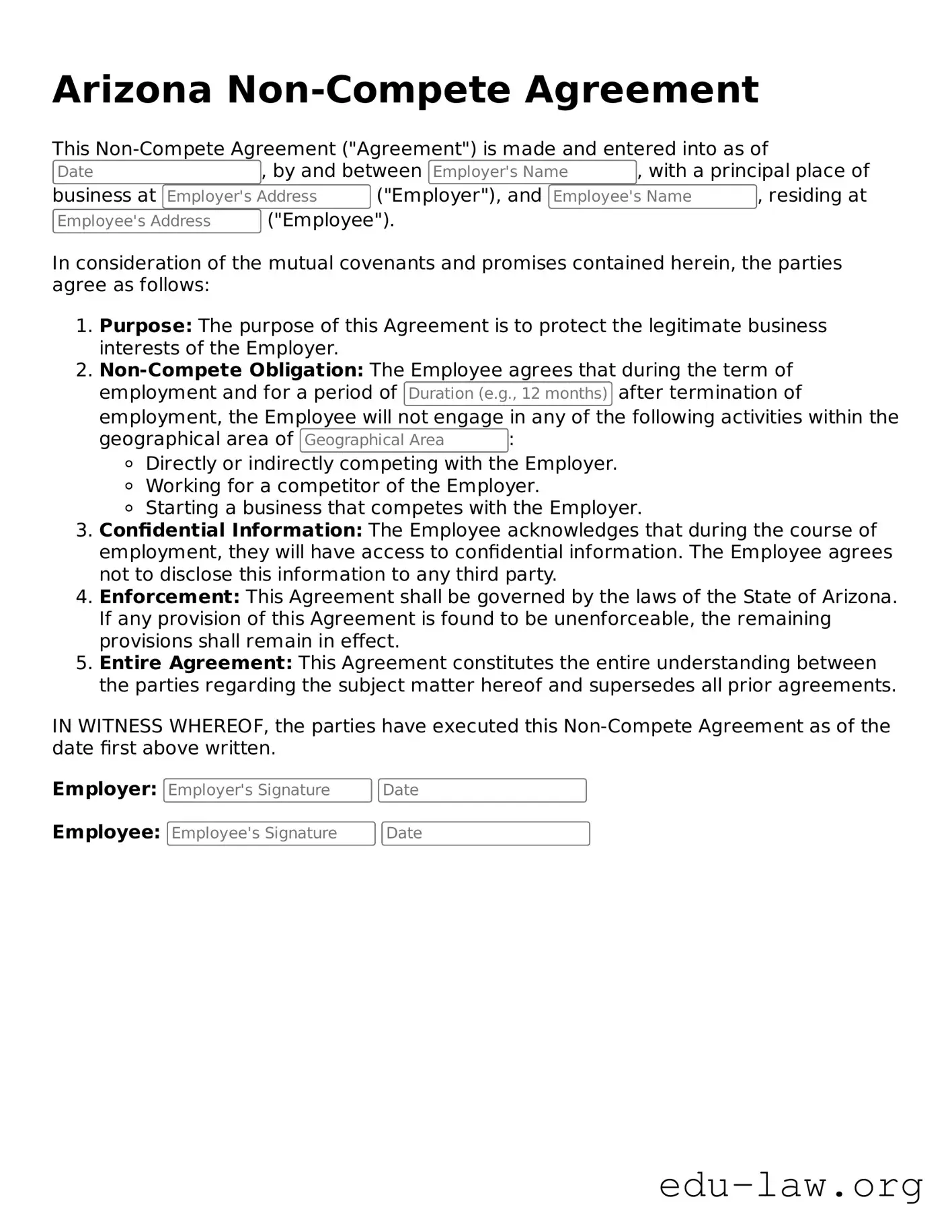
In the competitive landscape of Arizona's job market, the Non-compete Agreement serves as a crucial tool for employers seeking to protect their business interests while also defining the boundaries for their employees. This form outlines the specific terms under which an employee agrees not to engage in similar work or start a competing business within a designated timeframe and geographical area after leaving their current employer. Key elements of the agreement typically include the duration of the non-compete clause, the geographic limitations, and the types of activities that are restricted. It is essential for both parties to understand these terms, as they can significantly impact future employment opportunities and business operations. Clarity and fairness in the agreement are vital, ensuring that the rights of the employee are respected while safeguarding the legitimate interests of the employer. Understanding the implications of signing such a document can help individuals make informed decisions about their career paths and professional commitments.
Arizona Non-Compete Agreement
This Non-Compete Agreement ("Agreement") is made and entered into as of , by and between , with a principal place of business at ("Employer"), and , residing at ("Employee").
In consideration of the mutual covenants and promises contained herein, the parties agree as follows:
IN WITNESS WHEREOF, the parties have executed this Non-Compete Agreement as of the date first above written.
Employer:
Employee:
| Fact Name | Description |
|---|---|
| Governing Law | Arizona law governs non-compete agreements. |
| Enforceability | Non-compete agreements are enforceable in Arizona if they are reasonable in scope and duration. |
| Duration Limit | Typically, non-compete agreements should not exceed two years. |
| Geographic Scope | The geographic area must be reasonable and not overly broad. |
| Consideration | Consideration must be provided, such as employment or access to confidential information. |
| Public Policy | Arizona courts may refuse to enforce non-compete agreements that violate public policy. |
| Employee Rights | Employees have the right to seek legal advice before signing a non-compete agreement. |
| Trade Secrets | Non-compete agreements cannot prevent employees from using their general skills and knowledge. |
| Exceptions | Certain professionals, like physicians, may face different rules regarding non-compete agreements. |
After you have gathered all necessary information, you are ready to fill out the Arizona Non-compete Agreement form. Completing this form accurately is essential to ensure that all parties involved understand the terms clearly. Follow the steps below to fill out the form correctly.
Once the form is completed, ensure that both parties retain a copy for their records. This will help in maintaining transparency and clarity regarding the agreement's terms.
What is a Non-compete Agreement in Arizona?
A Non-compete Agreement is a legal contract between an employer and an employee. It restricts the employee from engaging in certain activities that compete with the employer’s business for a specified period and within a defined geographic area after leaving the company. In Arizona, these agreements must be reasonable in scope and duration to be enforceable.
Are Non-compete Agreements enforceable in Arizona?
Yes, Non-compete Agreements can be enforceable in Arizona, but they must meet specific criteria. The agreement should protect legitimate business interests, such as trade secrets or customer relationships. Courts will evaluate the reasonableness of the restrictions imposed. If deemed overly broad or harsh, a court may refuse to enforce the agreement.
How long can a Non-compete Agreement last in Arizona?
The duration of a Non-compete Agreement in Arizona varies, but it typically ranges from six months to two years. The length should be justifiable based on the nature of the business and the employee's role. A court may strike down an agreement with an excessively long duration, so it is crucial to keep the timeframe reasonable.
What should I include in a Non-compete Agreement?
A Non-compete Agreement should clearly outline the parties involved, the specific activities restricted, the geographic area covered, and the duration of the restrictions. Additionally, it should specify the legitimate business interests being protected. Clarity is essential to ensure that both parties understand their rights and obligations under the agreement.
Not Understanding the Scope of the Agreement: Many individuals fail to grasp the full implications of the non-compete agreement. They may overlook how the restrictions on employment can affect their future job opportunities.
Ignoring Geographic Limitations: Some people do not pay attention to the geographic area specified in the agreement. This can lead to confusion about where they are allowed to work after leaving their current position.
Overlooking Time Restrictions: The duration of the non-compete is crucial. Individuals often neglect to check how long the restrictions last, which can impact their career choices significantly.
Failing to Seek Legal Advice: Many sign the agreement without consulting a legal professional. This can result in agreeing to terms that are overly restrictive or unfair.
Not Considering Exceptions: Individuals frequently miss any exceptions or clauses that might allow for certain types of employment. Understanding these nuances can be beneficial for future job prospects.
Assuming All Agreements Are the Same: People often think that all non-compete agreements are identical. However, terms can vary significantly from one employer to another, making it essential to read each agreement carefully.
Neglecting to Keep a Copy: After signing, individuals sometimes forget to retain a copy of the agreement. This can create difficulties if they need to reference it in the future.
When entering into a Non-compete Agreement in Arizona, several other forms and documents may be relevant to ensure a comprehensive understanding of the terms and obligations involved. These documents help clarify the relationship between the employer and employee, protect sensitive information, and outline the expectations of both parties. Here are four commonly used forms alongside the Non-compete Agreement:
Understanding these documents is essential for both employers and employees. They work together to create a clear and legally sound environment that protects the interests of all parties involved. By being informed about these forms, individuals can navigate their professional relationships with confidence.
A confidentiality agreement, also known as a non-disclosure agreement (NDA), is similar to a non-compete agreement in that both documents aim to protect sensitive information. While a non-compete agreement restricts an individual from working with competitors for a specified time, a confidentiality agreement prevents them from disclosing proprietary information. Both agreements establish clear boundaries regarding the sharing of information and the competitive landscape, ensuring that businesses can safeguard their interests.
An employment contract often includes non-compete clauses, making it similar to a standalone non-compete agreement. This document outlines the terms of employment, including job responsibilities, compensation, and any restrictions on post-employment activities. Like a non-compete agreement, an employment contract is designed to protect the employer’s business interests while providing clarity to the employee about their obligations.
A non-solicitation agreement restricts an individual from soliciting clients or employees from a former employer. This document shares similarities with a non-compete agreement in that both aim to protect a business’s relationships and resources. While a non-compete agreement focuses on employment with competitors, a non-solicitation agreement specifically targets the act of reaching out to former clients or colleagues.
Intellectual property agreements often accompany non-compete agreements, particularly in industries where proprietary information is crucial. These agreements define ownership rights over inventions, designs, and trade secrets. Both types of agreements work together to ensure that an employee does not take valuable ideas or information to a competing business, thus protecting the employer’s intellectual assets.
A partnership agreement can also be similar to a non-compete agreement, particularly when it includes clauses that restrict partners from competing with the business after leaving. This document outlines the terms of the partnership, including roles, responsibilities, and exit strategies. By including non-compete provisions, partners can ensure that the business remains protected from former partners who might seek to establish competing ventures.
A franchise agreement frequently contains non-compete clauses to protect the franchisor's brand and business model. This document governs the relationship between the franchisor and franchisee, specifying the rights and obligations of both parties. The non-compete aspect ensures that franchisees do not open competing businesses within a certain radius or timeframe, thereby maintaining the integrity of the franchise system.
An independent contractor agreement may also include non-compete terms, especially when the contractor has access to sensitive business information. This agreement outlines the scope of work, payment terms, and any restrictions on future employment. Like a non-compete agreement, it aims to prevent contractors from using the knowledge gained during their engagement to benefit competitors.
Finally, a severance agreement sometimes includes non-compete clauses as part of the terms for receiving severance pay. This document outlines the conditions under which an employee receives compensation after leaving a company. Including a non-compete clause ensures that the departing employee does not immediately join a competitor, providing the employer with a buffer period to adjust to the change.
When filling out the Arizona Non-compete Agreement form, it is important to follow certain guidelines to ensure accuracy and compliance. Below is a list of things you should and shouldn't do during this process.
By adhering to these guidelines, individuals can better navigate the process of completing the Arizona Non-compete Agreement form, ensuring that their rights and interests are protected.
Non-compete agreements can be a source of confusion for many individuals and businesses in Arizona. Here are eight common misconceptions about these agreements, along with clarifications.
Not true. In Arizona, non-compete agreements must meet specific criteria to be enforceable. They must be reasonable in scope, duration, and geographic area.
This is a misconception. Employers can choose to require non-compete agreements for certain positions, particularly those involving sensitive information or trade secrets, but not all employees are required to sign one.
These are different legal tools. A non-disclosure agreement protects confidential information, while a non-compete agreement restricts an employee from working in similar roles for competitors after leaving a job.
This is misleading. A non-compete agreement may limit where and how long you can work in your field, but it does not prohibit you from working altogether.
This is incorrect. While they are more common for higher-level positions, non-compete agreements can be applied to various roles, depending on the nature of the business and the information accessed.
Employees can negotiate the terms of a non-compete agreement before signing. It is advisable to seek clarification on any terms that seem overly restrictive.
While many agreements may seem to favor employers, they must still be reasonable and not overly burdensome on the employee. Courts will not enforce agreements that are deemed too restrictive.
This is not guaranteed. While violating a non-compete can lead to legal action, employers may choose not to enforce the agreement for various reasons, including the cost of litigation.
Understanding these misconceptions can help individuals and businesses navigate the complexities of non-compete agreements in Arizona more effectively.
When filling out and using the Arizona Non-compete Agreement form, consider the following key takeaways:
By following these takeaways, businesses can effectively utilize the Arizona Non-compete Agreement form while safeguarding their interests.