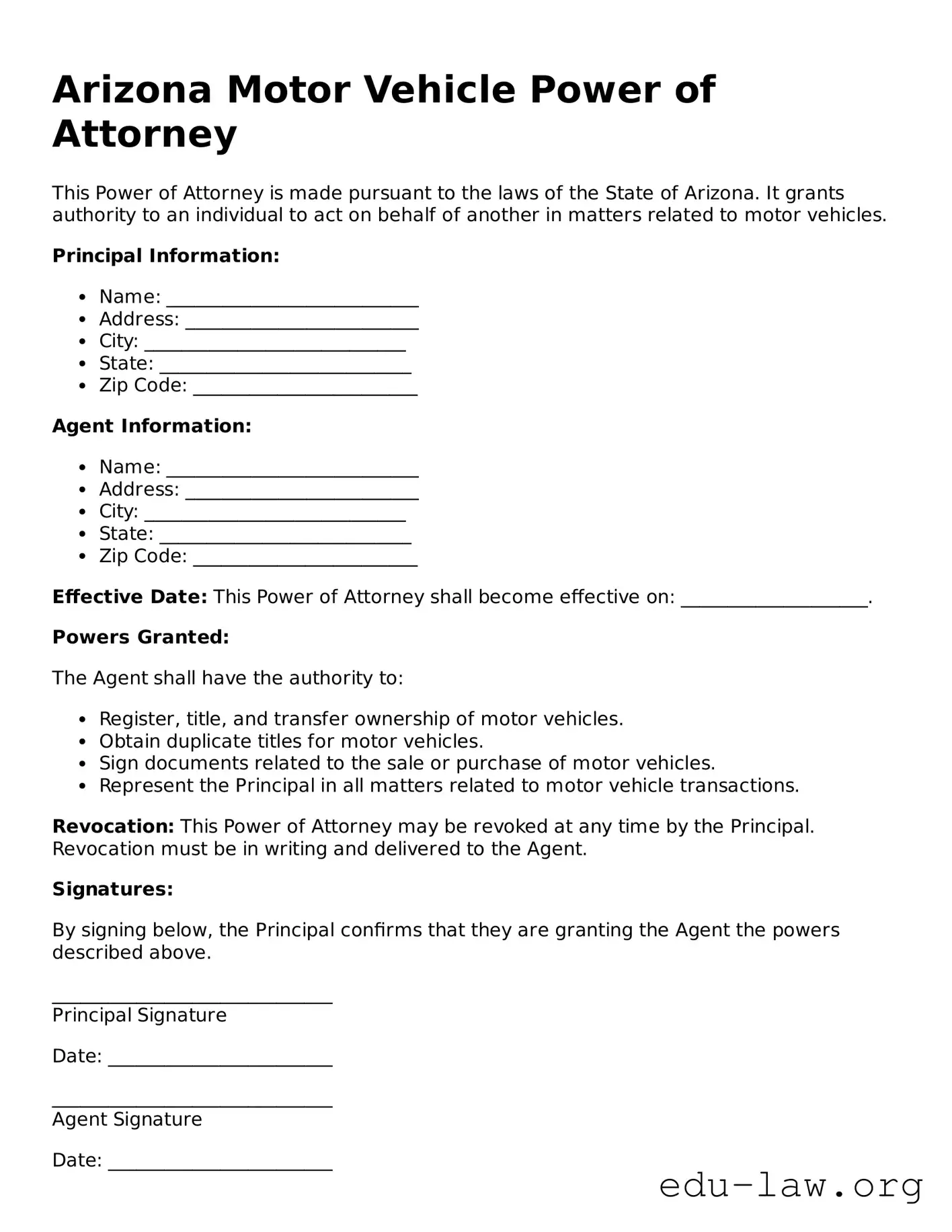
The Arizona Motor Vehicle Power of Attorney form serves as a crucial legal document, empowering an individual to designate another person to act on their behalf regarding motor vehicle transactions. This form is particularly useful when the vehicle owner is unable to be present for the completion of necessary paperwork, such as transferring ownership, registering a vehicle, or obtaining a title. By granting this authority, the principal can ensure that their interests are represented in a timely manner. The appointed agent must be a trustworthy individual, as they will handle significant responsibilities related to the vehicle. It is essential for the principal to clearly outline the specific powers being granted, as well as any limitations, to avoid potential misunderstandings. Additionally, the form requires signatures from both the principal and the agent, along with appropriate identification, to validate the agreement and ensure its legality. Understanding the implications and requirements of this form can help vehicle owners navigate the complexities of motor vehicle transactions with greater ease and confidence.
Arizona Motor Vehicle Power of Attorney
This Power of Attorney is made pursuant to the laws of the State of Arizona. It grants authority to an individual to act on behalf of another in matters related to motor vehicles.
Principal Information:
Agent Information:
Effective Date: This Power of Attorney shall become effective on: ____________________.
Powers Granted:
The Agent shall have the authority to:
Revocation: This Power of Attorney may be revoked at any time by the Principal. Revocation must be in writing and delivered to the Agent.
Signatures:
By signing below, the Principal confirms that they are granting the Agent the powers described above.
______________________________
Principal Signature
Date: ________________________
______________________________
Agent Signature
Date: ________________________
| Fact Name | Description |
|---|---|
| Purpose | The Arizona Motor Vehicle Power of Attorney form allows an individual to designate another person to act on their behalf regarding motor vehicle transactions. |
| Governing Law | This form is governed by Arizona Revised Statutes, specifically under Title 28, which pertains to transportation and motor vehicles. |
| Eligibility | Any adult resident of Arizona can create this power of attorney, as long as they are of sound mind and capable of understanding the implications of the document. |
| Revocation | The power of attorney can be revoked at any time by the principal, provided that the revocation is communicated to the agent and any relevant parties. |
| Agent Responsibilities | The agent must act in the best interest of the principal and handle all motor vehicle-related matters as specified in the document. |
| Signature Requirement | The form must be signed by the principal and may require notarization to be considered valid in Arizona. |
| Limitations | This power of attorney is limited to motor vehicle transactions and does not grant authority over other types of property or legal matters. |
Filling out the Arizona Motor Vehicle Power of Attorney form is straightforward. Once completed, this form allows someone you trust to handle your motor vehicle matters on your behalf. Follow these steps to ensure that the form is filled out correctly.
After completing the form, keep a copy for your records. Provide the original to the person you appointed, so they can act on your behalf when needed.
What is a Motor Vehicle Power of Attorney in Arizona?
A Motor Vehicle Power of Attorney (POA) in Arizona is a legal document that allows one person to authorize another person to act on their behalf regarding motor vehicle transactions. This can include buying, selling, registering, or transferring ownership of a vehicle. It’s particularly useful when the vehicle owner cannot be present to handle these matters themselves.
Who can be appointed as an agent in a Motor Vehicle Power of Attorney?
Any competent adult can be appointed as an agent. This means the person you choose must be at least 18 years old and capable of making decisions. Many people select trusted family members, friends, or professionals to act as their agent.
Do I need to notarize the Motor Vehicle Power of Attorney?
Yes, in Arizona, the Motor Vehicle Power of Attorney must be notarized. This step helps ensure that the document is valid and that the signatures are authentic. It also provides an added layer of protection against fraud.
Can I revoke a Motor Vehicle Power of Attorney?
Absolutely! You can revoke a Motor Vehicle Power of Attorney at any time, as long as you are of sound mind. To do this, you should create a written revocation document and inform your agent and any relevant parties, such as the Arizona Department of Transportation.
Is there a specific form I need to use for the Motor Vehicle Power of Attorney?
While Arizona does not have a state-mandated form for the Motor Vehicle Power of Attorney, it’s recommended to use a form that includes all necessary details, such as the names of the principal and agent, a description of the powers granted, and the vehicle information. Many legal websites provide templates that can be customized.
How long is a Motor Vehicle Power of Attorney valid?
The validity of a Motor Vehicle Power of Attorney can vary based on the terms you set within the document. Typically, it remains in effect until you revoke it or until a specific date or event occurs, such as the completion of a transaction.
Can I use the Motor Vehicle Power of Attorney for out-of-state transactions?
Generally, a Motor Vehicle Power of Attorney created in Arizona can be used for transactions in other states, but it’s wise to check the specific requirements of the state where the transaction will take place. Some states may have different rules regarding powers of attorney.
What if my agent misuses the Power of Attorney?
If you believe your agent is misusing their authority, you should take immediate action. This includes revoking the Power of Attorney and potentially seeking legal advice. Misuse can include actions that go against your wishes or that benefit the agent at your expense.
Can I include multiple agents in my Motor Vehicle Power of Attorney?
Yes, you can appoint multiple agents in your Motor Vehicle Power of Attorney. You can specify whether they must act together or if any one of them can act independently. Clear instructions will help avoid confusion and ensure your wishes are followed.
Where do I file the Motor Vehicle Power of Attorney?
You do not need to file the Motor Vehicle Power of Attorney with any government office in Arizona. However, you should keep it in a safe place and provide copies to your agent and any relevant parties, such as the dealership or the Arizona Department of Transportation, when necessary.
Inaccurate Information: One common mistake is providing incorrect personal details. This includes the names, addresses, or identification numbers of both the principal and the agent. Always double-check these details for accuracy.
Not Specifying Powers: Failing to clearly outline the powers granted can lead to confusion. It’s essential to specify whether the agent can handle all matters related to the vehicle or if their authority is limited to specific actions.
Omitting Signatures: Some individuals forget to sign the form altogether. Both the principal and the agent must sign the document. Without these signatures, the form is not valid.
Not Notarizing the Document: In Arizona, notarization is often required for the Power of Attorney to be effective. Neglecting this step can result in the form being rejected or not accepted by authorities.
When dealing with motor vehicle transactions in Arizona, it's essential to have the right documentation to ensure a smooth process. Along with the Arizona Motor Vehicle Power of Attorney form, several other forms and documents may be required or beneficial. Here’s a list of commonly used forms that can aid in various motor vehicle matters.
Having these documents prepared and organized can significantly ease the process of buying, selling, or managing a vehicle in Arizona. Ensure that all forms are filled out accurately and submitted promptly to avoid delays in your transactions.
The Arizona Vehicle Registration Application is a document that allows individuals to register their vehicles with the state. Similar to the Power of Attorney form, it requires personal information and identification details. Both documents facilitate the handling of vehicle-related matters, but the registration application focuses on establishing ownership and legal registration, while the Power of Attorney grants authority to another person to act on behalf of the vehicle owner.
The Vehicle Title Transfer form serves a similar purpose by enabling the transfer of ownership of a vehicle from one party to another. Like the Power of Attorney, it requires signatures from both the seller and buyer. However, while the Power of Attorney allows someone to act on behalf of the owner in various capacities, the Title Transfer form specifically deals with the change of ownership and is often a one-time transaction.
The Bill of Sale is another document that shares similarities with the Power of Attorney form. It serves as proof of the sale of a vehicle and includes details about the buyer and seller. Both documents require the identification of parties involved and may need to be notarized. However, the Bill of Sale focuses on the transaction itself, while the Power of Attorney allows for ongoing representation in vehicle matters.
The Arizona Affidavit of Vehicle Ownership is a document used when the owner cannot provide a title for the vehicle. Similar to the Power of Attorney, it allows a person to affirm ownership and request a title replacement. Both forms require the signer to provide personal information and may be used to clarify ownership in legal situations, but the Affidavit specifically addresses title issues.
The Application for Duplicate Title is another document that resembles the Power of Attorney form. It is used when a vehicle owner needs a replacement title due to loss or theft. Both documents require identification and personal information. However, while the Application for Duplicate Title is focused solely on obtaining a new title, the Power of Attorney allows for broader representation regarding vehicle matters.
The Vehicle Emissions Compliance Certificate is a document that certifies a vehicle meets emissions standards. Like the Power of Attorney, it is often required for vehicle registration or transfer. Both documents involve compliance with state regulations, but the Emissions Compliance Certificate is specifically concerned with environmental standards, while the Power of Attorney grants authority for various vehicle-related actions.
The Driver’s License Application is similar in that it requires personal information and identification. Both the Driver’s License Application and the Power of Attorney form are essential for legal identification and representation in vehicle matters. However, the Driver’s License Application focuses on obtaining a license to operate a vehicle, whereas the Power of Attorney allows someone to act on behalf of another in vehicle-related transactions.
Finally, the Arizona Notice of Sale is a document used to notify the state of a vehicle sale. This document is similar to the Power of Attorney in that it involves the transfer of rights and responsibilities. Both documents require the seller's information and details about the vehicle. However, the Notice of Sale specifically informs the state of the sale, while the Power of Attorney empowers another individual to act on behalf of the owner in various capacities.
When filling out the Arizona Motor Vehicle Power of Attorney form, it’s essential to approach the process with care. Here’s a helpful list of things to do and avoid to ensure everything goes smoothly.
Following these guidelines can help prevent misunderstandings and ensure that the Power of Attorney is valid and effective. Always take your time and double-check your work.
Understanding the Arizona Motor Vehicle Power of Attorney form is essential for anyone looking to delegate authority regarding vehicle-related matters. However, several misconceptions can lead to confusion. Below are five common misconceptions along with clarifications.
This is incorrect. While the form is often associated with selling vehicles, it can also be used for various purposes, including registering a vehicle, transferring ownership, or handling title-related issues.
In Arizona, notarization is not always required for a Motor Vehicle Power of Attorney. However, having the document notarized can add an extra layer of legitimacy and may be required by certain institutions.
This is not true. Individuals can create a Motor Vehicle Power of Attorney without a lawyer, provided they follow the state's guidelines and include all necessary information.
The validity of the form does not automatically expire. It remains effective until the principal revokes it or until the purpose for which it was created is fulfilled.
The authority granted to the agent is limited to what is specified in the Power of Attorney. The principal can outline specific tasks the agent is allowed to perform, ensuring control over the powers granted.
Filling out the Arizona Motor Vehicle Power of Attorney form can be straightforward if you keep these key takeaways in mind:
By following these takeaways, you can ensure that the process of using the Arizona Motor Vehicle Power of Attorney form goes smoothly.