In Arizona, a Medical Power of Attorney (MPOA) is an essential document that empowers individuals to make healthcare decisions on behalf of another person in the event that they become unable to do so themselves. This form allows you to designate a trusted person, often referred to as an agent, to act in your best interests regarding medical treatment and care. Key aspects of the MPOA include the ability to specify preferences for medical interventions, the authority to access medical records, and the responsibility to communicate with healthcare providers. It is crucial for individuals to consider their values and wishes when selecting an agent, as this person will play a significant role in making potentially life-altering decisions. Additionally, the MPOA can be tailored to include specific instructions about the types of treatment one would or would not want, ensuring that personal beliefs and desires are respected. Understanding the importance of this document can provide peace of mind, knowing that your healthcare decisions will be managed by someone you trust, even when you cannot voice your preferences yourself.
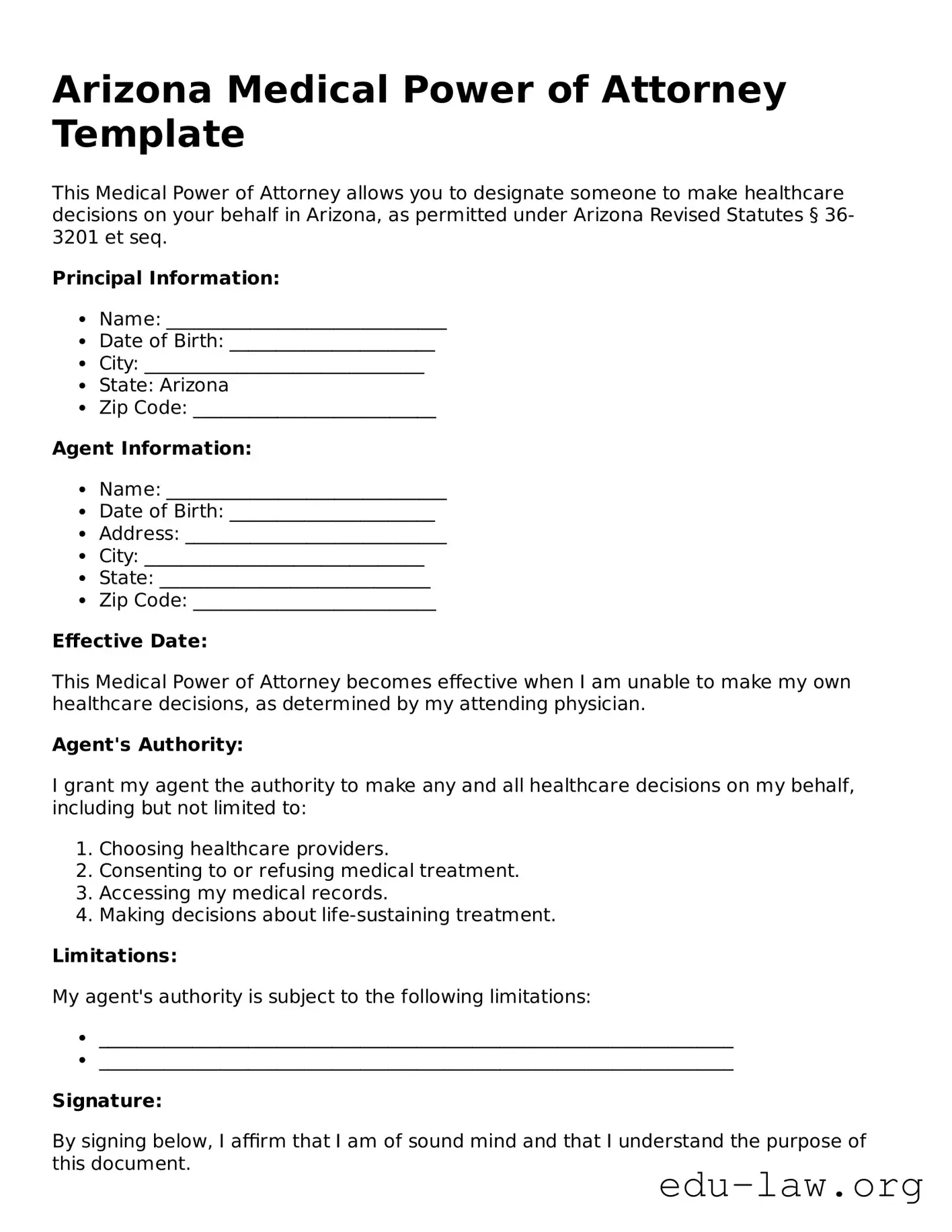
Arizona Medical Power of Attorney Template
This Medical Power of Attorney allows you to designate someone to make healthcare decisions on your behalf in Arizona, as permitted under Arizona Revised Statutes § 36-3201 et seq.
Principal Information:
Agent Information:
Effective Date:
This Medical Power of Attorney becomes effective when I am unable to make my own healthcare decisions, as determined by my attending physician.
Agent's Authority:
I grant my agent the authority to make any and all healthcare decisions on my behalf, including but not limited to:
Limitations:
My agent's authority is subject to the following limitations:
Signature:
By signing below, I affirm that I am of sound mind and that I understand the purpose of this document.
Signature of Principal: ___________________________
Date: _________________________________________
Witnesses:
This document must be signed in the presence of two witnesses who are not related to the principal or the agent.
Witness 1 Name: ______________________________
Witness 1 Signature: __________________________
Date: ______________________________________
Witness 2 Name: ______________________________
Witness 2 Signature: __________________________
Date: ______________________________________
Notarization:
State of Arizona, County of ______________________
Subscribed and sworn before me on this _____ day of ______________, 20__.
Notary Public Signature: ______________________
My Commission Expires: ______________________
| Fact Name | Description |
|---|---|
| Definition | The Arizona Medical Power of Attorney form allows individuals to designate someone to make healthcare decisions on their behalf if they become unable to do so. |
| Governing Law | This form is governed by Arizona Revised Statutes, Title 36, Chapter 32. |
| Eligibility | Any adult who is at least 18 years old can complete this form in Arizona. |
| Signature Requirement | The form must be signed by the principal (the person granting authority) and witnessed by two individuals or notarized. |
| Durability | The power granted remains in effect even if the principal becomes incapacitated. |
| Revocation | The principal can revoke the Medical Power of Attorney at any time, as long as they are competent to do so. |
| Scope of Authority | Agents can make decisions regarding medical treatment, including end-of-life care, based on the principal's wishes. |
| Healthcare Provider's Role | Healthcare providers must honor the decisions made by the agent as if they were made by the principal. |
| Advance Directives | This form can be part of a broader set of advance directives, which may include living wills and other healthcare instructions. |
| Access to Medical Records | Agents designated in the form have the right to access the principal's medical records to make informed decisions. |
Filling out the Arizona Medical Power of Attorney form is an important step in ensuring that your healthcare decisions are made according to your wishes. This document allows you to designate someone you trust to make medical decisions on your behalf if you become unable to do so. Below are the steps to complete the form effectively.
After completing these steps, you can feel more secure knowing that your healthcare wishes will be respected. It is always a good idea to review the form periodically to ensure it still reflects your preferences.
What is a Medical Power of Attorney in Arizona?
A Medical Power of Attorney is a legal document that allows you to appoint someone you trust to make healthcare decisions on your behalf if you become unable to do so. This can happen due to illness, injury, or any condition that affects your ability to communicate your wishes regarding medical treatment.
Who can I appoint as my agent in a Medical Power of Attorney?
You can choose any competent adult to be your agent, but it is often best to select someone who understands your values and preferences regarding medical care. This could be a family member, a close friend, or a trusted advisor. It’s important to discuss your wishes with them beforehand to ensure they are comfortable making these decisions for you.
What decisions can my agent make on my behalf?
Your agent can make a wide range of healthcare decisions, including those related to medical treatments, surgeries, and end-of-life care. They can also decide on the use of life-sustaining treatments if you are unable to communicate your wishes. However, your agent must always act in accordance with your preferences and best interests.
Do I need a lawyer to create a Medical Power of Attorney in Arizona?
No, you do not need a lawyer to create a Medical Power of Attorney in Arizona. However, it is advisable to seek legal advice if you have complex medical or family situations. A legal professional can help ensure that your document meets all legal requirements and accurately reflects your wishes.
How do I revoke or change my Medical Power of Attorney?
You can revoke or change your Medical Power of Attorney at any time, as long as you are mentally competent. To do this, you should create a new document that explicitly states your intentions or write a revocation letter. Make sure to inform your previous agent and any healthcare providers about the changes you have made.
Is my Medical Power of Attorney valid in other states?
While a Medical Power of Attorney created in Arizona is generally valid in other states, it is important to check the specific laws of the state where you are traveling or residing. Some states may have different requirements or forms. If you spend significant time in another state, consider creating a new document that complies with that state's laws.
What happens if I do not have a Medical Power of Attorney?
If you do not have a Medical Power of Attorney and become unable to make your own healthcare decisions, the court may appoint a guardian to make decisions on your behalf. This process can be lengthy and may not reflect your personal wishes. Having a Medical Power of Attorney in place helps ensure that your preferences are honored and that your loved ones are not burdened with making difficult decisions during a crisis.
Not Choosing the Right Agent: One of the most common mistakes is failing to select an appropriate person as your agent. This should be someone you trust implicitly, as they will make crucial health care decisions on your behalf. Friends or family members who may not understand your values or wishes can lead to complications.
Leaving Sections Blank: Some individuals mistakenly leave certain sections of the form blank, thinking it will be filled in later. This can create confusion or even render the document invalid. Every section should be completed to ensure clarity about your wishes.
Not Updating the Document: Life changes, and so do your preferences. Failing to update your Medical Power of Attorney after significant life events—like marriage, divorce, or the death of a designated agent—can lead to situations where your current wishes are not accurately represented.
Ignoring Witness and Notary Requirements: In Arizona, specific legal requirements must be met for the document to be valid. Some people overlook the need for witnesses or a notary. Without proper signatures, the form may not hold up when it’s needed most.
When considering the Arizona Medical Power of Attorney, it's important to understand that this document often works in conjunction with several other forms and legal documents. Each of these serves a unique purpose in ensuring that an individual's healthcare preferences and legal rights are respected. Below is a list of commonly used documents alongside the Medical Power of Attorney.
Each of these documents plays a vital role in ensuring that an individual's healthcare wishes are honored and that their rights are protected. Understanding how they interact with the Arizona Medical Power of Attorney can help individuals make informed decisions about their healthcare and legal needs.
The Arizona Medical Power of Attorney form is similar to the Durable Power of Attorney. Both documents allow individuals to designate someone to make decisions on their behalf. However, while the Durable Power of Attorney can cover a wide range of financial and legal matters, the Medical Power of Attorney specifically focuses on healthcare decisions. This distinction is crucial for individuals who want to ensure that their health-related choices are made according to their wishes when they are unable to communicate them directly.
Another comparable document is the Living Will. A Living Will outlines an individual's preferences regarding medical treatment in situations where they are terminally ill or incapacitated. Like the Medical Power of Attorney, it addresses healthcare decisions, but it does so in a more directive manner. The Living Will provides specific instructions about the types of medical interventions one does or does not want, while the Medical Power of Attorney appoints someone to make those decisions on the individual’s behalf.
The Healthcare Proxy is also similar to the Arizona Medical Power of Attorney. This document allows a person to appoint a trusted individual to make healthcare decisions when they are unable to do so. Both documents prioritize the individual's health care preferences and ensure that someone they trust will advocate for their needs. However, the Healthcare Proxy may have different legal requirements or implications depending on the state, so it’s essential to understand the specific laws in Arizona.
Lastly, the Advance Healthcare Directive encompasses both the Medical Power of Attorney and the Living Will. This comprehensive document combines the elements of appointing a decision-maker with the ability to specify treatment preferences. By using an Advance Healthcare Directive, individuals can ensure that their healthcare wishes are clearly articulated and legally recognized. This document serves as a holistic approach to managing one’s healthcare decisions, addressing both the need for a representative and the desire for specific treatment instructions.
When filling out the Arizona Medical Power of Attorney form, it is essential to approach the process with care. Here are some important do's and don'ts to keep in mind:
Understanding the Arizona Medical Power of Attorney form is crucial for making informed decisions about healthcare. However, several misconceptions can lead to confusion. Here are eight common misconceptions explained:
A Medical Power of Attorney specifically grants authority to make healthcare decisions, while a regular Power of Attorney covers financial and legal matters.
This form can be used whenever an individual is unable to make their own medical decisions, not just in terminal situations.
While you can choose anyone you trust, certain restrictions apply. For example, healthcare providers cannot serve as agents if they are involved in your care.
The Arizona Medical Power of Attorney can be revoked or updated at any time, allowing individuals to change their preferences as needed.
In Arizona, the form does not require notarization; however, it must be signed by the principal and two witnesses to be legally binding.
This document is strictly for medical decisions. For financial matters, a separate Power of Attorney form is needed.
While many states recognize Arizona's Medical Power of Attorney, each state has its own laws. It is essential to check the regulations in other states if you travel or move.
The Medical Power of Attorney only becomes effective when the individual is deemed unable to make decisions. This determination must be made by a qualified healthcare provider.
Clarifying these misconceptions can help individuals navigate their healthcare preferences more effectively.
Filling out a Medical Power of Attorney (MPOA) form in Arizona is an important step in ensuring that your healthcare preferences are honored. Here are some key takeaways to keep in mind:
By keeping these takeaways in mind, you can navigate the process of creating a Medical Power of Attorney in Arizona with confidence and clarity.