Creating a Last Will and Testament is an essential step in ensuring that your wishes are honored after your passing. In Arizona, this legal document serves as a guide for distributing your assets and appointing guardians for minor children, if applicable. The form typically includes vital information such as the testator's name, the designation of an executor, and a clear outline of how personal property and real estate should be allocated among beneficiaries. Additionally, it may address any debts or obligations you wish to settle before your estate is distributed. Understanding the nuances of the Arizona Last Will and Testament form can help you navigate this important process with confidence, ensuring that your intentions are clearly communicated and legally recognized. By taking the time to complete this document, you can provide peace of mind for yourself and your loved ones during a challenging time.
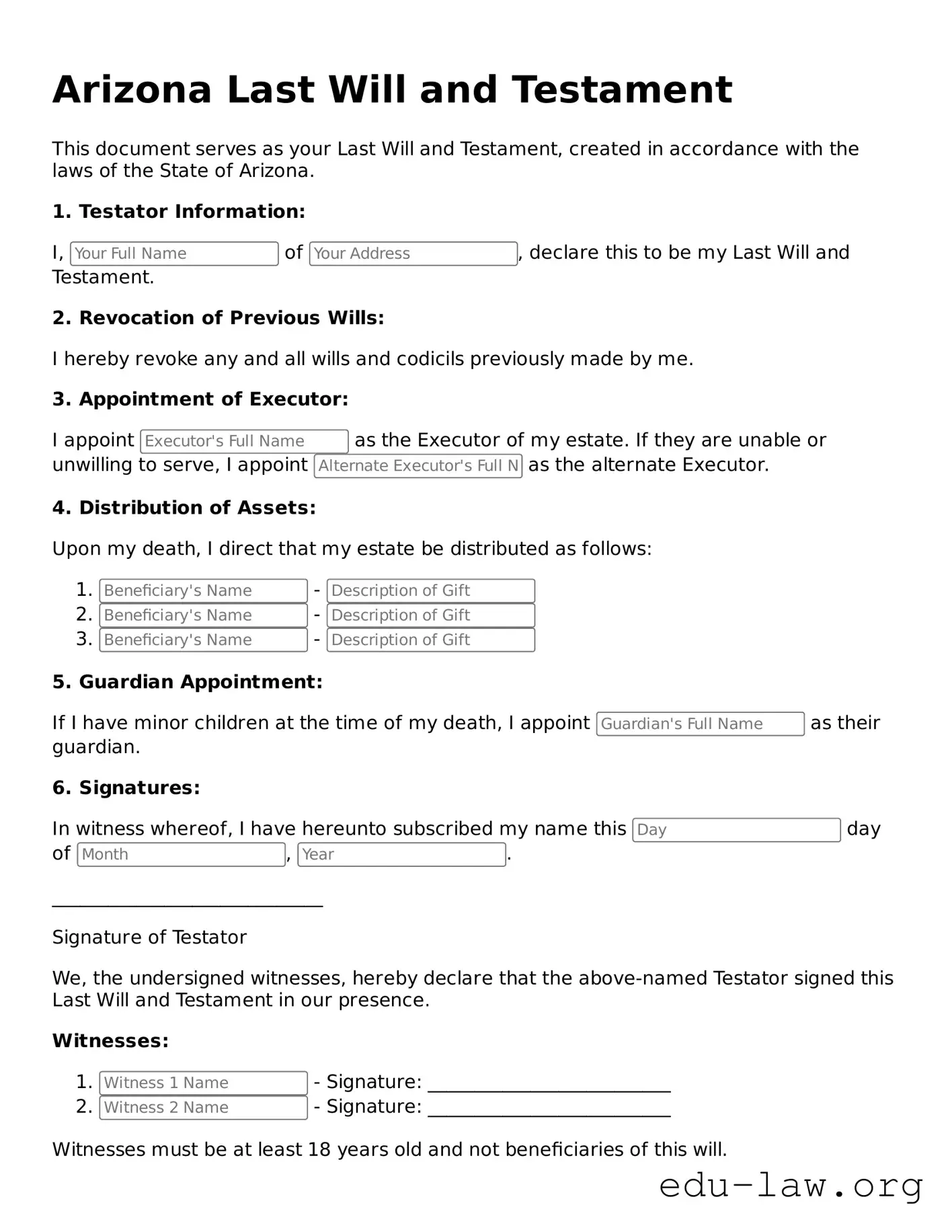
Arizona Last Will and Testament
This document serves as your Last Will and Testament, created in accordance with the laws of the State of Arizona.
1. Testator Information:
I, of , declare this to be my Last Will and Testament.
2. Revocation of Previous Wills:
I hereby revoke any and all wills and codicils previously made by me.
3. Appointment of Executor:
I appoint as the Executor of my estate. If they are unable or unwilling to serve, I appoint as the alternate Executor.
4. Distribution of Assets:
Upon my death, I direct that my estate be distributed as follows:
5. Guardian Appointment:
If I have minor children at the time of my death, I appoint as their guardian.
6. Signatures:
In witness whereof, I have hereunto subscribed my name this day of , .
_____________________________
Signature of Testator
We, the undersigned witnesses, hereby declare that the above-named Testator signed this Last Will and Testament in our presence.
Witnesses:
Witnesses must be at least 18 years old and not beneficiaries of this will.
| Fact Name | Description |
|---|---|
| Governing Law | The Arizona Last Will and Testament is governed by Arizona Revised Statutes, Title 14, Chapter 2. |
| Minimum Age | To create a valid will in Arizona, you must be at least 18 years old. |
| Testamentary Capacity | A person must have the mental capacity to understand the nature of making a will. |
| Witness Requirement | Arizona requires that a will be signed by at least two witnesses who are present at the same time. |
| Holographic Wills | A handwritten will (holographic will) is valid in Arizona, provided it is signed by the testator. |
| Revocation | A will can be revoked by creating a new will or by physically destroying the original document. |
| Self-Proving Wills | Arizona allows for self-proving wills, which can simplify the probate process. |
| Residency Requirement | There is no residency requirement to create a will in Arizona, but it must comply with state laws. |
| Probate Process | Wills must go through probate in Arizona, which involves validating the will and distributing assets. |
After obtaining the Arizona Last Will and Testament form, you will need to fill it out carefully to ensure that your wishes are clearly expressed. This document will guide the distribution of your assets and address other important matters after your passing. Follow the steps below to complete the form accurately.
What is a Last Will and Testament in Arizona?
A Last Will and Testament is a legal document that outlines how an individual's assets and affairs should be handled after their death. In Arizona, this document allows a person to designate beneficiaries for their property, appoint an executor to manage the estate, and specify guardianship for any minor children.
Who can create a Last Will and Testament in Arizona?
Any adult who is at least 18 years old and of sound mind can create a Last Will and Testament in Arizona. This includes U.S. citizens and legal residents. It is important to ensure that the will reflects the individual's wishes and is executed properly according to state laws.
What are the requirements for a valid Last Will and Testament in Arizona?
In Arizona, a valid Last Will and Testament must be in writing and signed by the testator (the person making the will) in the presence of at least two witnesses. These witnesses must also sign the will. Alternatively, a will can be handwritten and signed by the testator, known as a holographic will, but it must still meet certain criteria to be considered valid.
Can I change my Last Will and Testament once it is created?
Yes, you can change your Last Will and Testament at any time. This can be done by creating a new will or by drafting a codicil, which is an amendment to the existing will. It is essential to follow the same formalities as the original will to ensure that any changes are legally binding.
What happens if I die without a Last Will and Testament in Arizona?
If an individual dies without a Last Will and Testament, they are said to have died "intestate." In this case, Arizona law dictates how the deceased's assets will be distributed. Typically, assets will be distributed to surviving relatives according to a predetermined hierarchy, which may not align with the deceased's wishes.
Can I name guardians for my children in my Last Will and Testament?
Yes, you can name guardians for your minor children in your Last Will and Testament. This is an important provision that allows you to designate someone you trust to care for your children in the event of your death. It is advisable to discuss this decision with the potential guardians beforehand to ensure they are willing to take on this responsibility.
How is a Last Will and Testament executed in Arizona?
To execute a Last Will and Testament in Arizona, the testator must sign the document in the presence of two witnesses, who must also sign the will. It is recommended to have the will notarized to add an extra layer of authenticity, although notarization is not a legal requirement in Arizona.
Where should I keep my Last Will and Testament?
It is important to store your Last Will and Testament in a safe place where it can be easily accessed after your death. Common options include a safe deposit box, a fireproof safe at home, or with an attorney. Informing a trusted family member or friend about the location of the will is also advisable.
Filling out a Last Will and Testament form can be a daunting task. Many people want to ensure their wishes are honored after they pass, but mistakes can easily occur. Here are six common mistakes to avoid when completing the Arizona Last Will and Testament form:
Not being clear about beneficiaries. It's crucial to specify who will inherit your assets. Vague language can lead to confusion and disputes among loved ones.
Failing to sign the document properly. In Arizona, your will must be signed by you and witnessed by at least two individuals. Neglecting this step can render the will invalid.
Overlooking updates. Life changes, such as marriage, divorce, or the birth of a child, may necessitate updates to your will. Regularly review and revise your document to reflect your current situation.
Not considering alternate beneficiaries. If a primary beneficiary passes away before you, having an alternate beneficiary ensures that your assets are still distributed according to your wishes.
Ignoring the need for a personal representative. This individual will be responsible for carrying out the terms of your will. Choose someone trustworthy and capable of handling this important role.
Using outdated forms. Laws can change, and using an old version of the will form may lead to complications. Always ensure you are using the most current form available.
By avoiding these common pitfalls, you can create a clearer and more effective Last Will and Testament that reflects your wishes and protects your loved ones.
Creating a comprehensive estate plan often involves more than just drafting a Last Will and Testament. In Arizona, several other documents can complement a will and ensure that your wishes are clearly articulated and legally binding. Below is a list of commonly used forms and documents that can enhance your estate planning efforts.
Incorporating these documents into your estate planning can provide clarity and peace of mind. Each plays a unique role in ensuring that your wishes are respected and that your loved ones are taken care of according to your preferences.
The Arizona Last Will and Testament is a crucial document for anyone looking to outline their wishes regarding the distribution of their assets after passing. Similar to a will, a Living Will provides guidance, but focuses specifically on medical decisions. This document allows individuals to express their preferences for medical treatment in case they become unable to communicate. By creating a Living Will, you ensure that your healthcare wishes are respected, providing peace of mind for both you and your loved ones.
A Trust is another document that shares similarities with a Last Will and Testament. While a will distributes assets after death, a Trust can manage your assets during your lifetime and after your passing. This arrangement can provide more control over when and how your assets are distributed. Trusts can also help avoid probate, which is a common concern for many individuals looking to streamline the transfer of their estate.
Another document that bears resemblance to a Last Will is the Advance Healthcare Directive. This document combines elements of both a Living Will and a Durable Power of Attorney for healthcare. It allows you to specify your healthcare preferences and appoint a healthcare agent to make decisions on your behalf. This can be especially important in situations where you may not be able to voice your wishes, ensuring that your healthcare aligns with your values and desires.
In some cases, individuals may also consider a Codicil, which is essentially an amendment to an existing will. This document allows you to make changes to your will without having to create an entirely new one. A Codicil can be used to add new beneficiaries, change asset distributions, or update executor information. This flexibility can be beneficial as life circumstances change, making it a useful tool for estate planning.
Lastly, a Memorandum of Personal Property can complement a Last Will by providing specific instructions about personal items not covered in the will. This document can detail who should receive sentimental items, family heirlooms, or other personal belongings. By being clear about these wishes, you can help avoid potential disputes among family members and ensure that your cherished possessions are passed down according to your intentions.
When filling out the Arizona Last Will and Testament form, it's important to approach the process carefully. Here’s a straightforward list of things you should and shouldn't do:
Taking these steps will help ensure your wishes are honored and can make the process smoother for your loved ones. Remember, clarity and legality are key!
When it comes to creating a Last Will and Testament in Arizona, several misconceptions can lead to confusion. Understanding the truth behind these myths is essential for ensuring that your wishes are honored after your passing.
This is false. Arizona recognizes handwritten wills, also known as holographic wills, as valid as long as they are signed by the person making the will and the material provisions are in their handwriting.
While having a lawyer can be helpful, it is not a requirement in Arizona. Individuals can create their own will using the appropriate forms, as long as they follow state laws.
This is not true. A will must go through the probate process, which is the legal procedure to validate the will and distribute assets. However, certain assets can bypass probate if they are held in a trust or designated with a beneficiary.
This is incorrect. A will can be modified or revoked at any time, as long as the person is of sound mind. It is advisable to keep the will updated to reflect any significant life changes.
This is a common misconception. Everyone can benefit from having a will, regardless of their financial status. A will ensures that your wishes regarding your possessions and care of dependents are clearly stated.
Creating a Last Will and Testament in Arizona is an important step in ensuring your wishes are honored after your passing. Here are some key takeaways to consider when filling out and using the Arizona Last Will and Testament form: