In the vibrant state of Arizona, the Independent Contractor Agreement form serves as a crucial tool for businesses and freelancers alike, facilitating clear communication and expectations between parties. This form outlines the nature of the working relationship, ensuring that both the contractor and the hiring entity understand their rights and responsibilities. Key aspects include the scope of work, payment terms, and deadlines, which provide a roadmap for project completion. Additionally, it addresses confidentiality, intellectual property rights, and dispute resolution, safeguarding the interests of both sides. By establishing these parameters, the agreement fosters a professional environment that encourages collaboration and efficiency. Whether you're a seasoned contractor or a business owner seeking specialized services, understanding this form is essential for navigating the complexities of independent work in Arizona.
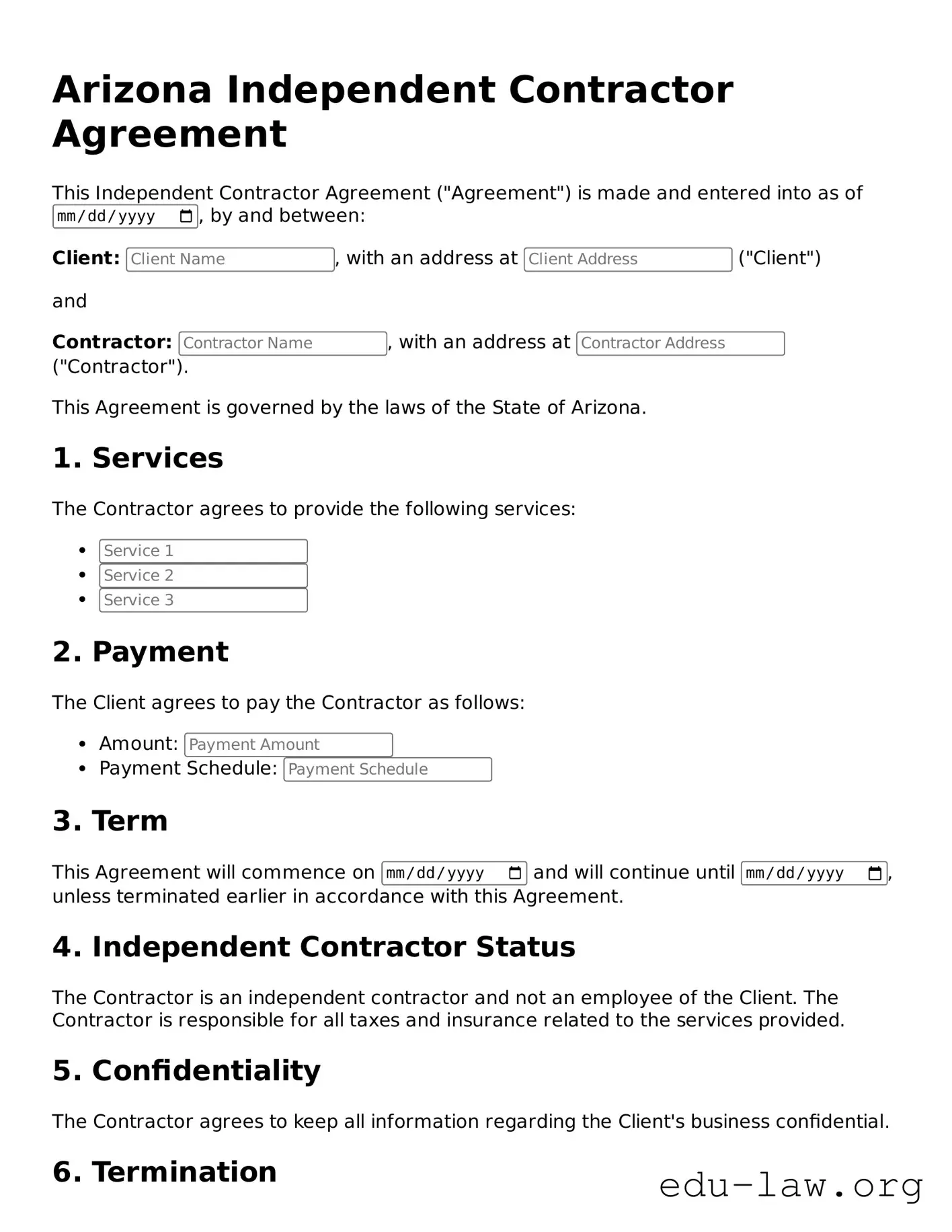
Arizona Independent Contractor Agreement
This Independent Contractor Agreement ("Agreement") is made and entered into as of , by and between:
Client: , with an address at ("Client")
and
Contractor: , with an address at ("Contractor").
This Agreement is governed by the laws of the State of Arizona.
1. Services
The Contractor agrees to provide the following services:
2. Payment
The Client agrees to pay the Contractor as follows:
3. Term
This Agreement will commence on and will continue until , unless terminated earlier in accordance with this Agreement.
4. Independent Contractor Status
The Contractor is an independent contractor and not an employee of the Client. The Contractor is responsible for all taxes and insurance related to the services provided.
5. Confidentiality
The Contractor agrees to keep all information regarding the Client's business confidential.
6. Termination
Either party may terminate this Agreement with written notice to the other party.
7. Governing Law
This Agreement shall be governed by and construed in accordance with the laws of the State of Arizona.
IN WITNESS WHEREOF, the parties have executed this Agreement as of the date first above written.
Client Signature: _________________________
Contractor Signature: _________________________
| Fact Name | Details |
|---|---|
| Purpose | The Arizona Independent Contractor Agreement outlines the terms between a contractor and a client. |
| Governing Law | This agreement is governed by the laws of the State of Arizona. |
| Key Components | It typically includes payment terms, project scope, and confidentiality clauses. |
| Independent Status | The agreement clarifies that the contractor is not an employee of the client. |
| Termination Clause | It usually contains terms for how either party can terminate the agreement. |
Completing the Arizona Independent Contractor Agreement form is a straightforward process. It’s important to fill it out accurately to ensure clarity and mutual understanding between the parties involved. Follow these steps to complete the form effectively.
After completing the form, ensure that both parties retain a copy for their records. This will help in maintaining transparency and accountability throughout the duration of the agreement.
What is an Arizona Independent Contractor Agreement?
An Arizona Independent Contractor Agreement is a legal document that outlines the relationship between a business and an independent contractor. This agreement specifies the terms under which the contractor will provide services, including payment, responsibilities, and the duration of the contract. It helps clarify expectations and protects both parties in case of disputes.
Why should I use an Independent Contractor Agreement?
Using an Independent Contractor Agreement is essential for defining the scope of work and the responsibilities of each party. It can help prevent misunderstandings and provide legal protection. By clearly outlining payment terms, deadlines, and other key details, both the contractor and the hiring party can work more effectively and avoid potential conflicts.
What key elements should be included in the agreement?
Important elements to include in an Arizona Independent Contractor Agreement are: the names and contact information of both parties, a detailed description of the services to be provided, payment terms, deadlines, confidentiality clauses, and termination conditions. Additionally, it is wise to specify whether the contractor is responsible for their own taxes and insurance.
How is payment structured in the agreement?
Payment structures can vary based on the nature of the work. The agreement should specify whether the contractor will be paid hourly, per project, or through a retainer. It's important to outline payment schedules, such as weekly or monthly, and detail any additional expenses that may be reimbursed. Clear payment terms help avoid confusion and ensure timely compensation.
Can the agreement be modified after it is signed?
Yes, the agreement can be modified after it is signed, but any changes should be documented in writing and agreed upon by both parties. It's best to create an amendment or addendum that outlines the specific changes. This ensures that both parties are aware of the updates and agree to the new terms, maintaining clarity and reducing the risk of disputes.
What happens if there is a dispute?
If a dispute arises, the agreement should outline the process for resolving it. Many agreements include a clause for mediation or arbitration, which can be a quicker and less expensive alternative to litigation. It’s important for both parties to understand the dispute resolution process specified in the agreement to ensure they are prepared if issues occur.
Is legal advice necessary when creating this agreement?
While it is possible to create an Independent Contractor Agreement without legal assistance, seeking legal advice is highly recommended. An attorney can help ensure that the agreement complies with Arizona laws and adequately protects your interests. Legal professionals can also provide guidance on any specific requirements or clauses that may be beneficial for your situation.
Incomplete Information: One of the most common mistakes is failing to provide all necessary details. This includes not filling out the contractor's name, address, and contact information. Omitting this information can lead to confusion and delays in processing the agreement.
Incorrect Classification: Misclassifying the worker is another frequent error. It is essential to ensure that the individual is indeed an independent contractor and not an employee. Misclassification can have legal and tax implications.
Missing Signatures: A signed agreement is crucial for its validity. Some people forget to sign the document or assume that verbal agreements are sufficient. Without signatures from both parties, the agreement may not be enforceable.
Neglecting Terms and Conditions: Failing to clearly outline the terms and conditions of the work can lead to misunderstandings. It is important to specify the scope of work, payment terms, and deadlines. Vague descriptions can create disputes later on.
Ignoring State-Specific Laws: Each state has its own regulations regarding independent contractors. Not being aware of Arizona's specific requirements can result in non-compliance. It is vital to review state laws to ensure the agreement meets all legal standards.
When entering into a professional relationship with an independent contractor in Arizona, several additional documents may be necessary to ensure clarity and compliance. These documents help outline responsibilities, protect both parties, and establish a clear understanding of the working arrangement. Below is a list of commonly used forms that accompany the Arizona Independent Contractor Agreement.
These documents are important in establishing a professional relationship that is clear and beneficial for both parties involved. By utilizing them, individuals can help ensure that all aspects of the independent contractor arrangement are properly addressed and understood.
The Arizona Independent Contractor Agreement is similar to the Employment Agreement. Both documents outline the terms of a working relationship, but they differ in the classification of the worker. An Employment Agreement typically establishes an employer-employee relationship, which includes benefits, taxes, and other obligations. In contrast, the Independent Contractor Agreement clarifies that the worker is self-employed, thus not entitled to the same benefits or protections as an employee. This distinction is crucial for both parties to understand their rights and responsibilities.
Another document that shares similarities is the Non-Disclosure Agreement (NDA). While the Independent Contractor Agreement focuses on the terms of work and payment, an NDA protects sensitive information shared during the course of the working relationship. Both documents often include clauses about confidentiality, ensuring that proprietary information remains protected. This is particularly important in industries where trade secrets and intellectual property are involved.
The Service Agreement is also akin to the Independent Contractor Agreement. A Service Agreement outlines the specifics of services to be provided, including deliverables, timelines, and payment terms. Like the Independent Contractor Agreement, it establishes a clear understanding between the parties about what is expected, ensuring that both sides are aligned on the scope of work. However, a Service Agreement can apply to various types of service providers, not just independent contractors.
The Consulting Agreement is another document that resembles the Independent Contractor Agreement. This type of agreement is typically used when a consultant is hired to provide expert advice or services. Both agreements delineate the nature of the relationship, payment terms, and the responsibilities of each party. However, a Consulting Agreement often includes specific provisions related to the consultant's expertise and the expected outcomes of their services.
The Partnership Agreement can also be compared to the Independent Contractor Agreement, though they serve different purposes. A Partnership Agreement outlines the terms of a business partnership, detailing each partner's roles, responsibilities, and profit-sharing arrangements. In contrast, the Independent Contractor Agreement does not imply any shared ownership or profits but rather a transactional relationship for specific services rendered.
The License Agreement shares similarities with the Independent Contractor Agreement in that both documents define the terms under which one party can use another party's intellectual property. A License Agreement allows one party to use certain rights, such as trademarks or copyrights, while the Independent Contractor Agreement may include clauses related to the use of intellectual property created during the contract period. This ensures clarity on ownership and usage rights of any work produced.
The Freelance Agreement is closely related to the Independent Contractor Agreement, as both are used to formalize the relationship between a client and a freelancer. These agreements outline the work to be completed, payment terms, and deadlines. However, a Freelance Agreement may be more tailored to creative professionals, such as writers or designers, while the Independent Contractor Agreement can apply to a broader range of services.
Lastly, the Memorandum of Understanding (MOU) can be compared to the Independent Contractor Agreement. An MOU outlines the intentions and expectations of two parties entering into a collaborative arrangement. While it may not be legally binding like an Independent Contractor Agreement, it serves as a framework for understanding the roles and responsibilities of each party. Both documents aim to foster clear communication and mutual understanding, though the MOU is often less formal.
When filling out the Arizona Independent Contractor Agreement form, it's essential to approach the task with care. Here are some important dos and don'ts to keep in mind:
By following these guidelines, you can ensure that the agreement is clear and effective for both parties involved.
When it comes to the Arizona Independent Contractor Agreement form, there are several misconceptions that can lead to confusion. Understanding these can help both contractors and businesses navigate their working relationships more effectively.
Many people believe that only large companies need to use an Independent Contractor Agreement. In reality, any business or individual hiring a contractor, regardless of size, should have this agreement in place to clarify expectations and protect both parties.
Some assume that an Independent Contractor Agreement can be used without any modifications. However, each agreement should be tailored to reflect the specific terms of the working relationship, including the scope of work, payment terms, and deadlines.
It's common for individuals to think that a verbal agreement is enough. Unfortunately, without a written contract, misunderstandings can easily arise. A written agreement provides clarity and can serve as a reference point if disputes occur.
Many believe that independent contractors are completely on their own and have no legal protections. This is not true. Contractors have rights under various laws, including payment protections and safety regulations, depending on the nature of their work.
Filling out and using the Arizona Independent Contractor Agreement form is crucial for both parties involved. Here are some key takeaways to keep in mind:
Taking the time to carefully fill out this form can save both parties from potential legal disputes in the future. It is essential to review the agreement thoroughly before signing.