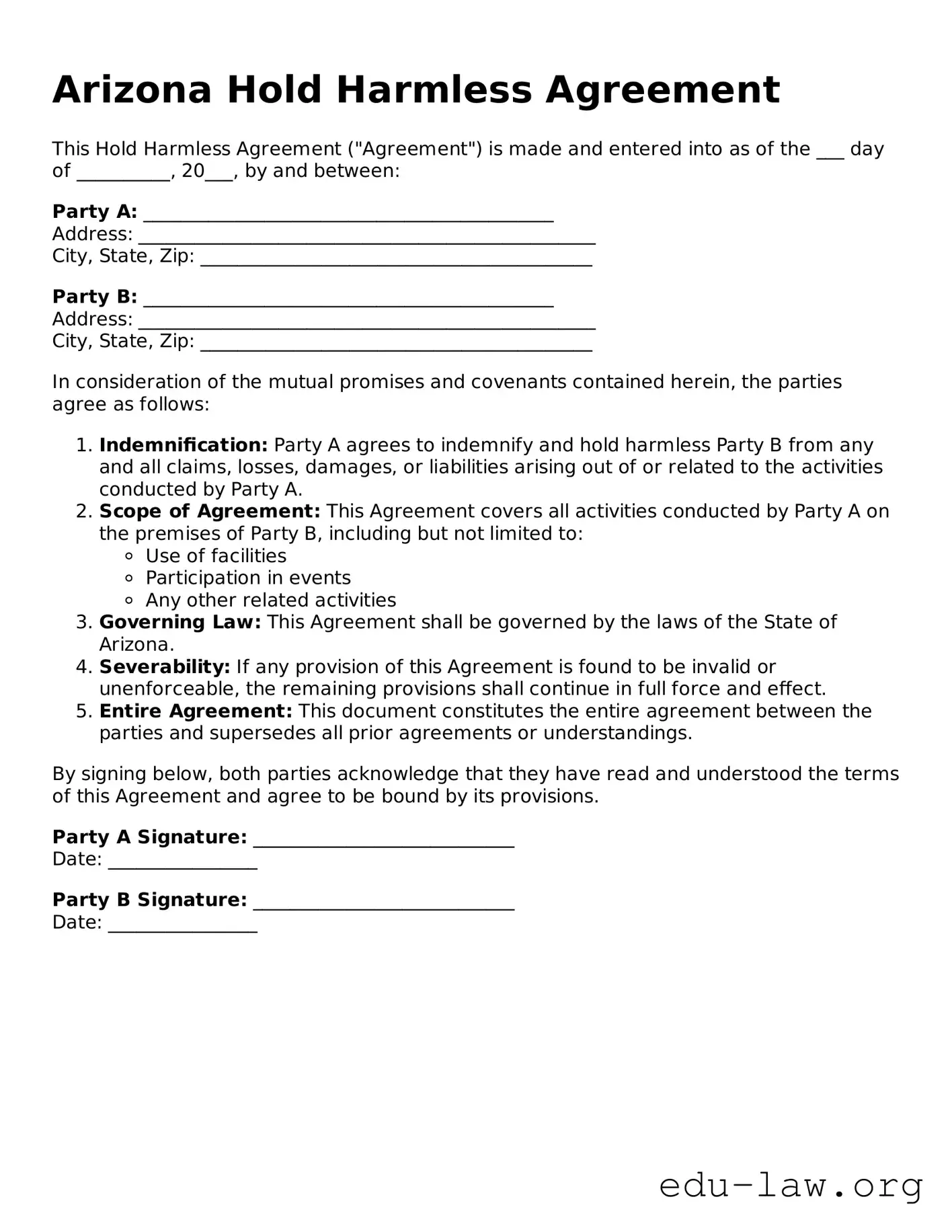
The Arizona Hold Harmless Agreement form serves a critical function in various contractual relationships, particularly in situations where one party seeks protection from liability for potential damages or injuries that may arise during the execution of a specific activity or event. This agreement is often utilized in contexts such as rental agreements, construction projects, and recreational activities, where inherent risks may exist. By signing the form, individuals or organizations agree to assume responsibility for any claims, damages, or losses that may occur, thereby shielding the other party from legal repercussions. It is essential for all parties involved to understand the implications of this agreement, as it can significantly impact their rights and responsibilities. The form typically outlines the scope of the agreement, the specific activities covered, and any limitations on liability, ensuring clarity and mutual understanding. Overall, the Arizona Hold Harmless Agreement is a vital tool for fostering trust and accountability in various transactions, allowing participants to engage in activities with a clear understanding of their legal obligations.
Arizona Hold Harmless Agreement
This Hold Harmless Agreement ("Agreement") is made and entered into as of the ___ day of __________, 20___, by and between:
Party A: ____________________________________________
Address: _________________________________________________
City, State, Zip: __________________________________________
Party B: ____________________________________________
Address: _________________________________________________
City, State, Zip: __________________________________________
In consideration of the mutual promises and covenants contained herein, the parties agree as follows:
By signing below, both parties acknowledge that they have read and understood the terms of this Agreement and agree to be bound by its provisions.
Party A Signature: ____________________________
Date: ________________
Party B Signature: ____________________________
Date: ________________
| Fact Name | Details |
|---|---|
| Definition | The Arizona Hold Harmless Agreement is a legal document where one party agrees to take responsibility for certain risks or liabilities. |
| Purpose | This agreement is used to protect one party from legal claims or damages that may arise from specific activities or events. |
| Common Uses | It is often used in rental agreements, event planning, and construction contracts. |
| Governing Law | The agreement is governed by Arizona state laws, particularly contract law. |
| Parties Involved | Typically, there are two parties: the indemnitor (who agrees to hold harmless) and the indemnitee (who is protected). |
| Requirements | The agreement must be in writing, clearly stating the responsibilities and liabilities of each party. |
| Enforceability | For the agreement to be enforceable, it must be signed by both parties and not violate public policy. |
| Limitations | Some liabilities, such as gross negligence or intentional misconduct, may not be covered by the agreement. |
| Review Recommendations | It is advisable to have a legal professional review the agreement before signing. |
| Modification | The agreement can be modified if both parties agree, but changes should be documented in writing. |
Completing the Arizona Hold Harmless Agreement form involves several straightforward steps. After filling out the form, you will be prepared to submit it according to the requirements set forth by the relevant parties involved. This ensures that all necessary information is accurately recorded and understood.
What is a Hold Harmless Agreement?
A Hold Harmless Agreement is a legal document that protects one party from liability or claims that may arise from specific activities or events. In Arizona, this agreement is often used in various contexts, including rental agreements, construction contracts, and event planning, to ensure that one party does not hold the other responsible for certain risks or damages.
Who typically uses a Hold Harmless Agreement in Arizona?
This agreement is commonly utilized by businesses, property owners, event organizers, and contractors. For instance, a property owner may require a tenant to sign this agreement to protect against claims resulting from accidents on the property. Similarly, event organizers may ask participants to sign a Hold Harmless Agreement to mitigate liability during an event.
What are the key components of a Hold Harmless Agreement?
Key components typically include the identification of the parties involved, a clear description of the activities or situations covered by the agreement, and the specific liabilities that are being waived. Additionally, the agreement may outline the duration of the waiver and any conditions that apply. It is essential for the language to be clear and understandable to all parties involved.
Is a Hold Harmless Agreement legally enforceable in Arizona?
Yes, a Hold Harmless Agreement can be legally enforceable in Arizona, provided that it meets certain criteria. The agreement must be clear, specific, and voluntarily signed by all parties. Courts may scrutinize the agreement to ensure that it does not violate public policy or contain unconscionable terms. Therefore, it is advisable to consult with a legal professional when drafting or signing such agreements.
Can a Hold Harmless Agreement protect against gross negligence or intentional misconduct?
Generally, Hold Harmless Agreements cannot protect a party from liability arising from gross negligence or intentional misconduct. Courts often view such protections as contrary to public policy. Therefore, it is crucial for individuals and businesses to understand the limitations of these agreements and to seek legal advice if they have concerns about liability in these contexts.
How does one properly execute a Hold Harmless Agreement?
To properly execute a Hold Harmless Agreement, all parties should read the document thoroughly before signing. Each party should ensure they understand the terms and implications of the agreement. It is also advisable to have the agreement reviewed by a legal professional to ensure its validity and enforceability. Once all parties are in agreement, signatures should be obtained, and copies should be distributed for record-keeping.
Are there any alternatives to a Hold Harmless Agreement?
Yes, there are alternatives to a Hold Harmless Agreement. One option is to obtain liability insurance, which can provide financial protection against claims. Additionally, parties may negotiate specific terms in contracts that limit liability without requiring a Hold Harmless Agreement. However, the best approach will depend on the specific circumstances and risks involved.
What should I do if I have questions about a Hold Harmless Agreement?
If you have questions or concerns about a Hold Harmless Agreement, it is advisable to consult with a qualified attorney. Legal professionals can provide guidance tailored to your specific situation, ensuring that you understand your rights and responsibilities. They can also help you navigate any complexities associated with drafting or signing such agreements.
Not reading the entire agreement thoroughly. It’s crucial to understand every section before signing.
Failing to provide complete and accurate personal information. Ensure your name, address, and contact details are correct.
Overlooking the date. Always include the date when you are signing the agreement.
Neglecting to specify the scope of the agreement. Clearly outline what activities or events the agreement covers.
Not understanding the implications of the agreement. Consider how it affects your rights and responsibilities.
Forgetting to sign the document. A signature is necessary for the agreement to be valid.
Leaving out witnesses or not having the agreement notarized, if required. Check if your situation requires additional verification.
Assuming the agreement is standard without confirming its specific terms. Each agreement may have unique clauses that need attention.
Not keeping a copy of the signed agreement. Always retain a copy for your records.
A Hold Harmless Agreement is a vital document that protects one party from liability for certain actions or events. In Arizona, this form is often used in various situations, such as rental agreements, construction contracts, or event planning. To ensure comprehensive protection and clarity, several other forms and documents are frequently utilized alongside the Hold Harmless Agreement. Below are some of the most common ones.
Understanding these related documents can enhance the effectiveness of a Hold Harmless Agreement. By using them together, parties can ensure they are adequately protected against potential liabilities. Always consider consulting a legal professional for tailored advice and guidance regarding these forms.
The Arizona Hold Harmless Agreement is similar to a Liability Waiver. Both documents serve to protect one party from legal claims resulting from the actions of another party. A Liability Waiver typically requires participants to acknowledge the risks involved in an activity and agree not to hold the provider responsible for any injuries or damages. This form is often used in recreational settings, such as sports or adventure activities, where the risk of injury is present. By signing, participants accept the inherent risks and relinquish their right to sue for negligence.
Another document that resembles the Hold Harmless Agreement is the Indemnity Agreement. This agreement focuses on one party agreeing to compensate another for any losses or damages that may arise from specific actions or events. While both documents aim to mitigate risk, the Indemnity Agreement often involves financial compensation, whereas the Hold Harmless Agreement primarily seeks to prevent legal claims. This distinction makes the Indemnity Agreement particularly useful in business contracts where financial liabilities are a concern.
The Release of Liability form is also akin to the Hold Harmless Agreement. This document releases one party from liability for any injuries or damages that may occur during a specific event or activity. Like the Hold Harmless Agreement, the Release of Liability form emphasizes the participant's acceptance of risk. However, it is more commonly used in situations where an individual voluntarily participates in an activity, such as a sports event or workshop, and acknowledges the potential dangers involved.
A Service Agreement can share similarities with the Hold Harmless Agreement, particularly when it includes indemnification clauses. In this context, the service provider agrees to protect the client from any claims arising from the services rendered. This mutual understanding helps ensure that both parties are aware of their responsibilities and liabilities, fostering a more secure working relationship. The Hold Harmless Agreement can serve as a standalone document or be incorporated into a broader Service Agreement.
The Rental Agreement often includes provisions similar to those found in a Hold Harmless Agreement. Many rental agreements specify that tenants must hold the property owner harmless from any claims arising from accidents or injuries that occur on the premises. This clause protects landlords from potential lawsuits while ensuring tenants understand their responsibilities when occupying the property. It emphasizes the importance of safety and caution while using the rented space.
The Construction Contract is another document that may contain hold harmless provisions. In construction projects, contractors often agree to indemnify property owners against claims resulting from their work. This arrangement protects the owner from legal repercussions stemming from accidents or damages that occur during the construction process. The Hold Harmless Agreement can serve as a complementary document to reinforce these terms and provide additional clarity on liability issues.
Insurance Policies, particularly General Liability Insurance, can also share characteristics with the Hold Harmless Agreement. While insurance policies provide financial protection against claims, a Hold Harmless Agreement outlines the responsibilities of each party regarding liability. Both documents aim to minimize risk and protect individuals or businesses from unforeseen circumstances. However, insurance policies typically involve financial compensation, while Hold Harmless Agreements focus on relinquishing legal claims.
Finally, the Partnership Agreement can include hold harmless clauses to protect partners from liabilities incurred by the business. This type of agreement outlines the responsibilities and expectations of each partner, ensuring that all parties understand their roles. By incorporating a Hold Harmless Agreement, partners can safeguard themselves against potential legal claims arising from the partnership’s activities, fostering a sense of security and cooperation among the partners.
When filling out the Arizona Hold Harmless Agreement form, it's important to ensure accuracy and clarity. Here are some key dos and don’ts to guide you through the process.
Following these guidelines will help ensure that the Arizona Hold Harmless Agreement is completed correctly and serves its intended purpose.
When considering an Arizona Hold Harmless Agreement, several misconceptions often arise. Understanding these can help individuals and businesses navigate their responsibilities more effectively.
Many believe that signing a Hold Harmless Agreement means they cannot be held liable for any actions. However, this is not entirely accurate. The agreement typically protects one party from claims or damages caused by another, but it does not cover gross negligence or intentional misconduct.
Some people think that Hold Harmless Agreements are only relevant in high-risk scenarios, such as extreme sports or construction. In reality, they can be beneficial in various situations, including rental agreements or service contracts, where one party may want to protect themselves from potential claims.
Another common belief is that a verbal Hold Harmless Agreement is just as effective as a written one. However, without a written document, proving the terms and intentions of the agreement can be challenging in a dispute. A written agreement provides clarity and serves as a legal record.
People often assume that all Hold Harmless Agreements have identical terms and conditions. This is misleading. Each agreement can vary significantly based on the specific circumstances, parties involved, and the legal language used. Customization is often necessary to ensure that the agreement meets the needs of all parties.
When dealing with an Arizona Hold Harmless Agreement, it's essential to understand its purpose and how to properly fill it out. Here are some key takeaways to keep in mind:
By keeping these points in mind, you can effectively fill out and utilize the Arizona Hold Harmless Agreement form to safeguard yourself and your interests.