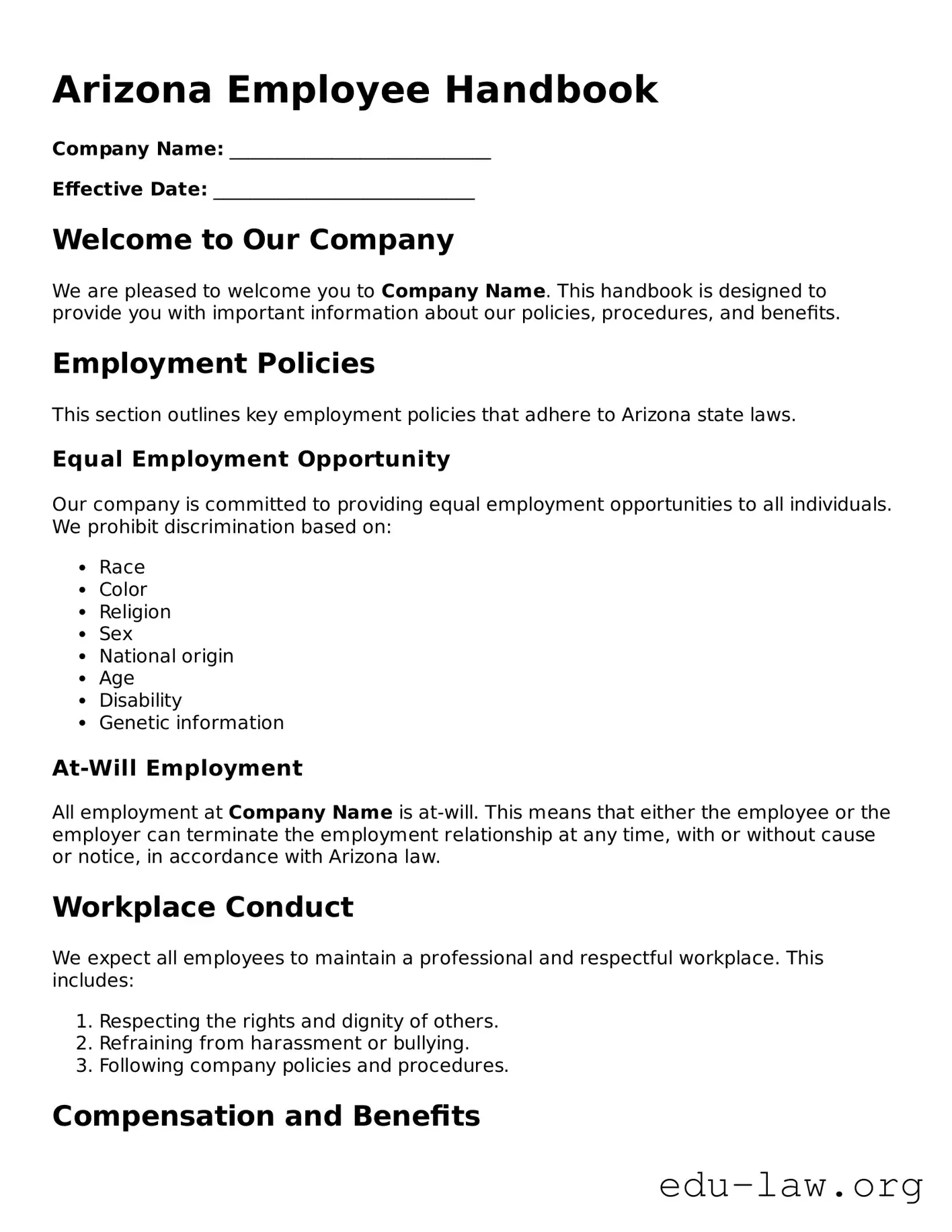
The Arizona Employee Handbook form is an essential tool for businesses operating within the state, serving as a comprehensive guide for employees regarding workplace policies and procedures. This document outlines key aspects such as employee rights, workplace expectations, and the company's code of conduct. It addresses critical topics including attendance policies, anti-discrimination practices, and disciplinary measures, ensuring that all employees understand their responsibilities and the standards they are expected to uphold. Additionally, the handbook may include information on benefits, leave policies, and safety regulations, fostering a clear understanding of the workplace environment. By providing this form, employers not only comply with state regulations but also create a foundation for a positive workplace culture where employees feel informed and valued.
Arizona Employee Handbook
Company Name: ____________________________
Effective Date: ____________________________
Welcome to Our Company
We are pleased to welcome you to Company Name. This handbook is designed to provide you with important information about our policies, procedures, and benefits.
Employment Policies
This section outlines key employment policies that adhere to Arizona state laws.
Equal Employment Opportunity
Our company is committed to providing equal employment opportunities to all individuals. We prohibit discrimination based on:
At-Will Employment
All employment at Company Name is at-will. This means that either the employee or the employer can terminate the employment relationship at any time, with or without cause or notice, in accordance with Arizona law.
Workplace Conduct
We expect all employees to maintain a professional and respectful workplace. This includes:
Compensation and Benefits
Employees are entitled to receive fair compensation for their work. Our compensation policies include:
Health and Safety
We prioritize the health and safety of our employees. All employees are expected to:
Employee Acknowledgment
I acknowledge that I have received and read the Arizona Employee Handbook for Company Name. I understand the policies and procedures outlined within.
Employee Name: ____________________________
Employee Signature: ____________________________
Date: ____________________________
| Fact Name | Description |
|---|---|
| Purpose | The Arizona Employee Handbook serves to outline workplace policies, procedures, and employee rights. |
| Governing Law | This handbook is governed by Arizona state laws, including the Arizona Revised Statutes. |
| Mandatory Policies | Employers must include certain policies, such as anti-discrimination and harassment policies, in the handbook. |
| Employee Acknowledgment | Employees are typically required to sign an acknowledgment form confirming they have received and understood the handbook. |
| Updates | Employers should regularly review and update the handbook to reflect changes in laws and company policies. |
| Accessibility | The handbook must be easily accessible to all employees, whether in print or digital format. |
Filling out the Arizona Employee Handbook form is an important step in ensuring that both employers and employees are on the same page regarding workplace policies and expectations. By completing this form, you will help create a clear understanding of the rules and guidelines that govern your work environment. Follow these steps to fill out the form accurately.
What is an Arizona Employee Handbook form?
The Arizona Employee Handbook form is a document that outlines the policies, procedures, and expectations of an employer for their employees. It serves as a guide for employees to understand their rights and responsibilities within the workplace. This handbook can cover various topics such as workplace conduct, benefits, and company policies.
Why is an Employee Handbook important?
An Employee Handbook is crucial for several reasons. It helps to set clear expectations for employees, which can lead to a more organized and efficient workplace. It also protects the employer by providing a written record of policies, which can be referred to in case of disputes. Additionally, it ensures compliance with state and federal laws.
Who should create the Employee Handbook?
What should be included in the Employee Handbook?
Key sections of an Employee Handbook may include an introduction to the company, employee rights and responsibilities, workplace policies, benefits information, and procedures for reporting issues. Additionally, it should address topics such as anti-discrimination policies, harassment, and disciplinary procedures.
How often should the Employee Handbook be updated?
Can an Employee Handbook be used in legal disputes?
Yes, an Employee Handbook can be used in legal disputes. It serves as evidence of the company's policies and procedures. If an employee claims that a policy was not followed, the handbook can demonstrate what the established procedures were. This can be beneficial for both employers and employees in resolving disputes.
Is it necessary to have employees sign the Employee Handbook?
While it is not legally required to have employees sign the Employee Handbook, it is highly recommended. A signed acknowledgment can serve as proof that the employee has received and understood the policies outlined in the handbook. This can be useful in case of future disputes.
What happens if an employee violates a policy in the Employee Handbook?
If an employee violates a policy in the Employee Handbook, the employer should follow the disciplinary procedures outlined in the handbook. This may involve verbal warnings, written warnings, or other disciplinary actions, depending on the severity of the violation. Consistency in enforcement is key to maintaining fairness.
Can an Employee Handbook be customized?
Yes, an Employee Handbook can and should be customized to fit the specific needs of the organization. Each company has unique policies and culture, so tailoring the handbook to reflect these aspects is essential. Customization ensures that the handbook is relevant and applicable to the employees.
Where can I find a template for an Arizona Employee Handbook?
Templates for an Arizona Employee Handbook can be found online through various legal and HR websites. Many organizations offer downloadable templates that can be customized. Additionally, consulting with an HR professional or legal expert can provide valuable guidance in creating a handbook that meets legal requirements.
When filling out the Arizona Employee Handbook form, individuals often encounter common mistakes that can lead to confusion or issues later on. Below is a list of five frequent errors:
Incomplete Information: Many people fail to provide all required details. This can include missing contact information or neglecting to sign the form.
Incorrect Dates: Some individuals mistakenly enter the wrong dates. This may apply to start dates or the date of completing the form, which can affect employment records.
Not Reading the Handbook: A common oversight is not thoroughly reviewing the employee handbook before signing. This can lead to misunderstandings about company policies.
Ignoring Updates: Employees sometimes overlook changes in policies. Failing to acknowledge or understand updates can create compliance issues.
Submitting the Form Late: Timeliness matters. Delaying the submission of the handbook form can result in complications with onboarding or employment status.
By being aware of these mistakes, individuals can better navigate the process of completing the Arizona Employee Handbook form accurately and efficiently.
The Arizona Employee Handbook is an essential document for employers, outlining workplace policies, procedures, and expectations. Alongside this handbook, several other forms and documents are commonly used to ensure compliance with state and federal laws, as well as to foster clear communication within the workplace. Below is a list of related documents that are often utilized in conjunction with the Employee Handbook.
Utilizing these documents alongside the Arizona Employee Handbook can help create a structured and legally compliant workplace. Clear communication and documentation contribute to a positive work environment and protect both employees and employers.
The Arizona Employee Handbook is similar to the Employee Manual, which serves as a comprehensive guide for employees. Both documents outline the company's policies, procedures, and expectations. They typically cover topics such as workplace behavior, attendance, and benefits. The Employee Manual often provides additional details about the company culture and values, making it a useful resource for new hires to understand their role within the organization.
Another document that shares similarities is the Onboarding Guide. This guide is designed to help new employees acclimate to their roles and the workplace environment. Like the Employee Handbook, it includes essential information about company policies and procedures. However, the Onboarding Guide is more focused on the initial transition period, offering checklists and resources to ensure a smooth start for new hires.
The Code of Conduct is also comparable to the Arizona Employee Handbook. This document specifically addresses the ethical standards and behavior expected from employees. While the Employee Handbook covers a broader range of topics, the Code of Conduct delves deeper into acceptable and unacceptable behaviors, reinforcing the company’s commitment to maintaining a respectful and productive work environment.
Similar to the Employee Handbook, the Benefits Guide outlines the various benefits offered to employees, such as health insurance, retirement plans, and paid time off. While the Employee Handbook may briefly mention these benefits, the Benefits Guide provides in-depth information about eligibility, enrollment procedures, and how to access these benefits, making it an essential companion document for employees.
The Policy Manual is another document that aligns closely with the Employee Handbook. This manual contains detailed descriptions of specific policies, such as anti-discrimination policies, harassment policies, and disciplinary procedures. While the Employee Handbook provides an overview of these policies, the Policy Manual goes into greater detail, offering clarity on procedures and consequences for violations.
Lastly, the Training Manual can be seen as similar to the Arizona Employee Handbook. This document focuses on the training and development opportunities available to employees. While the Employee Handbook may touch on professional development, the Training Manual provides specific information about training programs, workshops, and resources that support employees in enhancing their skills and advancing their careers.
When filling out the Arizona Employee Handbook form, it is essential to follow certain guidelines to ensure accuracy and compliance. Here are five things you should do and five things you should avoid.
Things You Should Do:
Things You Shouldn't Do:
Misconceptions about the Arizona Employee Handbook form can lead to confusion and improper use. Here are four common misunderstandings:
Many believe that having an employee handbook is not necessary. However, a well-drafted handbook can provide essential guidelines for both employers and employees, helping to clarify expectations and reduce misunderstandings.
Some assume that one handbook fits all businesses. In reality, each handbook should be tailored to the specific needs and policies of the organization, considering its unique culture, industry, and legal obligations.
It is a common misconception that an employee handbook is a one-time task. In fact, handbooks should be regularly reviewed and updated to reflect changes in laws, company policies, or organizational structure.
Some employees may think that they can ignore the handbook. However, it is crucial for employees to familiarize themselves with its contents, as it outlines their rights, responsibilities, and the procedures for addressing workplace issues.
When filling out and using the Arizona Employee Handbook form, consider the following key takeaways: