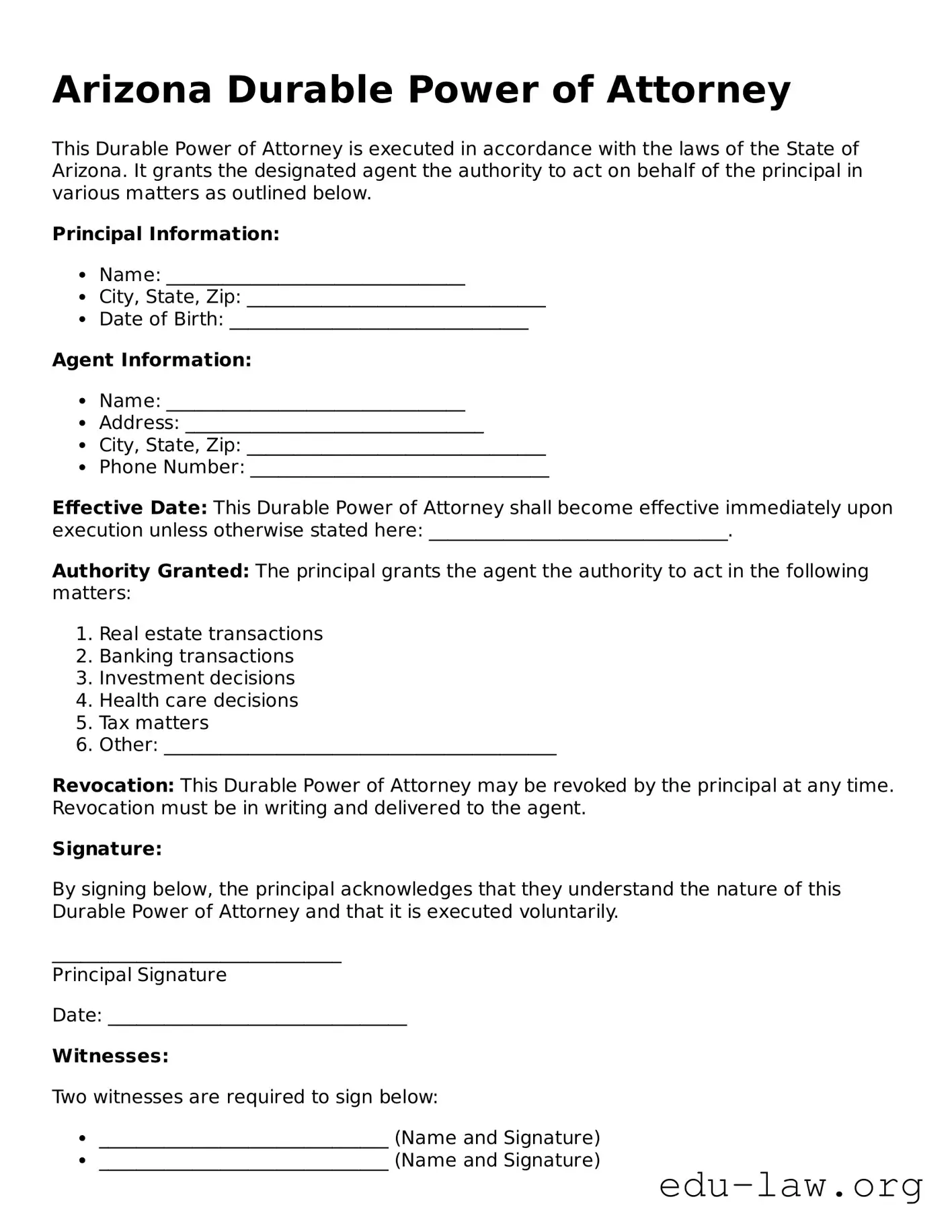
In Arizona, the Durable Power of Attorney form serves as a vital tool for individuals seeking to ensure their financial and medical decisions are managed according to their wishes, especially in the event they become incapacitated. This legal document empowers a designated person, often referred to as an agent or attorney-in-fact, to make important decisions on behalf of the individual who created the form, known as the principal. The authority granted can be broad or limited, depending on the specific needs and preferences of the principal. It’s essential to understand that this form remains effective even if the principal becomes unable to make decisions due to illness or injury, hence the term "durable." Key components of the form include the identification of the principal and the agent, the scope of powers granted, and any specific instructions or limitations the principal wishes to impose. By carefully outlining these aspects, the Durable Power of Attorney not only provides peace of mind but also ensures that one's financial and healthcare matters are handled by a trusted individual when it matters most.
Arizona Durable Power of Attorney
This Durable Power of Attorney is executed in accordance with the laws of the State of Arizona. It grants the designated agent the authority to act on behalf of the principal in various matters as outlined below.
Principal Information:
Agent Information:
Effective Date: This Durable Power of Attorney shall become effective immediately upon execution unless otherwise stated here: ________________________________.
Authority Granted: The principal grants the agent the authority to act in the following matters:
Revocation: This Durable Power of Attorney may be revoked by the principal at any time. Revocation must be in writing and delivered to the agent.
Signature:
By signing below, the principal acknowledges that they understand the nature of this Durable Power of Attorney and that it is executed voluntarily.
_______________________________
Principal Signature
Date: ________________________________
Witnesses:
Two witnesses are required to sign below:
Notary Public:
State of Arizona
County of ________________________________
Subscribed and sworn before me on this _____ day of ______________, 20__.
_______________________________
Notary Public Signature
My Commission Expires: ________________________________
| Fact Name | Description |
|---|---|
| Definition | The Arizona Durable Power of Attorney allows an individual to appoint someone to manage their financial affairs if they become incapacitated. |
| Governing Law | This form is governed by Arizona Revised Statutes, Title 14, Chapter 5. |
| Durability | This power of attorney remains effective even if the principal becomes incapacitated. |
| Agent Authority | The agent can handle various financial matters, including banking, real estate, and investments. |
| Revocation | The principal can revoke the Durable Power of Attorney at any time as long as they are competent. |
| Signing Requirements | The form must be signed by the principal and acknowledged before a notary public or witnessed by two individuals. |
| Limitations | The Durable Power of Attorney cannot be used to make healthcare decisions unless specified in a separate document. |
Filling out the Arizona Durable Power of Attorney form is an important step in ensuring that your financial and legal matters can be managed according to your wishes if you become unable to do so yourself. The following steps will guide you through the process of completing the form accurately.
Once you have filled out the form, it's essential to keep it in a safe place and inform your agent where to find it. This ensures that your wishes are respected and that your agent can act on your behalf when needed.
What is a Durable Power of Attorney in Arizona?
A Durable Power of Attorney (DPOA) in Arizona is a legal document that allows an individual, known as the principal, to appoint another person, called the agent, to make decisions on their behalf. This document remains effective even if the principal becomes incapacitated. It can cover a wide range of decisions, including financial, medical, and legal matters, depending on the specific powers granted in the document.
How do I create a Durable Power of Attorney in Arizona?
To create a Durable Power of Attorney in Arizona, the principal must be at least 18 years old and mentally competent. The document must be in writing, signed by the principal, and notarized or signed by two witnesses. It is essential to clearly specify the powers granted to the agent and whether the DPOA is effective immediately or only upon the principal's incapacity.
Can I revoke a Durable Power of Attorney in Arizona?
Yes, a Durable Power of Attorney can be revoked at any time by the principal, as long as they are mentally competent. To revoke the DPOA, the principal should create a written revocation document, notify the agent, and inform any institutions or individuals who may have relied on the original DPOA. It is advisable to keep a copy of the revocation for personal records.
What happens if I do not have a Durable Power of Attorney?
If an individual does not have a Durable Power of Attorney and becomes incapacitated, a court may need to appoint a guardian or conservator to make decisions on their behalf. This process can be time-consuming, costly, and may not reflect the individual’s wishes. Having a DPOA in place can help avoid this situation and ensure that trusted individuals make decisions aligned with the principal's preferences.
What should I consider when choosing an agent for my Durable Power of Attorney?
When selecting an agent for a Durable Power of Attorney, it is crucial to choose someone trustworthy, responsible, and capable of handling the decisions that may arise. Consider their understanding of your values and preferences, as well as their ability to act in your best interest. It is also wise to discuss your wishes with the potential agent to ensure they are willing to accept this responsibility.
Not selecting the right agent: One of the most critical mistakes is failing to choose someone who is trustworthy and capable of making decisions on your behalf. The agent should be someone who understands your values and preferences.
Leaving out specific powers: Some individuals forget to specify the powers they want to grant to their agent. It is essential to clearly outline what decisions your agent can make, whether it’s financial, medical, or legal matters.
Not signing the document correctly: A common error is not signing the Durable Power of Attorney form in the required places. Both the principal (the person granting authority) and the agent must sign the document for it to be valid.
Failing to date the form: Omitting the date can lead to confusion about when the powers take effect. Always include the date to establish a clear timeline for the authority granted.
Neglecting to have witnesses or notarization: Depending on state requirements, some forms may need to be witnessed or notarized. Skipping this step can render the document invalid.
Not reviewing the form regularly: Life circumstances change, and so do preferences. Failing to review and update the Durable Power of Attorney can lead to outdated decisions that no longer reflect your wishes.
A Durable Power of Attorney (DPOA) is an important legal document that allows one person to make decisions on behalf of another. While the DPOA itself is crucial, it is often accompanied by other forms and documents that can enhance its effectiveness or address related needs. Here is a list of some commonly used documents alongside the Arizona Durable Power of Attorney form:
Having these documents in place can provide clarity and peace of mind for both the individual and their loved ones. It is advisable to consult with a legal professional to ensure that all documents are correctly prepared and reflect the individual's wishes accurately.
The Arizona Durable Power of Attorney (DPOA) form is similar to a standard Power of Attorney (POA) form. Both documents allow an individual to designate another person to make decisions on their behalf. However, the DPOA remains effective even if the principal becomes incapacitated, whereas a standard POA may become invalid in such situations. This key distinction makes the DPOA particularly important for long-term planning.
A Living Will is another document that shares similarities with the DPOA. While the DPOA grants authority to manage financial and legal matters, a Living Will specifically addresses medical decisions. It outlines an individual’s wishes regarding medical treatment in case they become unable to communicate those wishes. Both documents are crucial for ensuring that a person's preferences are respected when they cannot express them directly.
The Healthcare Power of Attorney (HCPOA) is closely related to the DPOA but focuses solely on healthcare decisions. Like the DPOA, the HCPOA allows a designated agent to make medical choices for someone who is incapacitated. This document ensures that medical decisions align with the individual’s values and preferences, providing a comprehensive approach to both health and financial matters.
A Revocable Living Trust is another document that complements the DPOA. While the DPOA allows someone to manage financial affairs, a Revocable Living Trust can hold assets and manage them during the individual’s lifetime and after their death. Both documents serve to streamline the management of one’s affairs, but the trust also helps avoid probate, making it a popular choice for estate planning.
The Guardianship document is another related legal instrument. If a person becomes incapacitated and has not designated a DPOA, a court may appoint a guardian to make decisions on their behalf. This process can be lengthy and complicated, making the DPOA a preferable option for many. The DPOA allows individuals to choose their own agent rather than leaving the decision to the court.
The Financial Power of Attorney is a more specific version of the DPOA. It focuses exclusively on financial matters, granting authority to manage bank accounts, investments, and other financial transactions. While the DPOA can cover both financial and legal decisions, the Financial POA hones in on financial responsibilities, making it a useful tool for those who want to ensure their financial affairs are in good hands.
Lastly, the Will shares some similarities with the DPOA in terms of planning for the future. While a Will takes effect after death and governs the distribution of assets, the DPOA is active during the individual’s lifetime. Both documents are essential for comprehensive estate planning, ensuring that a person’s wishes are honored both during their life and after their passing.
When filling out the Arizona Durable Power of Attorney form, it's important to approach the task with care and attention. Here are some essential do's and don'ts to consider:
Understanding the Arizona Durable Power of Attorney form is essential for effective estate planning. However, several misconceptions can lead to confusion. Here are eight common misconceptions:
Many people believe that a Durable Power of Attorney is limited to financial decisions. In reality, it can also cover health care decisions, depending on how it is drafted.
This is not entirely true. A Durable Power of Attorney can be set up to take effect immediately or upon incapacitation, depending on the individual's preference.
Some assume that a Durable Power of Attorney has a time limit. In fact, it remains effective until revoked or until the principal passes away.
While you can choose anyone you trust, there are restrictions. For instance, your agent cannot be your health care provider unless they are a family member.
A Durable Power of Attorney differs from a regular Power of Attorney in that it remains effective even if you become incapacitated, whereas a regular one does not.
In Arizona, a Durable Power of Attorney must be signed in the presence of a notary public or two witnesses to be valid.
Although revocation in writing is common, it can also be revoked verbally or by creating a new Durable Power of Attorney that supersedes the previous one.
This is incorrect. A properly executed Durable Power of Attorney is legally binding and must be honored by third parties, such as banks and medical facilities.
When filling out and using the Arizona Durable Power of Attorney form, consider the following key takeaways: