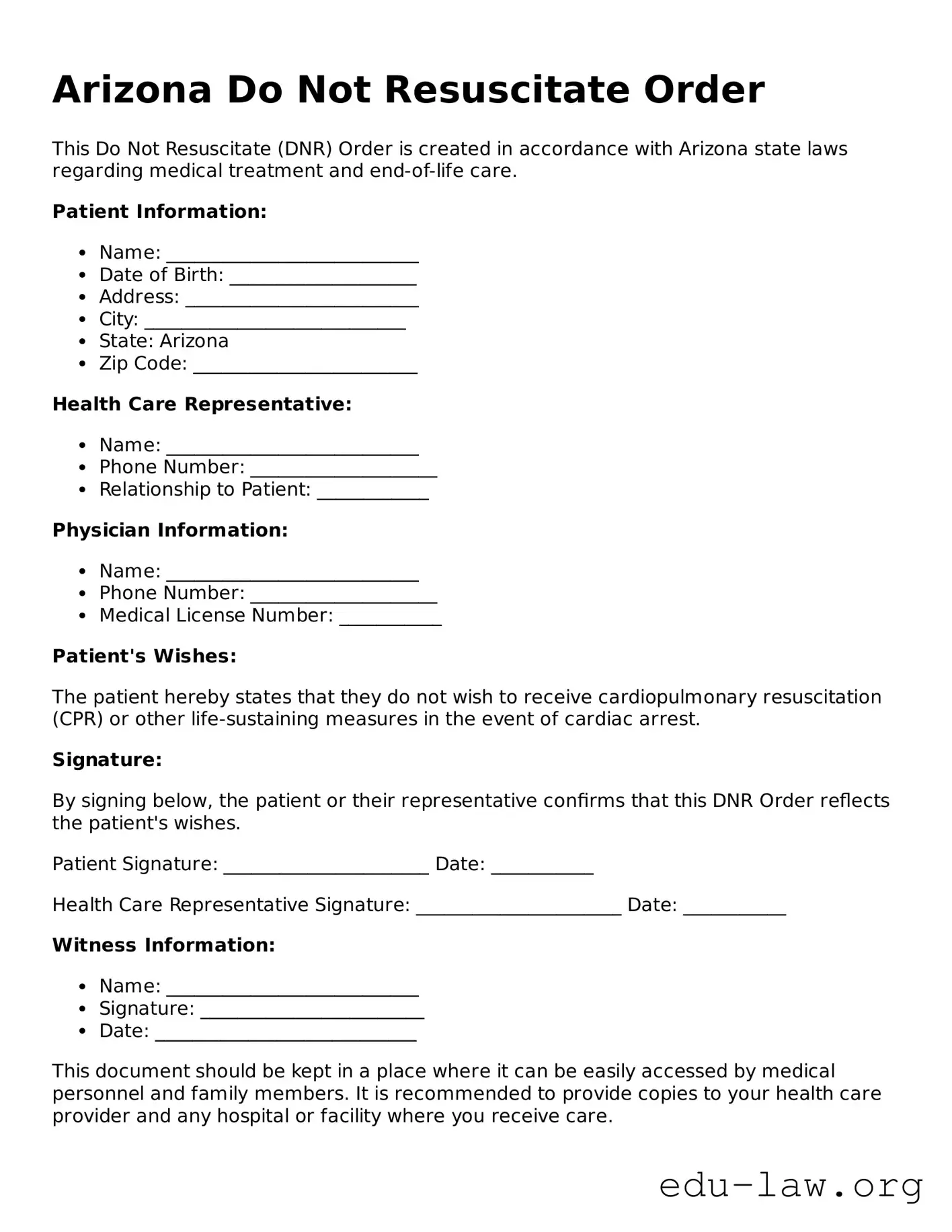
In Arizona, the Do Not Resuscitate (DNR) Order form is an essential document for individuals who wish to express their preferences regarding medical interventions in the event of a life-threatening situation. This form allows patients to indicate their desire to forgo cardiopulmonary resuscitation (CPR) and other life-sustaining measures if their heart stops or they stop breathing. It is crucial for patients to understand that this decision is deeply personal and should be made after careful consideration, often in consultation with healthcare providers and loved ones. The form must be completed and signed by the patient or their authorized representative, and it requires the signature of a physician to be valid. Once in place, this order guides medical personnel in emergency situations, ensuring that the patient's wishes are respected. It is also important to keep copies of the DNR order accessible, as first responders and hospital staff must be able to quickly verify its existence. Understanding the implications of a DNR order can help individuals make informed decisions about their end-of-life care, ensuring that their values and preferences are honored in critical moments.
Arizona Do Not Resuscitate Order
This Do Not Resuscitate (DNR) Order is created in accordance with Arizona state laws regarding medical treatment and end-of-life care.
Patient Information:
Health Care Representative:
Physician Information:
Patient's Wishes:
The patient hereby states that they do not wish to receive cardiopulmonary resuscitation (CPR) or other life-sustaining measures in the event of cardiac arrest.
Signature:
By signing below, the patient or their representative confirms that this DNR Order reflects the patient's wishes.
Patient Signature: ______________________ Date: ___________
Health Care Representative Signature: ______________________ Date: ___________
Witness Information:
This document should be kept in a place where it can be easily accessed by medical personnel and family members. It is recommended to provide copies to your health care provider and any hospital or facility where you receive care.
| Fact Name | Description |
|---|---|
| Purpose | The Arizona Do Not Resuscitate (DNR) Order form allows individuals to express their wishes regarding resuscitation efforts in the event of a medical emergency. |
| Governing Law | This form is governed by Arizona Revised Statutes, specifically ARS § 36-3201 through § 36-3210, which outline the legal framework for advance directives. |
| Eligibility | Any adult, or a minor with parental consent, can complete a DNR Order in Arizona. It is important that the individual understands the implications of this decision. |
| Signature Requirements | The form must be signed by the individual or their authorized representative and witnessed by at least one person who is not related to the individual or entitled to any portion of their estate. |
Completing the Arizona Do Not Resuscitate Order form is a crucial step in ensuring that your healthcare preferences are respected. After filling out the form, it is important to keep it in a place where it can be easily accessed by medical professionals. Make sure to discuss your wishes with family members and healthcare providers to ensure everyone is informed.
What is a Do Not Resuscitate (DNR) Order in Arizona?
A Do Not Resuscitate Order is a legal document that allows a person to refuse resuscitation efforts in the event of cardiac arrest or respiratory failure. In Arizona, this order is recognized by medical professionals and ensures that a patient’s wishes regarding end-of-life care are honored.
Who can request a DNR Order in Arizona?
A DNR Order can be requested by an adult patient who is capable of making their own medical decisions. If the patient is unable to make decisions, a legally authorized representative, such as a family member or legal guardian, may request the order on their behalf.
How is a DNR Order completed in Arizona?
To complete a DNR Order in Arizona, the patient or their representative must fill out the official DNR form. This form requires the signature of the patient and a physician. It must clearly state the patient’s wishes regarding resuscitation and be kept in a location accessible to emergency medical personnel.
Is a DNR Order valid in all healthcare settings?
Yes, a properly completed DNR Order is valid in all healthcare settings in Arizona, including hospitals, nursing homes, and home care situations. Medical personnel are required to honor the order as long as it is valid and properly executed.
Can a DNR Order be revoked?
Yes, a DNR Order can be revoked at any time by the patient or their authorized representative. To revoke the order, the individual should inform their healthcare provider and may need to complete a revocation form. It is important to ensure that all relevant parties are informed of the revocation.
What should I do if I want a DNR Order?
If you are considering a DNR Order, it is advisable to discuss your wishes with your healthcare provider. They can provide guidance on completing the necessary paperwork and help you understand the implications of the order. Having these discussions with family members is also beneficial.
Will a DNR Order affect other medical treatments?
A DNR Order specifically addresses resuscitation efforts. It does not affect other medical treatments or interventions. Patients can still receive other forms of medical care, including medications and treatments for comfort and pain relief.
How can I ensure my DNR Order is recognized?
To ensure that your DNR Order is recognized, keep a copy of the signed form in an easily accessible place. Inform your healthcare providers, family members, and anyone involved in your care about the existence of the order. Wearing a DNR bracelet or necklace can also help alert medical personnel in emergencies.
Where can I obtain a DNR Order form in Arizona?
You can obtain a DNR Order form from your healthcare provider, local hospitals, or the Arizona Department of Health Services website. It is important to use the official form to ensure it meets legal requirements.
Failing to complete the form in its entirety. Leaving sections blank can lead to confusion or misinterpretation of your wishes.
Not signing the form. A signature is essential for the document to be considered valid.
Using outdated versions of the form. Always ensure you have the most current version to avoid any legal issues.
Not discussing your wishes with family or healthcare providers. Open communication helps ensure everyone understands your decisions.
Forgetting to date the form. A date is important for verifying the document's relevance.
Neglecting to provide copies to relevant parties. Distributing copies to family members and healthcare providers is crucial.
Not reviewing the form periodically. Life circumstances can change, and so can your wishes.
Using medical jargon or unclear language. The form should be straightforward to avoid any misunderstandings.
Overlooking state-specific requirements. Each state may have unique rules regarding Do Not Resuscitate Orders.
Failing to keep the form in a visible location. It should be easily accessible in case of an emergency.
In Arizona, the Do Not Resuscitate (DNR) Order form serves as an essential document for individuals who wish to express their preferences regarding resuscitation efforts in the event of a medical emergency. However, several other forms and documents complement the DNR Order, helping to ensure that a person's healthcare wishes are respected. Below is a list of these important documents.
Understanding these documents is crucial for anyone considering their healthcare options. By preparing and discussing these forms, individuals can ensure that their medical preferences are clear and respected, providing peace of mind for themselves and their loved ones.
The Arizona Do Not Resuscitate (DNR) Order form is similar to the Advance Healthcare Directive, which allows individuals to outline their preferences for medical treatment in situations where they may be unable to communicate. Like the DNR, the Advance Healthcare Directive can specify the types of life-sustaining treatments a person wishes to receive or refuse. This document often includes preferences regarding resuscitation, but it also covers other medical interventions, making it a broader tool for expressing healthcare wishes. Both documents empower individuals to make choices about their medical care in advance, ensuring that their values and preferences are respected even when they cannot speak for themselves.
Another document akin to the DNR is the Physician Orders for Life-Sustaining Treatment (POLST) form. The POLST is designed for individuals with serious health conditions and translates their healthcare preferences into actionable medical orders. While the DNR focuses specifically on resuscitation, the POLST encompasses a wider range of treatment options, including the use of antibiotics and artificial nutrition. Both forms require healthcare providers to honor the wishes outlined by the patient, reinforcing the importance of respecting individual choices regarding end-of-life care.
The Living Will is yet another document that shares similarities with the Arizona DNR Order form. A Living Will allows individuals to express their wishes regarding end-of-life care, particularly in situations where they are terminally ill or in a persistent vegetative state. Like the DNR, this document is focused on ensuring that medical staff understand the patient’s desires regarding life-sustaining treatments. The Living Will typically includes directives about resuscitation efforts, making it a critical component of a person’s overall healthcare planning.
Lastly, the Medical Power of Attorney (MPOA) is closely related to the DNR form. This document appoints an individual to make healthcare decisions on behalf of someone else when they are unable to do so. While the DNR specifies preferences regarding resuscitation, the MPOA gives the designated agent the authority to interpret and act on the patient’s wishes in a broader context. This relationship between the DNR and MPOA highlights the importance of having trusted individuals who can advocate for a person’s healthcare choices, ensuring that their preferences regarding resuscitation and other treatments are honored.
When completing the Arizona Do Not Resuscitate Order form, it is essential to approach the task with care and understanding. This document holds significant weight in medical situations, and ensuring accuracy can provide peace of mind for both you and your loved ones. Here are six important guidelines to follow:
By following these guidelines, you can help ensure that your wishes regarding resuscitation are clearly communicated and respected in the event of a medical emergency.
Many people have misunderstandings about the Arizona Do Not Resuscitate (DNR) Order form. Here are seven common misconceptions:
This is not true. A DNR only prevents resuscitation efforts in the event of cardiac arrest. Other medical treatments can still be administered as needed.
While many people with terminal illnesses choose a DNR, anyone can request one. It is a personal decision based on individual health care preferences.
This is incorrect. A DNR can be revoked or modified at any time by the patient or their legal representative.
Emergency responders are trained to respect valid DNR orders. They will check for the proper documentation before making any decisions.
These are different documents. A living will outlines a person's wishes regarding medical treatment in general, while a DNR specifically addresses resuscitation efforts.
This is not necessary. The DNR form can be completed by the patient or their healthcare provider without legal assistance.
A DNR is valid in all settings, including at home and in long-term care facilities, as long as it is properly documented.
When considering the Arizona Do Not Resuscitate (DNR) Order form, it is essential to understand its purpose and implications. This document allows individuals to express their wishes regarding medical treatment in the event of a cardiac arrest or respiratory failure. Here are some key takeaways to keep in mind:
Understanding these aspects of the Arizona Do Not Resuscitate Order form can help individuals make informed decisions about their healthcare preferences and ensure that their wishes are respected in critical situations.