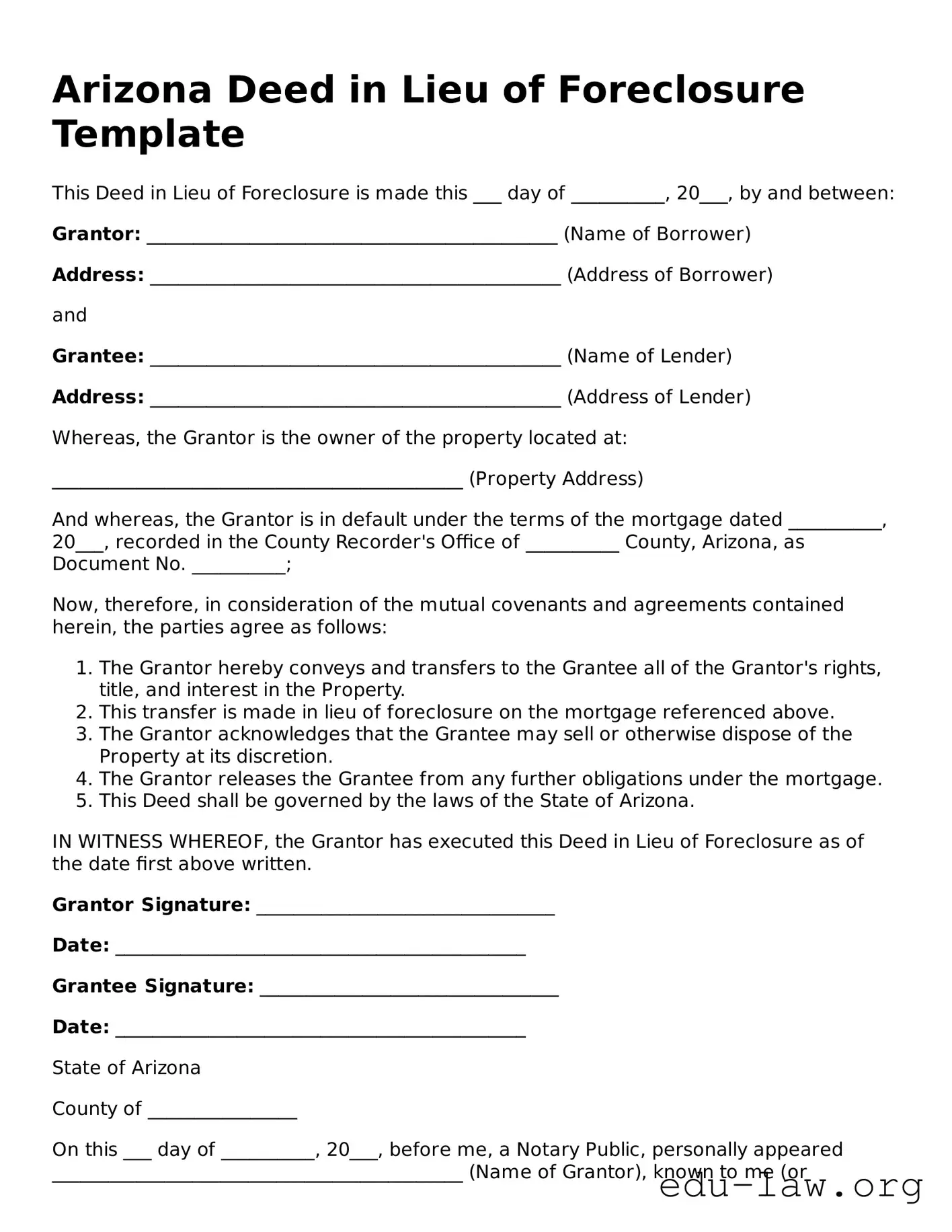
In the landscape of real estate transactions, the Arizona Deed in Lieu of Foreclosure form serves as a significant tool for homeowners facing financial distress. This legal document allows a property owner to voluntarily transfer ownership of their home to the lender, thereby avoiding the lengthy and often contentious process of foreclosure. By executing this form, the homeowner can mitigate the negative impact on their credit score and potentially negotiate a more favorable outcome with the lender. The form typically outlines essential details, such as the identification of the parties involved, a description of the property, and any existing liens. Importantly, it may also include provisions regarding the release of the borrower from further liability, allowing for a clean break from the mortgage obligation. This alternative not only streamlines the resolution of distressed properties but also presents an opportunity for lenders to reclaim their assets without incurring the costs associated with foreclosure proceedings. Understanding the implications and requirements of this form is crucial for both homeowners and lenders, as it can significantly influence the financial and emotional well-being of those involved.
Arizona Deed in Lieu of Foreclosure Template
This Deed in Lieu of Foreclosure is made this ___ day of __________, 20___, by and between:
Grantor: ____________________________________________ (Name of Borrower)
Address: ____________________________________________ (Address of Borrower)
and
Grantee: ____________________________________________ (Name of Lender)
Address: ____________________________________________ (Address of Lender)
Whereas, the Grantor is the owner of the property located at:
____________________________________________ (Property Address)
And whereas, the Grantor is in default under the terms of the mortgage dated __________, 20___, recorded in the County Recorder's Office of __________ County, Arizona, as Document No. __________;
Now, therefore, in consideration of the mutual covenants and agreements contained herein, the parties agree as follows:
IN WITNESS WHEREOF, the Grantor has executed this Deed in Lieu of Foreclosure as of the date first above written.
Grantor Signature: ________________________________
Date: ____________________________________________
Grantee Signature: ________________________________
Date: ____________________________________________
State of Arizona
County of ________________
On this ___ day of __________, 20___, before me, a Notary Public, personally appeared ____________________________________________ (Name of Grantor), known to me (or satisfactorily proven) to be the person whose name is subscribed to this instrument, and acknowledged that he/she executed the same for the purposes therein contained.
In witness whereof, I hereunto set my hand and official seal.
Notary Public Signature: ________________________________
My Commission Expires: ________________________________
| Fact Name | Description |
|---|---|
| Definition | A Deed in Lieu of Foreclosure is a legal document where a borrower voluntarily transfers property ownership to the lender to avoid foreclosure. |
| Governing Law | Arizona law governs the Deed in Lieu of Foreclosure process, specifically under Arizona Revised Statutes (A.R.S.) § 33-801 et seq. |
| Eligibility | Homeowners facing financial difficulties may qualify for this option if they are unable to make mortgage payments. |
| Benefits | This process can help avoid the lengthy and costly foreclosure process, providing a quicker resolution. |
| Impact on Credit | A Deed in Lieu of Foreclosure may have a less severe impact on credit scores compared to a foreclosure. |
| Property Condition | The property must typically be in good condition, as lenders may refuse the deed if significant repairs are needed. |
| Deficiency Judgments | In Arizona, lenders may pursue deficiency judgments after a deed in lieu, but this depends on the agreement made. |
| Tax Implications | Homeowners should consult a tax professional, as there may be tax consequences related to the cancellation of debt. |
| Negotiation | Borrowers can negotiate terms with lenders, including possible relocation assistance or forgiveness of remaining debt. |
Completing the Arizona Deed in Lieu of Foreclosure form is an important step for homeowners facing foreclosure. After filling out the form, it will be necessary to submit it to the appropriate parties, including your lender, to initiate the process of transferring the property back to them. Following these steps will help ensure that the form is completed accurately.
What is a Deed in Lieu of Foreclosure?
A Deed in Lieu of Foreclosure is a legal process where a homeowner voluntarily transfers the title of their property to the lender in exchange for relief from the mortgage obligation. This option is often considered when a homeowner is unable to continue making mortgage payments and wants to avoid the lengthy and costly foreclosure process.
What are the benefits of choosing a Deed in Lieu of Foreclosure?
Opting for a Deed in Lieu of Foreclosure can provide several advantages. First, it typically allows for a quicker resolution compared to foreclosure, which can take months or even years. Second, it may help preserve the homeowner's credit score better than a foreclosure would. Lastly, it can relieve the homeowner from the stress and uncertainty associated with the foreclosure process.
Are there any risks involved with a Deed in Lieu of Foreclosure?
Yes, there are potential risks to consider. One significant concern is that the lender may still pursue a deficiency judgment if the property's value is less than the outstanding mortgage balance. Additionally, homeowners may face tax implications, as forgiven debt could be considered taxable income. It's important to consult with a financial advisor or tax professional to understand these risks fully.
Who is eligible for a Deed in Lieu of Foreclosure?
Eligibility for a Deed in Lieu of Foreclosure varies by lender, but generally, homeowners who are experiencing financial hardship and can no longer afford their mortgage payments may qualify. Lenders typically require that the homeowner is in default or at risk of defaulting on their loan. Additionally, the property must be free of liens or other encumbrances to facilitate the transfer.
How does the process work?
The process begins with the homeowner contacting their lender to express interest in a Deed in Lieu of Foreclosure. The lender will then evaluate the homeowner's financial situation and the property's value. If approved, the homeowner will sign the deed, transferring ownership to the lender. The lender may then release the homeowner from their mortgage obligations, but this is subject to negotiation.
What documents are required for a Deed in Lieu of Foreclosure?
Homeowners will typically need to provide several documents, including proof of income, a hardship letter explaining their financial situation, and any relevant financial statements. The lender may also require a title search to ensure there are no outstanding liens on the property. Completing these documents accurately and promptly can help expedite the process.
Can a Deed in Lieu of Foreclosure affect my credit score?
While a Deed in Lieu of Foreclosure may have a less severe impact on your credit score compared to a foreclosure, it can still result in a decrease. The extent of the impact depends on various factors, including your overall credit history and the specific policies of credit reporting agencies. It's advisable to monitor your credit report after the process to understand the effects fully.
Failing to provide accurate property information. It's essential to include the correct legal description of the property. Inaccuracies can lead to delays or complications.
Not including all necessary parties. Ensure that all individuals listed on the title sign the document. Missing signatures can invalidate the deed.
Overlooking the notarization requirement. The form must be notarized to be legally binding. Without a notary's signature, the document may not be accepted.
Ignoring the implications of the deed. Understand that signing a deed in lieu of foreclosure may have tax consequences. Consulting a tax advisor is advisable.
Submitting the form without verifying lender approval. Always check that the lender has agreed to the deed in lieu process before proceeding.
Neglecting to keep copies of all documents. Retain copies of the signed deed and any correspondence with the lender for your records.
Rushing through the process. Take the time to read all instructions carefully. Mistakes made in haste can lead to significant issues down the line.
When dealing with a Deed in Lieu of Foreclosure in Arizona, several other forms and documents may be necessary to ensure a smooth process. Each document serves a unique purpose and helps clarify the responsibilities and rights of all parties involved. Below is a list of commonly used documents that accompany a Deed in Lieu of Foreclosure.
Understanding these documents can help you navigate the complexities of a Deed in Lieu of Foreclosure. Each plays a vital role in protecting both the borrower and the lender, ensuring that the transition is as smooth as possible. Having the right forms in place can make a significant difference in the outcome of the situation.
The Arizona Deed in Lieu of Foreclosure is similar to a Short Sale Agreement. Both options allow a homeowner to avoid foreclosure by transferring property ownership to the lender. In a short sale, the lender agrees to accept less than the full mortgage balance when the property is sold. This process can help the homeowner mitigate credit damage and relieve financial burdens while allowing the lender to recover some of their investment without going through the lengthy foreclosure process.
Another document that shares similarities is the Loan Modification Agreement. This agreement allows homeowners to change the terms of their existing mortgage, potentially lowering monthly payments or extending the loan term. While a deed in lieu results in the transfer of property, a loan modification keeps the homeowner in their home but may offer relief from unaffordable payments, helping them avoid foreclosure altogether.
The Forbearance Agreement is also comparable. In this document, the lender agrees to temporarily reduce or suspend mortgage payments for the homeowner facing financial hardship. Like the deed in lieu, it aims to prevent foreclosure. However, unlike the deed in lieu, the homeowner retains ownership during the forbearance period, allowing them time to recover financially.
A Bankruptcy Filing can serve a similar purpose by providing a legal way to address overwhelming debt, including mortgage obligations. Chapter 13 bankruptcy, in particular, allows homeowners to create a repayment plan while protecting their property from foreclosure. While a deed in lieu relinquishes ownership, bankruptcy can offer a way to keep the home and catch up on missed payments over time.
The Assumption of Mortgage Agreement is another relevant document. In this case, a third party assumes the mortgage obligations of the original borrower. This process can relieve the original homeowner of their debt, similar to a deed in lieu. However, it requires a willing buyer and lender approval, whereas a deed in lieu involves a direct transfer to the lender.
A Quitclaim Deed is also similar in that it transfers ownership of property. However, this document does not involve a lender and is often used between family members or to clear up title issues. Unlike a deed in lieu, a quitclaim deed does not provide any debt relief or protection from foreclosure, but it does facilitate the transfer of property rights.
The Release of Lien is another document that can be compared. This document is used when a lender agrees to release their claim on a property, often after a debt has been satisfied. While it does not directly prevent foreclosure, it can clear the title for the homeowner, similar to how a deed in lieu clears the mortgage obligation upon transfer of ownership.
A Property Settlement Agreement can also bear similarities, particularly in divorce cases. This document outlines how property will be divided between spouses, often including the transfer of real estate. While it doesn’t directly relate to foreclosure, it can lead to situations where a homeowner may choose a deed in lieu if they can no longer afford the mortgage after the settlement.
The Notice of Default is another relevant document. This notice is issued when a homeowner falls behind on mortgage payments. While it does not provide a solution, it signals the beginning of the foreclosure process. Understanding this document can help homeowners recognize the urgency to consider options like a deed in lieu to avoid further consequences.
Lastly, the Real Estate Purchase Agreement is similar in that it involves the transfer of property ownership. This document outlines the terms of a sale between a buyer and seller. While it typically involves a willing buyer, a deed in lieu serves a similar purpose by allowing the lender to take ownership of the property without a traditional sale process, helping the homeowner avoid foreclosure.
When filling out the Arizona Deed in Lieu of Foreclosure form, there are specific actions that can facilitate the process and others that may hinder it. Here are five important dos and don'ts to consider:
Understanding the Arizona Deed in Lieu of Foreclosure can be challenging. Here are some common misconceptions that people may have about this process:
A Deed in Lieu of Foreclosure does not automatically eliminate all debts. Borrowers may still be responsible for any remaining balances or other obligations tied to the mortgage.
While both processes involve the transfer of property, a Deed in Lieu of Foreclosure is typically less damaging to a borrower's credit score than a foreclosure.
The process can take time and may require negotiation with the lender. It is not always a fast fix for financial difficulties.
Not all lenders offer this option. Each lender has its own policies, and some may prefer to pursue foreclosure instead.
Once the Deed in Lieu is executed, the homeowner typically must vacate the property, which can be a difficult transition.
While it may have a less severe impact than foreclosure, a Deed in Lieu of Foreclosure can still negatively affect a borrower's credit rating.
Homeowners may still need to address any outstanding property taxes or maintenance issues before the transfer is complete.
While many people who pursue this option are experiencing financial difficulties, it can also be a strategic choice for those looking to avoid foreclosure.
Although some may feel comfortable navigating the process alone, having legal assistance can help ensure that all aspects are properly handled.
Filling out and using the Arizona Deed in Lieu of Foreclosure form can be a significant step for homeowners facing financial challenges. Here are some key takeaways to consider:
By being informed and prepared, homeowners can navigate the deed in lieu of foreclosure process with greater confidence.