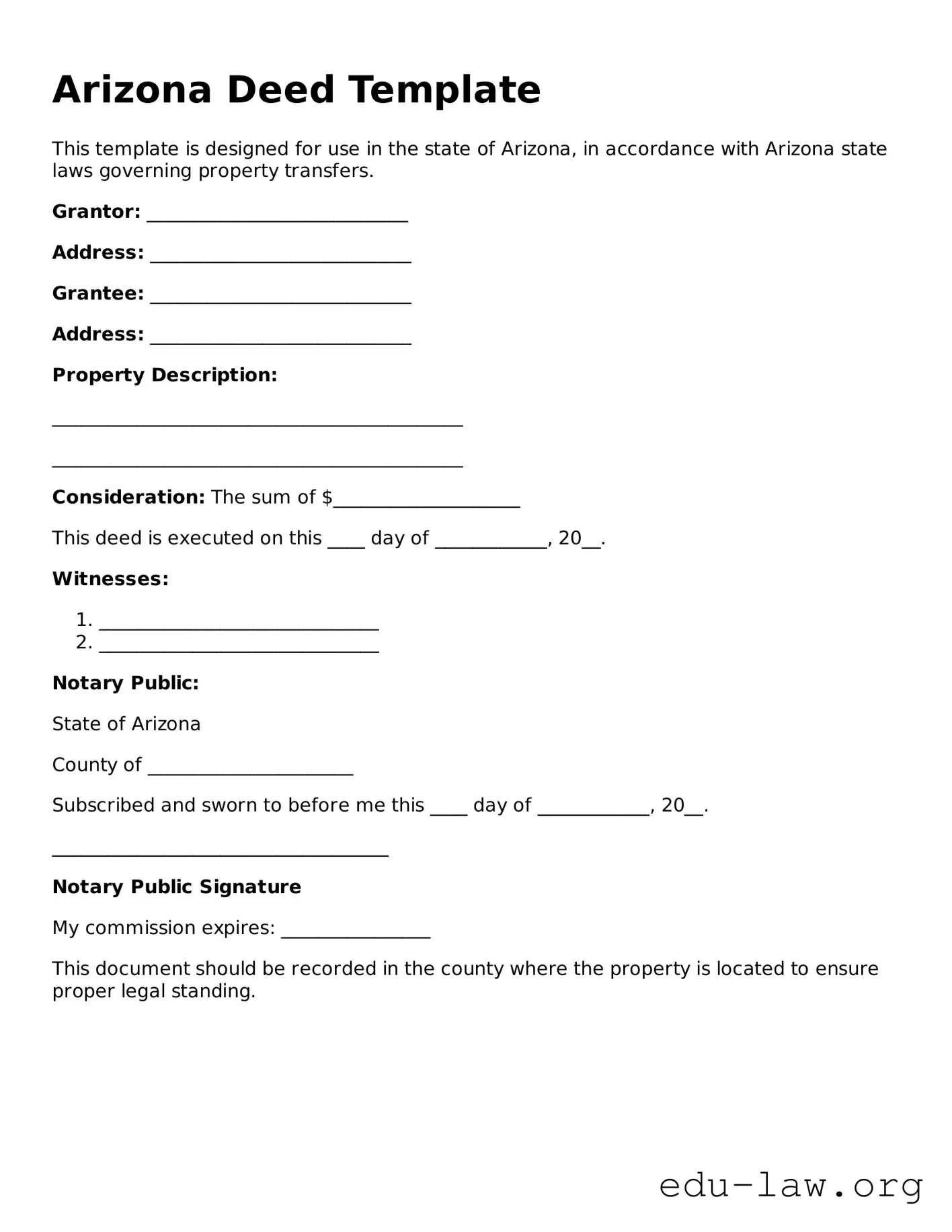
The Arizona Deed form is an essential document in real estate transactions, serving as a formal means to transfer property ownership. This form outlines critical details, such as the names of the parties involved, a description of the property being transferred, and the type of deed being used, whether it be a warranty deed, quitclaim deed, or special warranty deed. Each type of deed carries different implications for the rights and responsibilities of the parties. Additionally, the form requires the signature of the grantor, the person transferring the property, and often needs to be notarized to ensure its validity. Accurate completion of the Arizona Deed form is crucial, as it not only affects the legal standing of the property but also impacts future transactions and ownership rights. Understanding the various components of this form can empower individuals to navigate property transfers with confidence and clarity.
Arizona Deed Template
This template is designed for use in the state of Arizona, in accordance with Arizona state laws governing property transfers.
Grantor: ____________________________
Address: ____________________________
Grantee: ____________________________
Address: ____________________________
Property Description:
____________________________________________
____________________________________________
Consideration: The sum of $____________________
This deed is executed on this ____ day of ____________, 20__.
Witnesses:
Notary Public:
State of Arizona
County of ______________________
Subscribed and sworn to before me this ____ day of ____________, 20__.
____________________________________
Notary Public Signature
My commission expires: ________________
This document should be recorded in the county where the property is located to ensure proper legal standing.
| Fact Name | Description |
|---|---|
| Purpose | The Arizona Deed form is used to transfer ownership of real property from one party to another. |
| Types of Deeds | Common types include Warranty Deed, Quitclaim Deed, and Special Warranty Deed, each serving different purposes in property transfer. |
| Governing Law | The Arizona Revised Statutes, particularly Title 33, govern the laws related to property and deeds in Arizona. |
| Signature Requirements | All parties involved in the transfer must sign the deed for it to be valid, and signatures must be notarized. |
| Recording | To protect ownership rights, the deed must be recorded with the county recorder's office in the county where the property is located. |
| Consideration | The deed should state the consideration, or payment, made for the property, although it can be a nominal amount. |
| Legal Description | A detailed legal description of the property must be included in the deed to clearly define the boundaries of the property being transferred. |
| Tax Implications | Transferring property may have tax implications, so it's advisable to consult with a tax professional before completing the deed. |
Filling out the Arizona Deed form is a straightforward process that requires careful attention to detail. Once the form is completed, it will need to be submitted for recording with the appropriate county recorder's office. This ensures that the transfer of property ownership is officially recognized.
What is an Arizona Deed form?
An Arizona Deed form is a legal document used to transfer ownership of real estate in the state of Arizona. This form outlines the details of the property being transferred, including the names of the parties involved, the legal description of the property, and any terms related to the transfer. It is essential for ensuring that ownership is properly recorded and recognized by the state.
What types of Deed forms are available in Arizona?
In Arizona, there are several types of Deeds, including Warranty Deeds, Quitclaim Deeds, and Special Warranty Deeds. A Warranty Deed provides a guarantee that the seller has clear title to the property. A Quitclaim Deed transfers whatever interest the seller has in the property, without any guarantees. A Special Warranty Deed offers limited warranties, covering only the period during which the seller owned the property.
Do I need to have the Deed form notarized?
Yes, in Arizona, the Deed form must be notarized to be valid. This means that a notary public must witness the signing of the document. Notarization helps to prevent fraud and ensures that the identities of the parties involved are verified.
How do I record an Arizona Deed?
To record an Arizona Deed, you must submit the completed and notarized form to the County Recorder’s Office in the county where the property is located. There may be a recording fee, and it’s important to ensure that all required information is included to avoid delays in processing.
Is there a specific format for the Arizona Deed form?
While there is no official state template for the Arizona Deed form, it should include specific elements such as the names of the grantor and grantee, a legal description of the property, and the signature of the grantor. It’s advisable to follow best practices or consult with a legal professional to ensure compliance with state laws.
Can I create my own Arizona Deed form?
Yes, you can create your own Arizona Deed form, but it’s important to ensure that it meets all legal requirements. Many people choose to use templates or consult with an attorney to avoid mistakes that could invalidate the transfer of property.
What happens if I don’t record the Deed?
If you do not record the Deed, the transfer of ownership may not be recognized by third parties. This could lead to complications in the future, such as issues with selling the property or disputes over ownership. Recording the Deed protects your rights as the new owner and provides public notice of the ownership change.
How long does it take to process a recorded Deed in Arizona?
The processing time for a recorded Deed in Arizona can vary by county. Generally, it may take anywhere from a few days to a few weeks. After processing, you will receive a copy of the recorded Deed, which serves as proof of ownership.
Failing to include the grantor's and grantee's full legal names. Ensure that names match those on identification documents.
Not providing the correct property description. Use the legal description from the title or previous deed, avoiding vague terms.
Omitting the consideration amount. Even if the property is a gift, a nominal amount should be stated.
Neglecting to sign the deed. All grantors must sign the document in the appropriate section.
Forgetting to have the deed witnessed or notarized. Many states require this for the deed to be valid.
Not checking for errors after filling out the form. Review all entries for typos or incorrect information.
Using the wrong type of deed. Different types serve different purposes, such as warranty deeds versus quitclaim deeds.
Failing to record the deed with the appropriate county recorder. Recording is essential for public notice and legal protection.
Not understanding the tax implications of the transfer. Consult with a tax professional if necessary to avoid surprises.
When completing a property transaction in Arizona, several forms and documents may accompany the Arizona Deed form. Each of these documents serves a specific purpose in ensuring the transfer of ownership is clear and legally binding. Below is a list of commonly used forms that often accompany the Arizona Deed.
Understanding these accompanying documents is crucial for anyone involved in a real estate transaction in Arizona. Each form plays a significant role in ensuring a smooth transfer of ownership and protecting the interests of all parties involved.
The Arizona Deed form shares similarities with the Quitclaim Deed. Both documents transfer ownership of property but differ in the extent of the guarantee provided. A Quitclaim Deed conveys whatever interest the grantor has in the property without any warranties. This means that if the grantor has no legal claim, the grantee receives nothing. The simplicity of the Quitclaim Deed makes it useful for transferring property between family members or in divorce settlements.
Another document akin to the Arizona Deed is the Warranty Deed. This form provides a higher level of protection for the buyer. Unlike the Quitclaim Deed, a Warranty Deed guarantees that the grantor holds clear title to the property and has the right to sell it. If any issues arise regarding the title, the grantor is responsible for resolving them. This assurance makes Warranty Deeds a common choice in real estate transactions.
The Bargain and Sale Deed also resembles the Arizona Deed, albeit with its own nuances. This type of deed implies that the grantor has title to the property and the right to sell it, but it does not provide any warranties against encumbrances. It is often used in foreclosure sales or tax lien sales. Buyers should exercise caution, as they assume the risk of any claims against the property.
Similar to the Arizona Deed is the Special Purpose Deed, which serves specific functions. For example, a Trustee's Deed is used when a property is sold by a trustee, often in the context of a trust or bankruptcy. This deed transfers the property without the usual warranties, reflecting the unique circumstances under which the property is sold.
The Bargain and Sale Deed with Covenants is another document that shares features with the Arizona Deed. This deed provides some assurances about the title, typically including covenants that the grantor will defend the title against any claims. While it offers more protection than a simple Bargain and Sale Deed, it still lacks the full warranties found in a Warranty Deed.
A Deed of Trust also bears resemblance to the Arizona Deed, though its purpose differs. A Deed of Trust secures a loan by transferring the title of the property to a trustee until the borrower repays the debt. In this case, the property serves as collateral. While it functions differently from a traditional deed, it remains a critical component in real estate financing.
Lastly, the Executor's Deed is similar to the Arizona Deed in that it transfers property, but it is specifically used when a property is passed down through a will. This deed is executed by the executor of the estate and conveys the property to the heirs or beneficiaries. It ensures that the property is legally transferred according to the wishes of the deceased, maintaining the integrity of the estate planning process.
When filling out the Arizona Deed form, it is crucial to approach the task with care and attention to detail. Here are ten important dos and don'ts to consider:
By following these guidelines, you can help ensure that the process of filling out the Arizona Deed form goes smoothly and efficiently. Taking the time to do it right can save you from potential legal issues down the road.
Understanding the Arizona Deed form is essential for anyone involved in real estate transactions in the state. However, several misconceptions can lead to confusion. Here are ten common misunderstandings:
Many people believe that all deeds serve the same purpose. In reality, there are different types of deeds, such as warranty deeds and quitclaim deeds, each with its own implications and protections.
Some assume that a deed can be valid without a notary. However, in Arizona, a notary public must witness the signing of the deed for it to be legally enforceable.
Many think that a verbal agreement is sufficient to transfer property. In Arizona, a written deed is necessary to legally transfer ownership of real estate.
While having a lawyer can be beneficial, it is not mandatory for all property transfers in Arizona. Many individuals successfully handle simple transactions on their own.
Some believe that deeds are only needed for sales. In fact, they can also be used for gifting property, transferring ownership, or even adding someone to the title.
Many think that a deed is final once signed. However, it is possible to modify or revoke a deed through specific legal processes.
Some people believe that they can skip filing the deed with the county recorder. In Arizona, filing the deed is essential to ensure public record and protect ownership rights.
While it's wise to record a deed promptly, Arizona law does not require immediate recording. However, delaying can pose risks to ownership claims.
Some think that any document can serve as a deed. However, specific legal requirements must be met for a deed to be valid in Arizona.
Many believe that deeds apply only to homes. In reality, they are used for all types of real estate, including commercial properties and land.
By dispelling these misconceptions, individuals can approach their real estate transactions in Arizona with greater confidence and clarity.
When filling out and using the Arizona Deed form, there are several important points to keep in mind. Here are some key takeaways:
By following these guidelines, you can help ensure a smooth property transfer process in Arizona.