In the dynamic landscape of business formation, the Arizona Articles of Incorporation form serves as a crucial document for those looking to establish a corporation within the state. This form not only lays the groundwork for a corporation's existence but also delineates essential information that governs its operations. Key components include the corporation's name, which must be unique and compliant with state regulations, as well as the designated agent for service of process, ensuring that legal documents can be reliably delivered. Additionally, the form requires details about the corporation's purpose, which can be broad or specific, depending on the business's goals. The structure of the corporation, including the number of shares authorized for issuance, is another vital aspect that potential incorporators must address. By meticulously completing the Articles of Incorporation, entrepreneurs can effectively pave the way for their corporate journey, ensuring compliance with Arizona's legal requirements while setting a solid foundation for future growth and success.
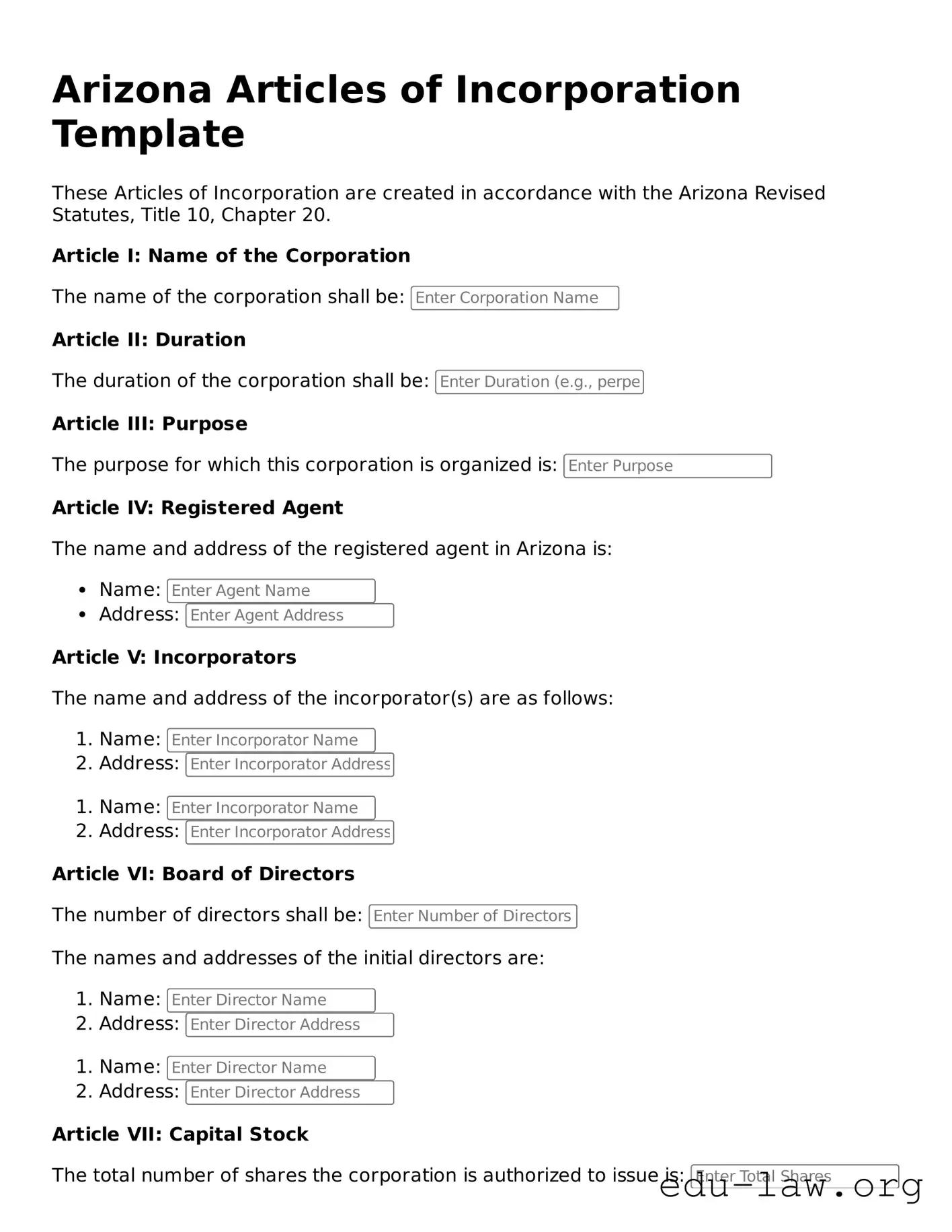
Arizona Articles of Incorporation Template
These Articles of Incorporation are created in accordance with the Arizona Revised Statutes, Title 10, Chapter 20.
Article I: Name of the Corporation
The name of the corporation shall be:
Article II: Duration
The duration of the corporation shall be:
Article III: Purpose
The purpose for which this corporation is organized is:
Article IV: Registered Agent
The name and address of the registered agent in Arizona is:
Article V: Incorporators
The name and address of the incorporator(s) are as follows:
Article VI: Board of Directors
The number of directors shall be:
The names and addresses of the initial directors are:
Article VII: Capital Stock
The total number of shares the corporation is authorized to issue is:
The par value of each share is:
Article VIII: Additional Provisions
Any additional provisions that the incorporators wish to include may be specified here:
IN WITNESS WHEREOF, the incorporator(s) have executed these Articles of Incorporation on this .
Signature of Incorporator:
| Fact Name | Details |
|---|---|
| Purpose | The Arizona Articles of Incorporation is used to establish a corporation in the state of Arizona. |
| Governing Law | The form is governed by the Arizona Revised Statutes, specifically Title 10, Chapter 2. |
| Filing Requirement | Filing the Articles of Incorporation is mandatory for all corporations seeking to operate in Arizona. |
| Information Required | The form requires the corporation's name, address, and details about the registered agent. |
| Registered Agent | A registered agent must be designated to receive legal documents on behalf of the corporation. |
| Filing Fee | There is a filing fee associated with submitting the Articles of Incorporation, which may vary. |
| Processing Time | Processing times for the form can vary, but expedited options are usually available for a higher fee. |
| Amendments | Changes to the Articles of Incorporation can be made through an amendment process, requiring a separate filing. |
| Corporate Structure | The form allows for different types of corporations, including nonprofit and for-profit entities. |
| Public Record | Once filed, the Articles of Incorporation become part of the public record and can be accessed by anyone. |
Once you have gathered all necessary information, it's time to complete the Arizona Articles of Incorporation form. This form is essential for establishing your business as a corporation in Arizona. Ensuring accuracy and completeness is crucial, as any mistakes could delay the process. Follow these steps carefully to fill out the form.
After submitting the Articles of Incorporation, you will receive confirmation from the state. This process typically takes a few weeks, depending on the volume of applications. Once approved, your corporation will officially exist, allowing you to move forward with your business operations.
What are the Articles of Incorporation in Arizona?
The Articles of Incorporation is a legal document that establishes a corporation in the state of Arizona. This document outlines essential information about the corporation, including its name, purpose, duration, and the number of shares it is authorized to issue. Filing the Articles of Incorporation with the Arizona Corporation Commission is a necessary step to legally create a corporation in the state.
What information is required to complete the Articles of Incorporation?
To complete the Articles of Incorporation, you must provide several key details. This includes the name of the corporation, which must be unique and distinguishable from other registered entities in Arizona. You will also need to specify the corporation's purpose, the address of its principal office, and the name and address of the statutory agent. Additionally, you must indicate the number of shares the corporation is authorized to issue and any other provisions deemed necessary for the management of the corporation.
How do I file the Articles of Incorporation in Arizona?
Filing the Articles of Incorporation in Arizona can be done online, by mail, or in person. For online filing, you can visit the Arizona Corporation Commission's website and follow the instructions provided. If you choose to file by mail, you must download and complete the form, then send it to the appropriate address along with the required filing fee. In-person filings can be made at the Corporation Commission office. It is important to ensure that all information is accurate and complete to avoid delays in processing.
What is the filing fee for the Articles of Incorporation in Arizona?
The filing fee for the Articles of Incorporation varies based on the type of corporation being formed. As of October 2023, the fee for a standard for-profit corporation is typically around $50, while a non-profit corporation may have a different fee structure. It is advisable to check the Arizona Corporation Commission's website for the most current fee schedule, as fees may change over time.
How long does it take to process the Articles of Incorporation?
The processing time for the Articles of Incorporation can vary depending on the method of filing and the current workload of the Arizona Corporation Commission. Generally, online filings are processed more quickly than those submitted by mail. Processing times can range from a few days to several weeks. To ensure timely processing, it is recommended to file online and to double-check that all information is complete and accurate.
Inaccurate Information: One common mistake is providing incorrect or incomplete information about the corporation. This includes errors in the name of the corporation, the address, or the names of the incorporators. Double-checking these details can save time and prevent delays in the approval process.
Failure to Include Required Provisions: The Articles of Incorporation must include certain mandatory provisions, such as the purpose of the corporation and the number of shares authorized. Omitting these can lead to rejection of the application. Always refer to the guidelines to ensure all necessary information is included.
Not Signing the Document: A surprisingly frequent oversight is neglecting to sign the Articles of Incorporation. This document must be signed by the incorporators to be valid. Without signatures, the filing will not be processed.
Incorrect Filing Fees: Each state has specific filing fees associated with the Articles of Incorporation. Submitting an incorrect amount can result in delays. It’s essential to verify the current fee structure before submitting your application.
When starting a business in Arizona, filing the Articles of Incorporation is just one step in the process. Several other forms and documents are often required or recommended to ensure compliance with state laws and to set up your corporation properly. Below is a list of important documents that you may need to consider.
Each of these documents plays a vital role in establishing and maintaining your corporation in Arizona. Ensuring that you have the necessary paperwork in order can help you avoid legal issues and set a solid foundation for your business's success.
The Articles of Organization is a document used to establish a Limited Liability Company (LLC) in Arizona. Similar to the Articles of Incorporation, it outlines essential information about the business, such as its name, address, and the names of its members. Both documents serve as foundational paperwork for forming a business entity, providing legal recognition and protection for owners. They also require filing with the state and may involve similar fees and processes.
The Certificate of Formation is another document akin to the Articles of Incorporation. This certificate is often required for corporations and LLCs in various states, including Arizona. It typically contains information about the business’s purpose, registered agent, and duration. Like the Articles of Incorporation, it formalizes the business’s existence and allows it to operate legally within the state.
The Bylaws of a corporation are similar in that they outline the internal rules and procedures for managing the business. While the Articles of Incorporation focus on external details required by the state, the Bylaws govern the day-to-day operations. They often include information about meetings, voting procedures, and the roles of officers. Both documents are essential for a corporation’s structure, providing clarity and guidance for its operation.
The Operating Agreement is comparable to the Bylaws but is specific to LLCs. This document outlines how the LLC will be managed, detailing the rights and responsibilities of its members. It serves as a blueprint for decision-making and profit distribution, similar to how Bylaws function for corporations. Both documents help prevent disputes by clearly defining expectations and processes.
The Statement of Information is another document that shares similarities with the Articles of Incorporation. This form is typically required periodically after a business is established. It updates the state on key information, such as the business address and the names of directors or members. While the Articles of Incorporation are filed once, the Statement of Information ensures that the state has current data about the business.
The Certificate of Good Standing is also related to the Articles of Incorporation. This document verifies that a corporation or LLC is legally registered and compliant with state requirements. It may be needed for various business transactions, such as applying for loans or entering contracts. Both documents affirm the legitimacy of the business entity, providing assurance to stakeholders and partners.
Finally, the Business License is similar in that it allows a business to operate legally within a specific jurisdiction. While the Articles of Incorporation establish the business’s legal existence, a Business License is often required to conduct operations in a particular area. Both documents are vital for compliance with state and local regulations, ensuring that the business can function without legal hindrances.
Filling out the Arizona Articles of Incorporation form is a crucial step in establishing your business. Here’s a helpful list of what you should and shouldn’t do during this process.
By following these guidelines, you can help ensure a smooth filing process for your Articles of Incorporation in Arizona.
When it comes to the Arizona Articles of Incorporation form, there are several misconceptions that can lead to confusion for those looking to start a business. Understanding these misconceptions can help ensure a smoother incorporation process.
This is not true. Even if you plan to operate as a sole proprietor, filing Articles of Incorporation is essential if you want to establish a corporation. This legal step provides your business with a separate identity and can protect your personal assets.
These two documents serve different purposes. Articles of Incorporation establish your business as a legal entity, while a business license allows you to operate legally within your city or state. Both are necessary, but they are distinct from one another.
While having legal advice can be beneficial, it is not a requirement. Many business owners successfully file their Articles of Incorporation on their own using available resources and templates. However, if you have specific questions or complex needs, consulting a lawyer can be helpful.
This is incorrect. You can amend your Articles of Incorporation if necessary. Changes might be needed due to changes in business structure, ownership, or other significant factors. The amendment process is straightforward and allows for flexibility as your business evolves.
Filling out and using the Arizona Articles of Incorporation form is a crucial step in establishing a corporation in the state. Here are some key takeaways to consider:
By keeping these points in mind, you can navigate the incorporation process more effectively and set a solid foundation for your business.