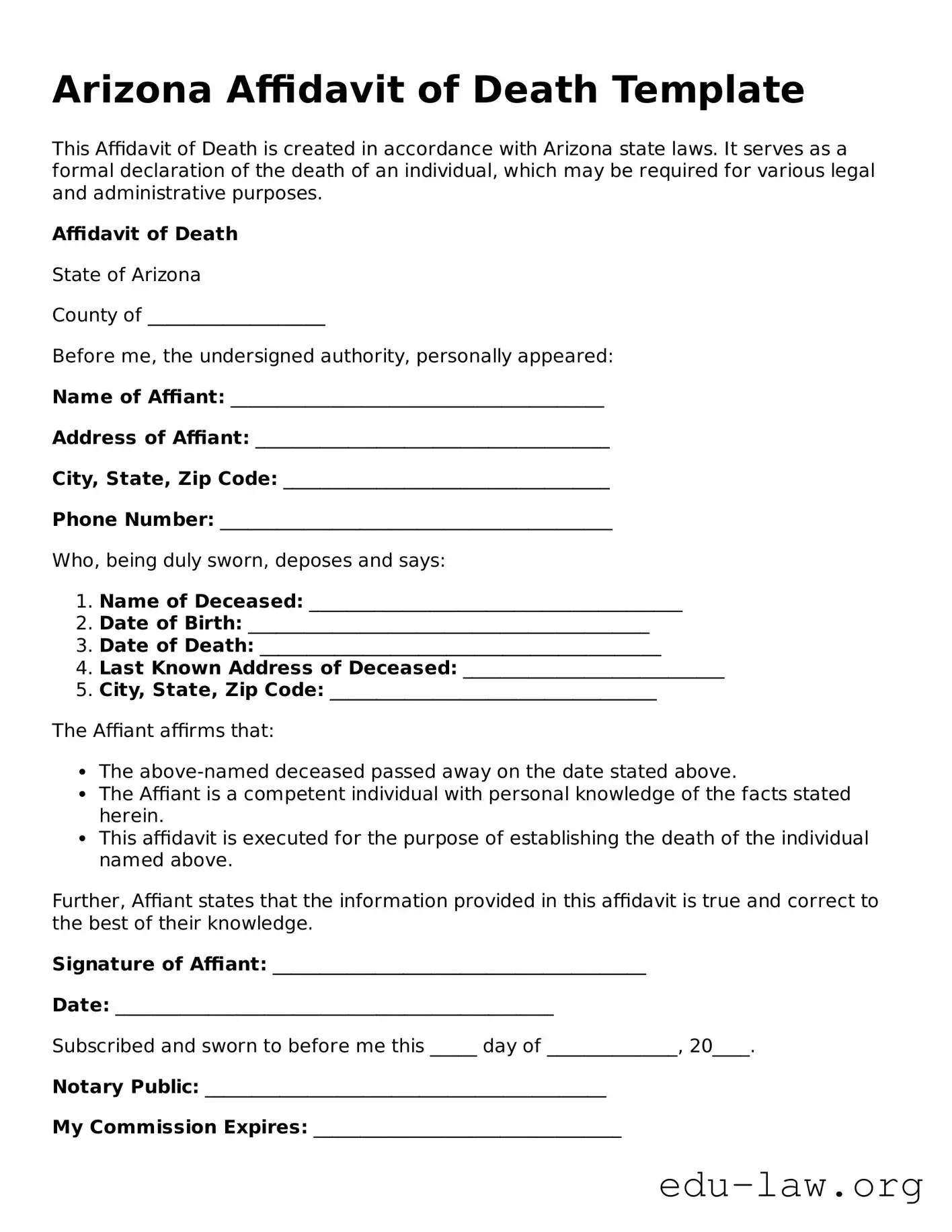
When a loved one passes away, navigating the legalities surrounding their estate can be overwhelming. One important document that often comes into play is the Arizona Affidavit of Death form. This form serves as a formal declaration confirming the death of an individual, which is crucial for settling estates and transferring assets. By using this affidavit, individuals can provide necessary information such as the deceased's name, date of death, and relevant details about the surviving heirs. This document is particularly useful for simplifying the process of transferring property, especially when the estate is small and does not require probate. Understanding how to properly complete and file this affidavit can ease the burden during a difficult time, allowing families to focus on healing while ensuring that their loved one’s affairs are handled appropriately.
Arizona Affidavit of Death Template
This Affidavit of Death is created in accordance with Arizona state laws. It serves as a formal declaration of the death of an individual, which may be required for various legal and administrative purposes.
Affidavit of Death
State of Arizona
County of ___________________
Before me, the undersigned authority, personally appeared:
Name of Affiant: ________________________________________
Address of Affiant: ______________________________________
City, State, Zip Code: ___________________________________
Phone Number: __________________________________________
Who, being duly sworn, deposes and says:
The Affiant affirms that:
Further, Affiant states that the information provided in this affidavit is true and correct to the best of their knowledge.
Signature of Affiant: ________________________________________
Date: _______________________________________________
Subscribed and sworn to before me this _____ day of ______________, 20____.
Notary Public: ___________________________________________
My Commission Expires: _________________________________
| Fact Name | Details |
|---|---|
| Purpose | The Arizona Affidavit of Death is used to formally declare the death of an individual. |
| Governing Law | Arizona Revised Statutes § 14-3201 governs the use of the Affidavit of Death. |
| Who Can File | Any interested party, such as a family member or executor, can file the affidavit. |
| Required Information | The form requires details such as the deceased's name, date of death, and place of death. |
| Notarization | The affidavit must be notarized to be legally valid. |
| Filing Location | It should be filed with the county recorder's office in the county where the deceased resided. |
| Impact on Estate | Filing the affidavit can help facilitate the transfer of property and assets from the deceased. |
| Additional Documentation | Often, a certified copy of the death certificate is required to accompany the affidavit. |
After gathering the necessary information, you will need to fill out the Arizona Affidavit of Death form. This process is straightforward and involves providing specific details about the deceased and the affiant. Follow these steps carefully to ensure the form is completed correctly.
Once the form is completed and notarized, it can be filed with the appropriate county recorder’s office. Ensure you keep a copy for your records.
What is the Arizona Affidavit of Death form?
The Arizona Affidavit of Death form is a legal document used to officially declare the death of an individual. This form serves as a way to provide proof of death, which may be necessary for settling estates, transferring property, or accessing financial accounts. It is typically completed by a person who has personal knowledge of the deceased’s death, such as a family member or close friend. This affidavit can be used in various situations, including probate proceedings and real estate transactions.
Who can complete the Affidavit of Death form?
Any individual who has direct knowledge of the deceased's passing can complete the Affidavit of Death form. This often includes family members, such as a spouse, child, or sibling. However, it can also be completed by close friends or associates who were aware of the death. It is important that the person completing the form is truthful and provides accurate information, as this document may be used in legal proceedings.
What information is required on the form?
The Arizona Affidavit of Death form typically requires several key pieces of information. This includes the full name of the deceased, their date of birth, and the date of death. Additionally, the form may ask for the place of death, such as the city or county. The affiant, or person completing the form, must also provide their own name, address, and relationship to the deceased. Finally, the form usually requires a signature and may need to be notarized to ensure its validity.
How is the Affidavit of Death used after completion?
Once the Affidavit of Death form is completed and signed, it can be used for various purposes. Common uses include filing it with the county recorder's office to update property records, presenting it to banks or financial institutions to access accounts, and submitting it in probate court to initiate the process of settling the deceased's estate. It is advisable to keep multiple copies of the affidavit, as different entities may require an original or certified copy for their records.
Failing to provide the decedent's full name. It is important to include the complete name as it appears on official documents.
Not including the date of death. This date is crucial for the validity of the affidavit.
Leaving out the decedent's address. Providing the last known address helps to establish residency.
Using incorrect witness signatures. Ensure that the witnesses are appropriate and their signatures are clear.
Not having the affidavit notarized. A notary's signature is often required for the document to be legally binding.
Filling out the form incomplete. Double-check that all sections are filled out before submission.
Providing inaccurate information. Any errors can lead to delays or complications in processing the affidavit.
Failing to check for deadlines. Be aware of any time limits for submitting the affidavit after the death.
Not keeping a copy of the submitted form. Retain a copy for personal records and future reference.
The Arizona Affidavit of Death form serves a crucial role in the process of settling an estate after a person's passing. However, several other forms and documents are often needed to ensure a smooth transition and proper legal compliance. Below is a list of these essential documents.
Understanding these documents and their purposes is essential for anyone navigating the estate settlement process in Arizona. Ensuring all necessary paperwork is completed accurately can help avoid delays and complications during this difficult time.
The Arizona Affidavit of Death form is similar to the Affidavit of Heirship. Both documents serve to establish the rightful heirs of a deceased person. An Affidavit of Heirship is often used when a person dies without a will, providing a sworn statement that identifies heirs based on state laws. This helps in transferring property and assets to the rightful heirs without going through probate court.
Another document akin to the Affidavit of Death is the Death Certificate. While the Affidavit of Death is a sworn statement regarding the fact of death, the Death Certificate is an official record issued by a government authority. It serves as legal proof of death and is often required for settling estates, claiming life insurance, and other legal matters following a person's passing.
The Will is also comparable to the Affidavit of Death. A Will outlines a person's wishes regarding the distribution of their assets after death. While the Affidavit of Death may be used to affirm the death of the individual named in the Will, the Will itself provides instructions on how their estate should be managed and distributed, making both documents essential in the estate planning process.
The Living Trust shares similarities with the Affidavit of Death in that both are involved in estate management. A Living Trust allows a person to manage their assets during their lifetime and specifies how those assets will be distributed upon death. When the individual passes away, the Affidavit of Death may be used to facilitate the transfer of assets held in the trust, ensuring a smooth transition without the need for probate.
The Small Estate Affidavit is another related document. This form allows heirs to claim assets of a deceased person without going through probate, provided the estate meets certain criteria. Similar to the Affidavit of Death, it simplifies the process of asset transfer and provides a legal way for heirs to access the deceased's property quickly.
The Probate Petition is also relevant. This document is filed in court to initiate the probate process, which involves validating a Will and distributing assets. While the Affidavit of Death may be used as part of the probate process to confirm the death, the Probate Petition formally starts the legal proceedings necessary to settle the estate.
The Affidavit of Support can be compared to the Affidavit of Death in terms of its sworn nature. Although the Affidavit of Support is primarily used in immigration cases to demonstrate financial support for a visa applicant, both documents require a sworn statement and serve legal purposes that can affect the rights and responsibilities of individuals involved.
Lastly, the Power of Attorney (POA) can be seen as similar in that both documents involve legal authority and responsibilities. While a POA allows one person to act on behalf of another while they are alive, the Affidavit of Death comes into play after death, confirming the end of that authority and facilitating the transition of responsibilities to the heirs or executors of the estate.
When filling out the Arizona Affidavit of Death form, it is important to follow certain guidelines to ensure accuracy and compliance. Here are some do's and don'ts to consider:
Understanding the Arizona Affidavit of Death form can be tricky. Here are five common misconceptions that people often have about this important document:
By clearing up these misconceptions, individuals can better navigate the process of handling a loved one’s affairs after death.
When completing and utilizing the Arizona Affidavit of Death form, it is essential to understand the following key points: