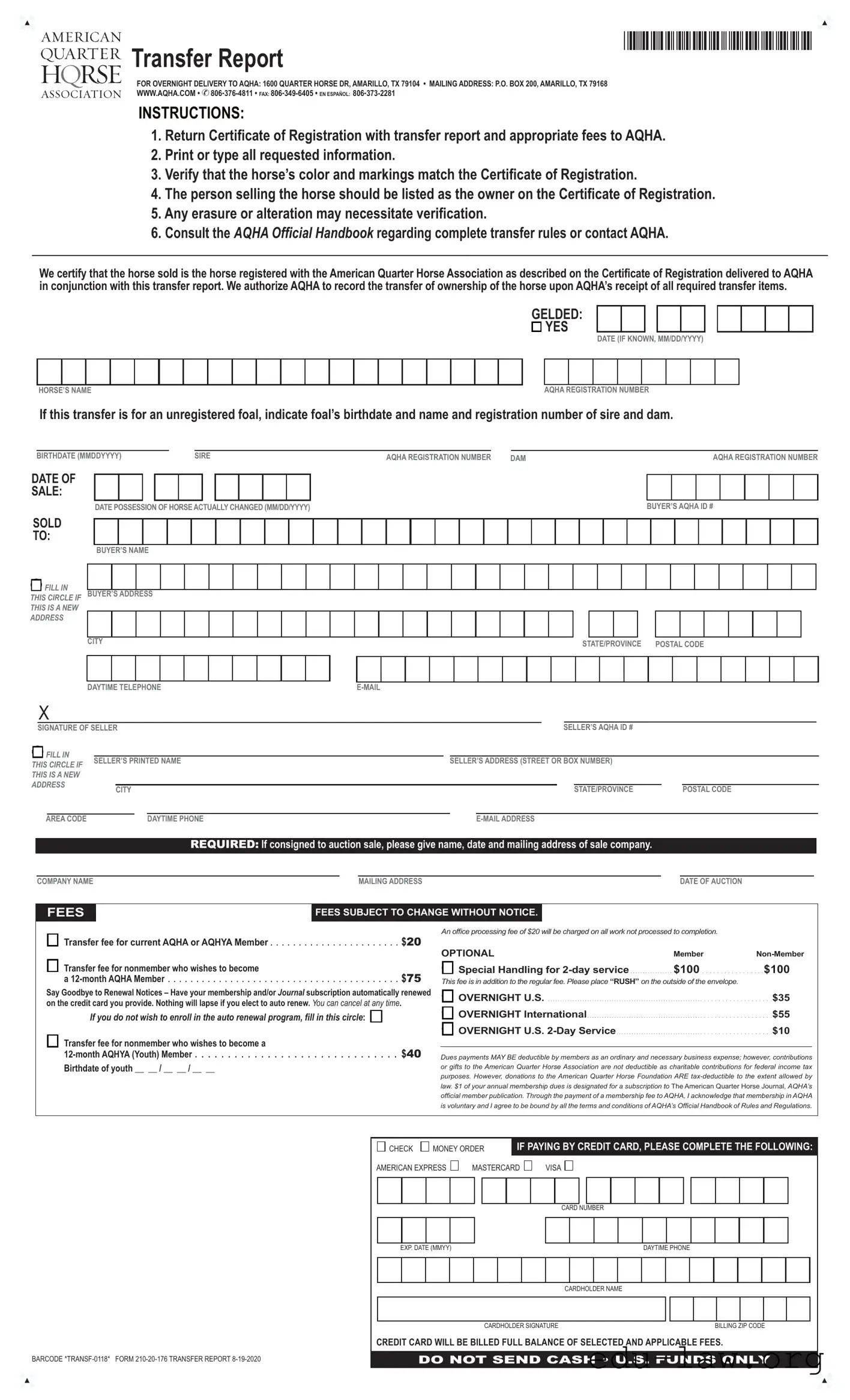
The AQHA transfer form is a crucial document for individuals looking to transfer ownership of American Quarter Horses. This form is essential for maintaining accurate records within the American Quarter Horse Association (AQHA) and ensures that all ownership changes are officially recognized. The transfer process typically requires the current owner’s signature, along with specific details about the horse, such as its registration number and the new owner's information. Additionally, it is important to include any applicable fees and to ensure that the form is submitted within the designated time frame to avoid penalties. Proper completion of the AQHA transfer form not only facilitates a smooth transition of ownership but also helps preserve the integrity of the breed's registry. Understanding the requirements and procedures associated with this form is vital for both buyers and sellers in the equine community.
Transfer Report |
|
|
FOR OVERNIGHT DELIVERY TO AQHA: 1600 QUARTER HORSE DR, AMARILLO, TX 79104 • MAILING ADDRESS: P.O. BOX 200, AMARILLO, TX 79168
WWW.AQHA.COM •
INSTRUCTIONS:
1.Return Certificate of Registration with transfer report and appropriate fees to AQHA.
2.Print or type all requested information.
3.Verify that the horse’s color and markings match the Certificate of Registration.
4.The person selling the horse should be listed as the owner on the Certificate of Registration.
5.Any erasure or alteration may necessitate verification.
6.Consult the AQHA Official Handbook regarding complete transfer rules or contact AQHA.
We certify that the horse sold is the horse registered with the American Quarter Horse Association as described on the Certificate of Registration delivered to AQHA in conjunction with this transfer report. We authorize AQHA to record the transfer of ownership of the horse upon AQHA’s receipt of all required transfer items.
GELDED:
O YES
DATE (IF KNOWN, MM/DD/YYYY)
HORSE’S NAME
AQHA REGISTRATION NUMBER
If this transfer is for an unregistered foal, indicate foal’s birthdate and name and registration number of sire and dam.
|
|
|
|
|
|
|
|
|
BIRTHDATE (MMDDYYYY) |
SIRE |
AQHA REGISTRATION NUMBER |
DAM |
AQHA REGISTRATION NUMBER |
||||
DATE OF SALE:
SOLD
TO:
O FILL IN
THIS CIRCLE IF THIS IS A NEW ADDRESS
|
|
|
|
|
|
|
|
|
|
|
|
|
|
|
|
|
|
DATE POSSESSION OF HORSE ACTUALLY CHANGED (MM/DD/YYYY) |
|
BUYER’S |
AQHA |
ID # |
|||||||||||||
BUYER’S NAME
BUYER’S ADDRESS
|
|
|
|
|
|
|
|
|
|
|
|
|
|
|
|
|
|
|
|
|
|
|
|
|
|
|
|
|
|
CITY |
|
|
|
|
|
|
|
|
|
|
|
|
|
|
|
|
|
|
|
STATE/PROVINCE POSTAL CODE |
|
|
|
|
|||||
DAYTIME TELEPHONE
X
|
SIGNATURE OF SELLER |
|
|
|
|
SELLER’S AQHA ID # |
|
|
|
|||||||
O FILL IN |
|
|
|
|
|
|
|
|
|
|
|
|
|
|
||
THIS CIRCLE IF |
SELLER’S PRINTED NAME |
SELLER’S ADDRESS (STREET OR BOX NUMBER) |
|
|
|
|||||||||||
THIS IS A NEW |
|
|
|
|
|
|
|
|
|
|
|
|
|
|
||
ADDRESS |
|
|
|
|
|
|
|
|
|
|
|
|
|
|
||
|
CITY |
|
|
|
|
|
STATE/PROVINCE |
|
POSTAL CODE |
|||||||
|
|
|
|
|
|
|
|
|
|
|||||||
|
|
|
|
|
|
|
|
|
|
|
|
|
|
|||
|
AREA CODE |
|
|
|
DAYTIME PHONE |
|
|
|
||||||||
REQUIRED: If consigned to auction sale, please give name, date and mailing address of sale company.
COMPANY NAMEMAILING ADDRESSDATE OF AUCTION
FEES |
|
FEES SUBJECT TO CHANGE WITHOUT NOTICE. |
|
|
|
|
|
||
O Transfer fee for current AQHA or AQHYA Member |
$20 |
An office processing fee of $20 will be charged on all work not processed to completion. |
|
|
|||||
OPTIONAL |
Member |
||||||||
O Transfer fee for nonmember who wishes to become |
|
||||||||
$75 |
O Special Handling for |
.$. .100 |
. . . . . . . . |
. . . . 對 |
$. . 100. . . |
||||
a |
|
|
|||||||
This fee is in addition to the regular fee. Please place “RUSH” on the outside of the envelope. |
|
|
|||||||
Say Goodbye to Renewal Notices – Have your membership and/or Journal subscription automatically renewed |
O OVERNIGHT U.S |
. . . . . . . . . $35 |
|||||||
on the credit card you provide. Nothing will lapse if you elect to auto renew. You can cancel at any time. |
O OVERNIGHT International |
|
|
|
|
||||
If you do not wish to enroll in the auto renewal program, fill in this circle: O |
. . . . . . . . . . . . |
. . . . . . . . . . |
. . . . . . . |
. . $55 |
|||||
O Transfer fee for nonmember who wishes to become a |
|
O OVERNIGHT U.S. |
. . . . . . . . . . . . |
. . . . . . . . . . |
. . . . . . . |
. . $10 |
|||
$40 |
|
|
|
|
|
|
|||
Dues payments MAY BE deductible by members as an ordinary and necessary business expense; however, contributions |
|||||||||
Birthdate of youth __ __ / __ __ / __ __ |
|
or gifts to the American Quarter Horse Association are not deductible as charitable contributions for federal income tax |
|||||||
purposes. However, donations to the American Quarter Horse Foundation ARE
BARCODE
CHECK |
MONEY ORDER |
|
|
|
IF PAYING BY CREDIT CARD, PLEASE COMPLETE THE FOLLOWING: |
|||||||||||||||||||||||||||
AMERICAN EXPRESS |
MASTERCARD |
|
VISA |
|
|
|
|
|
|
|
|
|
|
|
|
|
|
|
|
|
|
|
||||||||||
|
|
|
|
|
|
|
|
|
|
|
|
|
|
|
|
|
|
|
|
|
|
|
|
|
|
|
|
|
|
|
|
|
|
|
|
|
|
|
|
|
|
|
|
|
|
|
|
|
|
|
|
|
|
|
|
|
|
|
|
|
|
|
|
|
|
|
|
|
|
|
|
|
|
|
|
|
|
|
|
CARD |
NUMBER |
|
|
|
|
|
|
|
|
|
|
|
|
|
|
|||
|
|
|
|
|
|
|
|
|
|
|
|
|
|
|
|
|
|
|
|
|
|
|
|
|
||||||||
|
|
|
|
|
|
|
|
|
|
|
|
|
|
|
|
|
|
|
|
|
|
|
|
|
|
|
|
|
|
|
|
|
|
EXP. DATE |
(MMYY) |
|
|
|
|
|
|
|
|
|
|
|
|
|
|
|
|
|
|
|
DAYTIME |
PHONE |
|
|
|
|
|
||||
|
|
|
|
|
|
|
|
|
|
|
|
|
|
|
|
|
|
|
|
|
|
|
|
|
|
|
||||||
|
|
|
|
|
|
|
|
|
|
|
|
|
|
|
|
|
|
|
|
|
|
|
|
|
|
|
|
|
|
|
|
|
|
|
|
|
|
|
|
|
|
|
|
|
|
|
CARDHOLDER NAME |
||||||||||||||||||
|
|
|
|
|
|
|
|
|
|
|
|
|
|
|
|
|
|
|
|
|
|
|
|
|
|
|
||||||
|
|
|
|
|
|
|
|
|
|
|
|
|
|
|
|
|
|
|
|
|
|
|
|
|
|
|
|
|
|
|
|
|
|
|
|
|
|
|
CARDHOLDER SIGNATURE |
|
|
|
|
|
|
|
|
|
|
|
|
|
|
BILLING |
ZIP CODE |
|
|
|
|||||||
CREDIT CARD WILL BE BILLED FULL BALANCE OF SELECTED AND APPLICABLE FEES.
DO NOT SEND CASH • U.S. FUNDS ONLY

AREAS OF INTEREST
Please select your areas of interest. (Check all that apply)
O O O O O O O O O
Breeding – Ranch Work
Breeding – Racing
Breeding – Showing
Breeding – Recreational Riding
Recreational Riding
Racing Competition
Ranch Use
Compete in AQHA Horse Shows
Compete in Open and Local Shows
O O
O O O O
Rodeo Competition
Compete in Youth Events, such as
Pony Clubs, Playdays, Gymkhanas, etc. Compete in AQHA Youth Shows Professional Trainer/Exhibitor
Racing Fan
Compete in NCHA Events
O O O O O O O O
Compete in NRHA Events
Compete in NSBA Events
Compete in NRCHA Events
Compete in PHBA Events
Riding Instructor
Political Action
Mounted Shooting
Compete in Dressage
DO YOU BREED AMERICAN QUARTER HORSES?
OYES
If yes, for what purpose?
O Ranch Work
O Racing
O Showing
O Recreational Riding
ONO
BARCODE
| Fact Name | Description |
|---|---|
| Purpose | The AQHA transfer form is used to officially transfer ownership of a registered American Quarter Horse from one individual to another. |
| Requirements | Both the seller and buyer must complete the form, providing necessary information such as their names, addresses, and AQHA membership numbers. |
| Fees | A fee is required to process the transfer, which varies based on the type of membership held by the parties involved. |
| Governing Law | The transfer process is governed by the AQHA's bylaws and regulations, which are applicable in all states where AQHA operates. |
Once you have the AQHA transfer form in hand, the next step is to complete it accurately to ensure a smooth transfer process. Make sure to have all necessary information ready before you begin filling out the form.
After completing these steps, ensure that all information is accurate before sending the form. This will help prevent any delays in the transfer process.
What is the AQHA transfer form?
The AQHA transfer form is a document used to officially transfer ownership of an American Quarter Horse from one person to another. This form is essential for updating the horse's registration records with the American Quarter Horse Association (AQHA). Properly completing this form ensures that the new owner receives all rights and responsibilities associated with the horse.
How do I fill out the AQHA transfer form?
To fill out the AQHA transfer form, start by providing the necessary information about the horse, including its registered name, registration number, and the names of both the current owner and the new owner. Make sure to include signatures from both parties. It’s important to double-check all information for accuracy before submitting the form to avoid delays in the transfer process.
Is there a fee to transfer ownership using the AQHA transfer form?
Yes, there is typically a fee associated with transferring ownership of a horse through the AQHA transfer form. The amount may vary depending on whether the transfer is completed online or via mail. Check the AQHA website for the most current fee schedule and payment methods. Keeping this in mind will help you plan for the transfer process.
How long does it take to process the AQHA transfer form?
The processing time for the AQHA transfer form can vary. Generally, it takes about 2 to 4 weeks for the AQHA to process the transfer once they receive the completed form and payment. If you submitted the form online, it might be processed more quickly. To avoid any delays, ensure that the form is filled out correctly and all required fees are paid.
Failing to provide complete and accurate information. Every section of the AQHA transfer form must be filled out correctly. Missing details can lead to delays.
Not signing the form. A signature is required from both the seller and the buyer. Without it, the transfer cannot be processed.
Using incorrect identification numbers. Ensure that the AQHA membership numbers and horse registration numbers are accurate. Errors can result in complications.
Neglecting to include payment. The transfer fee must accompany the form. Omitting this can cause the form to be returned.
Not checking for additional requirements. Some transfers may require extra documentation, such as a bill of sale. Be sure to review the requirements thoroughly.
Using outdated forms. Always use the most current version of the AQHA transfer form. Older versions may not be accepted.
Failing to keep copies. Always make copies of the completed form and any supporting documents for your records. This can be helpful if any issues arise later.
Ignoring deadlines. Be aware of any deadlines for submitting the transfer form. Late submissions can incur additional fees or may not be accepted.
Not verifying the transfer status. After submitting the form, follow up to ensure that the transfer has been processed. This can prevent future misunderstandings.
The AQHA transfer form is essential for transferring ownership of American Quarter Horses. However, several other documents may be required or helpful during this process. Below is a list of forms and documents commonly used alongside the AQHA transfer form.
Having these documents ready can streamline the transfer process and ensure compliance with all necessary requirements. Always check with AQHA or a knowledgeable professional for any specific needs related to your situation.
The AQHA transfer form is similar to the Bill of Sale, which serves as a legal document proving the transfer of ownership of a horse. Like the AQHA transfer form, the Bill of Sale includes essential details such as the names of the buyer and seller, the description of the horse, and the sale price. Both documents require signatures from the involved parties, ensuring that the transaction is acknowledged and legally binding. This document is crucial for establishing proof of ownership and can be used in disputes or for future transactions.
Another document akin to the AQHA transfer form is the Registration Application. This form is used to officially register a horse with an organization, confirming its lineage and breed. Similar to the AQHA transfer form, it requires detailed information about the horse, including its pedigree and physical characteristics. Both documents play a vital role in maintaining accurate records within equine registries, which is essential for breeding, showing, and selling horses.
The Lease Agreement also shares similarities with the AQHA transfer form. This document outlines the terms under which one party may use a horse owned by another party. Like the transfer form, it includes the names of the parties involved and specific details about the horse. Both documents aim to clarify ownership rights and responsibilities, ensuring that all parties understand their obligations during the leasing period.
The Ownership Transfer Agreement is another document that resembles the AQHA transfer form. This agreement explicitly states the transfer of ownership from one party to another, detailing the horse’s identification and the terms of the transfer. Both documents require signatures and serve to protect the interests of both the buyer and seller, providing a clear record of the transaction for future reference.
The Equine Mortality Insurance Policy can also be compared to the AQHA transfer form. While primarily a financial document, it requires information about the horse, similar to the AQHA form. Both documents are essential for protecting the investment in the horse, whether through ownership transfer or insurance coverage. The policy provides peace of mind to owners, ensuring that they have financial protection in case of unforeseen events.
The Health Certificate is another document that shares characteristics with the AQHA transfer form. This certificate confirms that a horse is in good health and free from contagious diseases at the time of sale or transfer. Both documents require accurate information about the horse and are often necessary for legal transactions, ensuring that the buyer receives a healthy animal and that the seller is protected from liability.
The Breeding Contract is similar in nature to the AQHA transfer form as it outlines the terms under which a horse will be bred. This document includes details about the stallion and mare, similar to how the AQHA transfer form details ownership. Both documents are critical for establishing rights and responsibilities, ensuring that all parties are aware of their commitments in the breeding process.
Finally, the Affidavit of Ownership can be compared to the AQHA transfer form. This legal document is used to affirm ownership of a horse, often in cases where formal documentation may be lacking. Like the AQHA transfer form, it includes identifying details about the horse and requires signatures to verify the claims made within it. Both documents serve to establish legal ownership and can be crucial in resolving disputes or verifying ownership in various situations.
When filling out the AQHA transfer form, there are important guidelines to follow. Here are five things you should do and five things you should avoid.
Things You Should Do:
Things You Shouldn't Do:
Following these guidelines will help ensure a smooth transfer process. Take care in filling out the form, and you can feel confident about your submission.
There are several misconceptions surrounding the AQHA transfer form that can lead to confusion. Here are seven common misunderstandings:
Understanding these misconceptions can help ensure a smooth transfer process for AQHA registered horses.
When it comes to filling out and using the AQHA transfer form, there are several important points to keep in mind. This process is crucial for ensuring that ownership of your horse is officially recognized. Here are some key takeaways:
By following these guidelines, you can ensure a smooth transfer process and avoid potential issues down the line.