In the realm of estate planning, the Alaska Transfer-on-Death Deed (TOD Deed) serves as a valuable tool for property owners seeking to simplify the transfer of their real estate assets upon their passing. This legal document allows individuals to designate a beneficiary who will automatically receive ownership of the property, bypassing the often lengthy and costly probate process. By utilizing the TOD Deed, property owners can maintain control of their assets during their lifetime while ensuring a seamless transition to their chosen heirs. The form requires specific information, including the names of the property owner and beneficiary, a legal description of the property, and the owner's signature, all of which must be executed in accordance with Alaska state law. Importantly, the TOD Deed can be revoked or amended at any time prior to the owner's death, providing flexibility in estate planning. As families navigate the complexities of property ownership and inheritance, understanding the nuances of the Alaska Transfer-on-Death Deed can empower individuals to make informed decisions that align with their wishes and protect their loved ones.
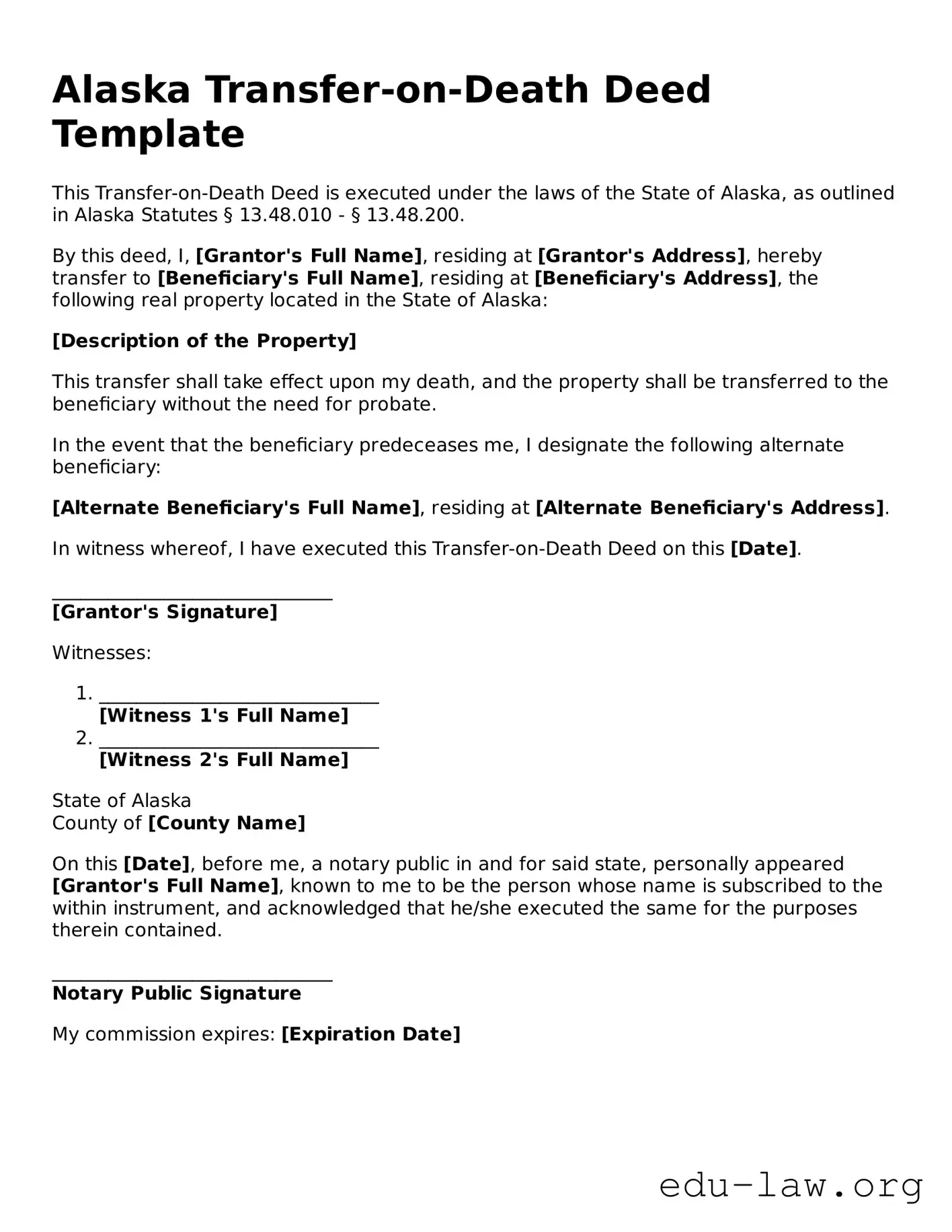
Alaska Transfer-on-Death Deed Template
This Transfer-on-Death Deed is executed under the laws of the State of Alaska, as outlined in Alaska Statutes § 13.48.010 - § 13.48.200.
By this deed, I, [Grantor's Full Name], residing at [Grantor's Address], hereby transfer to [Beneficiary's Full Name], residing at [Beneficiary's Address], the following real property located in the State of Alaska:
[Description of the Property]
This transfer shall take effect upon my death, and the property shall be transferred to the beneficiary without the need for probate.
In the event that the beneficiary predeceases me, I designate the following alternate beneficiary:
[Alternate Beneficiary's Full Name], residing at [Alternate Beneficiary's Address].
In witness whereof, I have executed this Transfer-on-Death Deed on this [Date].
______________________________
[Grantor's Signature]
Witnesses:
State of Alaska
County of [County Name]
On this [Date], before me, a notary public in and for said state, personally appeared [Grantor's Full Name], known to me to be the person whose name is subscribed to the within instrument, and acknowledged that he/she executed the same for the purposes therein contained.
______________________________
Notary Public Signature
My commission expires: [Expiration Date]
| Fact Name | Description |
|---|---|
| Definition | An Alaska Transfer-on-Death Deed allows property owners to transfer real estate to a beneficiary upon their death without going through probate. |
| Governing Law | The Transfer-on-Death Deed is governed by Alaska Statutes § 13.48.010 - § 13.48.090. |
| Eligibility | Any individual who owns real property in Alaska can create a Transfer-on-Death Deed. |
| Beneficiary Designation | Property owners can name one or more beneficiaries to receive the property upon their death. |
| Revocation | The deed can be revoked at any time before the owner's death, allowing flexibility in changing beneficiaries. |
| Filing Requirements | The deed must be recorded with the local recording office in the county where the property is located. |
| Effectiveness | The Transfer-on-Death Deed takes effect automatically upon the owner's death, bypassing probate. |
| Limitations | Transfer-on-Death Deeds cannot be used for all types of property, such as certain types of jointly owned property. |
After obtaining the Alaska Transfer-on-Death Deed form, the next steps involve accurately completing the document to ensure it reflects your intentions. It is important to provide all necessary information clearly and correctly. This will help facilitate the transfer of property upon your passing.
What is a Transfer-on-Death Deed in Alaska?
A Transfer-on-Death Deed (TOD Deed) is a legal document that allows property owners in Alaska to transfer their real estate to designated beneficiaries upon their death. This deed does not take effect until the owner's death, meaning the owner retains full control of the property during their lifetime.
Who can use a Transfer-on-Death Deed in Alaska?
Any individual who owns real property in Alaska can utilize a Transfer-on-Death Deed. This includes homeowners, property investors, and individuals holding title to land. However, the deed must be executed in accordance with Alaska state laws to be valid.
How do I create a Transfer-on-Death Deed?
To create a TOD Deed, you must complete the appropriate form, which includes details about the property, the owner, and the designated beneficiaries. The deed must then be signed in the presence of a notary public and recorded with the local recording office in the county where the property is located.
Can I change or revoke a Transfer-on-Death Deed?
Yes, you can change or revoke a Transfer-on-Death Deed at any time during your lifetime. To do this, you must execute a new TOD Deed that either names different beneficiaries or explicitly revokes the previous deed. It is important to record the new deed to ensure that it is legally recognized.
What happens if the beneficiary dies before the property owner?
If a beneficiary named in a Transfer-on-Death Deed passes away before the property owner, the deed does not automatically transfer to that beneficiary’s heirs. Instead, the property will pass according to the terms of the deed or, if there are no remaining beneficiaries, according to the owner’s estate plan or state intestacy laws.
Are there any tax implications associated with a Transfer-on-Death Deed?
Generally, the property transferred via a TOD Deed is not subject to probate, which can simplify the process for beneficiaries. However, beneficiaries may still be responsible for property taxes, and the transfer may have implications for capital gains taxes upon the sale of the property. Consulting a tax professional is advisable to understand the specific tax consequences.
Can a Transfer-on-Death Deed be used for all types of property?
A Transfer-on-Death Deed can be used for most types of real property, including residential homes and commercial properties. However, it cannot be used for personal property, such as vehicles or bank accounts. For those assets, other estate planning tools may be more appropriate.
Is a Transfer-on-Death Deed the same as a will?
No, a Transfer-on-Death Deed is not the same as a will. While both documents are used in estate planning, a TOD Deed specifically transfers real property outside of probate upon death. A will, on the other hand, outlines how all assets, including personal and real property, should be distributed after death and must go through the probate process.
Where can I find the Transfer-on-Death Deed form for Alaska?
The Transfer-on-Death Deed form can typically be obtained from the Alaska Department of Natural Resources or local county recording offices. Many legal websites also provide templates that comply with Alaska laws. It is important to ensure that any form used is up-to-date and meets all legal requirements.
Incomplete Information: One of the most common mistakes is failing to provide all necessary information. This includes not listing the full names of both the property owner and the beneficiary. Ensure that names are spelled correctly and match official documents.
Not Signing the Deed: A Transfer-on-Death Deed must be signed by the property owner. Forgetting to sign can render the deed invalid. Always double-check that your signature is present before submitting the document.
Improper Witnessing: In Alaska, the deed must be properly witnessed. Failing to have the required number of witnesses or not following the witnessing rules can lead to complications. Ensure that witnesses are present during the signing and that they meet the legal requirements.
Not Recording the Deed: After filling out the form, it must be recorded with the appropriate local government office. Some individuals forget this crucial step, which can result in the deed not being recognized. Recording the deed ensures that it is legally enforceable.
Ignoring State-Specific Requirements: Each state may have specific rules regarding Transfer-on-Death Deeds. Failing to familiarize oneself with Alaska's requirements can lead to errors. It is essential to understand local laws to ensure compliance.
The Alaska Transfer-on-Death Deed form is a useful legal document that allows property owners to designate beneficiaries who will inherit their property upon their death, without the need for probate. Alongside this form, there are several other documents that are commonly used in estate planning and property transfer. Understanding these documents can help ensure a smooth transition of assets and clarify intentions.
By familiarizing oneself with these documents, individuals can better navigate the complexities of estate planning and ensure their wishes are honored. Each document plays a vital role in facilitating the transfer of assets and providing clarity to beneficiaries during a challenging time.
The Alaska Transfer-on-Death Deed form shares similarities with a Last Will and Testament. Both documents allow individuals to dictate how their property will be distributed after their death. A Last Will and Testament requires probate, which can be a lengthy and costly process. In contrast, the Transfer-on-Death Deed allows for a more straightforward transfer of property, bypassing probate entirely. This can provide a quicker and less burdensome way for beneficiaries to receive their inheritance.
When filling out the Alaska Transfer-on-Death Deed form, it’s important to follow certain guidelines to ensure the process goes smoothly. Here are four things to keep in mind:
When it comes to the Alaska Transfer-on-Death Deed form, several misconceptions can lead to confusion. Understanding these misconceptions is crucial for anyone considering this legal tool.
This is incorrect. The deed only becomes effective upon the death of the property owner, but it does not transfer ownership until that moment. Until then, the owner retains full control of the property.
While it does allow for a direct transfer to beneficiaries, it does not completely eliminate the probate process. Certain circumstances, such as debts or disputes, may still require probate proceedings.
This is false. The property owner has the right to change or revoke the deed at any time before their death. This flexibility allows for adjustments based on changing circumstances.
Not all properties qualify. Certain types of property, such as those held in a trust or properties subject to a mortgage, may not be eligible for this type of deed.
Filling out and using the Alaska Transfer-on-Death Deed form can be a straightforward process, but it's important to understand the key aspects involved. Here are some essential takeaways to consider:
By keeping these key points in mind, you can navigate the process of using the Alaska Transfer-on-Death Deed form with greater confidence and clarity.