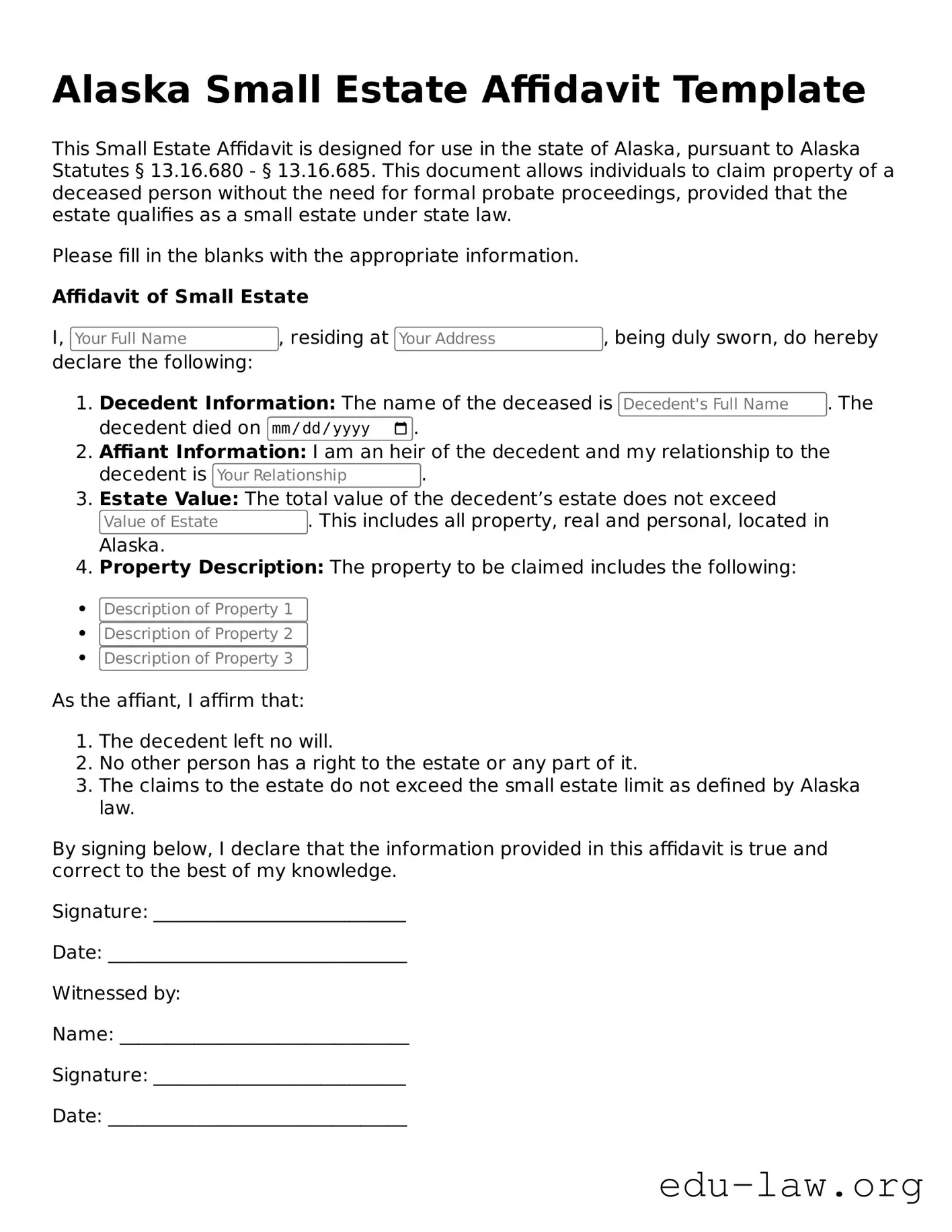
In Alaska, handling the estate of a deceased loved one can feel overwhelming, especially when it comes to navigating the legal processes involved. The Alaska Small Estate Affidavit form offers a streamlined solution for those dealing with smaller estates, allowing heirs to claim property without the need for a lengthy probate process. This form is primarily intended for estates valued at $50,000 or less, excluding certain types of property. By using the Small Estate Affidavit, individuals can assert their rights to inherit assets, such as bank accounts, personal belongings, and real estate, with relative ease. It simplifies the transfer of ownership by requiring the signer to affirm their relationship to the deceased and the details surrounding the estate. This means that heirs can focus more on healing and less on bureaucratic hurdles. Understanding how to properly fill out and submit this form is essential for anyone looking to efficiently manage a small estate in Alaska.
Alaska Small Estate Affidavit Template
This Small Estate Affidavit is designed for use in the state of Alaska, pursuant to Alaska Statutes § 13.16.680 - § 13.16.685. This document allows individuals to claim property of a deceased person without the need for formal probate proceedings, provided that the estate qualifies as a small estate under state law.
Please fill in the blanks with the appropriate information.
Affidavit of Small Estate
I, , residing at , being duly sworn, do hereby declare the following:
As the affiant, I affirm that:
By signing below, I declare that the information provided in this affidavit is true and correct to the best of my knowledge.
Signature: ___________________________
Date: ________________________________
Witnessed by:
Name: _______________________________
Signature: ___________________________
Date: ________________________________
| Fact Name | Description |
|---|---|
| Purpose | The Alaska Small Estate Affidavit is used to simplify the process of settling small estates without going through formal probate. |
| Eligibility | To qualify, the total value of the estate must not exceed $50,000, excluding certain assets such as real estate. |
| Governing Law | This form is governed by Alaska Statutes, specifically AS 13.16.680 - AS 13.16.695. |
| Filing Process | The affidavit must be signed in front of a notary public and filed with the appropriate court or presented to the financial institutions holding the assets. |
| Use of Form | It can be used by heirs or beneficiaries to claim assets directly, avoiding lengthy legal procedures. |
Once you have the Alaska Small Estate Affidavit form, you’ll need to complete it accurately to proceed with settling the estate. This process involves providing information about the deceased, the estate, and the heirs. Follow the steps below to fill out the form correctly.
After filling out the form, you may need to file it with the appropriate court or present it to financial institutions to access the deceased's assets. Make sure to follow any additional local requirements that may apply.
What is the Alaska Small Estate Affidavit?
The Alaska Small Estate Affidavit is a legal document that allows individuals to settle the estate of a deceased person without going through the lengthy and often costly probate process. This form can be used when the total value of the deceased's assets is below a certain threshold, making it a simpler option for heirs to claim their inheritance. It streamlines the process, allowing heirs to access the deceased’s assets more quickly and efficiently.
Who is eligible to use the Small Estate Affidavit in Alaska?
To qualify for the Small Estate Affidavit in Alaska, the total value of the deceased person's assets must not exceed $50,000, excluding certain items such as real estate. Typically, the heirs or beneficiaries of the estate are the ones who can file this affidavit. It's important to note that all heirs must agree to the use of this affidavit, ensuring a collective approach to settling the estate.
What information is required to complete the Small Estate Affidavit?
When filling out the Small Estate Affidavit, you will need to provide specific details about the deceased, including their name, date of death, and a list of assets. Additionally, you must include information about the heirs, such as their names and relationships to the deceased. It’s also essential to affirm that no probate proceedings are pending, ensuring that the affidavit serves as a legitimate and recognized claim to the estate’s assets.
How do I file the Small Estate Affidavit in Alaska?
Filing the Small Estate Affidavit in Alaska involves a few straightforward steps. First, complete the affidavit form with accurate information. Once completed, it must be signed in front of a notary public. After notarization, the affidavit should be presented to the financial institutions or entities holding the deceased's assets. They may require a copy of the death certificate along with the affidavit to process the transfer of assets to the heirs.
Not meeting the eligibility requirements: Before filling out the form, ensure the estate qualifies as a small estate. In Alaska, this typically means the total value of the estate is less than $50,000. Failing to confirm this can lead to complications later.
Incomplete information: Providing all required details is crucial. Missing information, such as the decedent's full name, date of death, or details about the assets, can result in delays or rejections of the affidavit.
Incorrect asset valuation: Accurately valuing the assets is essential. Underestimating or overestimating their worth can create legal issues. It's important to be as precise as possible to avoid future disputes.
Not signing the affidavit: An unsigned affidavit is invalid. Ensure that all required parties sign the document where indicated. This simple oversight can lead to significant delays in the estate settlement process.
Failure to notify interested parties: You must inform all interested parties about the affidavit. This includes heirs and creditors. Neglecting to do so can result in legal challenges and potential claims against the estate.
The Alaska Small Estate Affidavit is a useful document for individuals handling the estate of a deceased person with limited assets. However, several other forms and documents may be necessary to ensure a smooth process. Below is a list of these documents, each serving a specific purpose in the estate management process.
Gathering these documents can help streamline the process of settling an estate in Alaska. Each document plays a critical role in ensuring that the wishes of the deceased are honored and that the estate is managed according to legal requirements.
The Alaska Small Estate Affidavit form is similar to the Affidavit of Heirship, which is commonly used in many states. This document allows heirs to declare their relationship to the deceased and assert their right to inherit property without going through a formal probate process. Like the Small Estate Affidavit, it simplifies the transfer of assets for estates that do not exceed a certain value, making it easier for heirs to claim their inheritance without lengthy court proceedings.
Another document that shares similarities is the Petition for Summary Administration. This form is utilized in some jurisdictions to expedite the probate process for smaller estates. It allows the executor or administrator to request that the court simplify the administration of the estate, similar to how the Small Estate Affidavit allows heirs to bypass full probate. Both documents aim to streamline the transfer of assets, reducing the burden on families during a difficult time.
The Declaration of Trust can also be compared to the Small Estate Affidavit. While a trust is typically established during a person's lifetime to manage their assets, a Declaration of Trust can facilitate the transfer of property upon death without going through probate. This document, like the Small Estate Affidavit, allows for a more straightforward transfer of assets, ensuring that beneficiaries receive their inheritance efficiently and without unnecessary legal complications.
The Will is another important document that bears similarities to the Small Estate Affidavit. A will outlines how a person wishes their assets to be distributed after their death. However, unlike the Small Estate Affidavit, a will usually requires probate to validate its terms. In cases where the estate is small enough, the Small Estate Affidavit can serve as an alternative to probate, allowing heirs to claim assets directly without waiting for the will to be probated.
The Affidavit of Collection of Personal Property is also akin to the Small Estate Affidavit. This document allows individuals to collect personal property from a deceased person's estate without going through formal probate. It is often used for tangible items such as vehicles or household goods. Both documents provide a means for heirs to access and claim property quickly, thereby easing the transition during a challenging time.
Lastly, the Transfer on Death Deed (TOD) is another document that can be likened to the Small Estate Affidavit. A TOD allows individuals to designate beneficiaries for their real estate, enabling the property to transfer directly to those beneficiaries upon death without going through probate. This streamlined process shares the same goals as the Small Estate Affidavit, which is to simplify the transfer of assets and minimize the legal complexities that often accompany the distribution of an estate.
When filling out the Alaska Small Estate Affidavit form, it is essential to follow certain guidelines to ensure accuracy and compliance. Here are some important dos and don'ts:
Following these guidelines will help streamline the process and avoid potential complications.
Here are four common misconceptions about the Alaska Small Estate Affidavit form:
When filling out and using the Alaska Small Estate Affidavit form, consider the following key takeaways: